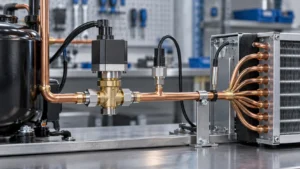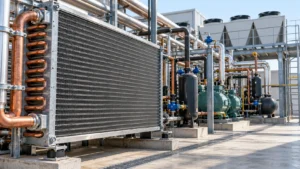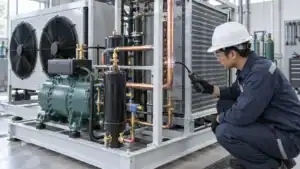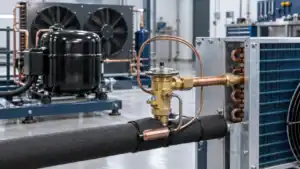

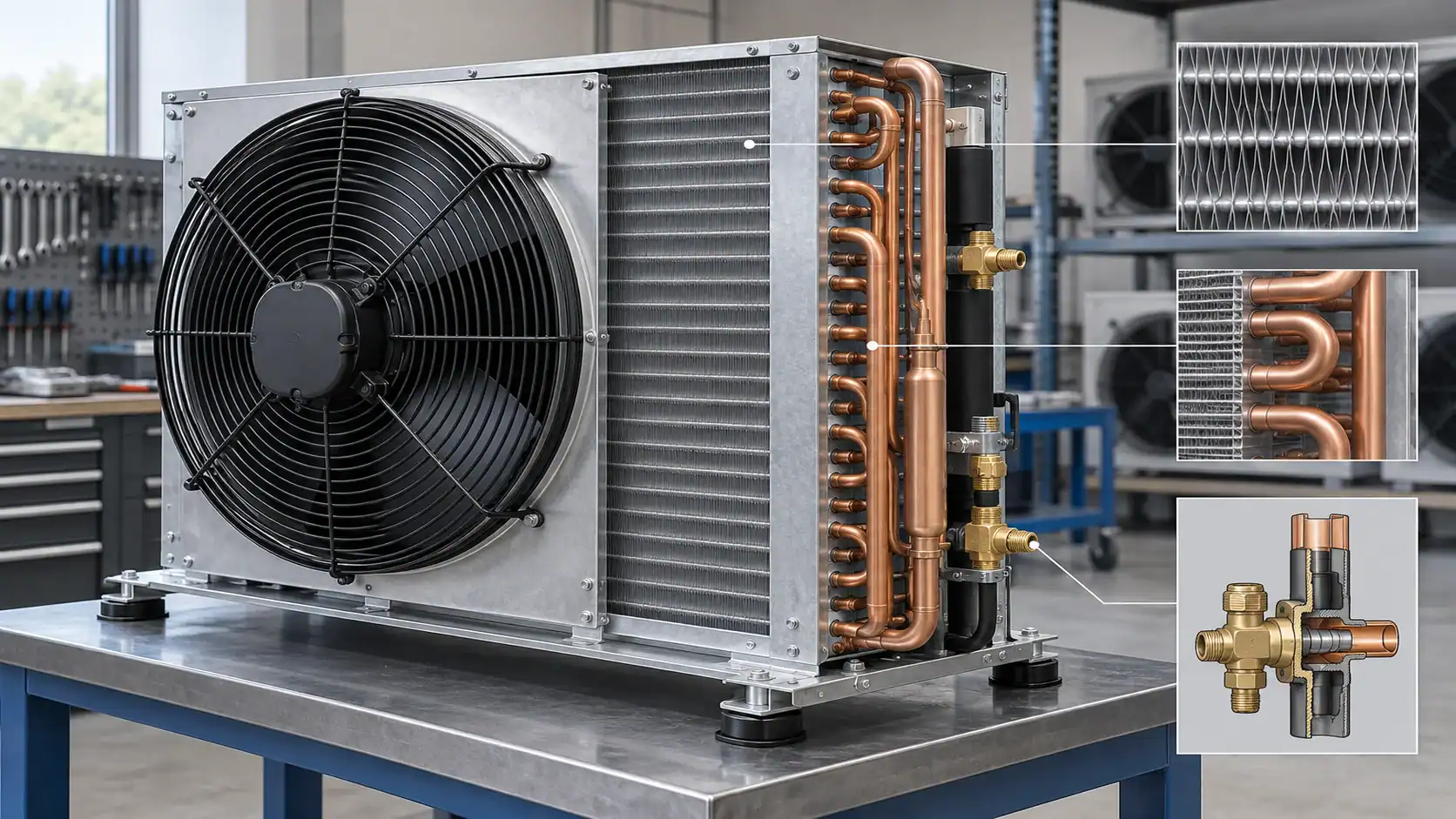
A heat pump condenser is the coil that rejects heat from the refrigerant in the operating mode being evaluated. In a reversible air-source system, the coil roles change: the outdoor coil is normally the condenser in cooling mode and the evaporator in heating mode, while the indoor coil changes in the opposite direction. A useful heat pump condenser specification therefore needs both mode duties, airflow, refrigerant conditions, coil geometry, defrost behavior, fit, noise, corrosion exposure, and validation requirements.
The phrase “heat pump condenser” often hides two different buying situations. An equipment engineer may be selecting a new outdoor coil for an OEM platform. A service or sourcing team may be replacing a coil and need to match the envelope, connections, fan, and operating duty. Those jobs need different evidence, but neither can be solved by choosing a coil from a nominal tonnage alone.
This guide focuses on condenser heat exchangers for commercial, HVAC, and OEM heat-pump equipment. It is not a household installation quote and it does not assume that a coil supplier supplies the complete heat pump, compressor, controls, or field installation.
What a heat pump condenser does in each operating mode
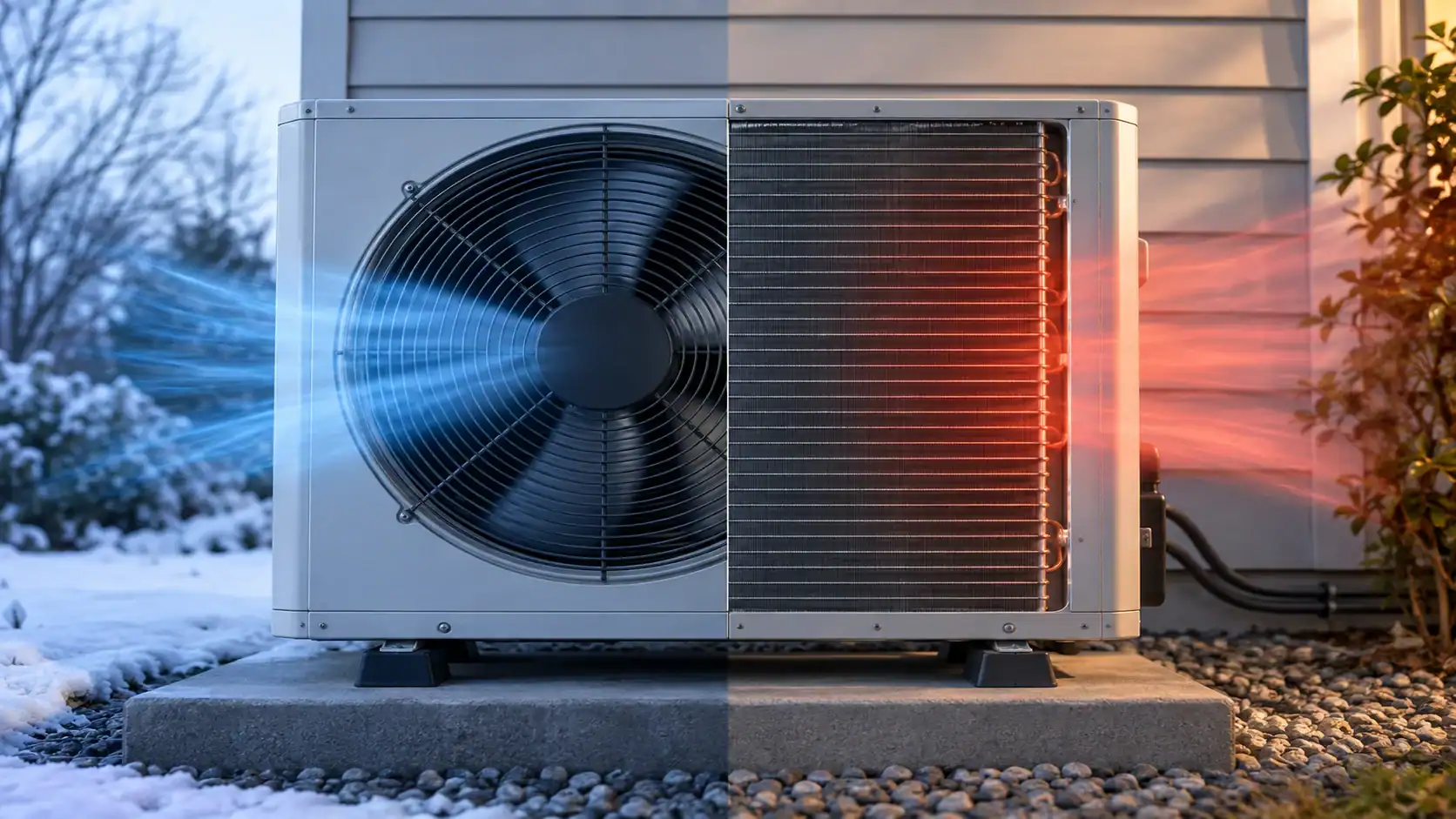
The first selection mistake is naming a coil by its position rather than by its thermodynamic duty. A heat pump reverses refrigerant flow through a four-way valve or equivalent arrangement. The same physical coil can condense refrigerant in one mode and evaporate it in the other.
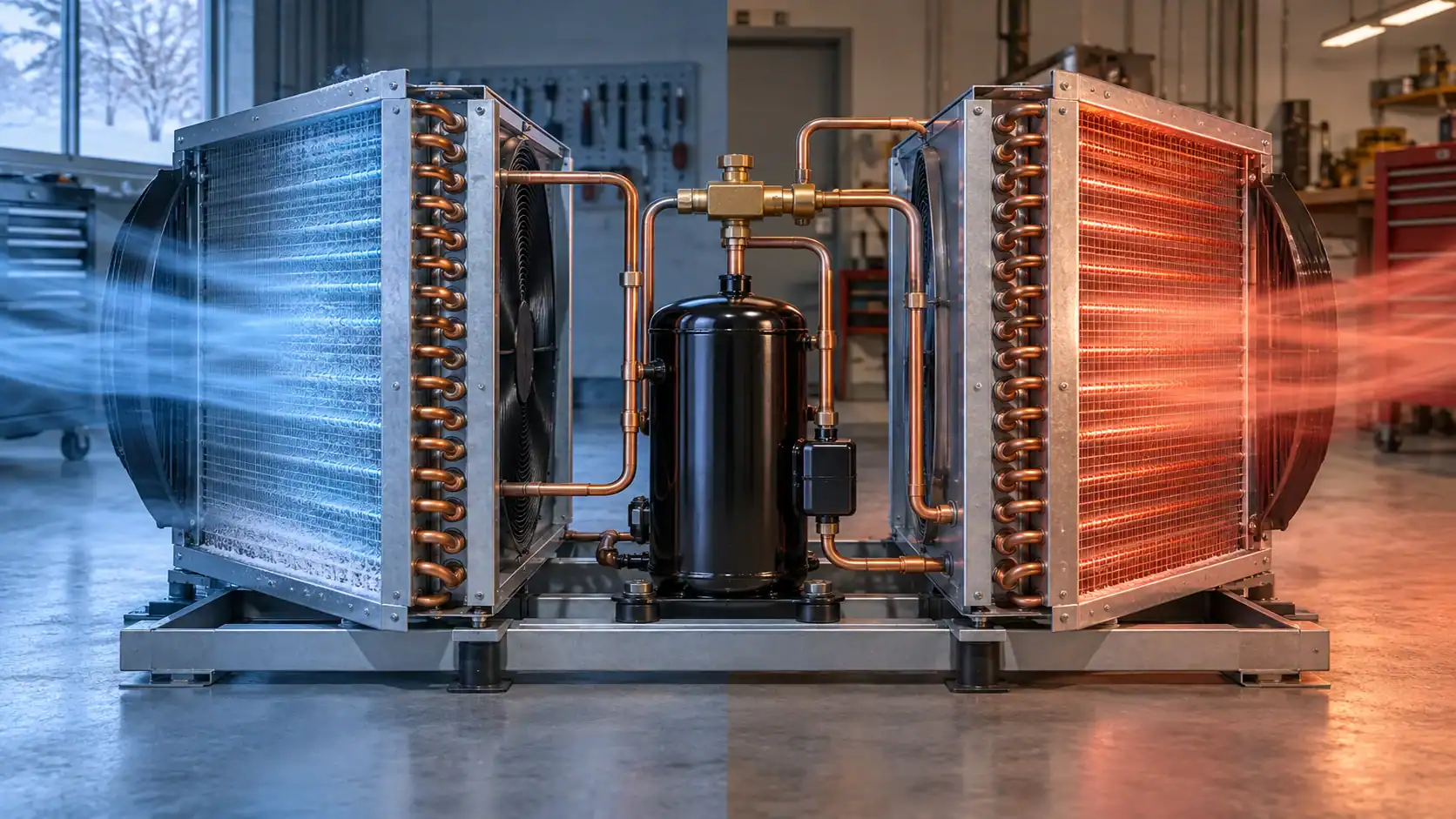
The U.S. Department of Energy describes heat pumps as systems that move heat rather than generate it, with the direction changing between heating and cooling operation. Danfoss also maps the compressor, reversing valve, expansion device, evaporator, and condenser as a connected application system. These references are useful for the system boundary, but the coil RFQ still needs the actual operating points for the equipment being built.
| Betriebsmodus | Outdoor coil role | Indoor coil role | Main outdoor-coil question |
|---|---|---|---|
| Kühlung | Kondensator | Verdampfer | Can the outdoor coil reject the refrigerant heat at the design ambient while staying inside airflow, pressure-drop, sound, and fan limits? |
| Heating | Verdampfer | Kondensator | Can the outdoor coil absorb heat in cold, humid air without unacceptable frost, airflow loss, or defrost interruption? |
| Abtauung | Temporarily heated or reverse-cycle evaporator-side coil | May provide or receive heat depending on control sequence | How will frost be removed, where will meltwater go, and how will the coil and fan behave during the transition? |
For a specification, write “outdoor coil in cooling mode” or “outdoor coil in heating mode” instead of simply writing “condenser.” This small wording change prevents a supplier from rating the same coil against the wrong side of the cycle.
Start with the heat pump duty point, not the coil drawing
A drawing is necessary for fit, but it cannot establish thermal performance. The first RFQ package should state the performance point for each relevant mode, including the design condition, expected operating envelope, and the limit that cannot be exceeded.
At minimum, separate the following inputs:
- Cooling-mode heat rejection duty and outdoor design condition.
- Heating-mode outdoor evaporator duty, outdoor air condition, and expected frost exposure.
- Refrigerant or working fluid, target saturation temperatures, superheat and subcooling assumptions, and allowable pressure drop.
- Entering and leaving air temperatures, airflow or fan operating point, and available static pressure.
- Compressor capacity range, staging or modulation behavior, and reversing-valve sequence.
- Defrost method, termination logic, fan behavior, meltwater path, and restart requirements.
Der Danfoss heat-pump component overview explains why condenser temperature and the required heating-medium temperature affect compressor selection. For a coil supplier, the practical lesson is similar: a heat-pump condenser cannot be separated from the refrigerant, compressor, expansion device, fan, and control assumptions.
Choose coil geometry that supports both modes
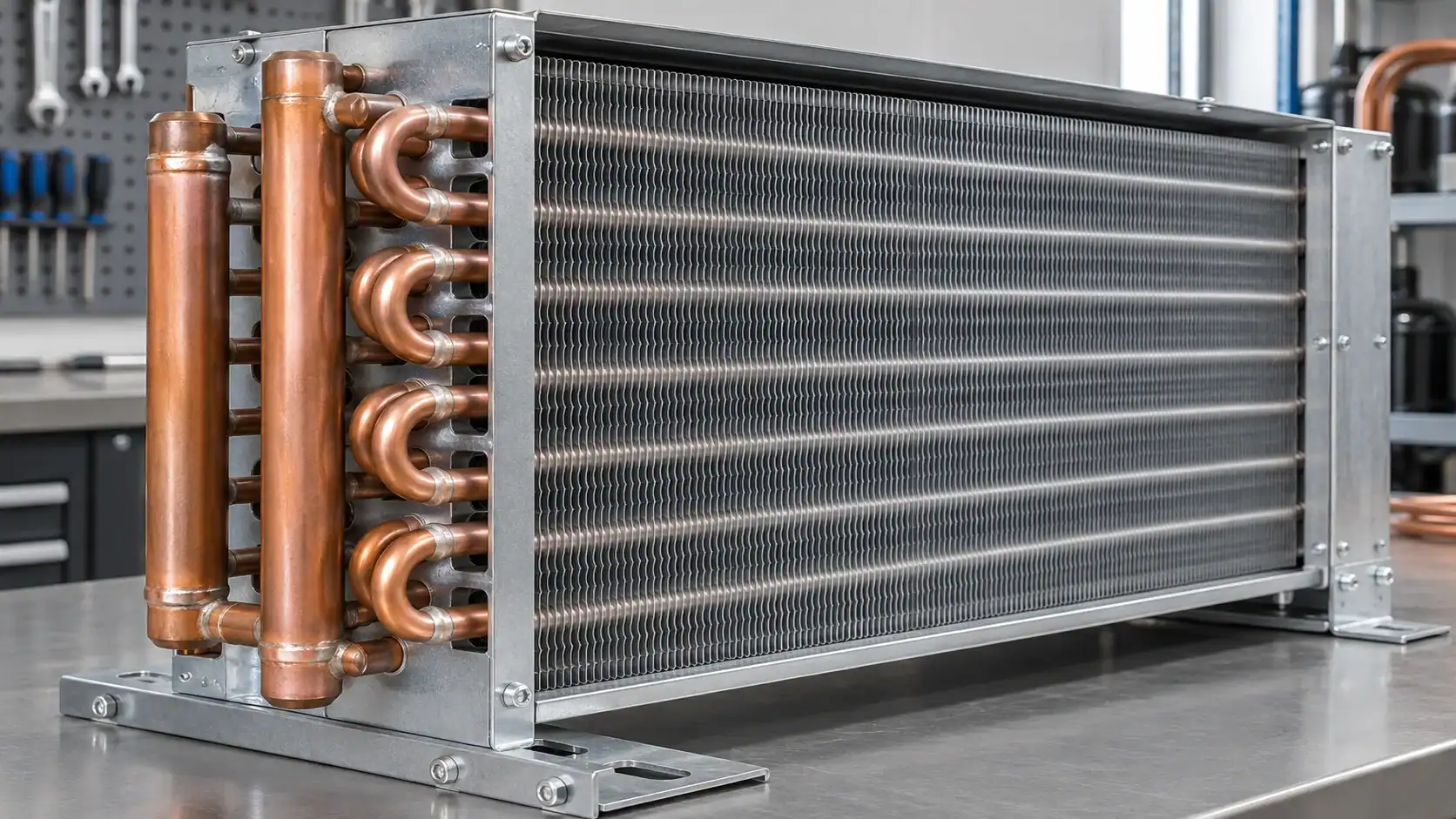
Heat transfer performance is only one part of the geometry decision. Tube diameter, tube spacing, fin pitch, row count, circuiting, headers, distributors, return bends, casing, and mounting rails influence capacity, pressure drop, frost behavior, serviceability, and cost.
| Auslegungsfeld | Why it matters in a reversible heat pump | What the buyer should provide or confirm |
|---|---|---|
| Rohr- und Lamellenkonstruktion | The same surface must support condensing heat rejection in one mode and evaporating heat absorption in the other. | Tube material, fin material, tube diameter, coating, rows, and approved alternatives. |
| Fin pitch and face area | Tighter fins can increase surface area but may increase air-side pressure drop and frost bridging. | Airflow, face velocity limit, frost exposure, cleaning method, and service access. |
| Verschaltung und Sammler | Circuit arrangement affects refrigerant distribution, pressure drop, oil return, and mode change behavior. | Refrigerant, circuit diagram or distributor requirement, inlet/outlet orientation, and allowable pressure drop. |
| Casing and supports | The coil must stay aligned under fan vibration, shipping loads, thermal cycling, and service access requirements. | Envelope, mounting points, rail locations, drain-pan interface, and allowable deflection. |
| Oberflächenbehandlung | Coatings may help in a corrosive environment, but coverage, thermal impact, joints, and inspection still need definition. | Exposure class, cleaning chemicals, coating scope, thickness or inspection method, and exclusions. |
Do not select a dense fin pack merely because a catalog image looks compact. If the outdoor coil becomes an evaporator in heating mode, frost can reduce the open airflow area and raise fan demand. The best geometry is the one that meets the defined duty and remains controllable across both modes.
Match airflow, fan, and pressure drop together
The condenser coil, fan, shroud, grille, guard, and cabinet opening form one air-side system. A coil that performs well in a laboratory at a free-air condition may not perform the same way after a guard, filter, louver, discharge bend, or protective screen is added.
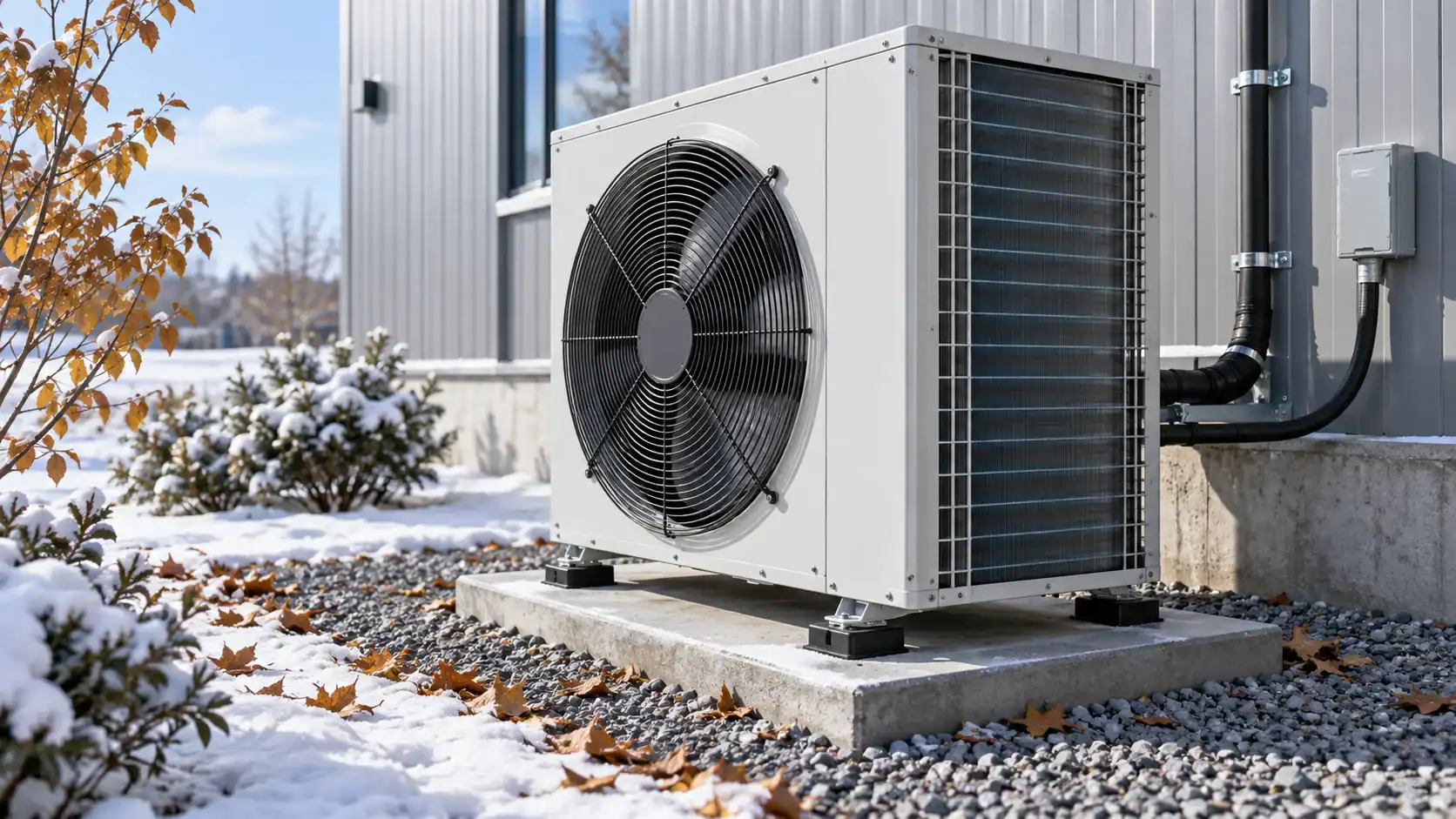
Ask for the installed air-side operating point rather than only a rated airflow number. The useful package includes the fan curve or operating map, coil pressure drop at the design airflow, available static pressure, motor control range, noise target, and the clearance around the intake and discharge.
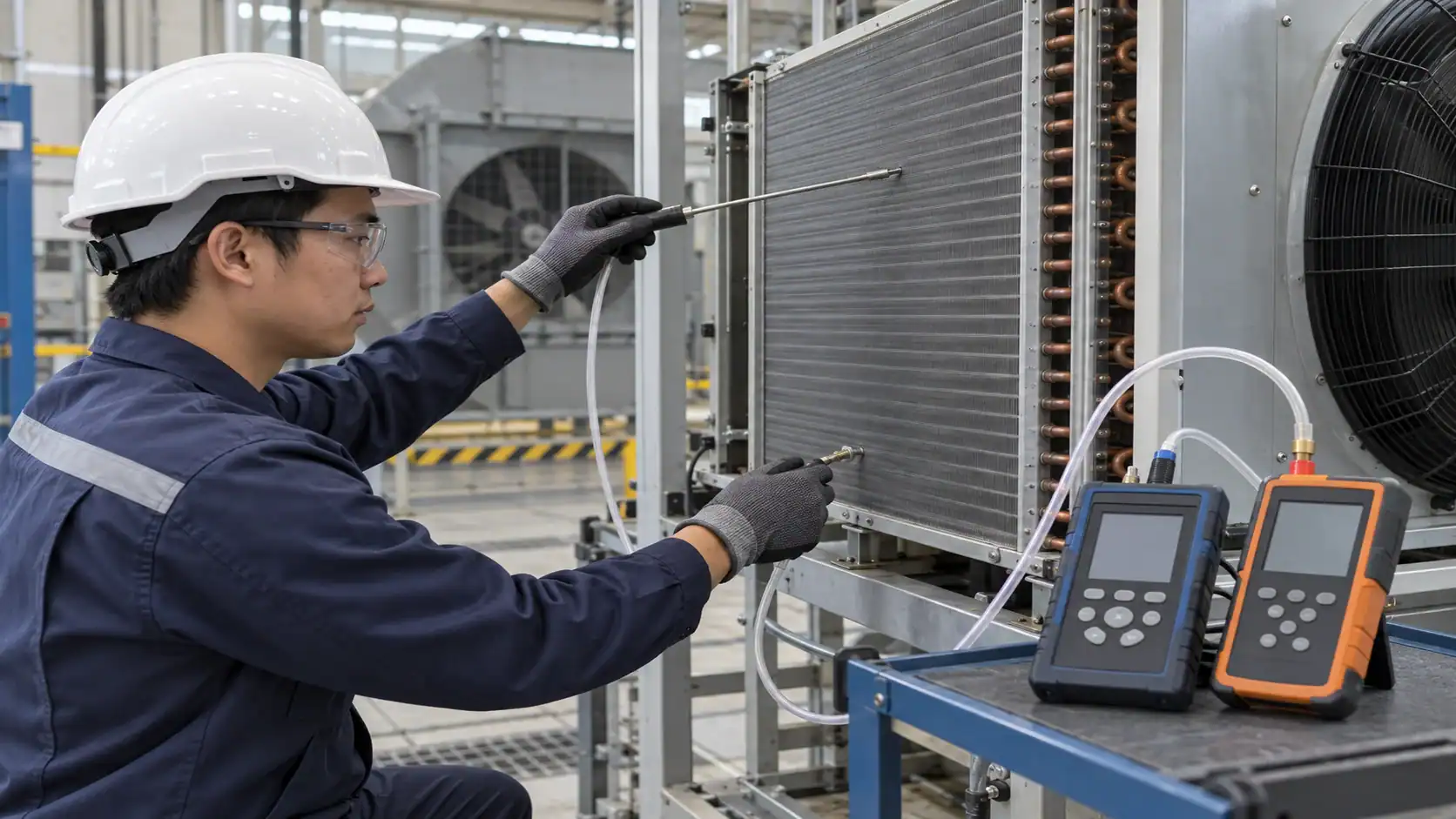
| Air-side check | Auswahlfrage | Nachweise anfordern |
|---|---|---|
| Luftstrom | Will the fan deliver the required flow at the coil and cabinet pressure drop? | Rating condition, fan curve or map, and installed pressure-drop basis. |
| Druckverlust | Does the coil remain inside the fan and motor operating range in both modes? | Air-side pressure-drop data at specified airflow and temperature. |
| Clearance | Can air enter and leave without recirculation, blockage, or snow and debris accumulation? | Assembly drawing showing intake, discharge, wall, guard, and service clearances. |
| Control range | Can the fan modulate or stage without unstable operation, excessive sound, or motor overheating? | Control signal, minimum speed, restart behavior, and operating limits. |
| Condensate and frost | Can water leave the coil during cooling and defrost without refreezing on the base or fan? | Drainage path, pan details, slope, heat trace requirement, and defrost observation. |
If the project uses an EC or variable-speed fan, include the control signal and minimum stable speed in the RFQ. If it uses a fixed-speed motor, define the acceptable operating range instead of expecting a supplier to infer it from the coil face dimensions.
Treat refrigerant distribution as a mode-change problem
In a standard condenser application, the buyer may focus on heat rejection and liquid outlet conditions. In a heat pump, the same coil must also distribute refrigerant as an evaporator when the system reverses. That changes the importance of headers, distributors, circuit balance, oil return, and connection orientation.
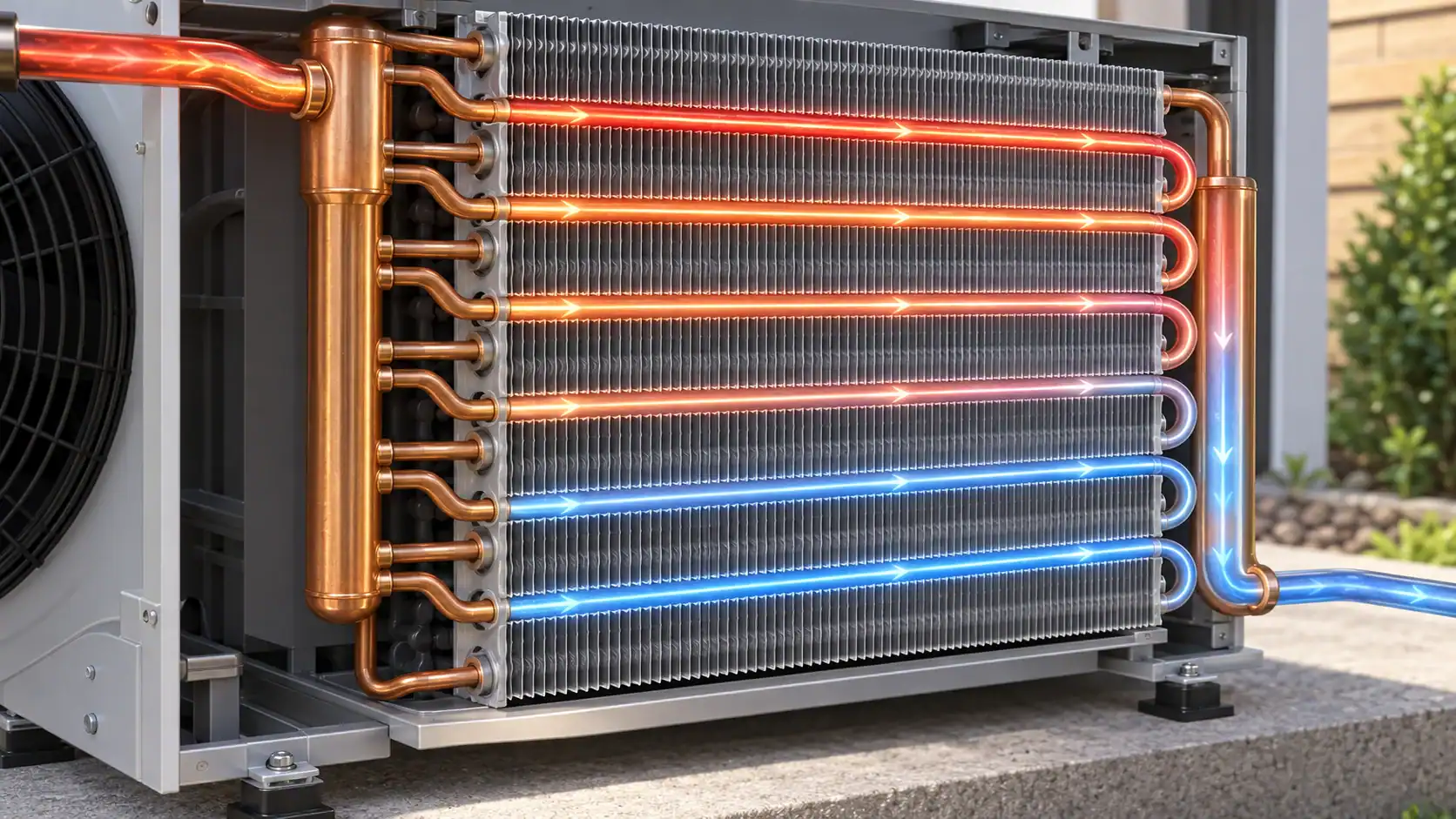
The supplier should receive the refrigerant, mass-flow or capacity basis, saturation temperatures, allowable pressure drop, and whether the coil will be used with an electronic expansion valve, thermostatic expansion valve, capillary arrangement, or another control strategy. Do not use a generic circuit count without stating what it is intended to achieve.
For a replacement project, record the existing inlet and outlet function in each mode. A physical connection that appears to be the “inlet” in cooling mode may serve another role after the reversing valve changes the flow path. The control schematic and service documentation are part of the replacement record.
Design frost and defrost before the coil is approved
In heating mode, an outdoor coil can operate below the outdoor-air dew point and below freezing. Moisture can freeze on the fin surface, reducing free area and heat transfer. The U.S. Department of Energy notes that frost on the outdoor coil reduces heat transfer and that reverse-cycle defrost is commonly used to remove it. The DOE defrost research summary is a useful reference for this boundary.
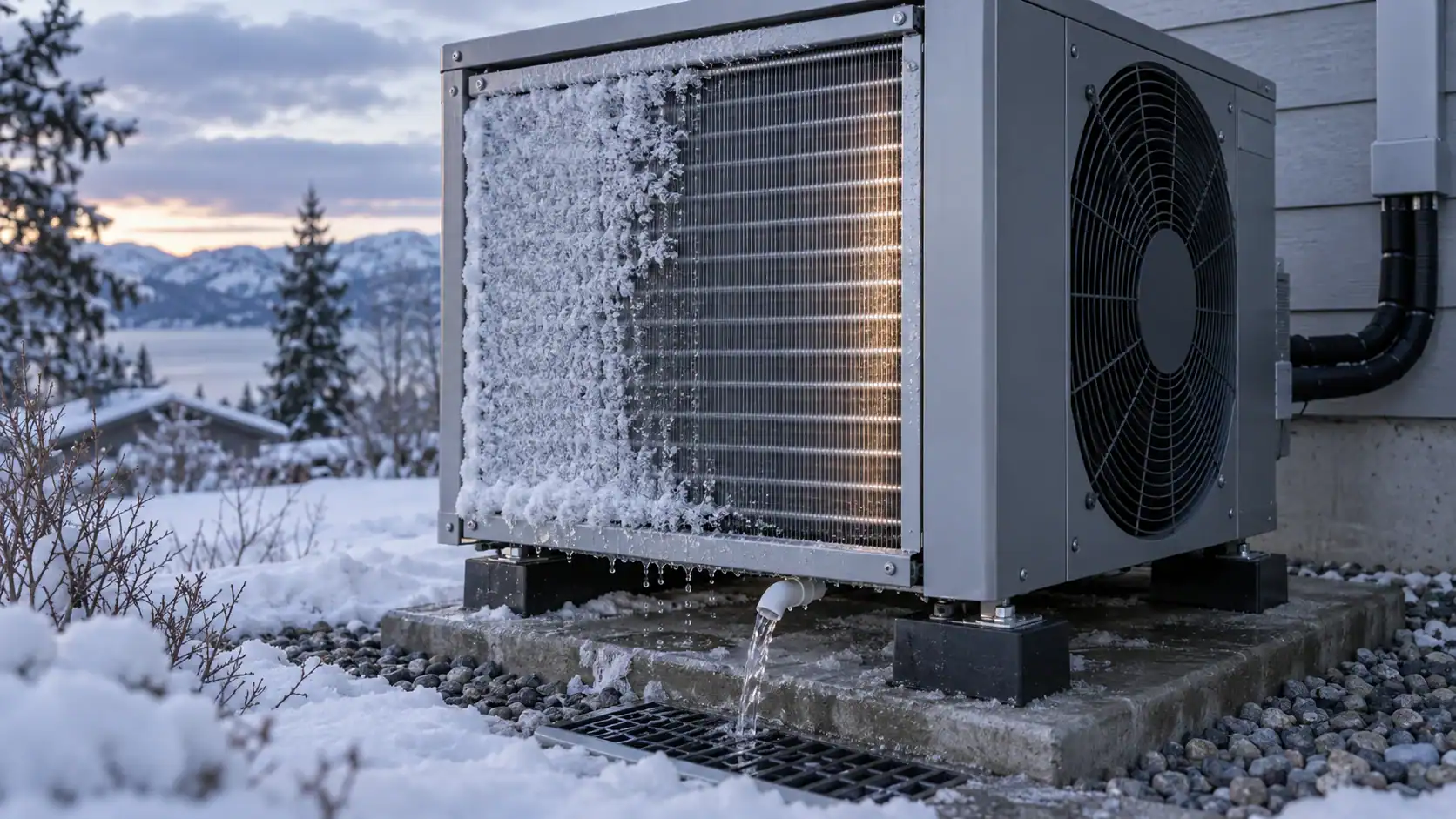
The coil design review should cover:
- Frost exposure by outdoor temperature, humidity, airflow, and coil surface temperature.
- The defrost trigger, whether time-based, temperature-based, pressure-based, demand-based, or a combined control.
- The defrost method, such as reverse-cycle or electric assistance, and the heat path during defrost.
- Fan stop, fan restart, reversing-valve timing, compressor protection, and transient sound.
- Meltwater drainage, base-pan geometry, ice bridging risk, and cold-weather installation details.
- The test evidence that shows the coil returns to stable heating operation after defrost.
Do not put “anti-frost coil” in an RFQ without describing the operating condition and defrost sequence. Frost is a system and control problem as well as a surface problem.
Select materials and coatings for the real exposure
Outdoor heat-pump condensers may face rain, salt air, industrial contaminants, cleaning chemicals, dust, snow, and repeated wet-dry cycles. Material and coating choices should follow the exposure and service plan rather than a generic “corrosion-resistant” label.
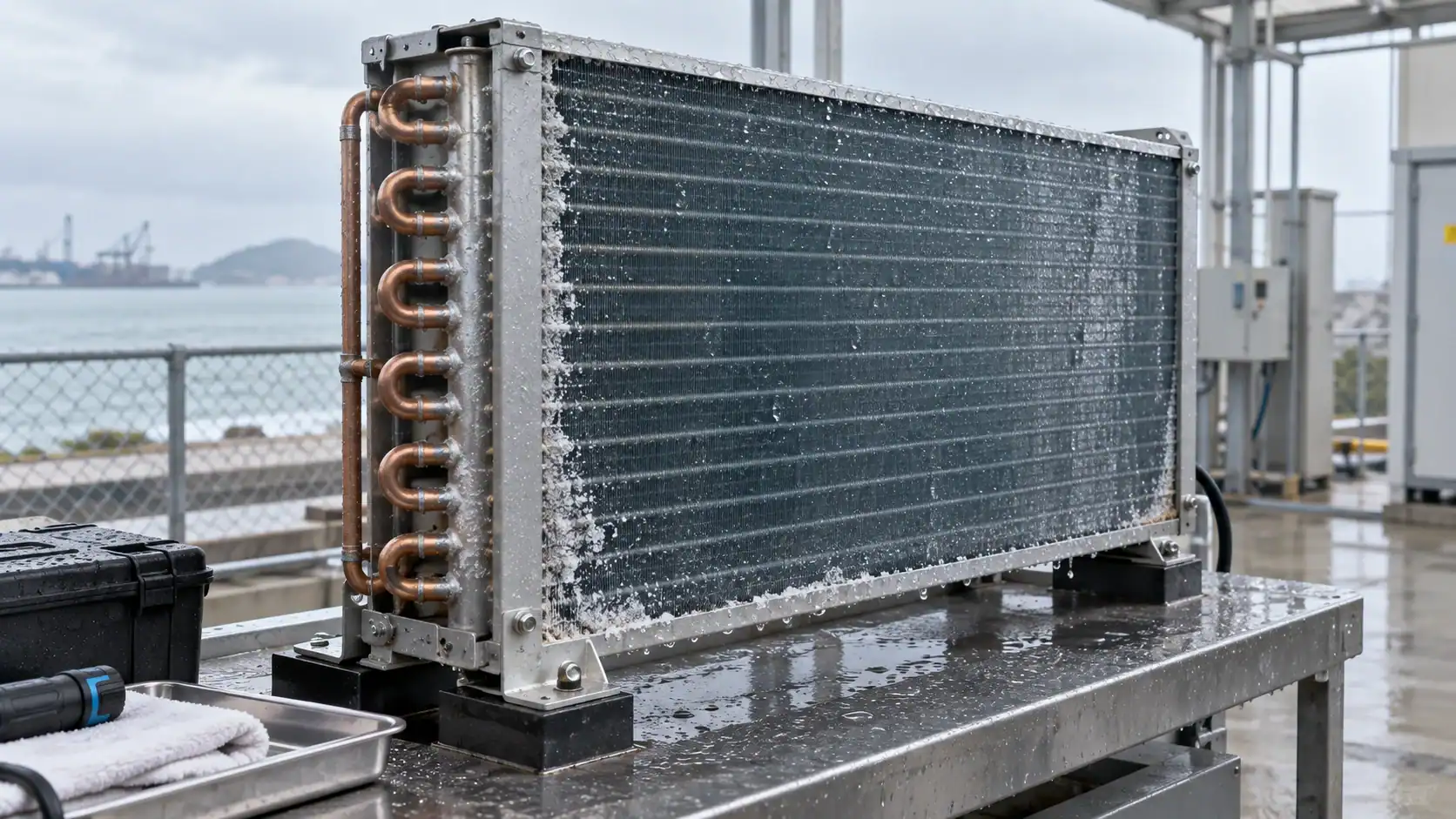
Specify the tube and fin materials, coating family if needed, joint and header coverage, cut-edge treatment, drain-pan materials, fastener compatibility, and inspection method. If a coating is used, ask whether it covers the fins, tubes, headers, return bends, joints, and accessible edges. A coated face with unprotected connection areas may not match the intended exposure.
Also define cleaning. A coil exposed to grease, salt, or process dust may need a different fin spacing and service access than a residential outdoor unit. The cleaning method, pressure, chemistry, and frequency should be considered with the coating and fin strength.
Check mechanical fit before comparing price
Heat-pump condenser replacements fail when the new coil is thermally plausible but physically impossible to install. Measure the full envelope and the interfaces that determine whether the coil can be mounted, connected, drained, guarded, and serviced.
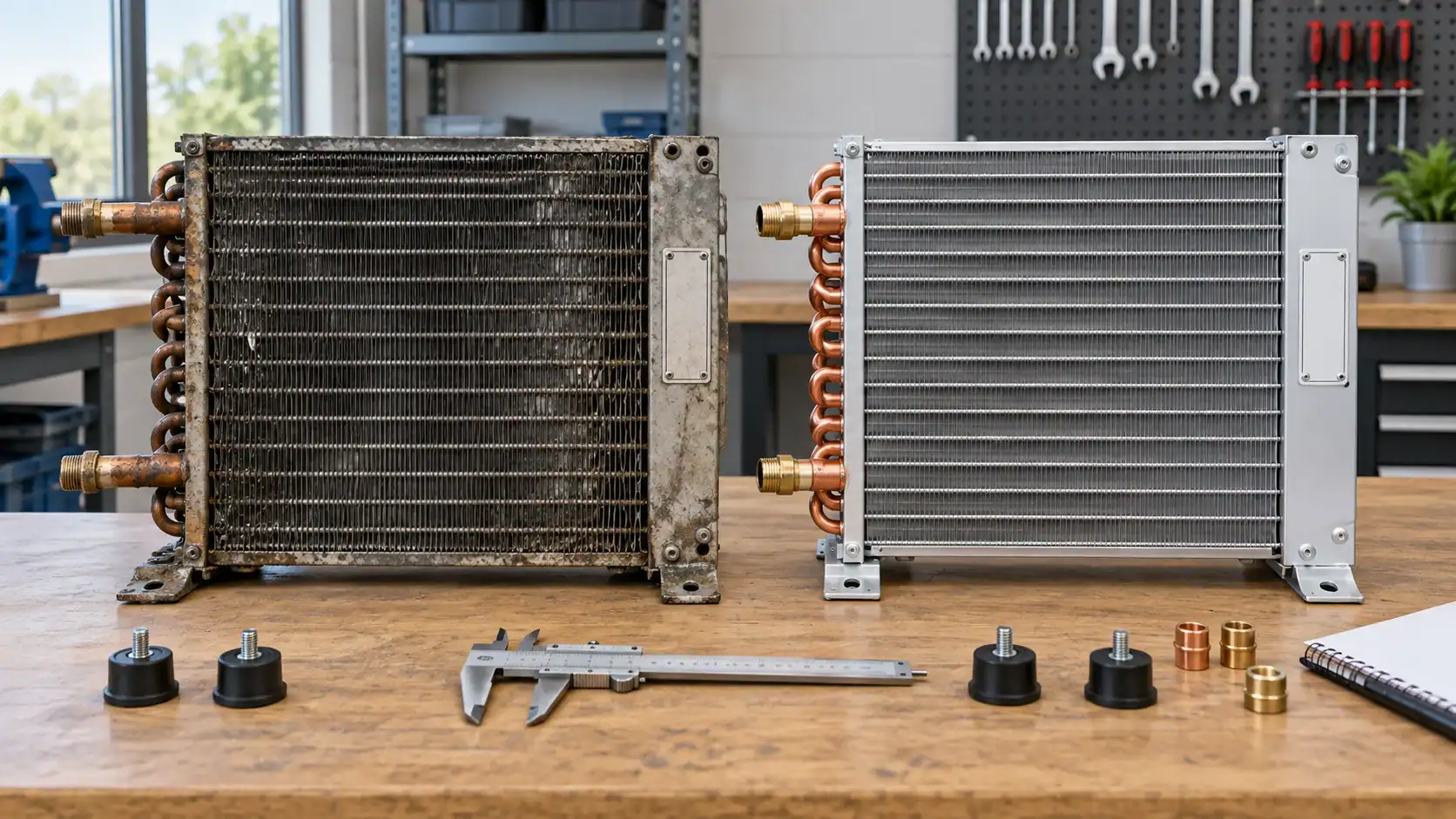
| Fit-up field | Record it this way | Why a photo alone is not enough |
|---|---|---|
| Gesamtabmessungen | Width, height, depth, casing projection, and service-side orientation. | A photo hides depth, clearance, and obstruction points. |
| Montage | Hole pattern, rail position, bracket type, fastener access, and allowable support change. | A similar outline may still miss the cabinet mounting points. |
| Anschlüsse | Tube size, location, direction, brazing access, and function in each mode. | Reversing flow makes connection function important, not only location. |
| Lüfterschnittstelle | Fan diameter, shroud, guard, motor position, rotation, speed control, and clearance. | Coil face area does not prove compatibility with the installed fan. |
| Entwässerung | Pan, outlet position, slope, heat trace, and meltwater discharge route. | Heating-mode defrost water may freeze where cooling condensate did not. |
For a replacement, send measured dimensions, clear photos with a scale, the nameplate, connection details, fan information, and the operating symptom. For a new OEM design, send the assembly envelope, drawings, design conditions, and required change-control process.
Include noise, vibration, and service access
The condenser assembly is usually close to the fan, grille, cabinet, and structure. A coil design that meets capacity can still create a field problem if it increases fan speed, causes recirculation, transmits vibration, or blocks cleaning access.
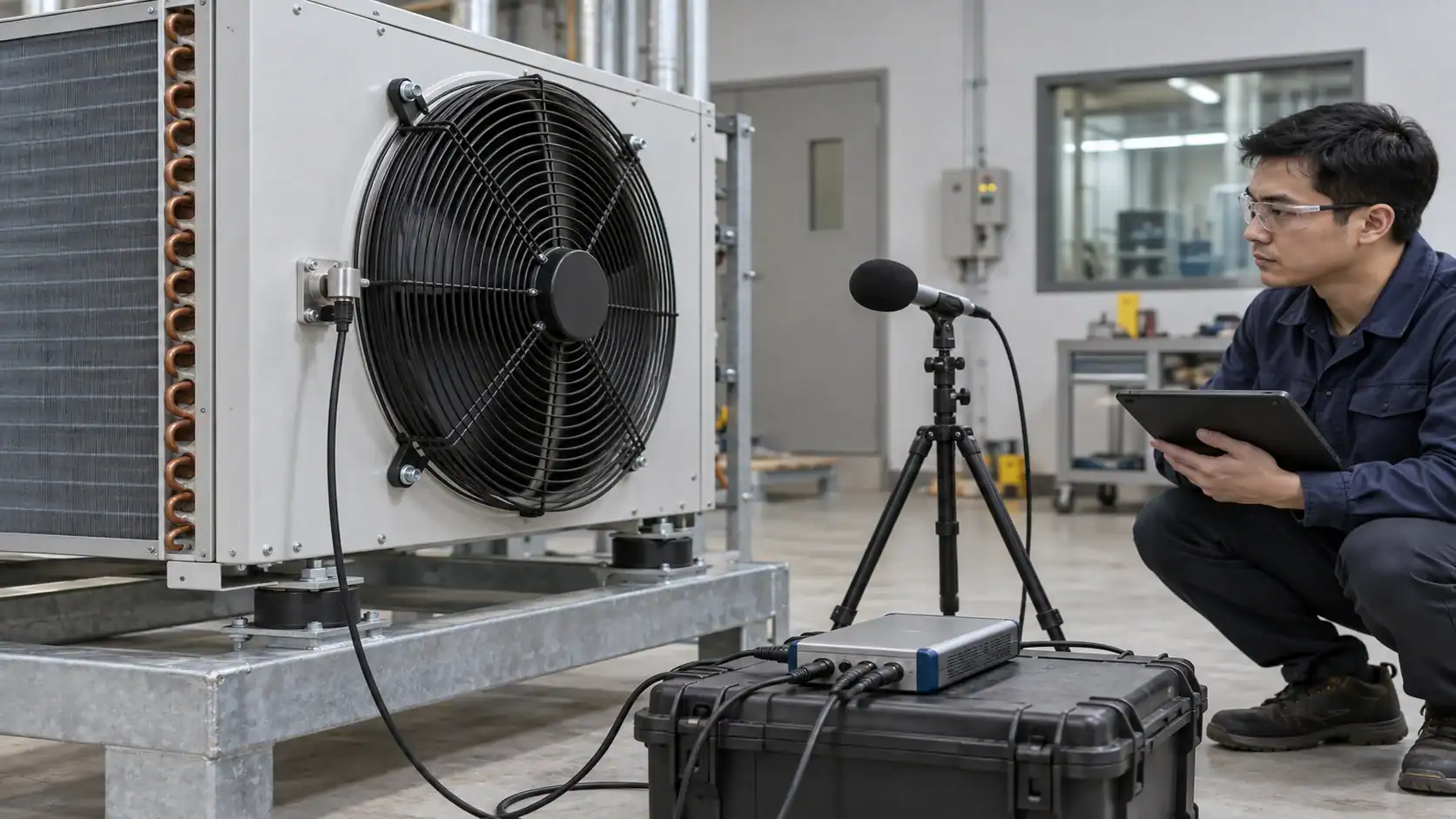
Define the measurement position and operating mode for sound. Record the fan speed, motor control state, airflow, cabinet panels, guard, and installation boundary. Vibration checks should include the fan, motor bracket, coil supports, headers, and any tubing that could contact the frame during startup or reversal.
Service access should allow coil cleaning, electrical inspection, leak checks, fan replacement, defrost-drain inspection, and connection work without removing unrelated equipment. This is especially important in compact OEM cabinets where the heat pump condenser is surrounded by panels and controls.
Use a supplier RFQ that separates design from proof
A clear RFQ makes supplier comparison easier and reduces the chance of an attractive but incomplete quote. The RFQ should separate what the supplier must design from what the supplier must prove.
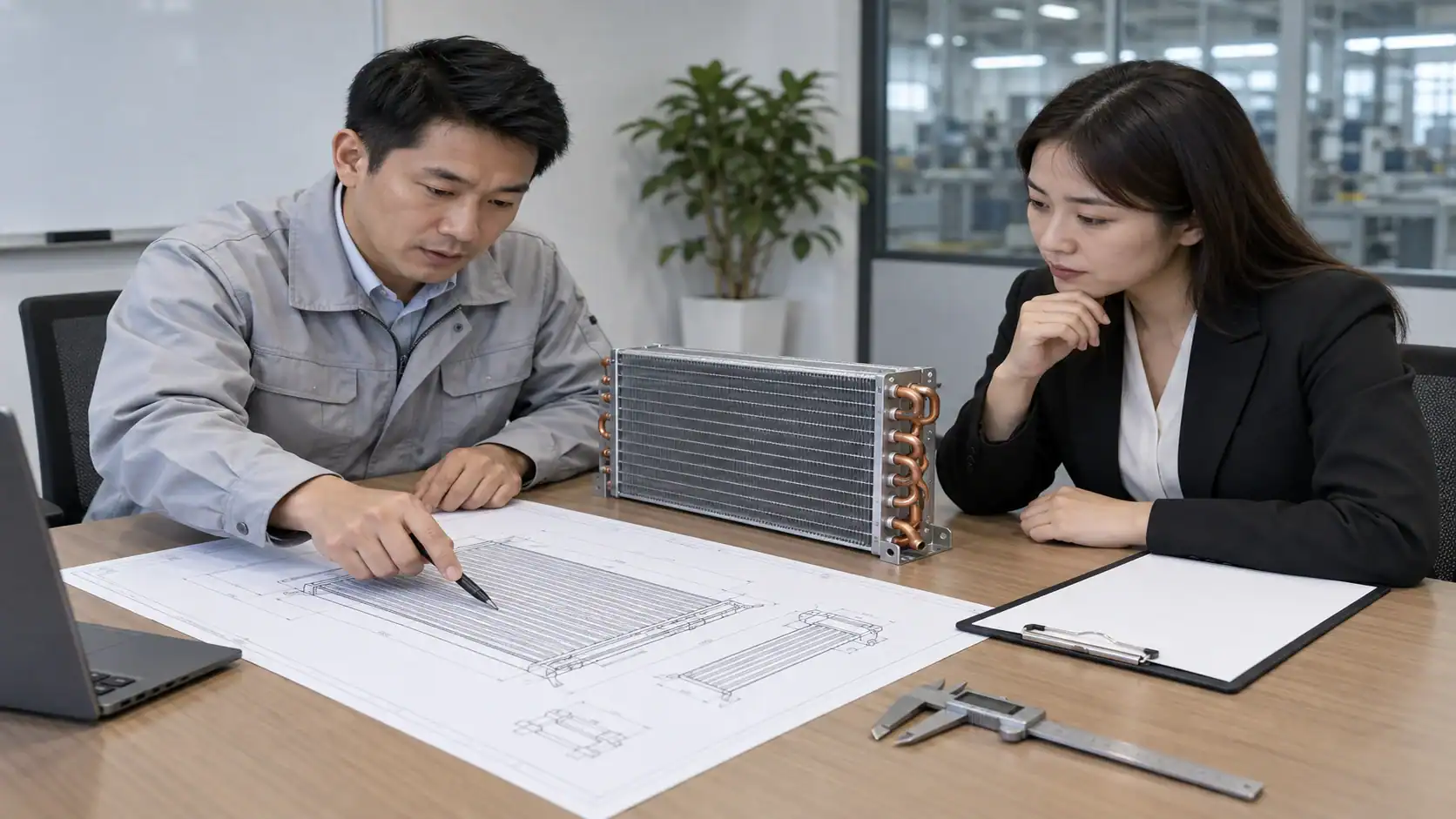
| Anfrageabschnitt | Zu sendende Informationen | Lieferantenantwort auf Anfrage |
|---|---|---|
| Anwendung | Equipment type, heating and cooling modes, installation environment, quantity, and project stage. | Recommended coil family, assumptions, and questions requiring confirmation. |
| Wärmeleistung | Capacity, entering and leaving air, ambient design points, refrigerant, saturation conditions, and allowable pressure drop. | Rating basis, capacity in each required mode, pressure drops, and operating limits. |
| Luftseite | Airflow, fan model or curve, static pressure, grille/guard details, sound target, and clearance. | Coil and fan interface, airflow assumptions, and any recirculation or clearance risk. |
| Mechanisch | Envelope, connections, mounting, drain, casing, coatings, and service access. | Drawing, connection schedule, material list, tolerance notes, and change assumptions. |
| Defrost and controls | Defrost method, trigger, termination, fan state, restart sequence, and water path. | Coil response assumptions, drainage requirements, and test or commissioning plan. |
| Qualität und Lieferung | Prototype quantity, inspection points, pressure/leak test, packaging, revisions, and target timing. | Inspection documents, sample plan, packaging basis, lead-time assumptions, and exclusions. |
Der Domi HVAC and Heat Pump Solutions page is the relevant site bridge for heat-pump heat-exchanger discussions. For a drawing-led project, also review the Seite zu technischen Fähigkeiten before sending the package. The correct request is not “quote a heat pump condenser.” It is “review this reversible heat-pump coil duty and confirm the design, fit, test, and production assumptions.”
Validieren Sie den Verflüssiger vor der Produktionsfreigabe
The approval plan should mirror the failure modes. A dimensional check cannot prove capacity. A pressure test cannot prove airflow. A clean prototype cannot prove defrost drainage in the installed cabinet.
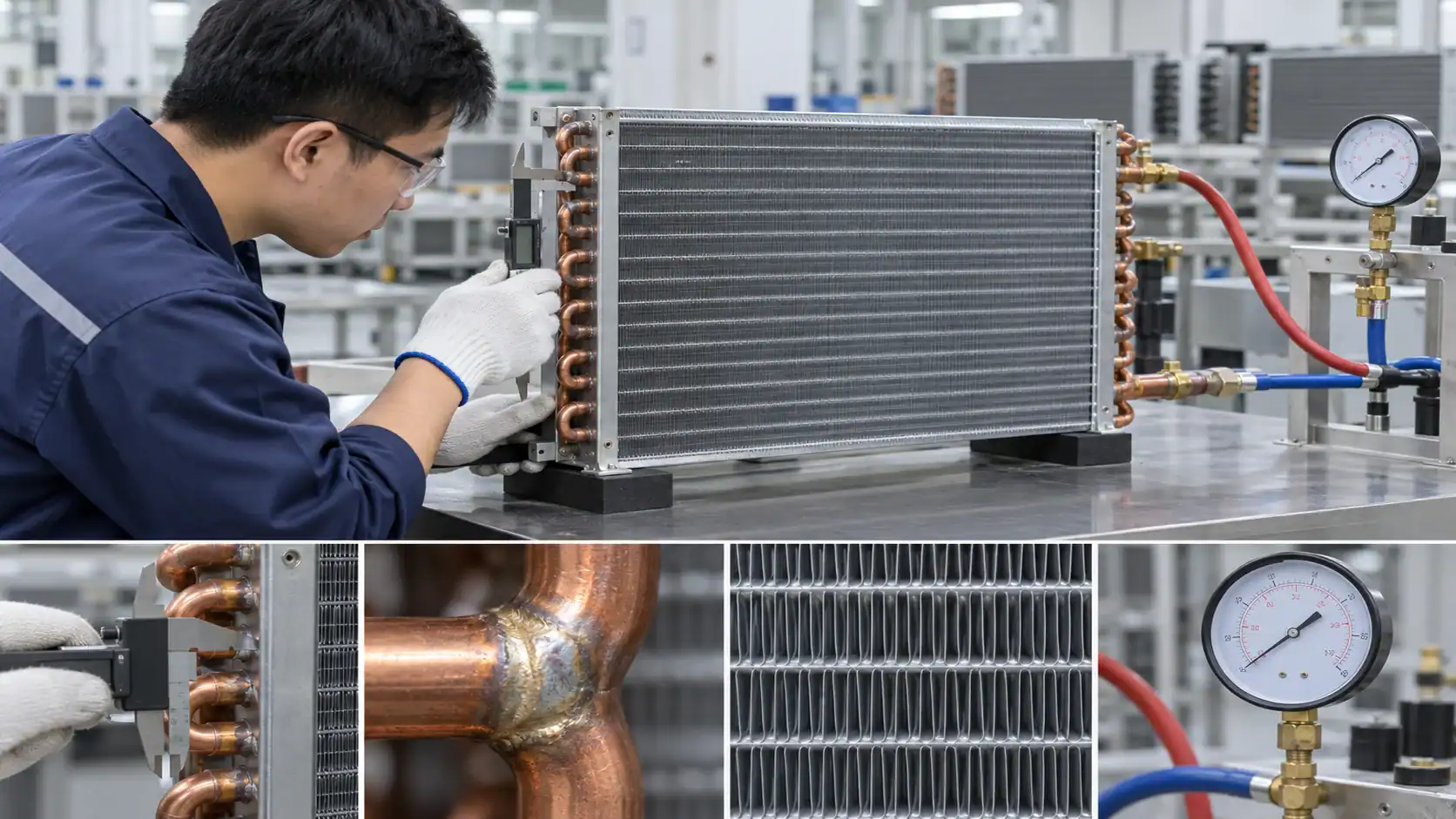
Use a staged review:
- Document review: confirm the duty points, refrigerant, circuiting, materials, drawings, tolerances, and assumptions.
- Dimensional inspection: check envelope, mounting, connections, fan interface, casing, drain, and service clearances.
- Pressure and leak evidence: confirm the test method, pressure boundary, acceptance criterion, and traceability expected by the project.
- Air-side verification: measure airflow and pressure drop with the installed fan, guard, grille, and cabinet restrictions where practical.
- Mode testing: record cooling and heating performance, control transitions, sound, current, and stable operation.
- Defrost observation: record frost growth, trigger, fan behavior, meltwater, termination, restart, and any ice bridging.
- Pilot approval: document changes from prototype to production and lock the approved drawing revision.
Der Domi Prüflabor-Seite can be used as a site-level discussion path for inspection and testing requirements. The exact test scope still needs to be confirmed for the project rather than assumed from a generic capability statement.
A practical heat pump condenser decision sequence
For a new design, make the decision in this order:
- Define outdoor-coil duty in cooling and heating modes.
- Confirm refrigerant, saturation conditions, pressure-drop limits, and compressor/control assumptions.
- Establish airflow, fan curve, clearance, sound, and motor-control boundaries.
- Select geometry, circuiting, materials, coating, casing, drain, and mounting from the duty and environment.
- Review frost, defrost, meltwater, snow, service, and restart behavior.
- Release a drawing and RFQ package that separates assumptions from required evidence.
- Validate fit, pressure/leak integrity, air side, mode performance, defrost, and pilot changes before production.
For a replacement, start with the nameplate and measured interface. Then recover the missing operating conditions from the equipment documentation or test data. If the operating duty cannot be reconstructed, label the quotation as a fit-based replacement review rather than promising equal capacity.
Häufig gestellte Fragen
Is a heat pump condenser the same as an air-conditioner condenser?
They can use similar finned-coil construction, but the application duty is not automatically the same. A reversible heat pump changes the coil roles between heating and cooling, so the coil, circuiting, controls, defrost, and pressure-drop requirements need to be checked for both modes.
Which coil is the condenser in heating mode?
In a typical air-source heat pump, the indoor coil acts as the condenser in heating mode and the outdoor coil acts as the evaporator. In cooling mode, the outdoor coil normally acts as the condenser. Always state the operating mode when requesting a rating.
How do I select a heat pump condenser coil?
Start with capacity and operating conditions in both modes. Then match refrigerant and pressure drop, airflow and fan curve, coil geometry, defrost, drainage, corrosion exposure, sound, mechanical fit, and the test evidence required for approval.
Why does the outdoor heat pump coil frost?
During heating, the outdoor coil can be colder than the surrounding air. Moisture can condense and freeze on the fin surface, reducing airflow and heat transfer. The control system must initiate and terminate defrost in a way that removes frost without creating unacceptable downtime, water, noise, or restart problems.
What should I send when replacing a heat pump condenser coil?
Send the model and nameplate, measured envelope, mounting and connection dimensions, fan and shroud information, photos with a scale, refrigerant, operating symptoms, available performance data, and any restrictions on the replacement. Include the drain and defrost arrangement because a new coil may produce a different meltwater path.
Can a supplier quote from a heat pump condenser photo?
A photo can start the review but cannot establish performance or fit. A reliable quote needs dimensions, connections, duty points, refrigerant, airflow, fan information, defrost conditions, quantity, and the required inspection or testing evidence.
Send the operating conditions with your condenser drawing
The fastest way to compare heat pump condenser options is to send the operating points and the installed interfaces together. Include heating and cooling duties, refrigerant, air conditions, airflow, fan limits, defrost sequence, dimensions, connections, material or coating requirements, quantity, and the evidence needed for approval.