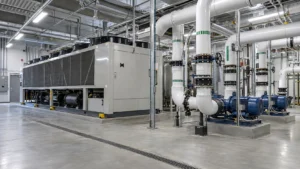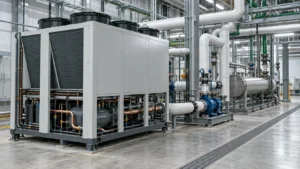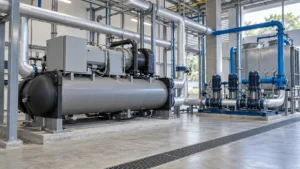

An HVAC chiller removes heat from water or a water and glycol mixture, then sends the cooled fluid through a building loop to AHU and fan-coil cooling coils. The right choice depends on the block load, required leaving-fluid conditions, heat-rejection space, water availability, part-load profile, controls, and the evidence a supplier can provide in the RFQ. It is not a decision that can be made reliably from floor area alone.
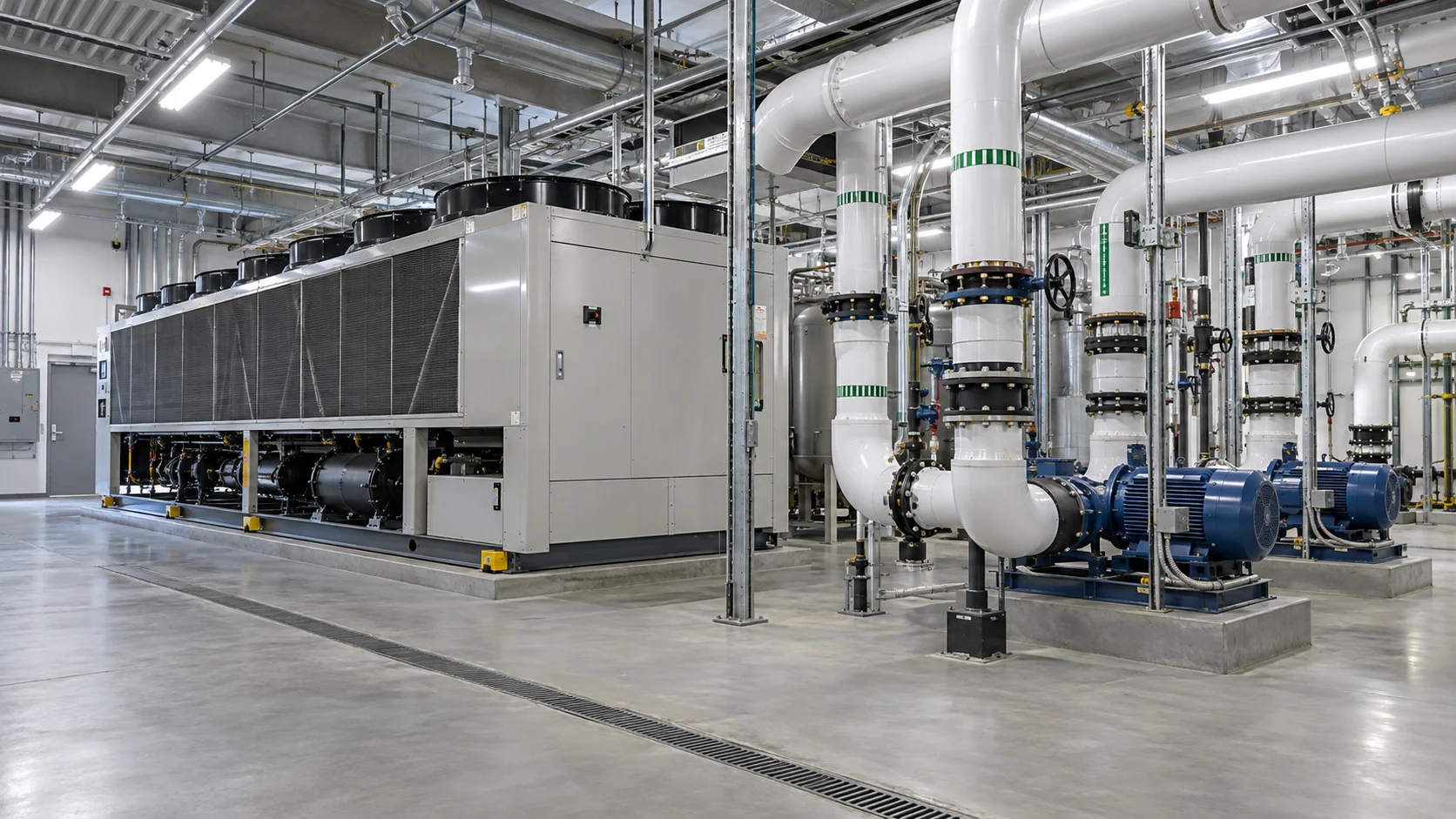
This guide is for engineers, facility teams, contractors, and procurement managers comparing a central chilled-water plant with direct-expansion equipment. It stays focused on building HVAC. Process duty has a different load profile and risk boundary, so use Domi’s industrial chiller selection guide when the cooled fluid serves a machine, production line, or process heat exchanger.
What an HVAC chiller does
In a central HVAC system, the chiller is the refrigeration machine at the center of a water loop. The evaporator transfers heat from returning chilled water into the refrigerant. The compressor raises refrigerant pressure. The condenser rejects that heat to outdoor air or condenser water, and the expansion device drops the refrigerant pressure before the cycle begins again. Trane describes the same building-scale role in its commercial chiller glossary. AHRI also treats liquid chillers as equipment that produces chilled liquid for air-conditioning or process applications, with the rating conditions defining what the published performance means.
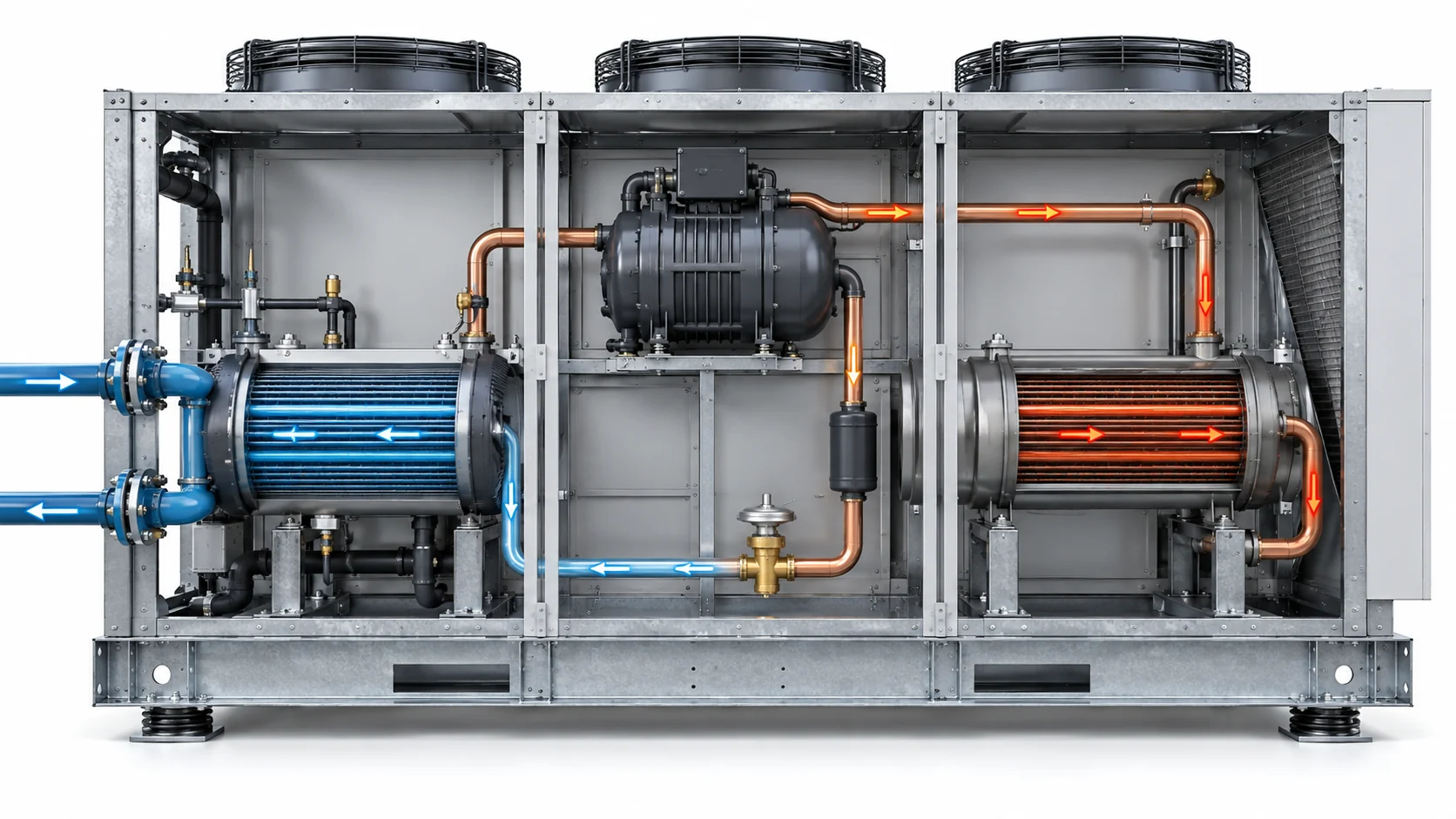
The chiller does not cool every room directly. Pumps move chilled water to terminal coils. A coil transfers heat from return air into the water, while fans move the conditioned air into occupied spaces. That separation is the reason a central plant can serve many zones, but it also creates more design interfaces than a single packaged DX unit.
HVAC chiller versus process chiller
Building HVAC loads follow occupancy, weather, ventilation, and schedules. Process loads can remain high at night, change quickly with a machine cycle, or require a narrow fluid temperature band. Trane’s process chiller explanation is a useful boundary check. If a production asset depends on continuous heat removal, size and protect the loop as a process system rather than reusing a comfort-cooling rule of thumb.
When a central chilled-water plant is the right fit
An HVAC chiller becomes attractive when a building has enough connected cooling load to justify a plant, when the owner wants a common chilled-water loop, or when many air handlers need a shared cooling source. Hospitals, campuses, laboratories, hotels, offices, and large retail buildings often have these characteristics, but the final choice still depends on the site.
Choose a central plant when the project benefits from multiple air handlers, staged equipment, accessible mechanical-room service, or a future expansion path. A smaller building with short piping runs may be better served by packaged DX equipment. A water-cooled plant can offer a strong part-load result, but it needs a cooling tower, condenser-water pumps, water treatment, and a place to reject heat. An air-cooled plant simplifies that boundary, yet outdoor temperature and coil fouling directly affect condenser performance.
The useful question for procurement is not “Which chiller is best?” It is “Which heat-rejection and distribution arrangement keeps this building inside its operating limits through the year?”
Air-cooled versus water-cooled HVAC chillers
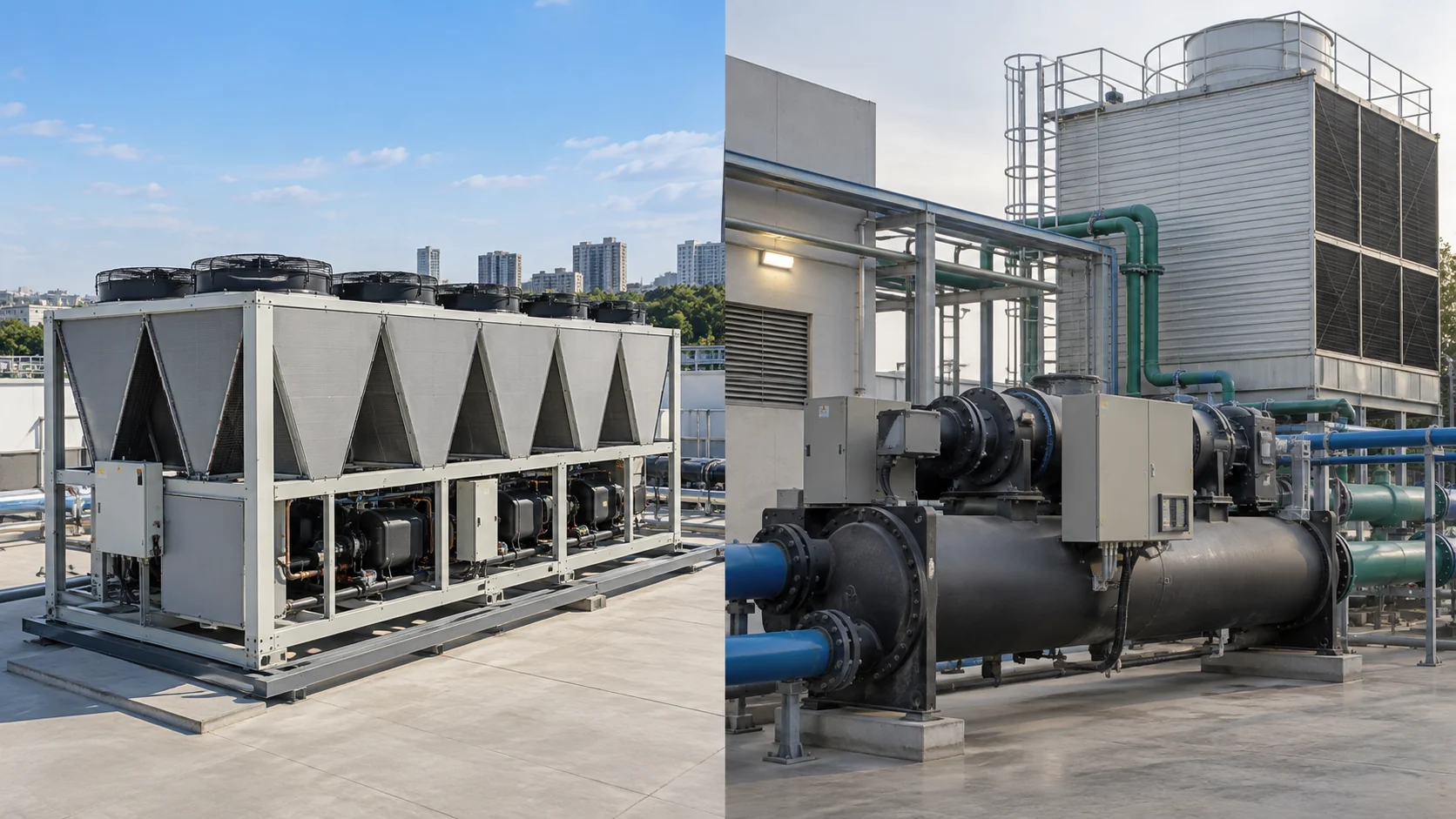
Both arrangements can deliver chilled water. Their plant requirements are different, and those requirements should appear in the project comparison before a model number is selected.
| Campo de decisión | Air-cooled HVAC chiller | Water-cooled HVAC chiller |
|---|---|---|
| Heat-rejection path | Refrigerant heat moves through outdoor condenser coils and fans | Refrigerant heat moves to condenser water, then to a cooling tower or dry heat-rejection device |
| Site equipment | Chiller, service clearance, electrical supply, pumps and chilled-water accessories | Chiller, condenser-water pumps, tower or heat-rejection device, water treatment, piping and controls |
| Uso de agua | No condenser-water loop | Makeup water, blowdown, filtration and treatment are part of the operating plan |
| Placement question | Can the outdoor unit receive airflow without recirculating hot air or creating a noise conflict? | Is there room for the tower, safe access, drift control, winter protection and water services? |
| Typical reason to choose | Faster plant boundary, fewer water-side components, or a site with water restrictions | Large central plant, steady maintenance program, and a site that can support condenser-water infrastructure |
| Main design watch-out | High outdoor temperature and dirty condenser coils reduce capacity and efficiency | Poor condenser-water temperature, fouling, scaling, or tower control can erase expected efficiency |
There is no universal winner. An air-cooled chiller can be the responsible choice when water, tower height, or maintenance staffing is limited. A water-cooled plant can make sense when the site has a large, steady load and the owner will operate the condenser-water loop properly. Request the same load points and weather assumptions from every bidder so the comparison is fair.
Follow the chilled-water path, not just the chiller casing
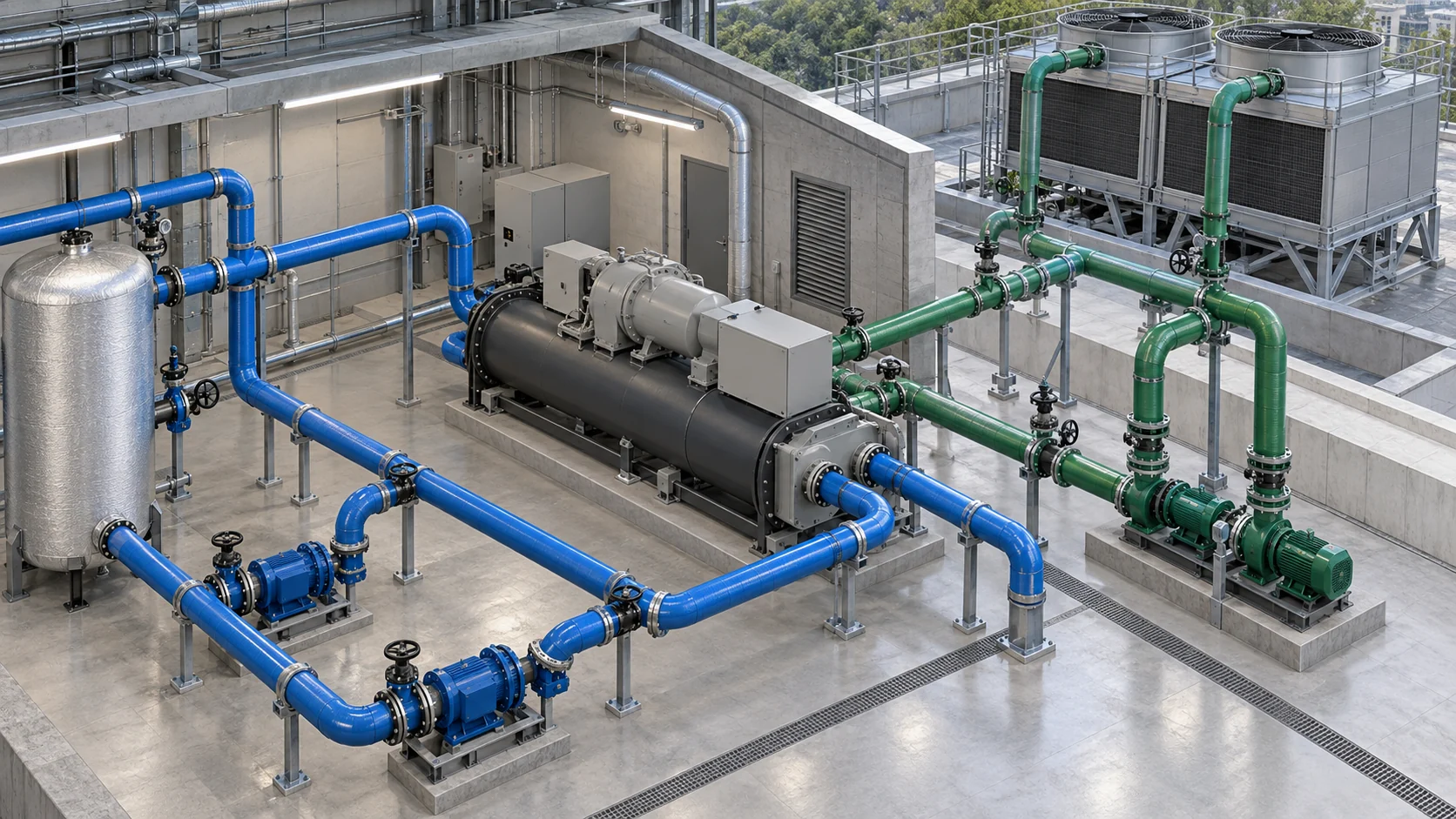
A useful design review traces four paths:
- Chilled water leaves the evaporator and passes through the supply header.
- Pumps and control valves deliver flow to AHU and fan-coil coils.
- Return water carries the building heat back to the evaporator.
- A separate condenser path rejects refrigeration heat when the chiller is water cooled.
The review should show isolation valves, strainers, air separation, expansion control, drains, vents, sensors, and service clearances. It should also show where a low flow alarm, freeze protection sequence, or pump failure is detected. A chiller schedule without a loop diagram leaves too many assumptions hidden.
AHU cooling coil interface
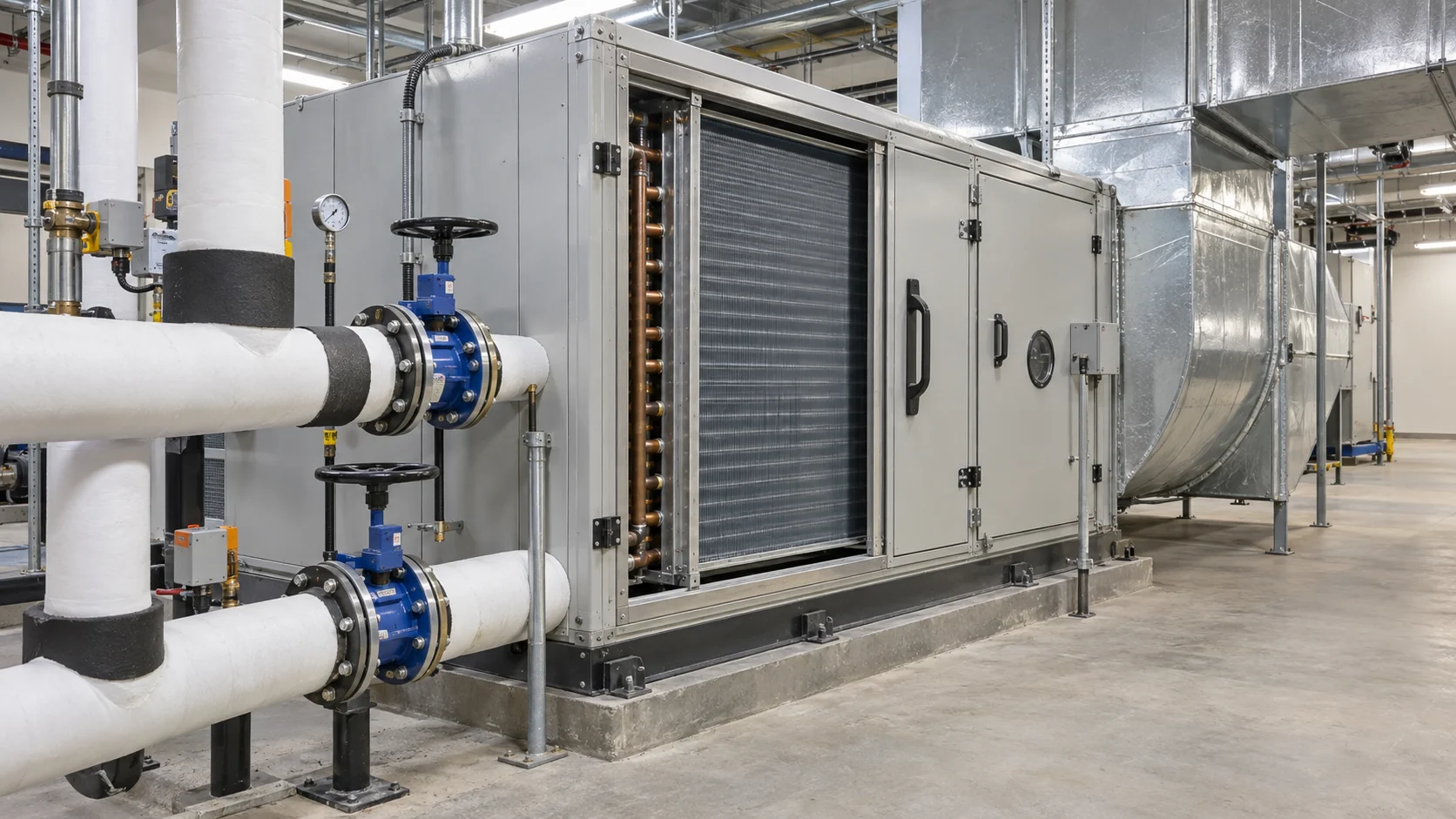
An AHU coil must transfer the required sensible and latent load at the available water flow and air flow. Confirm entering-air condition, leaving-air target, face velocity, rows, fin spacing, tube material, connection size, pressure drop, drain-pan arrangement, and access for cleaning. Domi’s commercial cooling coil page is the relevant starting point for a coil review. The chiller selection should use the actual coil pressure drop and design flow rather than a generic terminal-unit allowance.
Fan-coil and terminal-unit interface
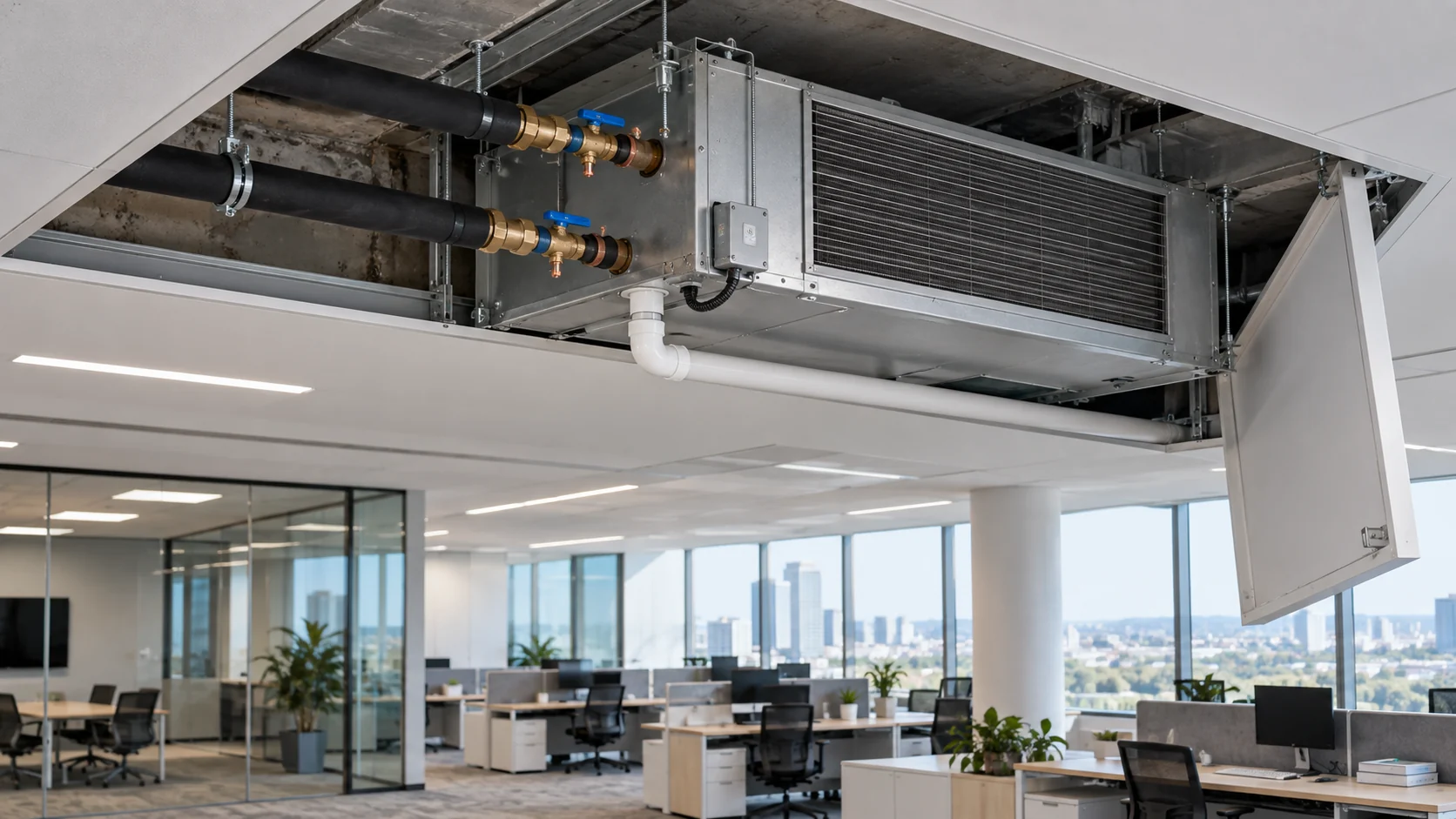
Fan-coil units usually serve smaller zones and have tighter space constraints. Check branch balancing, valve authority, condensate drainage, access-panel dimensions, sound requirements, and the effect of low load on the plant. If many terminal valves close at the same time, the control sequence must maintain a safe minimum flow or stage pumps and chillers accordingly.
Match the chiller arrangement to the building load

Start with a block load model and the operating schedule. Gather weather design points, occupancy, ventilation, lighting, equipment, envelope, solar, process-adjacent heat, and future phases. Then separate connected load from coincident peak load. A plant sized to every terminal at full output may short-cycle during normal operation, while a plant sized to an optimistic average can fail on the hottest design day.
Use the following table as a conversation starter, not as a capacity calculator.
| Building or operating condition | Starting point for selection | Evidence to request before award |
|---|---|---|
| Office or hotel with strong daily schedule | Model occupied and unoccupied periods, ventilation, and morning pull-down | Block-load file, hourly schedule, and part-load rating points |
| Hospital or laboratory with high ventilation | Separate critical areas, redundancy, humidity, and filtration pressure drop | Zone load summary, redundancy philosophy, and AHU coil data |
| Campus or phased development | Compare central plant, distributed plants, and future tie-in points | Phase loads, plot plan, headers, and expansion allowances |
| Retail or mixed-use building | Account for tenant diversity, extended hours, and changing fit-outs | Tenant schedule, diversity assumptions, and control zoning |
| Building with low-temperature or glycol loop | Confirm fluid properties and coil approach temperature | Concentration, viscosity, freeze point, materials, and pump curve |
Do not use square-foot rules as the final answer
Square-foot rules can start a budget conversation, but they cannot capture ventilation, glass, internal equipment, humidity, or diversity. For the RFQ, provide design outdoor air conditions, supply and return water temperatures, design flow, allowable pressure drop, altitude, fluid chemistry, electrical service, sound limits, and the load at several operating points. Ask bidders to state assumptions so the owner can compare like with like.
Choose compressor technology and part-load control
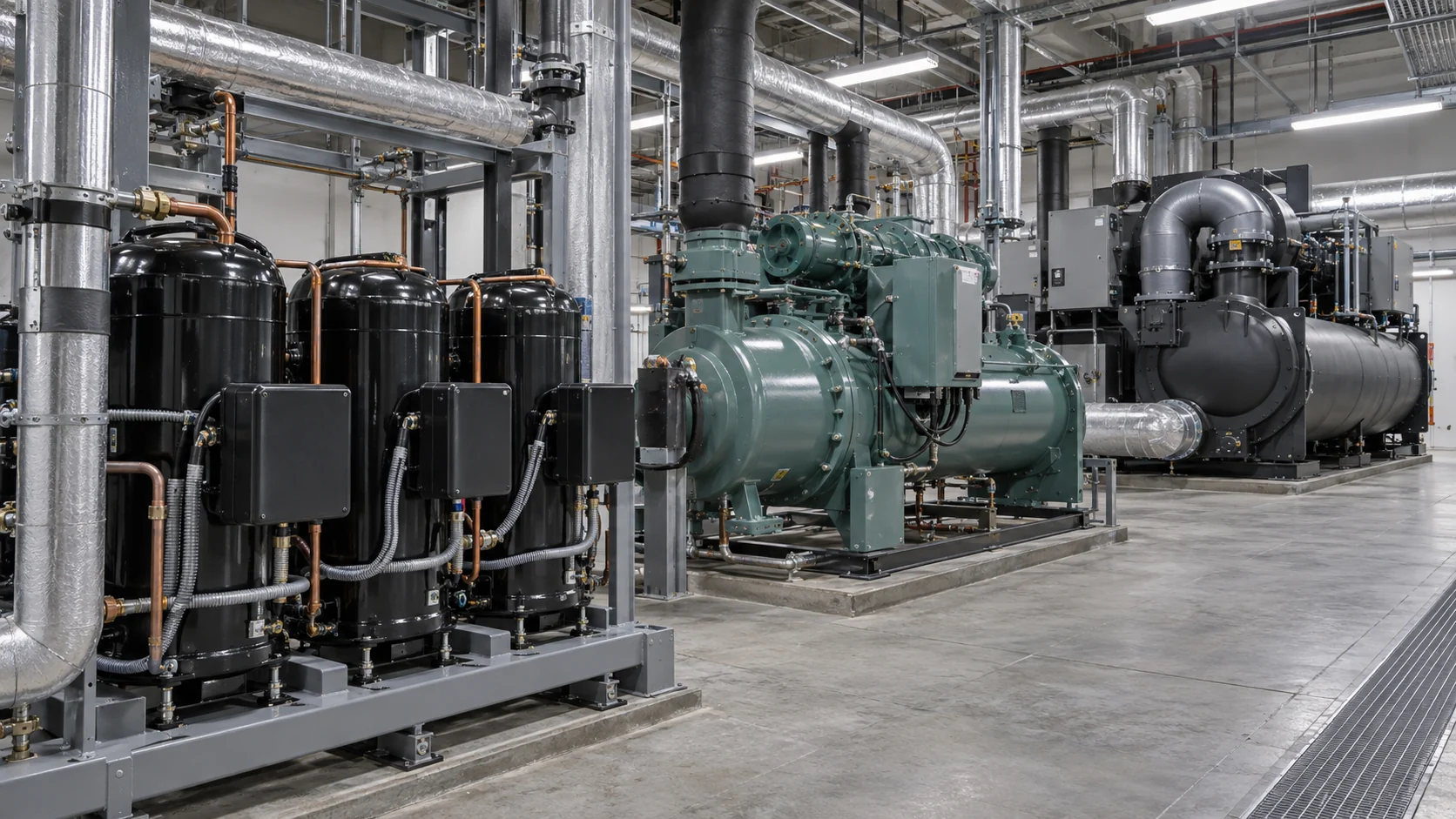
Compressor choice follows capacity range, modulation needs, refrigerant circuit arrangement, sound limits, service strategy, and the number of operating hours at part load. Scroll compressors often suit smaller modular machines. Screw compressors cover many medium and larger applications. Centrifugal compressors are commonly considered for large central plants, where lift, flow, and staging must be reviewed carefully. These are selection tendencies, not a promise that one technology fits every project.
Ask for compressor map limits, minimum stable loading, unloading method, oil-management requirements, surge protection where applicable, and the control response during rapid load changes. If the plant runs several chillers, compare one large machine against staged modules using the same annual load profile. The lowest full-load input is not automatically the lowest annual operating cost.
Size from water temperatures, flow, and real constraints
Cooling capacity follows the heat carried by the fluid and the temperature change across the evaporator. A basic engineering relationship is:
Cooling load = mass flow x specific heat x temperature difference
Use the fluid data that will actually be installed. Water and glycol mixtures have different heat capacity, viscosity, and pressure drop. Higher viscosity can increase pump energy and change coil performance. A lower leaving-water temperature can improve dehumidification but may reduce chiller efficiency and increase the risk of condensation on surfaces that were not designed for it.
The rating sheet should state entering and leaving fluid temperatures, flow, fouling assumptions, ambient condition, altitude, sound, refrigerant, electrical frequency, and whether auxiliary pumps or tower fans are included in input power. Without those fields, two capacity numbers may look comparable while describing different operating points.
Judge efficiency at the load profile that matters

Ask for full-load and part-load data, not one headline efficiency value. DOE FEMP’s guidance on purchasing energy-efficient electric chillers recommends evaluating equipment against the operating conditions and life-cycle cost that matter to the facility. ASHRAE’s central chilled-water plant design and control guidance is useful when the plant includes several chillers, variable flow, towers, and a building automation system.
For each bidder, request the same full-load and part-load points, entering and leaving water temperatures, flow, pressure drop, sound data, and total plant power boundary. Also request the controls and alarm list so the BAS comparison covers actual operator actions rather than a marketing feature list.
Do not convert a manufacturer’s test result into a guaranteed annual bill. The result depends on weather, load, condenser-water temperature, water quality, control tuning, and maintenance. Use the rating as an input to the model, then verify the installed plant during commissioning.
Plan condenser-water treatment and maintenance

Water-cooled systems add a maintenance boundary that should be assigned before purchase. Scaling, corrosion, biological growth, poor filtration, and incorrect blowdown can raise approach temperatures and reduce heat transfer. EPA WaterSense’s chilled-water system guidance provides practical context for water use, treatment, and operating checks.
The owner should identify who samples conductivity, checks chemical dosing, cleans strainers, inspects tubes, records tower basin condition, and approves a response when condenser-water temperature rises. If that responsibility is unclear, the plant may lose performance even when the chiller itself is healthy. Air-cooled systems avoid this water-side duty, but their condenser coils, fans, filters, and outdoor clearances still need a written maintenance plan.
Connect the chiller to BAS controls and redundancy
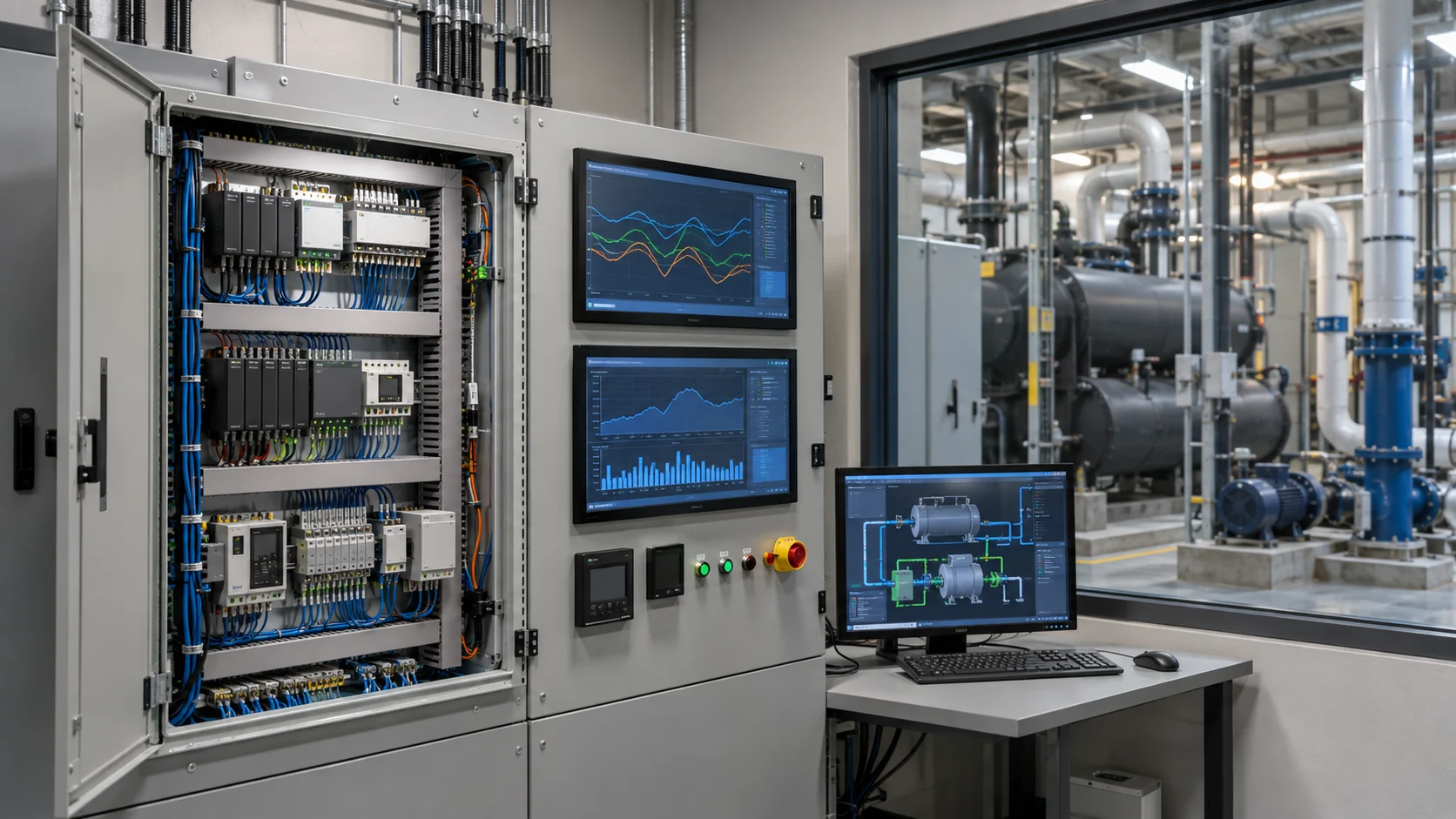
Controls should coordinate chiller staging, pump speed, valve position, leaving-water temperature, differential pressure, condenser-water temperature, freeze protection, and alarm handling. A good sequence describes what happens at start-up, low load, high load, loss of flow, sensor failure, communication failure, and planned maintenance.
For critical buildings, define the consequence of one chiller, pump, or power feed being unavailable. Redundancy can mean standby capacity, multiple smaller machines, spare heat-exchanger circuits, or a temporary connection point. The correct arrangement depends on the risk assessment. Do not label a plant “N+1” without stating which component is redundant and what load remains available after a failure.
Commission the complete system

Commissioning should prove the loop, not only the compressor. Balance chilled-water flow, confirm sensor locations, verify valve operation, record supply and return temperatures, check pump differential pressure, trend plant power, and test the response to a staged load. For a water-cooled plant, record condenser-water flow, entering and leaving temperatures, approach, tower fan operation, and treatment readings.
| Commissioning check | Minimum record | Pass condition to define in the project plan |
|---|---|---|
| Chilled-water flow | Flow meter value at each design branch and plant total | Flow reaches the approved design range with valves in the intended position |
| Diferencia de temperatura | Supply and return temperatures at chiller and representative coils | Delta T follows the approved sequence and load test |
| Pressure and air removal | Pump differential pressure, vents, strainers, and expansion device status | No unstable flow, trapped air, or unexpected pressure loss |
| Controls sequence | Start, stop, staging, reset, alarm, and manual override logs | BAS commands and feedback match the written sequence |
| Rechazo de calor | Condenser-water or outdoor-air readings and fan or tower status | Chiller remains inside the approved operating envelope |
| Handover evidence | Trend files, calibration certificates, as-built loop, and O&M records | Facility team can operate and troubleshoot the plant |
Put the right information in the HVAC chiller RFQ

An RFQ should let a supplier rate the equipment without guessing. Include the project location, design weather, load profile, required capacity points, leaving and entering water temperatures, flow, fluid chemistry, glycol concentration, pressure limits, electrical service, sound limits, refrigerant requirements, heat-rejection arrangement, controls protocol, access route, service clearances, testing requirements, documentation, packaging, and delivery constraints.
| Sección de RFQ | Entrada del comprador | Respuesta del proveedor a la solicitud |
|---|---|---|
| Load and schedule | Peak, coincident, minimum, and future loads | Rated capacity and input at each agreed point |
| Fluid and piping | Water or glycol, temperatures, flow, pressure drop, materials | Evaporator and coil selection, pump duty, and compatibility notes |
| Rechazo de calor | Outdoor ambient or condenser-water entering condition | Condenser selection, fan or tower duty, and operating limits |
| Controles | BAS protocol, sensors, interlocks, alarms, and reset logic | Point list, sequence narrative, and interface responsibility |
| cURL Too many subrequests by single Worker invocation. To configure this limit, refer to https://developers.cloudflare.com/workers/wrangler/configuration/#limits | Inspection plan, pressure tests, factory or site checks | Test method, records supplied, and nonconformance process |
| Logistics and service | Access route, packaging, lifting, spares, and maintenance space | Shipping dimensions, service clearances, manuals, and spare list |
For coil or heat-exchanger work, Domi can review drawings and operating data through its capacidades de ingeniería, laboratorio de pruebas, y servicio de fabricación de serpentines personalizados pages. Those links describe the documented engineering and thermal-component scope. They do not change the responsibility of the chiller OEM, controls contractor, tower supplier, or installing contractor.
Preguntas frecuentes
What is a chiller in HVAC?
An HVAC chiller removes heat from water or a water and glycol mixture and circulates the cooled fluid to AHU or fan-coil cooling coils. The refrigeration circuit and the building water loop work together, so the chiller schedule should be reviewed with the coil and pump schedules.
What is the difference between HVAC and chillers?
HVAC is the wider building discipline that covers heating, ventilation, air conditioning, distribution, controls, and indoor conditions. A chiller is one cooling asset inside that system. It may feed several air handlers, but it does not replace the pumps, coils, ducts, valves, sensors, or controls that distribute the cooling.
What is the difference between an air conditioner and a chiller?
An air conditioner commonly delivers refrigerant or conditioned air to a limited zone. A chiller produces chilled liquid for a separate distribution loop. A chiller can serve many zones through AHU and fan-coil coils, while a packaged air conditioner may be simpler for a small building or a short piping layout.
Is an air-cooled or water-cooled HVAC chiller better?
Air cooled is often easier to deploy when the site has water restrictions, limited tower space, or a small maintenance team. Water cooled can suit a large central plant that has room for a tower, condenser-water pumps, treatment, and a trained operating team. Compare total plant equipment, design weather, water services, and part-load data rather than the chiller shell alone.
How should an HVAC chiller be sized?
Start with a block-load model and the actual operating schedule. Provide peak and minimum loads, design water temperatures, flow, fluid properties, pressure drop, outdoor conditions, ventilation, and future phases. Ask for several rating points and document every assumption. A square-foot shortcut is not enough for an award decision.
What should be included in an HVAC chiller RFQ?
Include the load profile, design weather, leaving and entering water temperatures, flow, fluid chemistry, pressure limits, heat-rejection arrangement, electrical service, sound limits, controls and alarms, testing, documentation, access, packaging, and service requirements. Request a written deviation list so exclusions do not appear after the order.
Send your HVAC chiller RFQ for review
If the plant includes custom coils, heat exchangers, or a difficult fluid and airflow interface, send the drawing and operating data before the equipment schedule is frozen. Domi can review the thermal-component portion, clarify the information needed for a defensible selection, and identify which checks belong to the complete chiller package. Send your HVAC chiller RFQ through the contact page with the load points, fluid data, dimensions, and required delivery boundary.