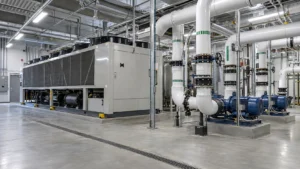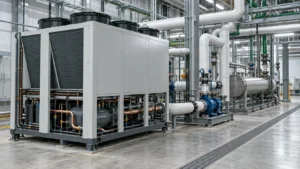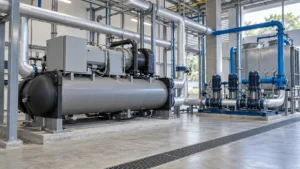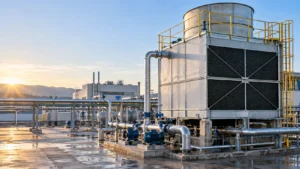

An industrial chiller removes heat from a manufacturing process or piece of equipment by circulating chilled water, glycol, or another approved fluid through a heat exchanger. The right selection matches the real load profile, fluid temperatures, flow, heat-rejection method, compressor control, service space, and proof required at release. This guide gives engineers and procurement teams a practical way to compare industrial chiller packages without treating nominal tons as a complete design.
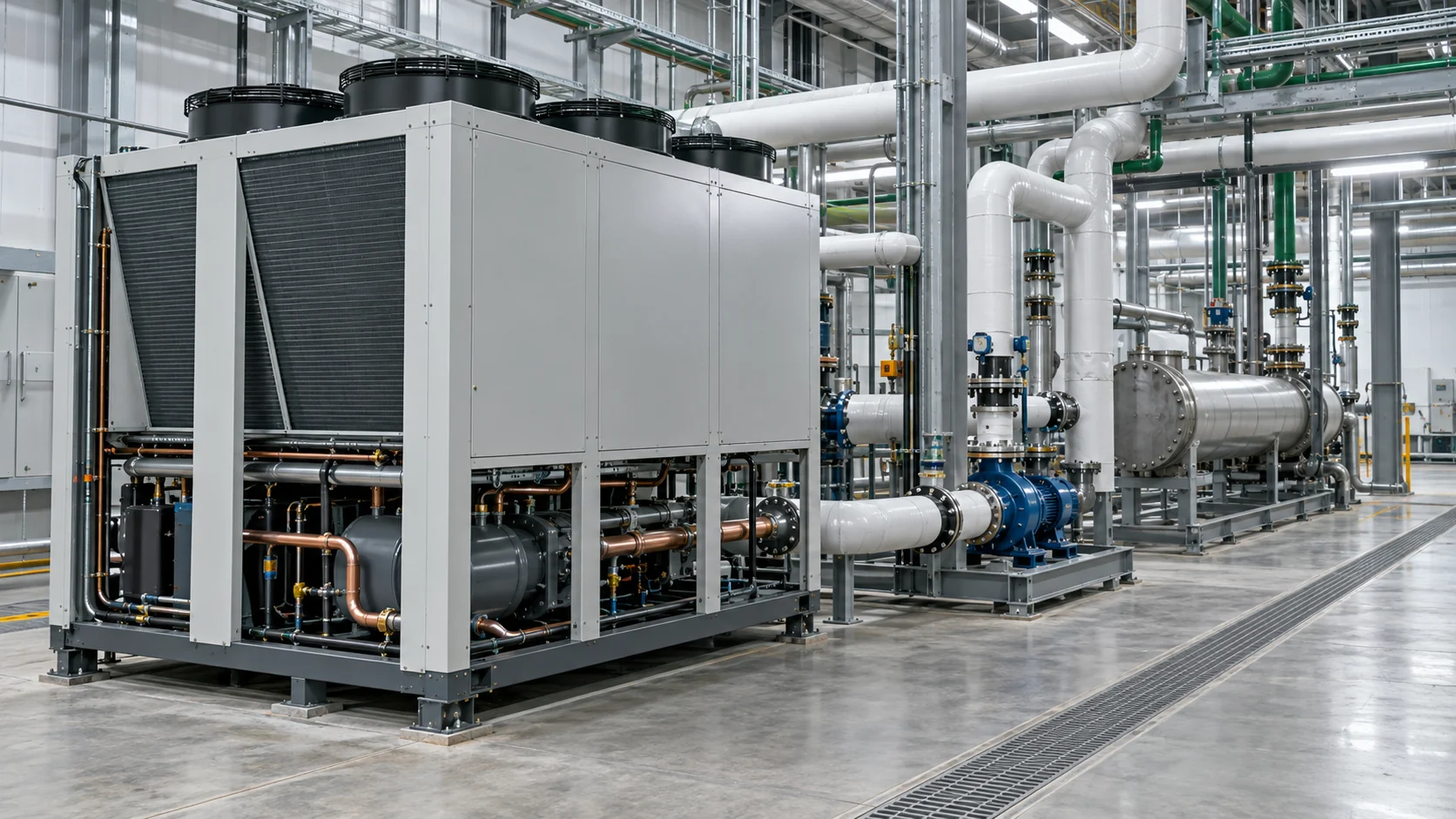
Start with the process duty, not the nameplate
The phrase industrial chiller covers several very different jobs. A plastics molder may need a stable mold-water temperature through short cycles. A laser or machine tool may need a clean, tightly controlled loop with little tolerance for drift. A food or pharmaceutical process may add material compatibility, hygiene, or documentation requirements. A data-center or test-rig load may run for long periods but change quickly when equipment stages.
Trane defines a process chiller as a cooling system that removes heat from a manufacturing process or equipment and keeps a material within a required temperature range. That definition is more useful than a catalog label because it starts with the load and the consequence of temperature drift. Before asking for a model, write down:
- the heat source and what failure looks like if temperature rises;
- the maximum, normal-shift, turndown, and expansion heat loads with units and duration;
- the process-fluid leaving and entering temperatures, flow envelope, and allowable variation;
- fluid chemistry, glycol concentration, viscosity, and materials restrictions;
- ambient or condenser-water conditions, sound limits, footprint, and service route;
- the required redundancy, controls interface, documents, tests, and delivery boundary.
El Trane process chiller explanation is a useful definition reference. It also lists metalworking, plastics, chemical processing, food and beverage, printing, and pharmaceutical work as examples of process applications. Those applications share a need for repeatable conditions, but they do not share one universal leaving-fluid temperature or compressor choice.
| Design field | Why it changes the chiller choice | Evidence to send with an RFQ | Risk when it is missing |
|---|---|---|---|
| Peak and typical heat load | Sets capacity, staging, and useful turndown | Load calculation or logged trend with units and time basis | A package can meet the peak but run poorly at the normal load |
| Process-fluid supply and return | Sets evaporator duty, flow, and control range | Design values, reset limits, and allowable fluctuation | A quoted supply temperature may be impossible at the real return condition |
| Fluid composition | Changes heat capacity, viscosity, freezing point, and materials | Water or glycol type, concentration, additives, and safety data | Flow and heat-transfer assumptions become incomparable |
| Caudal y caída de presión | Determines pump head, nozzle size, and heat-exchanger selection | Normal, minimum, and maximum flow plus allowable pressure drop | Low flow can trip the chiller or damage heat-transfer performance |
| Heat-rejection condition | Sets condensing pressure and fan, pump, or tower duty | Outdoor design temperatures or entering condenser-water profile | One rating point hides hot-weather or low-ambient limitations |
| Operating hours and load shape | Determines full-load versus part-load value | Hourly profile, shift pattern, and planned expansion | The lowest first-cost unit may have the highest operating cost |
| Footprint and service envelope | Controls equipment layout and maintenance access | Plan, lifting path, tube-pull space, and clearance constraints | A unit can fit on paper but be impossible to service |
Define the industrial chiller boundary
An industrial chiller is the refrigeration machine and its immediate heat-transfer interfaces. A usable process-cooling system also includes pumps, piping, valves, filters, sensors, a buffer volume when required, controls, and a heat-rejection device. The AHRI liquid chiller overview describes chillers as part of a larger system and notes that manufacturing and process applications may need reliable cooling, redundancy, and technical support.
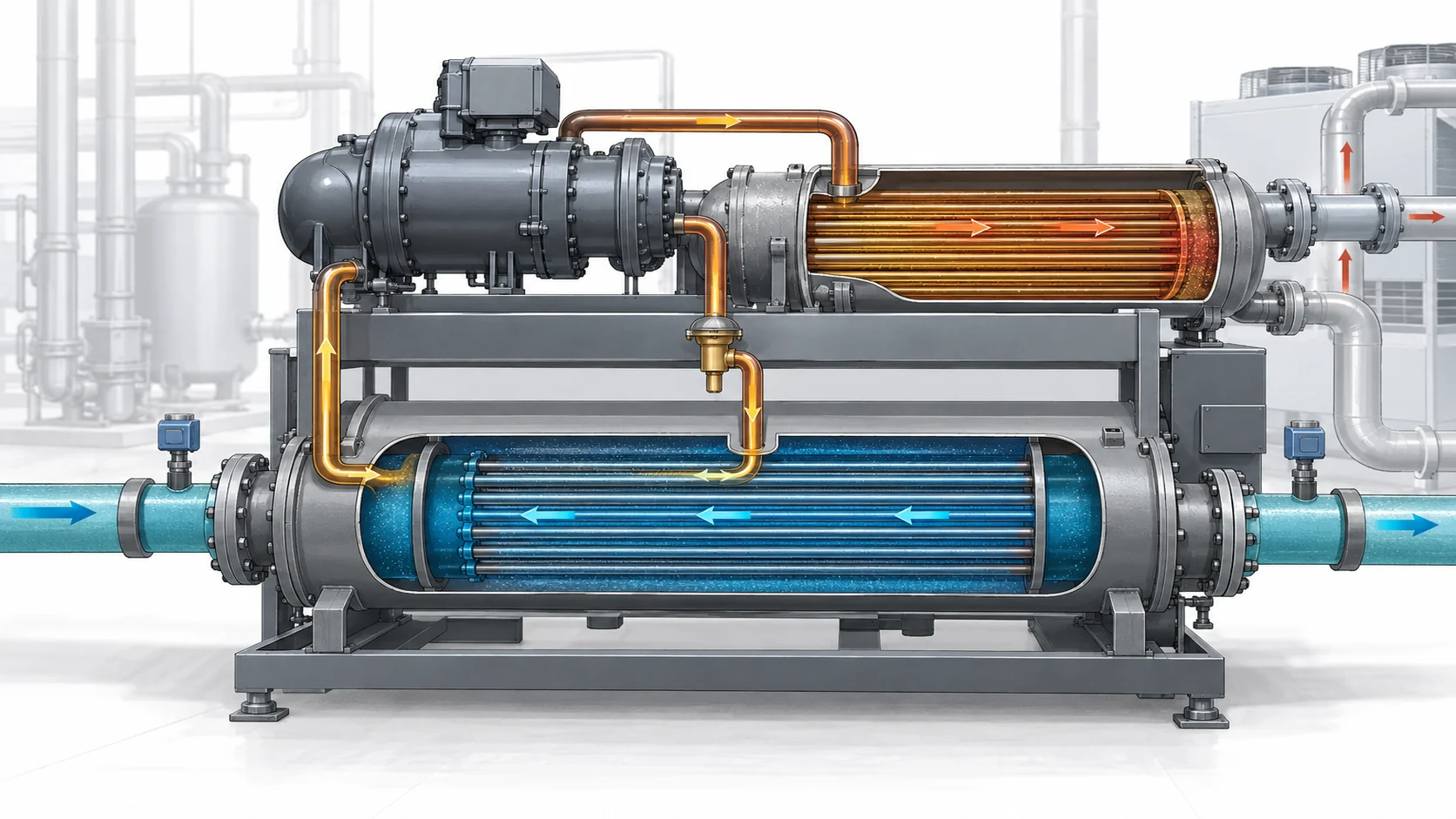
In a vapor-compression cycle, the evaporator takes heat from the process fluid. The compressor raises the refrigerant pressure and temperature. The condenser rejects heat to air, condenser water, or an evaporative surface. An expansion device drops the refrigerant pressure before the cycle repeats. The process fluid and refrigerant stay separated by the heat-transfer surfaces; they do not mix.
That boundary matters when a buyer compares quotations. Ask which items are inside the quoted package and which remain with the integrator. A complete plant may require a cooling tower, condenser-water pumps, water treatment, a secondary process heat exchanger, controls programming, and field commissioning. If these items are omitted from the comparison, the lowest package price is not the lowest installed cost.
When a packaged chiller is the wrong starting point
Do not start with a packaged chiller if the process load is still a guess, the fluid is chemically aggressive, the required temperature is below the proposed fluid freeze point, or the equipment cannot tolerate a brief trip. Stabilize the process data first. A short measurement campaign or a conservative thermal model is cheaper than replacing a machine that never reaches the required condition.
Choose the heat-rejection architecture
The heat-rejection method is a site decision as much as a chiller decision. Air-cooled equipment rejects heat through fans and a finned coil. Water-cooled equipment sends heat to a condenser-water loop, often with a cooling tower. Evaporative designs wet the heat-transfer surface to improve heat rejection but add water chemistry and maintenance considerations.
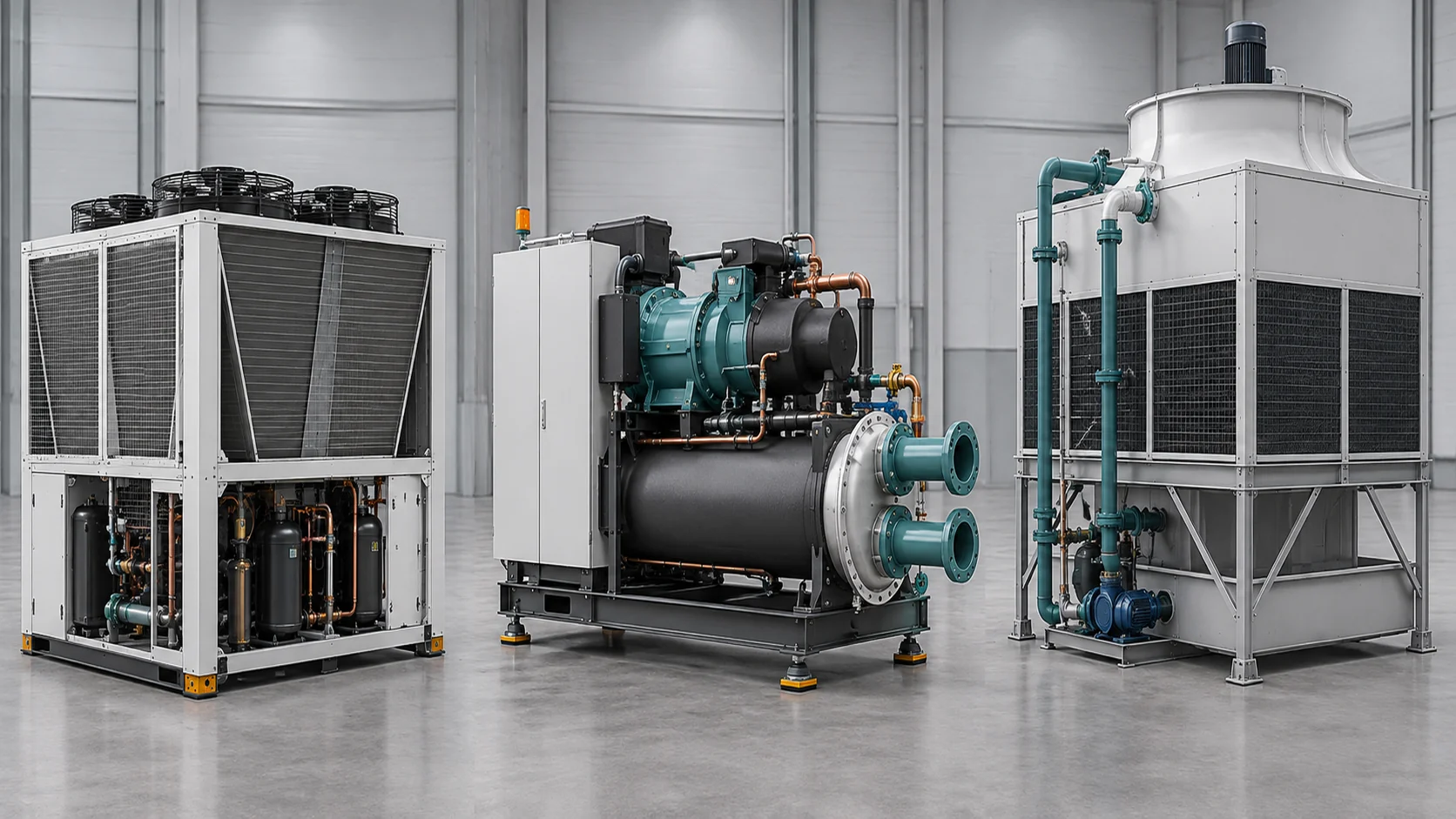
Use the comparison below as a screening tool, then ask for selections at the same design point. The Trane chiller overview explains the basic air-cooled and water-cooled paths and the role of the compressor, condenser, evaporator, and expansion device.
| Heat-rejection path | Advantages in an industrial project | Added obligations | Best fit when |
|---|---|---|---|
| Air-cooled | No cooling tower, condenser-water piping, or tower makeup water; simpler installation | Fan sound, hot-air recirculation, coil cleaning, and high-ambient derating | Water is scarce, the site wants a self-contained package, or the load is moderate |
| Enfriado por agua | Can support larger central loads and favorable condensing temperatures | Cooling tower, pumps, treatment, blowdown, freeze protection, and tube cleaning | The site has a credible water program and long operating hours justify the extra loop |
| Evaporativo | Can improve heat rejection in suitable dry conditions | Spray-water quality, drift control, cleaning, and seasonal water management | Water availability and climate support the approach and maintenance owner is clear |
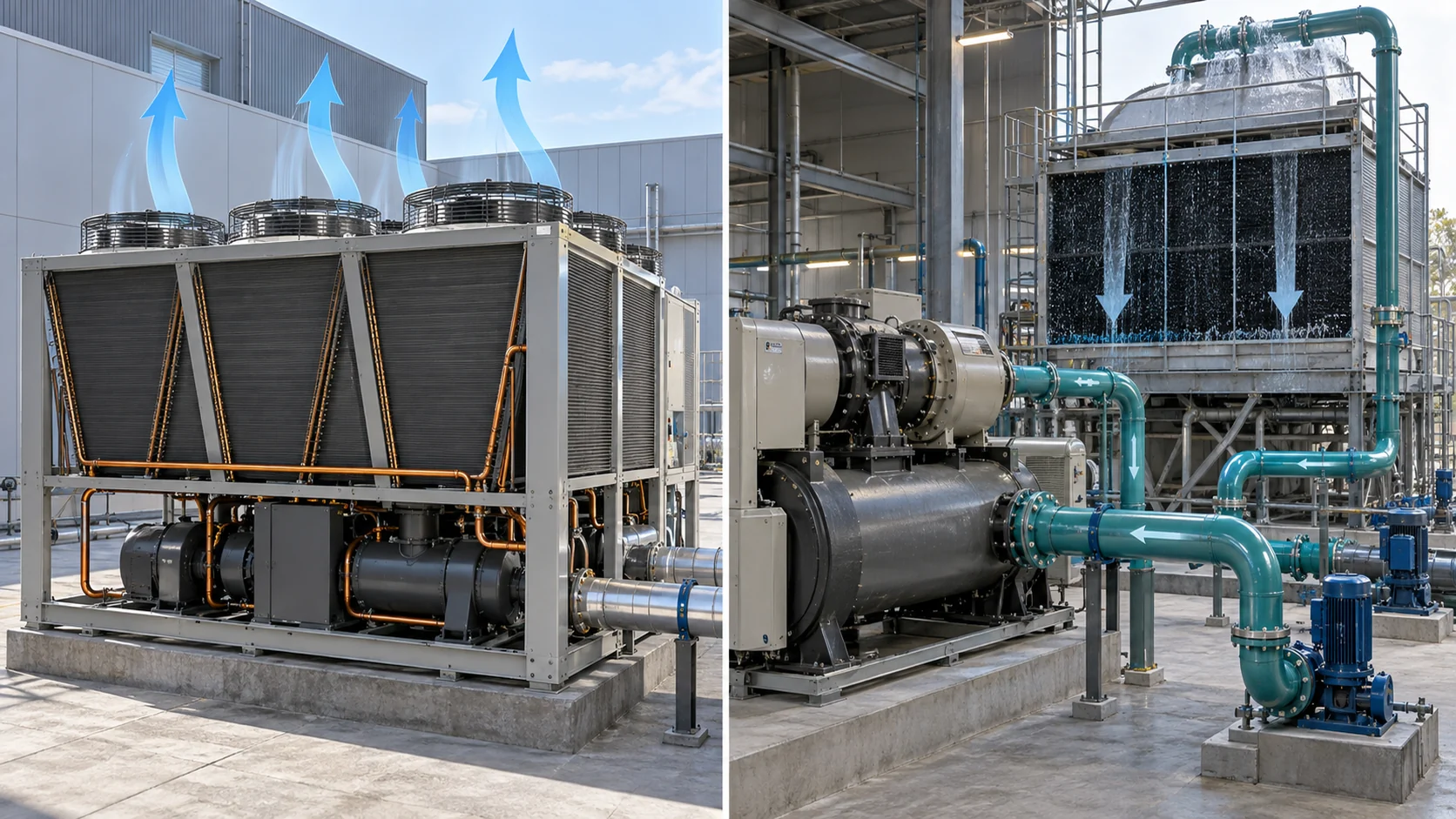
For air-cooled units, check coil face velocity, fan turndown, hot-air recirculation, winter controls, and access for fin cleaning. For water-cooled units, check entering condenser-water temperature, design wet bulb, tube velocity, water chemistry, and the full pump and tower sequence. An industrial site may use more than one method: a dedicated process chiller can protect a critical load while a central plant serves less sensitive equipment.
Match the compressor to load shape
Compressor technology should follow the duty and the maintenance reality, not a preference carried over from another project. Scroll compressors can suit smaller modular packages. Screw compressors often fit medium and larger process loads with useful unloading. Centrifugal compressors are common in large central plants where stable water-side conditions and part-load control can be maintained. Reciprocating machines still have a place in some compact or specialized systems.
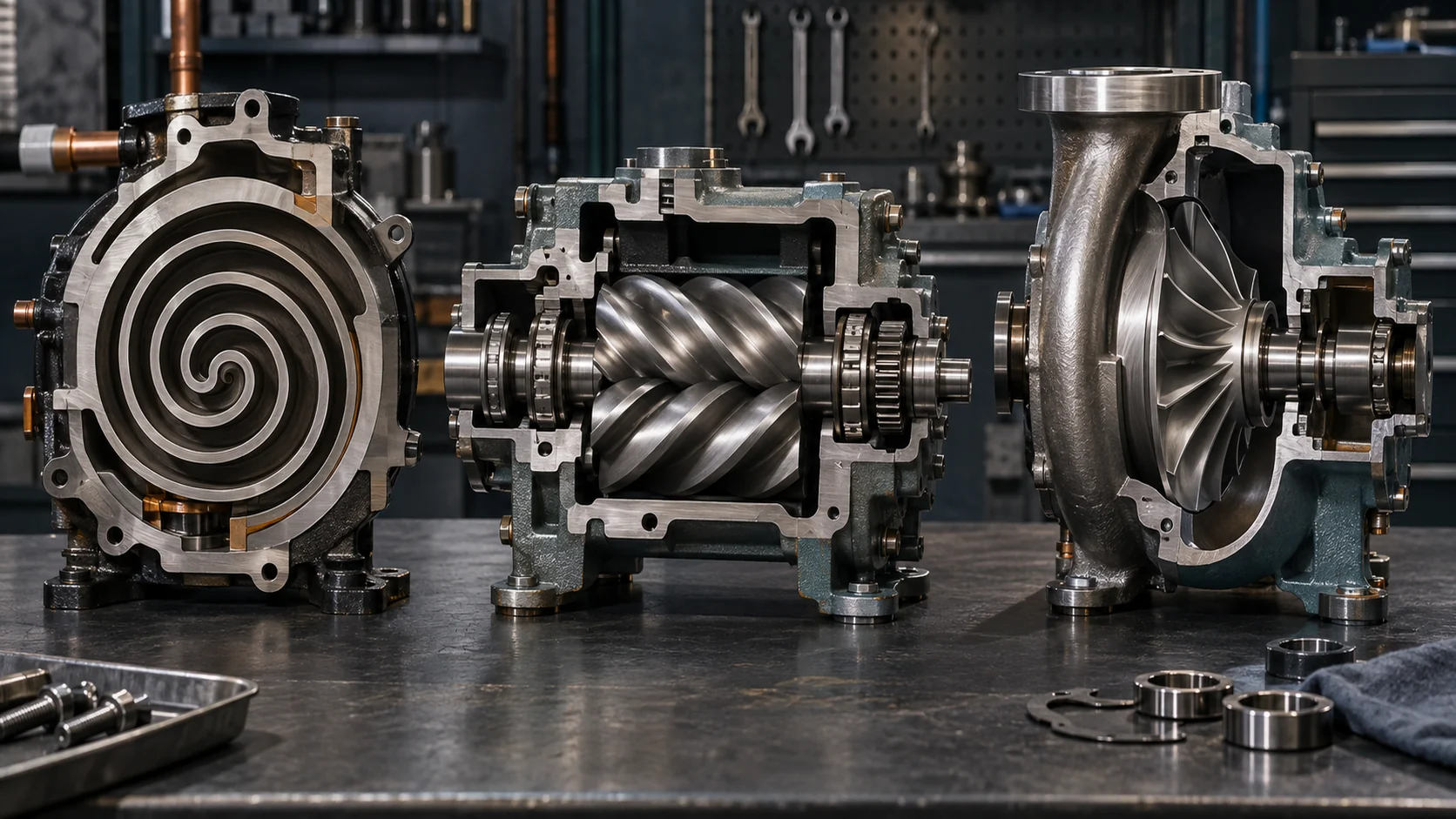
El AHRI liquid chiller guidance describes the application of scroll, helical-rotary, and centrifugal technologies and the importance of capacity control. Compare each bid using the same process-fluid conditions, condenser condition, electrical basis, fouling assumption, and sound requirement.
Ask the supplier to show:
- minimum stable capacity and the number of capacity stages;
- unloading method, variable-speed range, and restart behavior;
- oil management, refrigerant circuit count, and service parts;
- minimum evaporator flow and the protection used when a valve closes;
- surge or low-lift controls for centrifugal equipment;
- expected performance at the load bands where the process normally operates.
A unit that looks attractive at full load may cycle at the actual process load. Conversely, a larger modular arrangement can keep one circuit near a useful operating point while another is isolated for service. Request the sequence of operation and the alarm list before the purchase order, not after commissioning.
Design the process-fluid loop around the chiller
The process loop is where many industrial chiller selections succeed or fail. The ASHRAE chilled-water plant course emphasizes load profiles, plant components, piping, condenser-water systems, controls, and operational limits. The same systems thinking applies to a process loop.
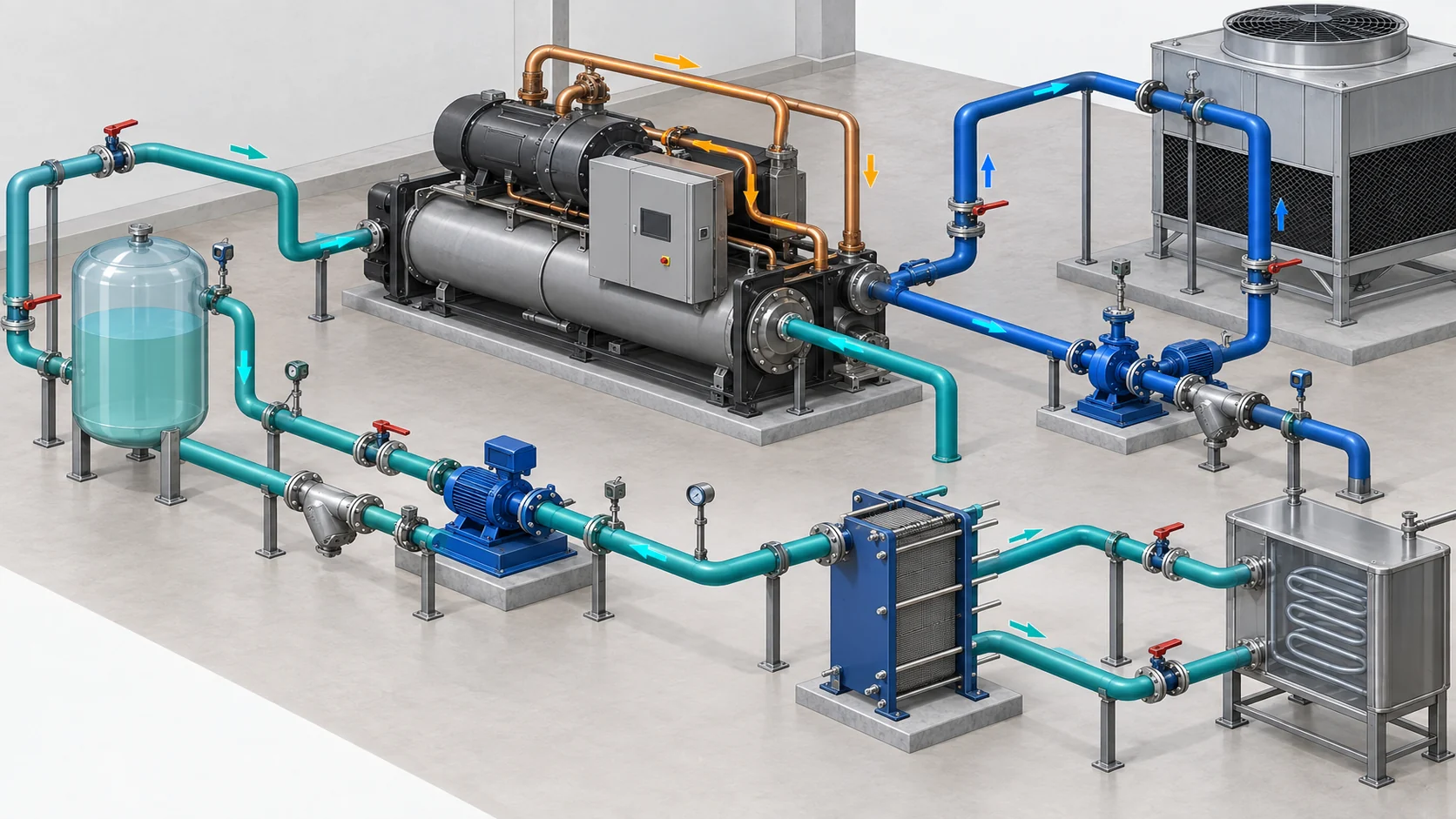
Trace the fluid from the chiller outlet to the load and back again. Confirm pump duty at normal and minimum flow, valve authority, bypass behavior, buffer volume, air removal, drains, vents, and filter access. If several machines share a header, define whether the pumps are primary, secondary, or variable-primary and how an isolated machine is protected.
Keep the heat exchanger visible in the design
The process-side heat exchanger may be a shell-and-tube exchanger, a brazed plate exchanger, a fin-and-tube coil, or a custom geometry inside an OEM machine. Its duty, approach temperature, pressure drop, material, connection orientation, and cleanability affect the chiller selection. Do not hide those fields behind the phrase “standard coil.”
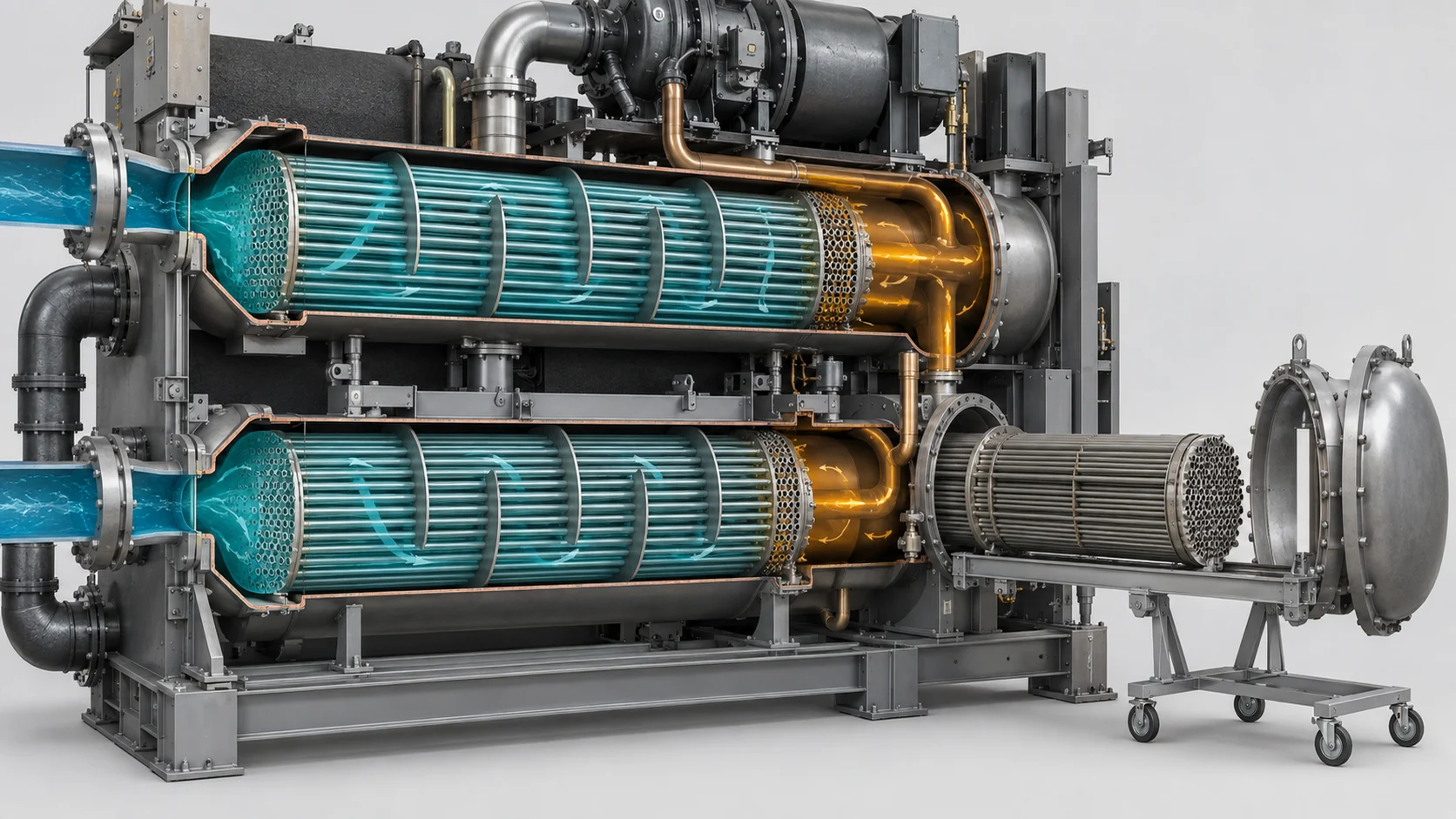
For a replacement or OEM redesign, compare the original drawing with measured connections and the real operating fluid. The Domi commercial cooling coil page shows the kind of component context a coil supplier can address. The chiller OEM or system integrator remains responsible for the complete refrigeration package and plant sequence.
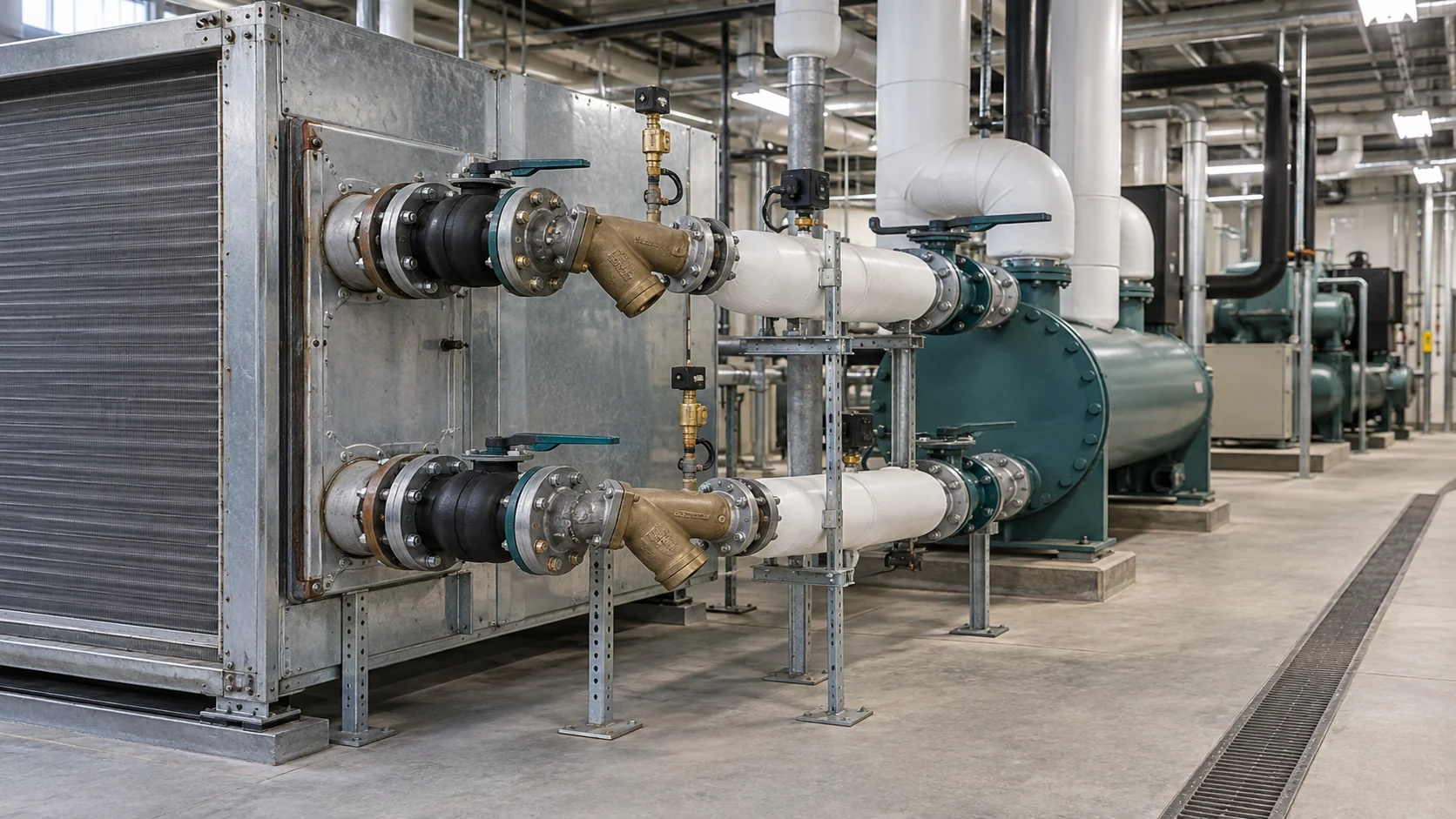
At minimum, put these interface fields on the drawing review list:
- face dimensions, tube or plate material, circuiting, and header arrangement;
- process-fluid temperature, flow, pressure, and allowable pressure drop;
- design pressure, test pressure, relief path, and drain or vent locations;
- connection standard, nozzle orientation, flexible connector, strainer, and isolation points;
- insulation, condensate management, access for cleaning, and replacement route.
Size the machine from measured or modeled heat
For clean water at ordinary industrial temperatures, a quick screening estimate is:
Cooling load (Btu/h) ≈ 500 × flow (GPM) × fluid ΔT (°F)
Divide the result by 12,000 for approximate refrigeration tons, or by 3,412 for cooling kW. This is a screening calculation. Glycol, high viscosity, elevation, unusual fluid properties, and a non-water process fluid require a correction using density and specific heat. The final selection must come from the supplier at the specified conditions.
Example: 250 GPM with a 12°F rise gives roughly 1,500,000 Btu/h, or about 125 tons. That result is only a check on the order of magnitude. Validate the maximum and normal-shift loads, turndown, expansion allowance, redundancy, pump head, heat-rejection condition, and permitted process swing before releasing a purchase order.

Use a visible selection sequence so another engineer can reproduce the result.
| Selection step | Pregunta de ingeniería | Supplier evidence | Release gate |
|---|---|---|---|
| Establish the duty | What heat must be removed, for how long, and at what fluid condition? | Selection sheet with load, fluid properties, temperatures, and units | Inputs match a model, measurement, or approved design basis |
| Screen the architecture | Which heat-rejection path and compressor range suit the site? | Air, water, or evaporative comparison with ambient or condenser-water points | Water, sound, space, and maintenance owners are identified |
| Check the loop | What flow, pressure drop, buffer, bypass, and control sequence are required? | Pump curve, minimum-flow statement, valve sequence, and interface drawing | Nozzle, pump, sensors, and service envelope fit together |
| Test the sensitivity | What happens at typical load, peak load, future load, and adverse ambient? | Performance points or curves for each scenario | Margin and limitations are documented rather than assumed |
| Freeze the quote | Which documents and tests are part of the purchase? | BOM, drawings, rating basis, inspection plan, and delivery boundary | Every open field has an owner and a due date |
Undersizing can leave a process above its safe temperature or force all available machines to run continuously. Oversizing can increase cycling, reduce control resolution, and make the installed system more expensive than expected. If the load is uncertain, request a sensitivity set rather than inserting an unexplained safety factor.
Compare efficiency at the loads you will actually run
Efficiency is not one number. The U.S. Department of Energy FEMP chiller guidance separates full-load efficiency from integrated part-load value and explains why both matter. Use the same rating basis for every bid, then calculate plant performance with pumps, tower fans, treatment equipment, and controls included where those loads are material.
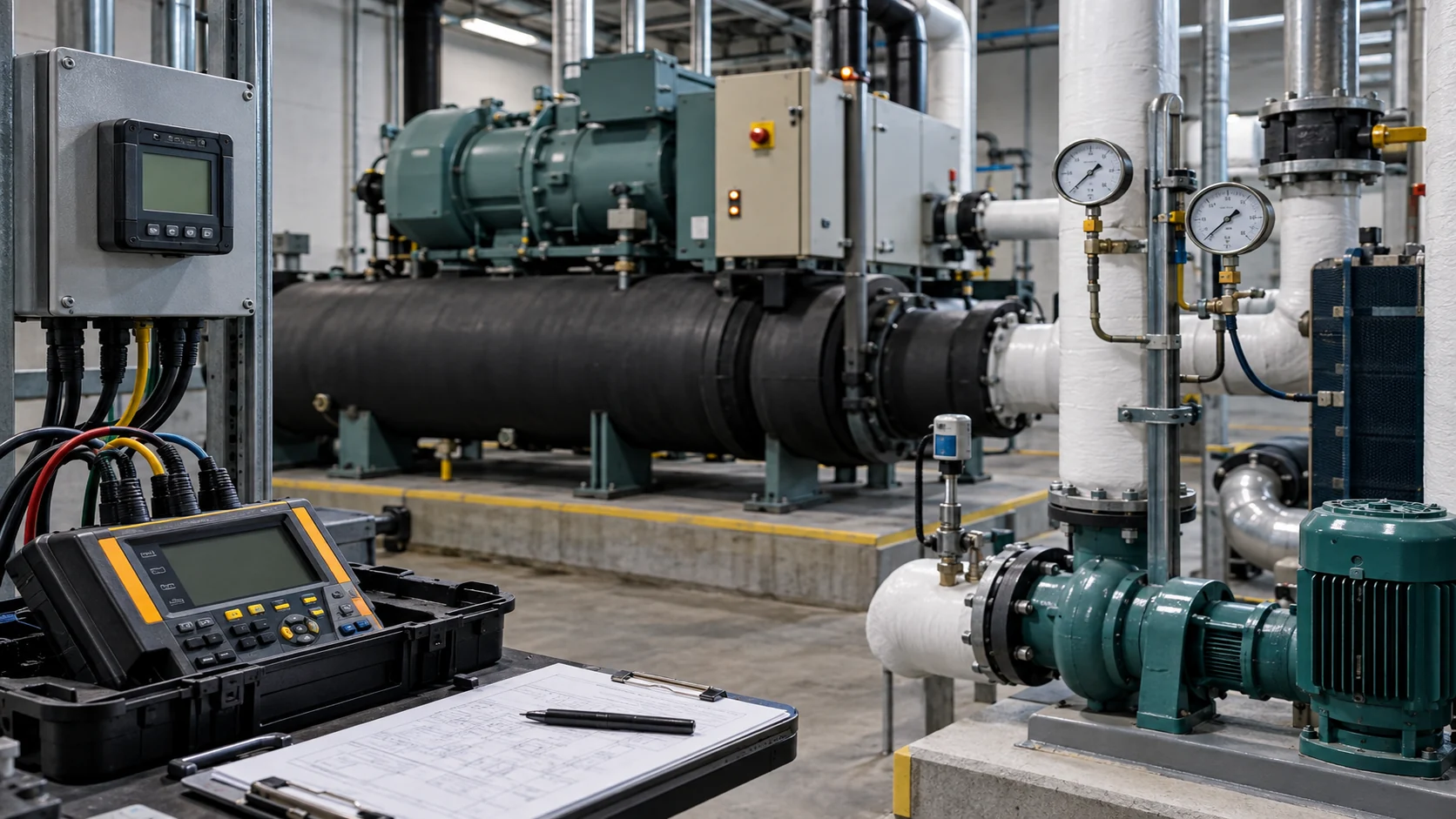
Ask each bidder for two performance views: the design point and the load band the process will run most often. The submittal should state leaving and entering fluid temperatures, flow, water-side fouling allowance, electrical input, and control mode. Map those points to the shift schedule. Saving power at a rare peak is not useful if the machine is inefficient or unstable during normal production.
Look for the following control evidence:
- leaving-fluid reset limits and the sensor location used for control;
- minimum flow protection when a process valve closes or a pump stages down;
- compressor staging, pump speed, tower fan speed, and bypass sequence;
- alarm, trip, restart, and lead-lag behavior after a power interruption;
- trend points that will prove temperature, flow, pressure, power, and runtime after handover.
Life-cycle cost should include the installed heat-rejection path, water and wastewater, treatment labor, service access, replacement parts, and the cost of an unplanned process trip. Avoid a payback claim unless the electricity rate, run hours, maintenance assumptions, and quotation premium are documented.
Plan water quality, fouling, and service
Water quality is a design input, not an operations footnote. Scale, corrosion products, suspended solids, and biological growth can reduce heat transfer and increase pressure drop. The EPA WaterSense chilled-water systems guide notes that chiller sizing should follow peak and profile loads, and that loop components work together to determine energy and water performance. The same guide discusses fouling, treatment, and cleaning responsibilities.
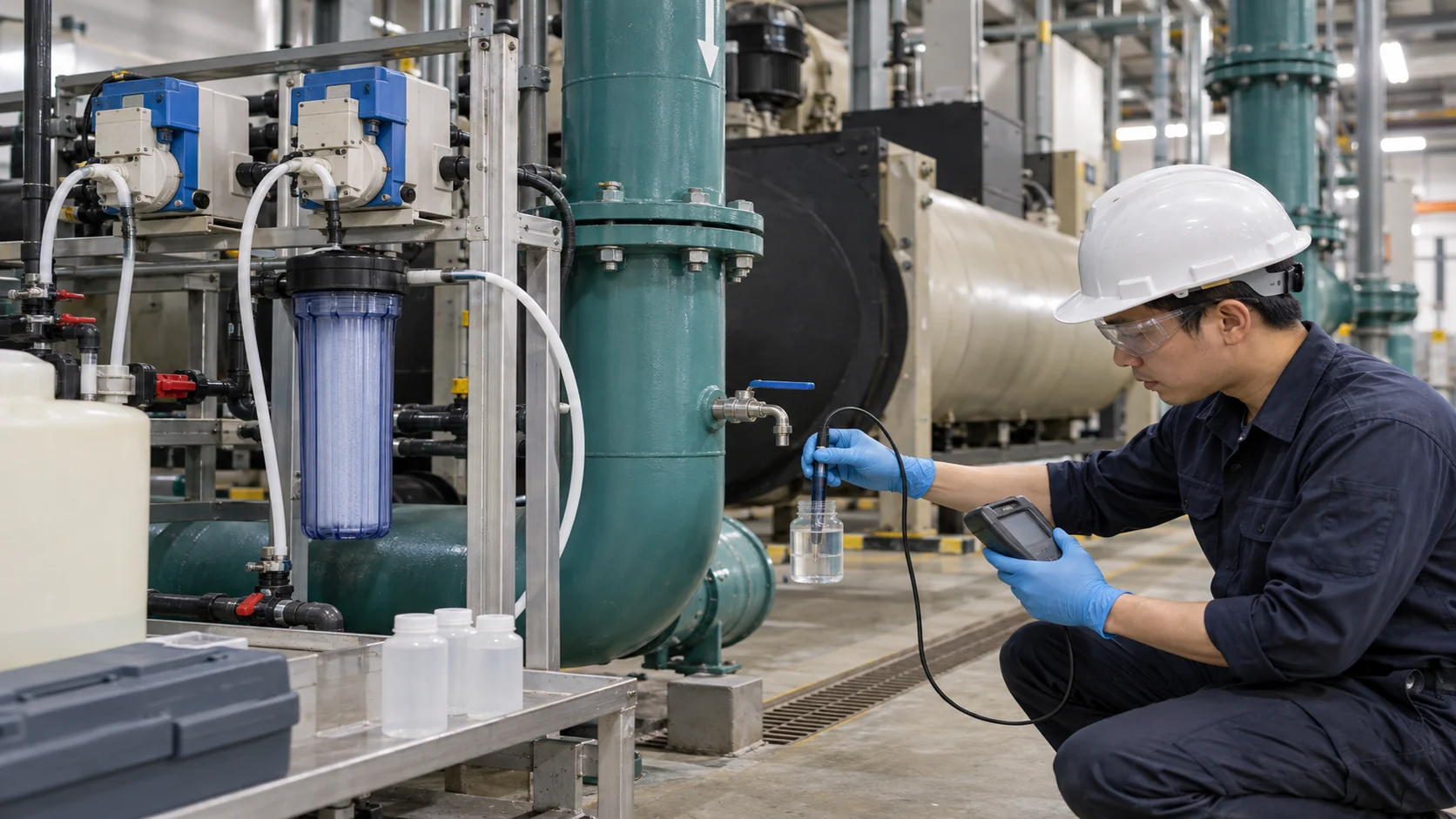
For a water-cooled or evaporative system, assign owners for sampling, filtration, chemical dosing, blowdown, discharge, biological control, and tube cleaning. For a closed process loop, specify fluid replacement, inhibitor checks, filter changes, and freeze protection. State the water chemistry limits in the equipment schedule and ask the chiller supplier to confirm tube and gasket materials against them.
Service access deserves the same attention. Show the lifting route, panel swing, tube-pull length, filter removal path, drain points, electrical clearances, and safe instrument locations on the layout. If a service technician cannot reach the condenser coil or heat-exchanger cover, the maintenance plan is theoretical.
Commission the package as a system
Commissioning should prove the relationship between the chiller, pumps, heat exchanger, valves, sensors, controls, and process load. A start-up statement alone does not show that the package meets the design intent. The AHRI liquid chiller information describes performance ratings and support expectations, while ASHRAE’s plant guidance highlights functional testing and operating limits.
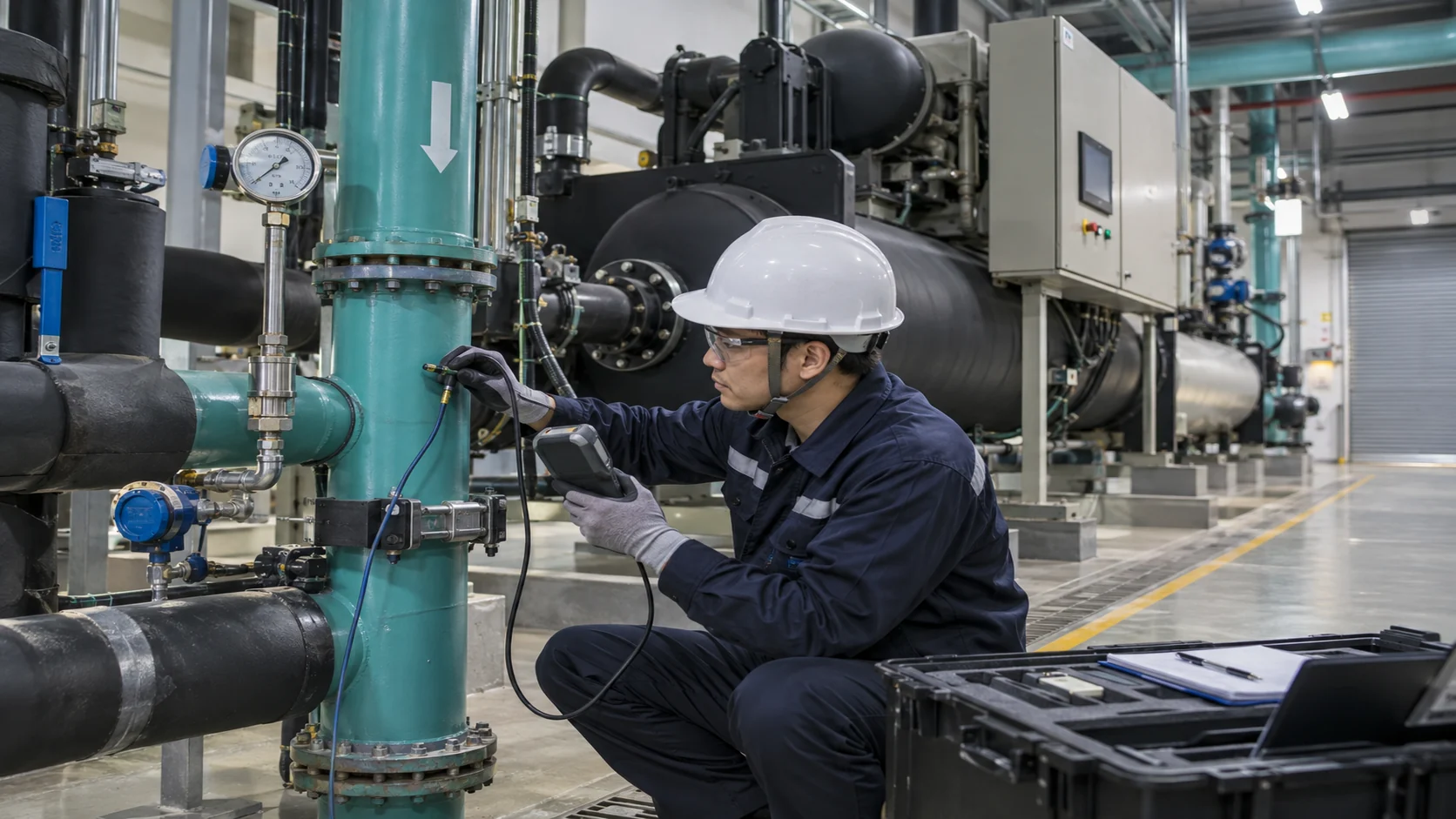
Request the instrument list, calibration status, test conditions, measured values, and acceptance criteria. Test the design load when safe, then capture a normal-shift operating point as well. If the process cannot reach design conditions during commissioning, record the limitation and schedule a repeat test rather than marking the performance complete.
| Evidence package | Qué registrar | Por qué protege al comprador |
|---|---|---|
| Factory selection and rating | Capacity, fluid temperatures, flow, power, refrigerant, rating method, and assumptions | Makes competing quotations comparable |
| Pressure and leak checks | Circuit tested, method, hold time, instrument identity, and result | Confirms the refrigerant and fluid boundaries before shipment |
| Control and safety test | Start, stop, staging, minimum flow, alarms, trips, and restart behavior | Shows that the process sequence can be operated safely |
| Site performance test | Supply and return temperature, flow, pressure, power, ambient or condenser-water condition | Connects installed behavior to the design point |
| Handover and maintenance | Filters, treatment limits, tube access, spare parts, trend points, and service clearances | Gives operations a repeatable maintenance baseline |
Build an RFQ with evidence fields
An industrial chiller RFQ should let a supplier answer the same questions without filling gaps by assumption. Include the process description, load profile, fluid data, temperature limits, flow and pressure drop, heat-rejection condition, electrical service, sound or location constraints, redundancy, controls interface, footprint, lifting route, and the required test and document package.

Use a revision-controlled drawing. Mark every connection, sensor, drain, vent, support, lifting point, and access zone. Ask for a redline return when the supplier changes a nozzle, circuit, material, control point, or service clearance. That record prevents a small drawing change from becoming a field fit-up problem.
If a drawn-to-order coil or heat-transfer core sits at the boundary, Domi’s custom coil fabrication service can review its material, circuiting, connections, and duty. Domi’s documented offer covers component fabrication, thermal engineering, prototypes, and test planning. Leave the packaged industrial chiller, cooling tower, pumps, controls, and plant integration to the selected chiller OEM or integrator.
For a drawing-led discussion, use cURL Too many subrequests by single Worker invocation. To configure this limit, refer to https://developers.cloudflare.com/workers/wrangler/configuration/#limits y testing lab information to define which dimensional, pressure, leak, or heat-transfer checks are required. If a specification is not yet fixed, say so in the inquiry. A clear unknown is easier to resolve than a guessed value.
Use a component review when coils sit at the boundary
The chiller package and the process coil are often purchased by different teams, but their interfaces must agree. A coil with the wrong circuiting can create an unexpected pressure drop. A header that fits the pipe but not the service route can delay installation. A material chosen without the fluid chemistry can shorten the useful life of the entire system.
Send the coil or heat-exchanger drawing, revision, sample photos or measurements, fluid, design duty, test pressure, connection standard, and inspection requirement. Domi can review feasibility and fabricate component-level hardware within the confirmed drawing and material boundary. It should not be represented as a complete chiller selection or a certified plant performance result.
Preguntas frecuentes
What does an industrial chiller do?
An industrial chiller removes heat from a process or piece of equipment by circulating chilled water, glycol, or another approved fluid through a heat exchanger. The refrigeration circuit rejects that heat to air, condenser water, or an evaporative surface. Pumps, controls, piping, and the process heat exchanger determine whether the complete system can hold the required condition.
How do I choose an industrial chiller type?
Start with the load profile, process-fluid condition, site water availability, ambient or condenser-water design point, service space, sound limit, and required redundancy. Screen air-cooled, water-cooled, and evaporative heat rejection against those constraints, then compare compressor capacity control and part-load data at identical rating conditions.
How do I calculate a preliminary industrial chiller size?
For a water loop with near-standard density and heat capacity, multiply 500 by GPM and the fluid temperature rise in °F to estimate Btu/h. Divide by 12,000 for approximate tons or by 3,412 for cooling kW. Apply a density and specific-heat correction for glycol or another fluid, then have the supplier select the machine at the documented load, flow, pressure drop, heat-rejection condition, and standby requirement.
Which compressor is best for an industrial process chiller?
There is no universal best compressor. Scroll machines can suit smaller modular duties, screw machines often fit medium or larger process loads, centrifugal machines can suit large central plants with stable water-side control, and reciprocating machines can fit compact or specialized duties. Compare minimum capacity, unloading, service parts, sound, and the actual load profile.
What efficiency data should an industrial chiller supplier provide?
Require full-load and integrated part-load values on a common rating basis. Each value should carry the fluid temperatures, flow, water-side fouling allowance, electrical input, and control mode used to produce it. Add pump, tower, and auxiliary power when plant efficiency matters. A nameplate number by itself cannot predict annual energy use or process stability.
Can Domi supply a complete industrial chiller package?
Domi’s approved scope is drawn-to-order refrigeration and HVAC coils, heat-transfer components, thermal engineering, prototyping, and testing review. Domi can assess a coil or exchanger interface for an industrial chiller project. Packaged chiller equipment, cooling towers, pumps, controls, and plant commissioning belong with the selected OEM or system integrator.
Send a complete industrial chiller RFQ
Selection risk falls when the heat-load record travels with the fluid-side data: maximum and normal duty, leaving and entering temperatures, flow, chemistry, heat-rejection condition, pressure drop, connection drawing, controls interface, service envelope, and release evidence. If a custom coil or exchanger is inside that boundary, send the drawing to Domi for review. The review can then cover geometry, materials, circuiting, test scope, and component limits instead of guessing from nominal tonnage.