

빠른 답변: HVAC symbols identify equipment, air paths, piping, control points, and operating conditions on plans, schematics, schedules, and submittals. Common examples include AHU for air-handling unit, SA for supply air, CHWS for chilled-water supply, TXV for thermostatic expansion valve, SST for saturated suction temperature, and VFD for variable-frequency drive. Always read the project legend first because the same code can carry a different meaning on another drawing.
A drawing can look precise and still be easy to misread. HP may mean heat pump on an equipment schedule and horsepower beside a motor. DP may mean dew point on a psychrometric sheet or differential pressure on a control diagram. DO may mean digital output in a controls list, while an architectural note could use it differently.
Below, the 112 terms are grouped by the place you are most likely to encounter them. The aim is practical: help engineers, equipment designers, procurement teams, and technicians review a drawing or prepare a coil inquiry without guessing.
One boundary matters. This list covers text codes, units, and short labels. Graphical shapes are a separate layer. Mechanical offices, manufacturers, and software libraries may draw the same component differently, so the legend on the issued document remains the controlling reference.
How to read HVAC symbols without guessing
Use this five-step check before assigning a meaning to any abbreviation:
- Find the legend. Look for a symbol key, abbreviation schedule, general notes, or standard detail sheet.
- Identify the document type. A plan, P&ID, wiring diagram, sequence of operation, equipment schedule, and coil drawing use different vocabularies.
- Trace the connected system. A code beside ductwork, hydronic piping, refrigerant tubing, or a control wire gains meaning from its connections.
- Check the units. Temperature, pressure, airflow, water flow, and capacity values can reveal what a nearby code represents.
- Confirm the revision. Use the issued revision and its matching schedules. A revised coil duty with an old piping diagram can create a technically consistent-looking but incorrect package.
ASHRAE Terminology provides a broad vocabulary reference for HVAC and refrigeration. ISO 14617-1 covers general rules for graphical symbols used in diagrams. Neither removes the need to follow the legend and notes on the actual project drawing.
112 HVAC and refrigeration symbols at a glance
Equipment and packaged-unit abbreviations
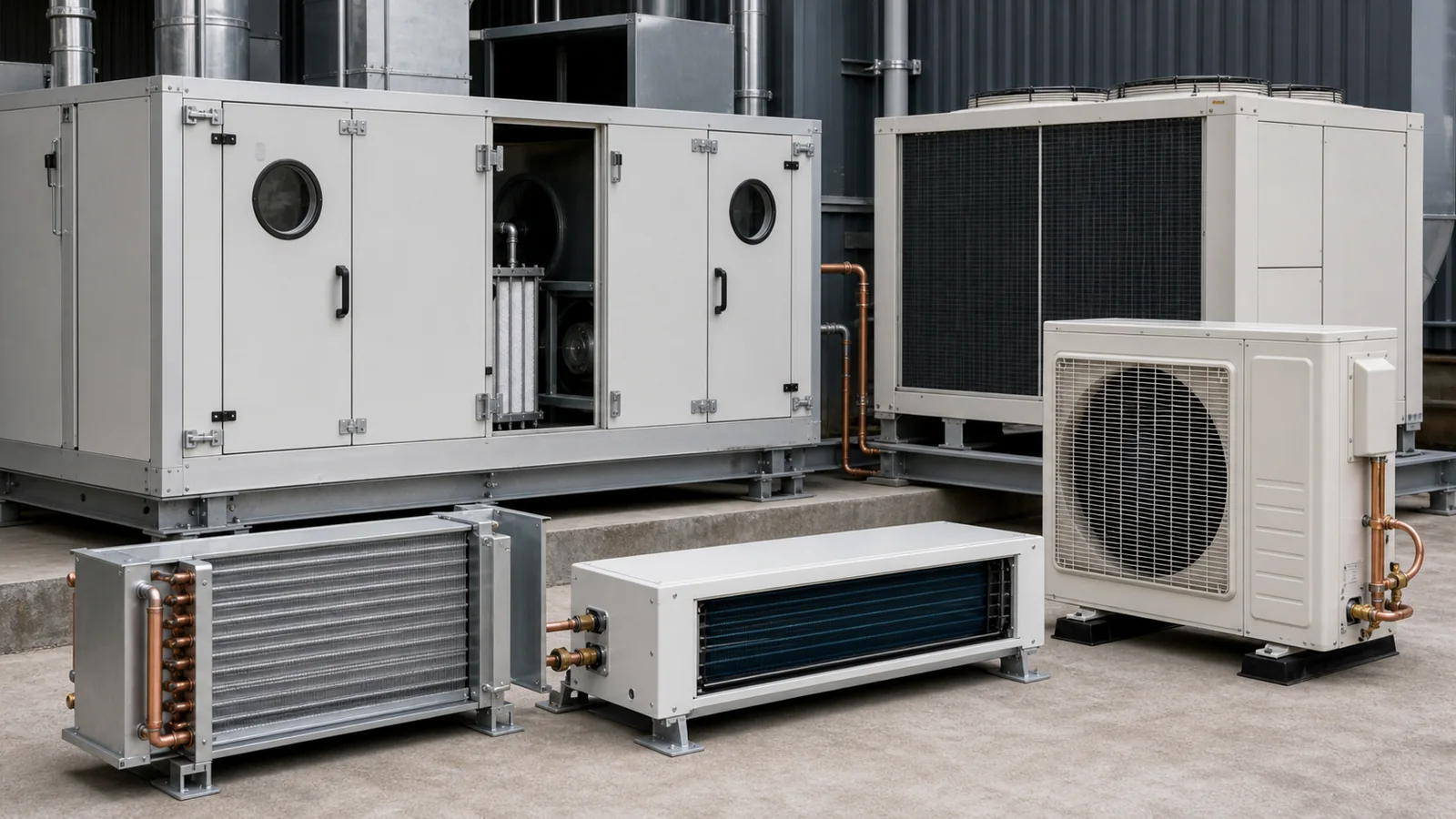
These labels usually appear on floor plans, roof plans, equipment schedules, control diagrams, and submittals. The tag may be followed by a number, such as AHU-2 or RTU-5, to identify one specific unit.
| No. | Symbol | 의미 | Where it appears and what to check |
|---|---|---|---|
| 1 | AHU | Air-handling unit | 필터, 코일, 댐퍼, 팬을 통해 공기를 조화하고 순환시킵니다. 공기 흐름이나 코일 부하를 사용하기 전에 태그를 일정표와 일치시키십시오. |
| 2 | RTU | Rooftop unit | 지붕이나 연석에 설치되는 패키지 유닛. 냉방 방식, 난방원, 외기 요구사항, 전기 데이터 및 연석 배치를 확인하세요. |
| 3 | FCU | Fan coil unit | 방이나 구역을 서비스하는 팬 및 코일 어셈블리입니다. 코일이 냉온수, 온수, 글리콜 또는 냉매를 사용하는지 확인하십시오. |
| 4 | MAU | Makeup air unit | 배기 또는 공정 공기를 대체하기 위한 공기를 공급합니다. 그 부하는 환기 조건보다 실외 설계 조건에 의해 좌우될 수 있습니다. |
| 5 | DOAS | Dedicated outdoor air system | 옥외 환기 공기를 구역 현열 부하와 별도로 처리합니다. 급기 조건, 회수 장치 및 하류 단말 전략을 확인하십시오. |
| 6 | FAHU | Fresh air-handling unit | 외기에 중점을 둔 공기 조화기에 대한 지역 또는 프로젝트별 용어입니다. 범례에서 MAU 또는 DOAS와 동일한지 확인하십시오. |
| 7 | ERV | Energy recovery ventilator | 배기와 외기 기류 간에 현열 및 대개 잠열 에너지를 전달합니다. 회수 유형, 누기 한계 및 결빙 방지 전략을 확인하십시오. |
| 8 | HRV | Heat recovery ventilator | 공기 흐름 간에 현열을 일반적으로 전달합니다. ERV와의 정확한 차이점은 장비 일람표(schedule)에서 확인해야 합니다. |
| 9 | CU | 응축 유닛 | Usually includes a compressor and condenser. CU can be ambiguous, so verify whether the project uses it for condensing unit, control unit, or another item. |
| 10 | ACU | Air-conditioning unit | 범위가 매우 다양하게 적용되는 일반적인 장비 명칭입니다. 분리형, 패키지형, 공랭식 또는 수냉식 중 어떤 방식인지 확인하려면 장비 일람표를 참조하십시오. |
| 11 | HP | 히트 펌프 | Often identifies reversible heating and cooling equipment. Near motors, hp may instead mean horsepower, so capitalization and context matter. |
| 12 | WSHP | Water-source heat pump | 수순환 루프와 열을 교환합니다. 루프 유입수 온도 범위, 수량, 압력 손실 및 응축수 요구 사항을 확인하십시오. |
| 13 | VRF | Variable refrigerant flow | 냉매 유량이 조절되는 멀티존 직접 팽창 시스템입니다. 분기 배관 구성, 등가 배관 길이 및 제조사 규정을 확인하십시오. |
| 14 | VRV | Variable refrigerant volume | VRF 시스템에 자주 사용되는 제조사 관련 명칭입니다. 고유 사양서에서 이 용어들이 상호 호환된다고 가정하지 마십시오. |
| 15 | CRAC | Computer room air conditioner | 활성 냉동 회로가 있는 정밀 냉방 장비입니다. 공기 토출 패턴, 이중화, 습도 제어 및 방열 방식을 확인하십시오. |
| 16 | CRAH | Computer room air handler | 냉수와 주로 연결되는 정밀 공기 조화 장비입니다. 코일 부하, 수온, 팬 제어 및 바닥 하부 또는 상부 토출 방식을 확인하십시오. |
Airside and duct-system abbreviations
Airside codes describe where air came from, where it is going, and how much of it moves through a duct or unit. The same fan can have several airflow values, so distinguish scheduled design airflow from measured or minimum airflow.
| No. | Symbol | 의미 | Where it appears and what to check |
|---|---|---|---|
| 17 | SA | Supply air | 장비나 터미널을 나와 서비스 공간으로 향하는 공조된 공기. 언급된 온도가 코일, 장비 또는 실내 디퓨저에서의 온도인지 확인하십시오. |
| 18 | RA | Return air | 실내에서 장비로 되돌아가는 공기. 반송로는 천장 플리넘, 덕트, 이동 그릴 및 배출 경로를 포함할 수 있습니다. |
| 19 | OA | Outdoor air | 실외에서 시스템으로 유입되는 공기. 설계 온도, 습도, 최소 환기량, 흡기 위치를 확인하십시오. |
| 20 | EA | Exhaust air | Air discharged from a building or process. Do not confuse it with relief air, which may vary with building pressure. |
| 21 | FA | Fresh air | Often means outdoor ventilation air, but some drawings use another definition. The legend should confirm whether FA 및 OA are equivalent. |
| 22 | MA | Mixed air | 코일이나 공기 처리기로 유입되는 외기와 환기의 혼합물. 혼합 공기 상태는 코일 선정의 중요한 입력 요소입니다. |
| 23 | TA | Transfer air | 직접 공급되지 않고 한 공간에서 다른 공간으로 이동하는 공기. 개구부나 덕트에 대한 압력 관계 및 법규 요구 사항을 확인하십시오. |
| 24 | CFM | Cubic feet per minute | 인치-파운드 단위계에서 사용되는 기류 단위. 해당 값이 실제, 표준, 설계, 최소 또는 측정된 기류인지 확인하십시오. |
| 25 | L/s | Litres per second | SI 유도 공기 흐름 단위입니다. 단위 기호는 일반적인 복수형 약어보다 관례를 따르기 때문에 대소문자와 슬래시 배치가 중요합니다. |
| 26 | ACH | Air changes per hour | 실내 풍량을 시간당 실내 부피로 나눈 값입니다. 계산 시 공급, 배기, 외기 또는 재순환 공기 중 어떤 것을 사용하는지 확인하십시오. |
| 27 | FPM | Feet per minute | 덕트, 그릴, 필터 및 코일 면(face) 검사에 사용되는 풍속. 높은 면속도는 압력 손강과 수분 비산에 영향을 미칠 수 있습니다. |
| 28 | ESP | External static pressure | 패키지 유닛 또는 팬 섹션 외부의 저항. 명시된 경계에 어떤 부속품과 덕트 섹션이 포함되어 있는지 확인하십시오. |
| 29 | TSP | Total static pressure | 팬 또는 시스템에 대한 더 넓은 정압 요구 사항. 측정 기준점은 팬 선정과 일치해야 합니다. |
| 30 | VAV | Variable air volume | 풍량을 가변하는 시스템 또는 터미널. 최소 유량, 재가열, 환기 제어 및 소음 한계를 검토하십시오. |
| 31 | CAV | Constant air volume | 설정된 공기 유량을 유지하도록 설계된 시스템 또는 터미널. 공기 온도는 여전히 재설정되거나 단계별로 조절될 수 있습니다. |
| 32 | VCD | Volume control damper | 공기 흐름을 조절하는 데 사용되는 수동 또는 구동식 댐퍼. 블레이드 유형, 크기, 액추에이터, 접근성 및 필수 위치를 확인하십시오. |
Hydronic and water-side abbreviations
Hydronic codes often sit beside piping arrows and equipment connections. Supply and return labels can be defined from the plant’s point of view or the connected unit’s point of view, so follow the flow arrows.
| No. | Symbol | 의미 | Where it appears and what to check |
|---|---|---|---|
| 33 | CHWS | Chilled-water supply | 냉동기 또는 플랜트에서 냉각 코일로 공급되는 물. 코일 성능 정격에 사용되는 실제 공급 온도를 기록하십시오. |
| 34 | CHWR | Chilled-water return | 열을 흡수한 후 플랜트로 돌아오는 물. CHWR과 CHWS의 차이가 필요한 유량을 결정합니다. |
| 35 | HWS | Hot-water supply | 코일이나 말단 장비로 전달되는 난방수. 온도, 글리콜 농도, 제어 밸브 구성을 확인하십시오. |
| 36 | HWR | Hot-water return | Water returning after releasing heat. Low return temperature may affect plant performance and coil sizing. |
| 37 | CWS | Condenser-water supply | 수냉식 응축기로 공급되는 물로, 대개 냉각탑에서 공급됩니다. 냉수 공급과 혼동하지 마십시오. |
| 38 | CWR | Condenser-water return | Water returning from the condenser to the heat-rejection equipment. Check the drawing’s supply and return convention. |
| 39 | EWT | Entering water temperature | 장비 입구에서의 물 또는 글리콜 온도. 유입 공기 조건, 유량 및 유체 농도와 함께 사용하십시오. |
| 40 | LWT | Leaving water temperature | 장비 출구의 유체 온도. 부하, 유량 및 열교환기 성능의 결과입니다. |
| 41 | GPM | Gallons per minute | 인치파운드 단위계에서 부피 기준 물 유량 단위입니다. 갤런이 미국 갤런인지 여부를 명시하고 유체를 식별하십시오. |
| 42 | L/min | Litres per minute | 미터법 체적 유량 단위입니다. 단위를 값에 붙여서 유지하고 비공식적인 약어로 다시 쓰지 마십시오. |
| 43 | ΔT | 온도 차이 | 두 온도 간의 차이입니다. 단순한 델타 값만 나열하는 대신, 입구 및 출구 수온과 같이 지점을 명시하십시오. |
| 44 | ΔP | Pressure difference | 두 지점 간의 압력 손실 또는 차압. 해당 값이 코일, 밸브, 회로 또는 전체 시스템 중 어디에 적용되는지 확인하십시오. |
| 45 | TDH | Total dynamic head | 정의된 시스템의 고도, 압력, 속도 및 마찰 효과를 극복하는 데 필요한 펌프 양정. 계산 경계를 확인하십시오. |
| 46 | PHE | Plate heat exchanger | 일반적인 판형 열교환기입니다. 일정표에는 가스켓형, 브레이즈형, 용접형 또는 기타 구조가 명시되어야 합니다. |
| 47 | BPHX | Brazed-plate heat exchanger | 브레이징 처리된 플레이트로 만든 콤팩트한 열교환기입니다. 유체 적합성, 설계 압력, 오염 위험 및 정비 전략을 확인하십시오. |
| 48 | ET | 팽창 탱크 | 밀폐형 난방/냉수 시스템의 유체 부피 변화를 수용합니다. 연결 지점, 예압, 허용 부피 및 압력 정격을 점검하십시오. |
Refrigeration component abbreviations
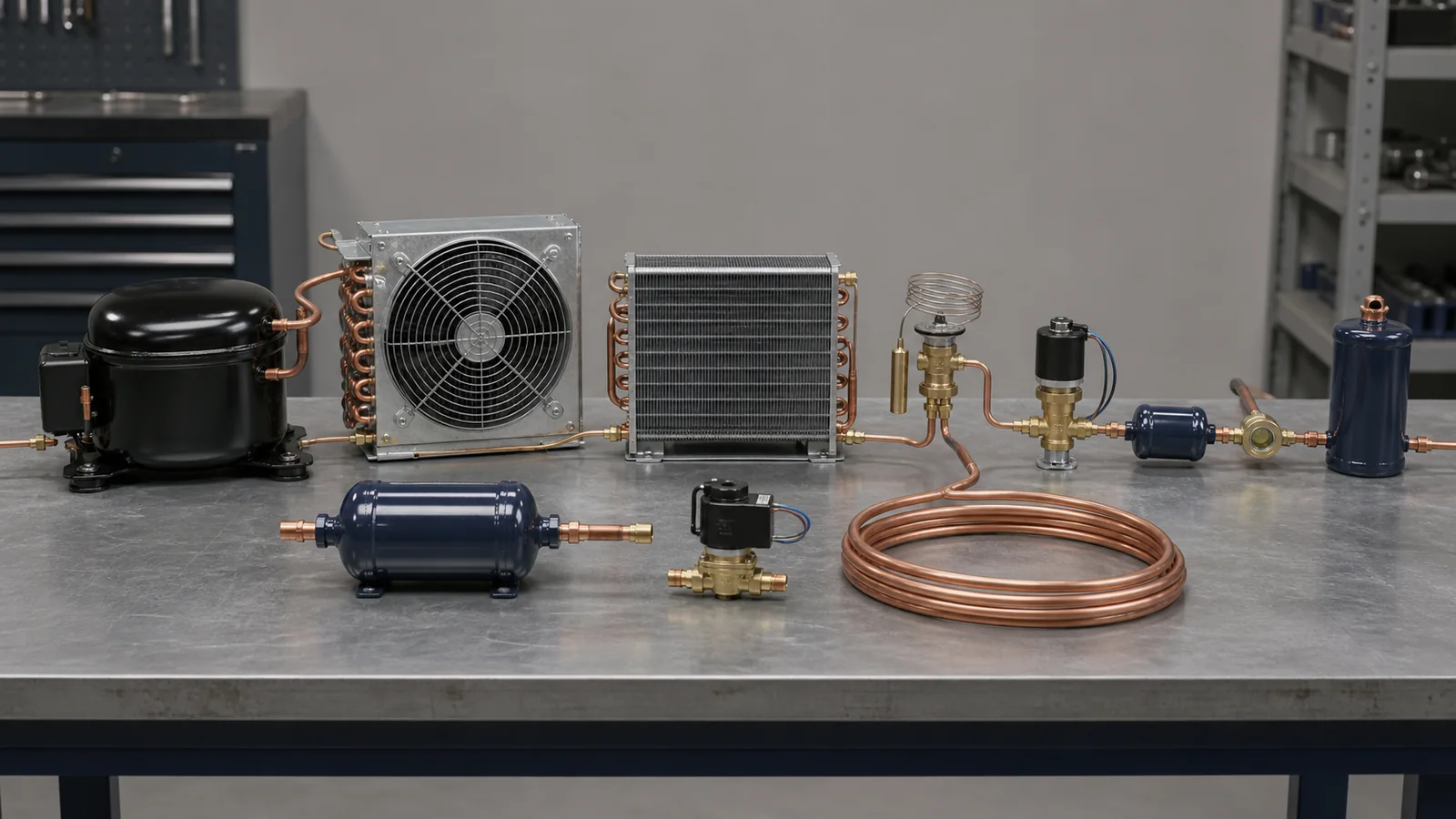
These codes are common on refrigeration schematics, P&IDs, equipment schedules, control sequences, and service documentation. The same component can be drawn with different shapes, but its connected piping often reveals its function.
| No. | Symbol | 의미 | Where it appears and what to check |
|---|---|---|---|
| 49 | COMP | 압축기 | 냉매 증기의 압력과 온도를 상승시킵니다. 냉매, 용량 포인트, 속도 제어, 오일 관리 및 작동 영역을 확인하십시오. |
| 50 | COND | 콘덴서 | 열을 방출하고 냉매를 응축합니다. 이 약어는 코일, 쉘 앤 투브 유닛 또는 완전한 방열부를 지칭할 수 있습니다. |
| 51 | EVAP | 증발기 | 냉매가 증발하면서 열을 흡수합니다. 적용 온도, 공급 방식, 과열도 제어, 성에 및 배수를 점검하십시오. |
| 52 | TXV | 감온식 팽창 밸브 | 온도 감지 요소를 사용하여 냉매를 계량합니다. 냉매, 용량, 균압기, 충전량 및 선택된 과열도 범위를 확인하십시오. |
| 53 | TEV | 감온식 팽창 밸브 | TXV의 대체 약어입니다. 다른 장치로 가정하지 말고 프로젝트나 제조업체의 관례를 일관되게 사용하십시오. |
| 54 | EEV | 전자식 팽창 밸브 | 전자 제어에 따라 냉매를 계량합니다. 드라이버, 스텝 수 또는 신호, 제어 로직, 페일 포지션을 확인하십시오. |
| 55 | LLSV | Liquid-line solenoid valve | 액체 냉매의 흐름을 열거나 닫습니다. 전압, 압력 차이, 흐름 방향, 용량 및 펌프다운 순서를 확인하십시오. |
| 56 | RV | Reversing valve | Redirects refrigerant flow in a heat pump. RV can also mean relief valve, so trace the ports and read the schedule. |
| 57 | F/D | 필터 드라이어 | 냉매 회로에서 이물질과 수분을 제거합니다. 배관 위치, 유량 방향, 크기, 교체형 또는 밀폐형 구조를 확인하십시오. |
| 58 | SG | 사이트 글라스 | 육안으로 상태를 확인할 수 있는 표시기를 제공하며, 대개 수분 감지 소자가 포함되어 있습니다. 거품은 부하, 과냉도, 시스템 상태와 연관지어서만 해석해야 합니다. |
| 59 | LR | 수액기 | 액체 냉매를 저장하고 충전량을 관리하는 데 도움을 줍니다. 용량, 방향, 설계 압력, 밸브 및 적용 가능한 안전 요구 사항을 확인하십시오. |
| 60 | ACC | 흡입 어큐뮬레이터 | 액체 냉매가 압축기로 유입되는 것을 방지합니다. 오일 회수, 압력 강하, 용량 및 방향을 확인하십시오. |
| 61 | O/S | 유분리기 | 토출 가스에서 오일을 분리하여 회수하거나 관리합니다. 회수 방식과 압력 조건이 선정에 영향을 미칩니다. |
| 62 | O/R | 오일 리저버 | 다중 압축기 또는 관리형 오일 시스템에서 분배할 오일을 보관합니다. 레벨 컨트롤, 압력 조절 및 연결 상태를 점검하십시오. |
| 63 | CPR | 크랭크케이스 압력 조절기 | 고부하 조건에서 압축기 흡입 압력을 제한합니다. 설정점, 용량 및 기타 제어 장치와의 상호 작용을 확인하십시오. |
| 64 | EPR | Evaporator pressure regulator | 밸브 상류의 최소 증발기 압력을 유지합니다. 증발기가 서로 다른 온도에서 작동할 때 자주 사용됩니다. |
Refrigerant piping and operating-condition codes
This group contains some of the most consequential labels in a coil selection. A pressure or temperature value without its reference condition can move the design point enough to change circuiting, tube count, and control selection.
| No. | Symbol | 의미 | Where it appears and what to check |
|---|---|---|---|
| 65 | SL | Suction line | 증발기에서 압축기로 저압 증기를 운반합니다. 속도, 오일 회수, 단열, 경사 및 압력 강하를 확인하십시오. |
| 66 | DL | Discharge line | 압축기에서 고압 증기를 운반합니다. 온도, 오일 이송, 진동, 지지대 및 압력 정격을 검토하십시오. |
| 67 | LL | Liquid line | 응축된 액체 냉매를 팽창 장치로 이송합니다. 압력 강하와 열 유입은 가용 과냉도에 영향을 미칩니다. |
| 68 | HGL | Hot-gas line | 제상, 재열, 용량 제어 또는 기타 기능을 위해 뜨거운 토출 가스를 이송합니다. 작동 모드와 제어 방식을 정의하십시오. |
| 69 | SST | Saturated suction temperature | 지정된 냉매의 흡입 측 압력에 해당하는 포화 온도. 측정된 흡입 배관 온도를 대신 사용하지 마십시오. |
| 70 | SCT | Saturated condensing temperature | 응축 측 압력에 해당하는 포화 온도. 혼합물의 경우 이슬점 또는 버블점 기준 중 어떤 것이 사용되는지 명시하십시오. |
| 71 | SH | 과열 | 동일 압력에서의 포화 온도보다 높은 증기 온도. 해당 값이 증발기 출구인지 압축기 입구인지 확인하십시오. |
| 72 | SC | 서브쿨링 | 동일 압력에서의 포화 온도 이하의 액체 온도. 측정 위치와 냉매 기준을 확인하세요. |
| 73 | TD | 온도 차이 | 명명된 두 온도 간의 일반적인 차이. 실내 대 증발기, 공기 대 유체, 또는 기타 프로젝트에서 정의된 한 쌍을 의미할 수 있습니다. |
| 74 | psig | Pounds per square inch, gauge | 현지 대기압을 기준으로 측정된 압력입니다. 프로젝트 표준에 표시된 소문자 단위 형식을 사용하세요. |
| 75 | psia | Pounds per square inch, absolute | 진공을 기준으로 측정된 압력입니다. 열역학적 계산에서 게이지 압력과 상호 교환하여 사용할 수 없습니다. |
| 76 | kPa | Kilopascal | SI 압력 단위입니다. 단위 기호는 복수형으로 쓰이지 않으며, 일반적으로 마침표를 찍지 않습니다. |
| 77 | bar | Bar | 많은 냉동 문서에서 사용되는 압력 단위입니다. 구분이 중요할 때는 게이지 압력인지 절대 압력인지 명시하십시오. |
| 78 | DP | Dew point | The temperature at which vapor begins to condense under the stated condition. DP may also mean differential pressure, so context is essential. |
| 79 | BP | Bubble point | For a refrigerant blend, the condition at which the first bubble of vapor forms from liquid. BP can have other project meanings. |
| 80 | P-T | Pressure-temperature relationship | 냉매 포화 압력과 온도를 연결하는 표 또는 차트입니다. 해당되는 경우 올바른 냉매와 이슬점 또는 거품점 열을 사용하십시오. |
For refrigerant numbering and safety-classification context, use the ASHRAE refrigerant-designation resources. A refrigerant label alone does not define the complete safety, charge, ventilation, or code strategy for an installation.
Psychrometric and performance abbreviations
Air-coil performance depends on both dry-bulb temperature and moisture condition. A coil RFQ that supplies only room temperature may not contain enough information to predict latent capacity, condensate, or leaving-air condition.
| No. | Symbol | 의미 | Where it appears and what to check |
|---|---|---|---|
| 81 | DB | Dry-bulb temperature | 증발식 습구 효과 없이 측정한 일반적인 기온입니다. 습도 정보와 함께 사용하십시오. |
| 82 | WB | Wet-bulb temperature | 증발 냉각의 영향을 받는 온도입니다. 해당 값이 측정값인지, 계산값인지 또는 설계 조건인지 확인하십시오. |
| 83 | RH | Relative humidity | 동일한 온도에서 포화 수증기압에 대한 실제 수증기압의 비율입니다. 기온이 변할 때 함께 변합니다. |
| 84 | h | Specific enthalpy | Energy per unit mass used in psychrometric and refrigeration calculations. Do not confuse lowercase h with an hour symbol in another context. |
| 85 | W | Humidity ratio | Mass of water vapor per mass of dry air. Some documents use w, x, or another symbol, so check the chart legend. |
| 86 | SHR | Sensible heat ratio | Sensible capacity divided by total capacity. It helps describe how a cooling coil divides temperature and moisture removal. |
| 87 | BF | Bypass factor | A model of the fraction of air that behaves as though it did not reach the coil surface condition. It is tied to coil geometry and airflow. |
| 88 | ADP | Apparatus dew point | The effective coil-surface saturation point found by extending the air-conditioning process line. It is a performance model, not one measured spot. |
| 89 | EAT | Entering air temperature | Air temperature at the equipment or coil inlet. State dry-bulb plus wet-bulb, RH, or dew point as needed. |
| 90 | LAT | Leaving air temperature | Air temperature at the equipment or coil outlet. Clarify whether it is coil-off, unit-discharge, or space-supply temperature. |
| 91 | RAT | Return air temperature | Temperature of air returning from the served zone. It can differ from the coil entering condition when outdoor air is mixed in. |
| 92 | SAT | Supply air temperature | Temperature of air delivered by the system. SAT may also be read as saturation temperature in refrigeration notes, so check the sheet type. |
| 93 | COP | Coefficient of performance | Useful heating or cooling effect divided by energy input on a consistent basis. State the operating condition and included auxiliaries. |
| 94 | EER | Energy efficiency ratio | Cooling capacity divided by electrical input at a specified rating condition. Do not compare values measured under different conditions. |
| 95 | SEER2 | Seasonal energy efficiency ratio 2 | A seasonal cooling-efficiency metric for covered equipment under the applicable test procedure. It is not a single design-point coil rating. |
| 96 | HSPF2 | Heating seasonal performance factor 2 | A seasonal heating-efficiency metric for covered heat-pump equipment. Climate and test assumptions differ from a project design point. |
The U.S. Department of Energy explains SEER2 and purchasing requirements for covered central air conditioners. For a custom coil, the thermal duty, air and fluid conditions, pressure-drop limits, and cabinet constraints still need to be stated directly.
Controls, electrical, and point-list abbreviations
Controls drawings connect physical equipment to sensors, commands, alarms, and sequences. A point name can be correct while the device range, signal type, or fail action is still missing.
| No. | Symbol | 의미 | Where it appears and what to check |
|---|---|---|---|
| 97 | BAS | Building automation system | The supervisory control system for building equipment. Define required points, network, trends, alarms, and responsibility boundaries. |
| 98 | BMS | Building management system | Often used similarly to BAS, sometimes with broader facility functions. Follow the project’s definition rather than assuming exact equivalence. |
| 99 | DDC | Direct digital control | Digital control of equipment or systems through programmable controllers. Review sensors, outputs, sequences, and fallback behavior. |
| 100 | PLC | Programmable logic controller | An industrial controller used for machines, skids, or plant processes. Confirm I/O, communications, program ownership, and safety separation. |
| 101 | VFD | Variable-frequency drive | Controls AC motor speed by varying frequency and voltage. Check motor compatibility, enclosure, bypass, harmonics, and minimum speed. |
| 102 | ECM | 전자 정류식 모터 | A motor with integrated electronic commutation, common in fans and pumps. Verify control signal, speed range, and programmed behavior. |
| 103 | PID | Proportional-integral-derivative control | A feedback-control method that responds to current, accumulated, and changing error. Tuning depends on the controlled process. |
| 104 | SP | Setpoint | The target value for a control loop. SP may also mean static pressure, so look at the point name and units. |
| 105 | PV | Process variable | The measured value being controlled or monitored. Confirm sensor location, range, scaling, and units. |
| 106 | AI | Analog input | A continuously varying input to a controller, such as temperature or pressure. In other contexts, AI may have a different meaning. |
| 107 | AO | Analog output | A modulating command from a controller, such as a valve or drive signal. State the signal type and fail response. |
| 108 | DI | Digital input | A discrete status input, such as proof, alarm, or contact state. Define what open and closed mean. |
| 109 | DO | Digital output | A discrete command output, such as start, stop, enable, or relay operation. Confirm interlocks and whether the output is maintained or pulsed. |
| 110 | HOA | Hand-off-auto | A selector that permits manual command, disables the command, or returns control to the automatic sequence. Define where each mode is active. |
| 111 | NC | Normally closed | A contact or valve state under the stated normal condition. The normal condition must be defined as de-energized, unpowered, or another basis. |
| 112 | NO | Normally open | A contact or valve state under the stated normal condition. Verify fail position separately because normal and fail states are not always identical. |
Unit symbols are not ordinary abbreviations
Codes such as AHU 및 TXV are abbreviations. Symbols such as kPa, L/s, 그리고 °C represent units. That distinction changes how they should be written.
다음은 NIST SI style guide explains that unit symbols are mathematical entities. They are normally not pluralized, and they are not followed by a period unless they end a sentence. That is why 20 kPa is correct while 20 kPas is not.
The same discipline helps in an RFQ. Keep the value and unit together, preserve capitalization, and state whether pressure is gauge or absolute. If a schedule mixes inch-pound and SI values, identify which column controls and check the conversion rather than assuming the displayed values are equivalent.
Common symbol conflicts that deserve a second look
| Code | Meaning 1 | Meaning 2 | Safe resolution |
|---|---|---|---|
| HP | 히트 펌프 | Horsepower | Check whether the code is an equipment tag or a motor rating. |
| CU | 응축 유닛 | Control unit or project-specific tag | Trace connected refrigerant piping and match the equipment schedule. |
| RV | Reversing valve | Relief valve | Review port count, line location, and component schedule. |
| DP | Dew point | Differential pressure | Check the units and whether the sheet is psychrometric or controls-focused. |
| SAT | Supply air temperature | Saturation temperature | Check the point list, refrigerant notes, and associated units. |
| SP | Setpoint | 정압 | Read the full point name and measurement location. |
| NC | Normally closed | No cooling or another local shorthand | Read the legend and sequence of operation. |
| OA | Outdoor air | Overall dimension or local shorthand | Check whether the code sits on ductwork or a fabrication detail. |
If a code is still unclear, do not quietly guess. Add a question to the submittal or RFQ, cite the sheet and detail, and ask the responsible party to confirm the intended meaning.
What to include when a symbol list becomes a coil RFQ

A marked drawing is useful, but a buildable coil inquiry needs more than tags. For a replacement or custom HVAC coil, include the following where applicable:
- equipment tag and drawing revision
- coil function, such as evaporator, condenser, chilled-water, hot-water, steam, or heat-recovery duty
- refrigerant or fluid, including concentration where a glycol mixture is used
- entering and leaving air conditions
- entering and leaving fluid conditions
- airflow and allowed airside pressure drop
- fluid flow and allowed fluid-side pressure drop
- total and sensible capacity targets
- saturated suction and condensing conditions for direct-expansion or condenser duties
- superheat or subcooling basis when relevant
- face dimensions, depth, casing limits, tube rows, fin spacing, and connection locations
- material, coating, corrosion exposure, drain-pan, frost, and defrost requirements
- design and test pressure requirements
- quantity, schedule, packaging, and inspection documentation needed
If the old coil is being replaced, add clear photographs, overall dimensions, connection details, circuiting information, and the equipment nameplate. If the project is new, send the design conditions and cabinet constraints before freezing the drawing.
도미의 엔지니어링 역량 page explains the drawing-review path. The 맞춤 코일 제작 및 시험 연구소 pages show the related manufacturing and validation routes. These links do not replace project specifications, but they help route a technical inquiry to the right team.
자주 묻는 질문
하나의 통일된 HVAC 기호 세트가 있나요?
아니요. 많은 기호와 약어가 널리 인식되고 있지만, 그래픽 형태, 태그 형식, 단축 코드는 사무실, 제조사, 소프트웨어 라이브러리, 지역, 프로젝트에 따라 다릅니다. 발행된 도면의 범례와 주석이 해석을 결정합니다.
HVAC 기호와 약어의 차이점은 무엇인가요?
A graphical symbol is a shape or line convention representing a component or function. An abbreviation is a shortened text label such as AHU or TXV. A unit symbol such as kPa is a third category with its own writing rules.
처음으로 HVAC 도면을 어떻게 읽어야 하나요?
표제란, 개정판, 범례 및 장비 일람표로 시작하세요. 그런 다음 소스에서 터미널까지 한 번에 하나의 시스템을 따라가십시오. 화살표와 연결을 추적하고, 태그를 일람표와 일치시키며, 기계, 전기 및 제어 도면을 함께 펼쳐 놓으세요.
왜 같은 약어가 두 가지 의미를 가질까요?
HVAC 도면은 여러 분야를 좁은 공간에 담아냅니다. 하나의 약어가 장비, 제어, 전기 및 공기조화 문맥에서 재사용될 수 있습니다. 단위, 연결부, 도면 유형 및 프로젝트 범례를 통해 이러한 충돌을 대개 해결할 수 있습니다.
냉동에서 SST와 SCT는 무엇을 의미하나요?
SST usually means saturated suction temperature, and SCT usually means saturated condensing temperature. Both depend on the stated refrigerant and pressure reference. They are not the same as measured suction-line or liquid-line temperatures.
교체용 코일 도면과 함께 어떤 정보를 보내야 합니까?
장비 및 코일 태그, 도면 개정 번호, 치수, 튜브 및 핀 세부 정보, 연결 위치, 회로 구성 정보, 자재, 사진, 작동 조건, 압력 강하 한계, 수량을 보내주세요. 도면에 정의되지 않은 약어가 있다면 표시해 주세요.
공급업체가 풍량과 치수만으로 코일 크기를 선정할 수 있습니까?
대개 확신할 수 없습니다. 기류와 외형 치수는 업무의 일부일 뿐입니다. 공급업체는 또한 입출구 공기 조건, 유체 또는 냉매 조건, 용량 목표, 압력 강하 한계, 자재 및 작동 제약 조건이 필요합니다.
냉매 안전 규정은 어디서 확인해야 합니까?
Use the applicable codes, the current ASHRAE refrigerant designation and safety-classification resources, manufacturer documentation, and the authority having jurisdiction. The U.S. EPA SNAP listings are also relevant for allowed-use context in the United States.
Turn the legend into a buildable coil RFQ
A symbol list helps you decode the document. The useful next step is to turn those codes into named conditions, dimensions, materials, and acceptance requirements. A careful drawing review keeps a short label from becoming an expensive assumption.
Send Your Coil Drawing for Review: mark any uncertain tags, attach the current revision and operating conditions, then use the 연락처 페이지 to request a technical review and quotation route.