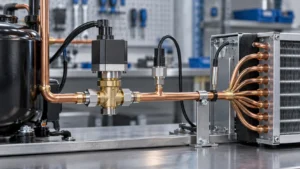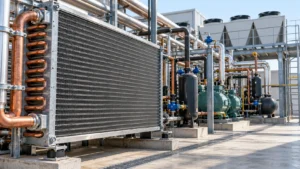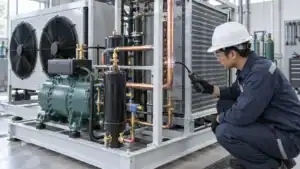

Radiator fins help by adding surface area to the hot tubes, so heat moves into the passing air much faster. More fin area means more convective heat transfer, which means better cooling from the same size core.
Ask “how do the fins help in a radiator” and you’ll get a one-line answer everywhere: “they increase surface area.” True, but that explanation leaves out the interesting part — why surface area matters so much, what the fins are actually fighting against, and why a bent or dirty fin costs you real cooling.
We design and build finned heat-transfer coils, so fins are not an abstraction to us. The same principle that cools a car engine also cools a refrigerator and a walk-in freezer. This guide explains how the fins help in a radiator at the physics level, what the different fin shapes do, what happens when fins get damaged, and how the exact same idea shows up in the condenser and evaporator coils we manufacture. By the end you’ll understand fins well enough to spot a good design from a bad one.
It’s worth saying up front why this question matters beyond curiosity. If you maintain vehicles or cooling equipment, the fins are the part you can actually see, damage, and fix — so understanding them turns a mysterious “it’s running hot” into a checklist. And if you’re specifying or buying a radiator or coil, the fins are where much of the performance and price difference hides. Two cores that look identical from across the room can cool very differently because of what their fins are doing up close.
How Do the Fins Help in a Radiator?
The fins help in a radiator by giving the heat a much larger surface to escape from, so it transfers into the air far faster than from the bare tubes alone.
Here’s the core idea. A radiator carries hot coolant (or refrigerant) through metal tubes. Heat has to get out of those tubes and into the air flowing past. The problem is that bare tube surface touching air is tiny — the tubes are narrow, and air is a poor conductor. Left alone, the tubes can’t shed heat fast enough.
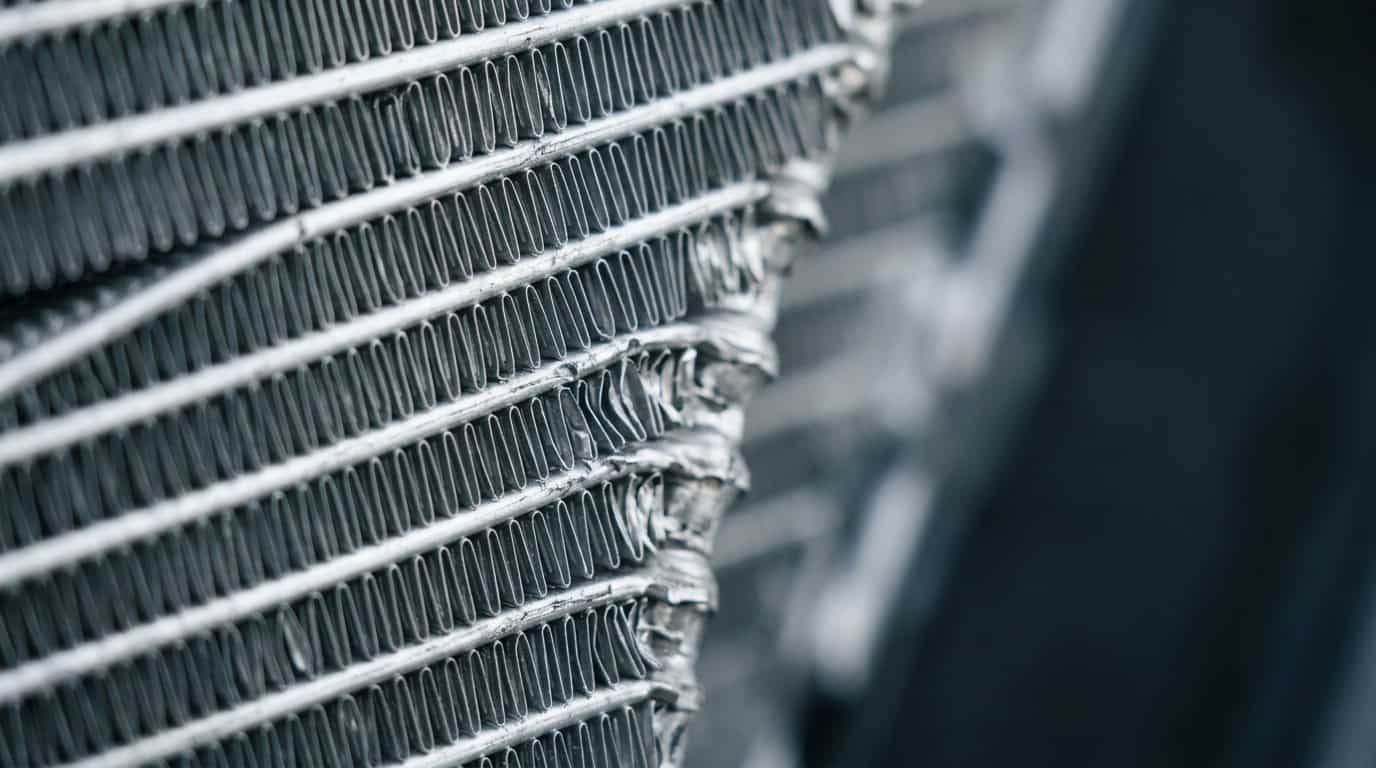
Fins fix this by being thin metal sheets bonded to the tubes. They conduct heat outward from the tube and present a huge area to the air. A typical finned core has many times more air-contact surface than the tubes alone. So the answer to how the fins help in a radiator is really about overcoming a bottleneck: the tubes have plenty of heat to give, the air is willing to take it, and the fins are the bridge that makes the handoff fast enough to matter.
| Without fins | With fins |
|---|---|
| Small tube-to-air surface | Large extended surface |
| Slow heat transfer to air | Fast convective heat transfer |
| Large, heavy core needed | Compact core does the same job |
| Easily overwhelmed under load | Holds temperature under load |
This is why every modern radiator and cooling coil is finned. Drop the fins and you’d need a radiator several times larger to reject the same heat.
Picture the numbers. A bare run of tubing might expose a few hundred square centimeters of surface to the air. Fold thin fins onto those same tubes and the air-contact surface can jump by an order of magnitude, all packed into the same volume. As the general overview at Wikipedia’s radiator article notes, a radiator is fundamentally a device for maximizing surface contact between a hot fluid circuit and the surrounding air — and the fins are how that maximization actually happens. The tubes carry the heat; the fins give it somewhere to leave.
There’s a second effect people miss. Air right against a smooth surface forms a slow, clingy layer — the boundary layer — that insulates the surface from the faster-moving air beyond it. Fins don’t just add area; the better fin shapes also keep disturbing that boundary layer so fresh air keeps reaching the metal. So “how do the fins help in a radiator” has two answers stacked together: more surface, and better contact with moving air across that surface.
The Science: Why Fins Increase Heat Transfer
Fins increase heat transfer by extending the surface where convection happens, attacking the weakest link in the heat path: the tube-to-air boundary.
Heat moves through a radiator in two steps. First, conduction carries heat through the metal — from coolant to tube wall, and out along each fin. Metals conduct well, so this step is rarely the bottleneck. Second, convection carries heat from the metal surface into the moving air. This step is slow, because air has a low heat-transfer coefficient. As the engineering reference at Wikipedia’s article on fins as extended surfaces explains, fins exist specifically to enlarge the convective surface where that slow step happens.
The film coefficient problem
The rate of convective heat transfer depends on three things: the surface area, the temperature difference between metal and air, and a “film coefficient” describing how readily that particular fluid carries heat away. Air’s film coefficient is low. You can’t easily change the temperature difference. So the lever you can pull is area — and that’s exactly what fins multiply. This is the same logic behind a heat sink on a computer chip: when the fluid is air, you win by adding surface.
It’s worth noticing what this means in reverse. If you cooled the tubes with water instead of air, you’d barely need fins at all, because water carries heat away dozens of times faster than air for the same surface. Fins are a response to air specifically being a weak coolant. That’s why water-cooled equipment uses compact bare-tube exchangers while everything air-cooled — radiators, condensers, heat sinks — is covered in fins. Once you see fins as “the fix for air,” the whole design language clicks into place.
Fin efficiency
There’s a catch the simple “more area is better” story misses. Heat has to conduct all the way to the fin tip, and the tip is always slightly cooler than the base because some heat has already left along the way. The fraction of a fin’s area doing useful work is its fin efficiency. Make a fin too tall or too thin and the tip barely contributes — you’ve added metal and airflow resistance for little gain. Good fin design balances height, thickness, and material so most of the fin stays close to base temperature. This is the kind of detail that separates a cheap core from one that actually performs.
Why turbulence helps
The boundary layer we mentioned earlier is the quiet villain of air-side cooling. A smooth, undisturbed airflow builds a thick insulating film along the fin, and heat struggles to cross it. That’s why aggressive fin patterns deliberately trip the air into small-scale turbulence: a churning airflow scrubs the boundary layer thin and keeps fresh, cooler air arriving at the metal. The trade is always the same — more turbulence buys more heat transfer but costs more airflow resistance, so the fan (or vehicle speed) has to push harder. Every fin design is a negotiation between these two. A radiator engineer and a refrigeration coil engineer are both, at heart, managing the same boundary-layer fight.
Types of Radiator Fins (and Coil Fins)
Radiator fins come in several shapes — plate, louvered, wavy, and pin — each trading airflow resistance against heat transfer.
The fin shape is a real engineering decision, not cosmetic. Different patterns disturb the air differently, and disturbing the air is good for heat transfer but bad for airflow resistance. Walk through a parking lot and the radiators behind every grille use different fin patterns for exactly this reason — the designers balanced cooling need against the fan power and the dirt the car would eat.
- Plate (flat) fins — simple continuous sheets. Low airflow resistance, easy to clean, modest heat transfer. Common where airflow is limited.
- Louvered fins — slit and angled to repeatedly break up the air boundary layer. Much higher heat transfer, standard in automotive radiators, but they clog and bend more easily.
- Wavy / corrugated fins — gently undulating to extend the air path and add turbulence without the fragility of louvers. A common middle ground.
- Pin fins — individual posts instead of sheets, used where airflow comes from many directions or in compact electronics cooling.
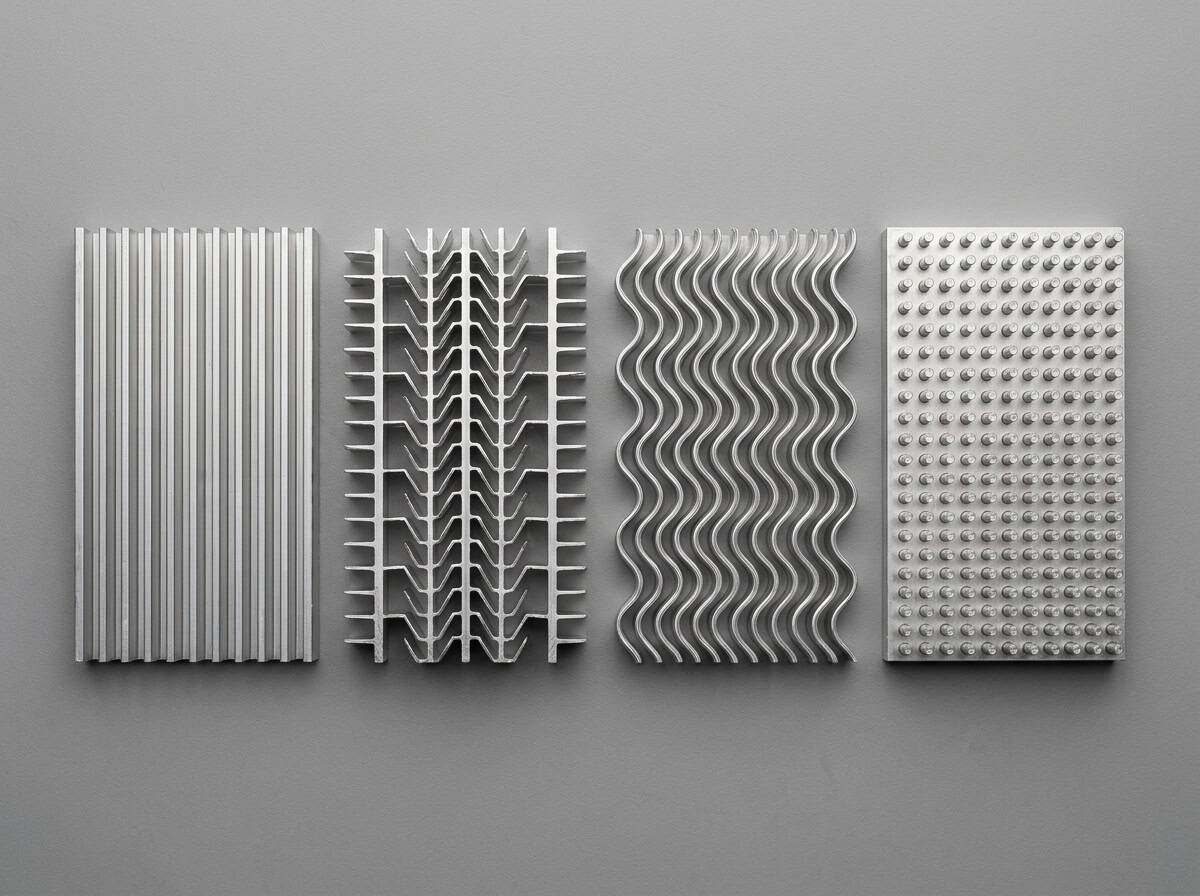
Here’s how the common fin types trade off, which is exactly the decision we weigh when designing a coil:
| Fin type | Heat transfer | Airflow resistance | Durability / cleaning |
|---|---|---|---|
| Plate (flat) | Moderate | Low | Easy to clean, robust |
| Louvered | High | Higher | Bends and clogs easily |
| Wavy / corrugated | High | Moderate | Reasonable balance |
| Pin | Varies | Varies | Niche / multidirectional |
The right fin depends on the duty. A dusty industrial environment argues for flatter, more open fins that resist fouling; a clean, airflow-rich automotive application can exploit aggressive louvers.
There’s also a manufacturing dimension behind these shapes. Louvered and wavy fins are stamped or rolled in high volume, which is why they dominate mass-produced radiators and coils. Pin fins and exotic geometries cost more to make and are reserved for cases where their performance pays for itself. When we quote a coil, the fin type is partly a thermal decision and partly a question of how the fin will be produced, bonded to the tubes, and survive shipping and service. A fin that performs brilliantly in a simulation but crushes the first time someone leans a ladder against it isn’t a good fin for the real world.
Fins in Radiators vs Refrigeration Coils
The fins help the same way in a radiator and a refrigeration coil — extending surface for air-side heat transfer — but the operating temperatures and the fluid inside differ.
This is where our world and the automotive world meet. A car radiator rejects engine heat to air. A refrigeration condenser coil rejects refrigerant heat to air. Both rely on fins for exactly the same reason: the air side is the bottleneck, so you add fin area to overcome it. The physics is identical.
The differences are practical. A radiator runs hot — coolant well above ambient — so the temperature difference driving heat transfer is large. A refrigeration condenser runs closer to ambient, so it needs more fin area to move the same heat. And an evaporator coil faces the opposite problem: it’s colder than the air, absorbing heat, and its fins can frost up — which a radiator never does. That frost risk changes fin spacing decisions entirely; pack the fins too tight on a freezer evaporator and ice bridges them shut.
So when someone asks how the fins help in a radiator, the honest expert answer is “the same way they help in any air-side heat exchanger — and the design just shifts with the temperatures and the fluid.” It’s why coil engineering and radiator engineering share a textbook. Our finned coil products apply the same extended-surface principle, tuned for refrigerants and freezing duty instead of engine coolant.
Consider a concrete contrast. An engine radiator might see coolant at 90–100 °C against ambient air near 30 °C — a 60-degree-plus gap that drives heat out fast, so the fins can be relatively open. A refrigeration condenser might condense refrigerant only 10–20 degrees above ambient, a far smaller gap, so it needs noticeably more fin area to reject the same amount of heat. Now flip to the evaporator, which sits below ambient and pulls heat in. Its fins must do the same surface-area job while staying clear of the frost that forms whenever a cold fin drops below the dew point. That single difference — frost — is why a freezer evaporator uses wider fin spacing than a condenser of similar capacity, even though the underlying “fins add surface” logic is identical. Understanding that lets you read any finned core and predict roughly what it was built for.
What Happens When Fins Are Damaged or Dirty
Damaged or dirty fins cut heat transfer fast, because they reduce the effective surface area and block the airflow the fins depend on.
This is the most practical part of the fins question, and it answers two of the most common follow-ups: what happens if you damage radiator fins, and can bent fins cause overheating. The short answer to both: yes, it matters.
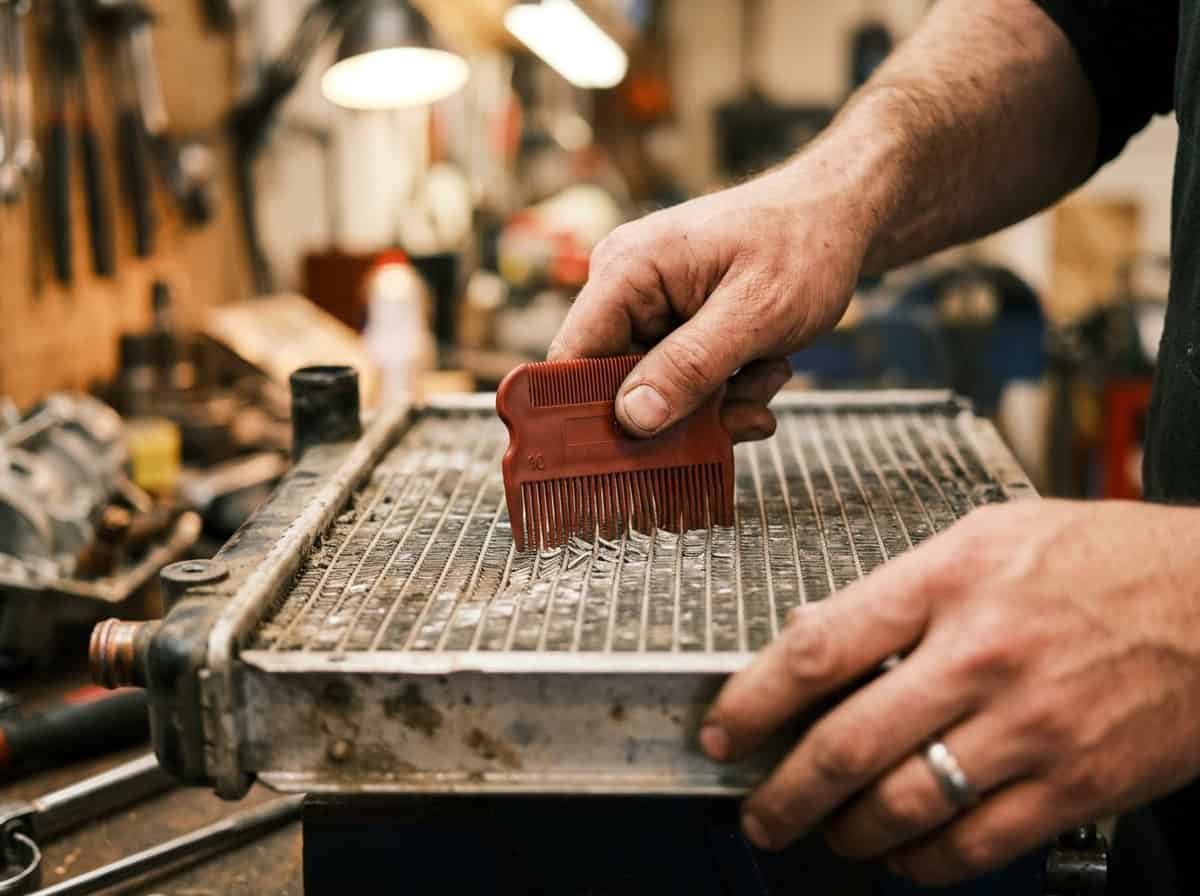
- Bent fins — flattened or folded fins block the air channels between them. Air takes the path of least resistance and skips the blocked section, so that area stops transferring heat. Enough bent fins and the radiator runs hot under load. A fin comb straightens them and restores the channels.
- Dirt, bugs, and debris — a fouled fin pack is like a partially blocked filter. Airflow drops, and with it heat transfer. We’ve measured significant temperature rises on coils that looked only “a bit dusty.” Cleaning the fins often fixes an “overheating” complaint with no other repair.
- Corrosion — corroded fins lose contact with the tube and conduct poorly, or crumble away entirely, permanently reducing area. Coastal and chemical environments accelerate this, which is why fin coatings exist.
Corrosion deserves a closer look because it’s the damage you can’t comb out. Salt air, industrial fumes, and even certain cleaning chemicals eat aluminum fins over time. The first sign is usually a white powdery bloom; later the fin material weakens and flakes, and the bond between fin and tube degrades. Once that happens the lost surface area is gone for good — you’re replacing the core, not repairing it. That’s why, on coils headed for harsh environments, we specify protective coatings or alternative materials from the start. It’s far cheaper to coat the fins up front than to replace a corroded core every couple of years. The fins help in a radiator only as long as they physically survive, and in tough conditions survival is a design choice, not luck.
Expert tip: Before blaming a water pump, thermostat, or refrigerant charge for overheating, look at the fins. A blocked or bent fin pack mimics almost every cooling fault, and it’s the cheapest thing to rule out.
Here’s the inspection order we use when cooling drops off and the fins are suspect:
- Eyeball the fin pack in good light. Look for flattened bands, debris mats, and corrosion bloom. Damage is usually visible.
- Check airflow by feel across the whole face — cold or dead spots reveal blocked sections.
- Comb out bent fins gently with the correct fin-comb pitch; forcing the wrong pitch tears them.
- Wash fouling with low-pressure water or coil cleaner from the clean side outward, never high-pressure that folds the fins flat.
- Re-measure temperatures or pressures afterward. Restoring the fins often restores the cooling with no other repair.
The lesson from the field is consistent: fins are the part most exposed to physical and environmental damage, and they’re also the part whose damage shows up directly as lost cooling. Protect the fins and you protect the whole system’s capacity. It’s striking how often a “failing” radiator or coil is really just a fin pack that needs combing and a wash.
Fin Design Tradeoffs: Density, Material & Spacing
Fin design balances density, material, and spacing — more fins add area but resist airflow and trap dirt, so the best spacing depends on the duty.
Fin design is where the theory becomes a real, manufacturable part, and it’s full of competing pressures. Push one lever and another pushes back. The art is finding the combination that performs for a specific airflow, fluid, and environment rather than chasing a single “best” number. A few levers decide how well the fins help in a radiator or coil:
- Fin density (fins per inch). More fins mean more area and more heat transfer — up to a point. Pack them too tight and airflow resistance climbs, fouling accelerates, and on a cold coil, frost bridges the gaps. We typically open up fin density for dirty or freezing environments and tighten it where air is clean and abundant.
- Fin material. Aluminum dominates for its conductivity-to-weight-to-cost balance. Copper conducts better but costs and weighs more. The material sets how efficiently heat reaches the fin tip.
- Fin thickness. Thicker fins conduct heat to the tip better (higher fin efficiency) but add weight, cost, and airflow blockage. Thin fins are cheaper and lighter but waste tip area.
- Tube-to-fin bond. Heat has to cross from tube to fin. A loose or corroded bond throttles the whole path no matter how good the fins are. Mechanical expansion, brazing, or bonding quality matters as much as fin shape.
According to a peer-reviewed study on automotive cooling published through the US National Library of Medicine, optimizing fin geometry and material can measurably raise a radiator’s heat-rejection performance without enlarging the core — confirming that the fins, not just the tubes, set the ceiling on cooling. That matches our bench experience: change the fin design and you change the capacity, full stop.
The common mistake we see is treating fins as a free upgrade — “add more fins, get more cooling.” It doesn’t work that way past a point. Beyond an optimal density the extra fins choke airflow more than they add useful surface, and on a cold coil they invite frost that wipes out the gain entirely. The other frequent error is ignoring the tube-to-fin bond: a beautiful fin pack that’s loosely attached to the tubes conducts heat poorly and underperforms a humbler design with a tight bond. Fins help in a radiator only when the whole path — tube, bond, fin, airflow — is right. Optimizing one link while ignoring another is how good intentions produce mediocre coolers.
Future Trends (2026 & Beyond)
Fin technology is advancing toward microchannel cores, enhanced surfaces, and corrosion-resistant coatings that pack more heat transfer into less metal.
The basic principle — fins extend surface to beat the air-side bottleneck — won’t change. But how fins are made keeps improving, and the pressure to do more with less metal has only grown as low-charge flammable refrigerants and weight-conscious vehicles spread. As of early 2026:
- Microchannel cores replace round tubes and traditional fins with flat tubes and tightly integrated louvered fins, cutting weight and the refrigerant or coolant charge while raising performance.
- Enhanced and textured fin surfaces add micro-features that disturb the air boundary layer for more heat transfer at the same size.
- Advanced coatings protect fins against corrosion and fouling, extending the working life of the fin area in harsh environments.
- Better aluminum alloys improve conductivity and formability so thinner, lighter fins keep high fin efficiency.
| Trend | What it improves | Why it matters |
|---|---|---|
| Microchannel cores | Weight, charge, compactness | More cooling per gram of metal |
| Enhanced fin surfaces | Air-side heat transfer | More capacity, same footprint |
| Anti-corrosion coatings | Fin lifespan | Capacity survives harsh duty |
| Improved alloys | Fin efficiency | Thinner fins, same performance |
As Britannica’s overview of heat transfer notes, convection at a surface is governed by area and the fluid’s properties — so as long as we cool things with air, the fin will stay central. The innovation is in squeezing more effective surface and better airflow out of less material.
For anyone specifying equipment, the practical implication is that fin design is no longer a detail to leave to chance. The shift toward microchannel and enhanced-surface cores means two coils with the same face dimensions can differ substantially in capacity depending entirely on their fins. When we engineer a coil, the fin choice is one of the first decisions, not the last — because it sets how much the rest of the design can achieve. The tubes and the fan matter, but the fins are where most of the air-side performance is won or lost, exactly as they are in a radiator.
FAQ
How do the fins help in a radiator, in one sentence?
Fins add surface area to the hot tubes so heat transfers into the passing air much faster. The tubes alone touch too little air; the fins act as a bridge that multiplies the air-contact surface, which is the key to fast convective cooling.
Are radiators with fins more efficient?
Yes, dramatically. A finned radiator rejects far more heat than bare tubes of the same size because the fins multiply the surface where heat meets air. Without fins you’d need a much larger, heavier core to match the cooling, which is why effectively every radiator is finned.
What happens if you damage radiator fins?
Damaged fins lose cooling capacity. Bent fins block airflow channels so that section stops transferring heat, and crushed or corroded fins lose effective surface area. Enough damage causes overheating under load. A fin comb can straighten bent fins and restore most of the lost airflow.
Can bent radiator fins cause overheating?
Yes. Bent fins block the air gaps the radiator relies on, so airflow and heat transfer drop in those areas. A small patch is harmless, but widespread bent or blocked fins can push temperatures up under heavy load. Straightening them with a fin comb usually restores performance.
Why are radiator fins made of aluminum?
Aluminum balances good thermal conductivity, low weight, low cost, and easy forming. Copper conducts heat better but is heavier and pricier. For the thin, mass-produced fins a radiator needs, aluminum’s combination of properties wins almost every time.
Do refrigeration coils use fins the same way as radiators?
Yes, the principle is identical — fins extend surface for air-side heat transfer. The difference is the fluid and temperatures: a refrigeration condenser or evaporator runs near or below ambient, so fin spacing and frost management differ, but the fins help for exactly the same reason.
How many fins per inch is best?
It depends on the duty. Clean, high-airflow applications can use dense fins for maximum area; dusty or freezing environments need more open spacing to resist fouling and frost. There’s no universal number — the best fin density balances heat transfer against airflow and cleaning for that specific use, which is why a reputable coil maker asks about your environment before quoting a fin count.
Conclusion
So, how do the fins help in a radiator? They solve the air-side bottleneck. Heat has no trouble reaching the tube walls, and the air is ready to carry it away — the fins are the high-surface-area bridge that makes the handoff fast enough to keep things cool. Get the fin shape, density, material, and bond right and a compact core does the work of a much larger one. Bend, foul, or corrode those fins and the cooling drops just as fast.
Keep three things in mind and you’ll never be confused by a finned core again. First, the fins exist to beat the slow air-side step, not the metal. Second, the best fin is a balance — enough area and turbulence to move heat, but not so much that airflow chokes or frost bridges the gaps. Third, fins only help while they’re intact, clean, and well bonded to the tubes; a damaged fin pack is lost capacity you can often recover with nothing more than a comb and a wash.
That principle is the foundation of every air-cooled heat exchanger we build, from finned condenser coils to evaporators. If you’re specifying a coil and want the fin design matched to your airflow, fluid, and environment — clean or dusty, ambient or freezing — that’s exactly the engineering we do. Start at our products overview or talk to our thermal engineers.