
Coil Manufacturing Process for Custom Refrigeration Coils

Domi Refrigeration supports custom coil manufacturing for OEM refrigeration, HVAC and industrial cooling equipment. The workflow covers fin stamping, tube forming, fixture-based assembly, brazing or other joint processing, leak testing, visual inspection and export packaging. Send a drawing, sample photo or existing coil data so the team can review fit, materials, circuiting, testing and packaging requirements before quotation or prototype work.

SUPPLIER TRUST

What to Compare When Choosing a Coil Manufacturing Supplier

When buyers compare coil manufacturing suppliers, the useful questions are practical: Can the supplier review your drawing or sample? Which tube, fin and header materials fit the duty? How will circuiting, joints, leak testing and inspection documents be handled? How will the finished coil be protected in transit? Domi’s process gives engineering and procurement teams a place to review these inputs before production. The process visuals are illustrative; confirm site-specific equipment, materials, inspection records and commercial terms for the project.

Dimensional Variation

Problem: Small differences in fin pitch, tube position or mounting dimensions can affect assembly and equipment performance.
Solution: Controlled fin stamping, tube forming and fixture-based assembly help reduce fit-up risk for OEM and replacement projects.

Brazing or Welding Instability

Problem: Unstable brazing, welding or joint quality can lead to leakage, weak connections or inconsistent product reliability.
Solution: Brazing process control, temperature curve review and joint inspection help improve manufacturing consistency.

Leakage Risk

Problem: Leakage in refrigeration coils or heat exchangers can cause equipment failure, warranty claims and project delays.
Solution: Leak testing, pressure review and project-specific inspection steps help identify leakage risk before shipment.

Transport Damage

Problem: Fins, tubes, headers and connection points may be damaged if export packaging is not planned correctly.
Solution: Packaging review, carton or pallet protection and product-specific support structures help reduce damage during international shipping.

WORKFLOW

From Raw Material to Finished Coil Assembly

01

Material Preparation

Prepare copper tubes, aluminum fins, steel wire, plates, headers, fittings or other materials according to the product structure and project requirements.

02

Fin Stamping and Tube Processing

Use fin stamping, tube cutting, bending, expanding or forming processes to prepare the core heat exchange structure.

03

Assembly and Fixture Positioning

Assemble fins, tubes, headers, plates or wire structures using fixtures to support dimensional consistency.

04

Brazing, Welding or Joint Processing

Apply the appropriate joint process according to material, structure and application requirements.

05

Leak Testing and Visual Inspection

Inspect dimensions, appearance, joint areas, leakage performance and surface condition before packaging.

06

Packaging and Export Preparation

Protect fins, tubes, connection points and coated surfaces with suitable packaging for shipment.
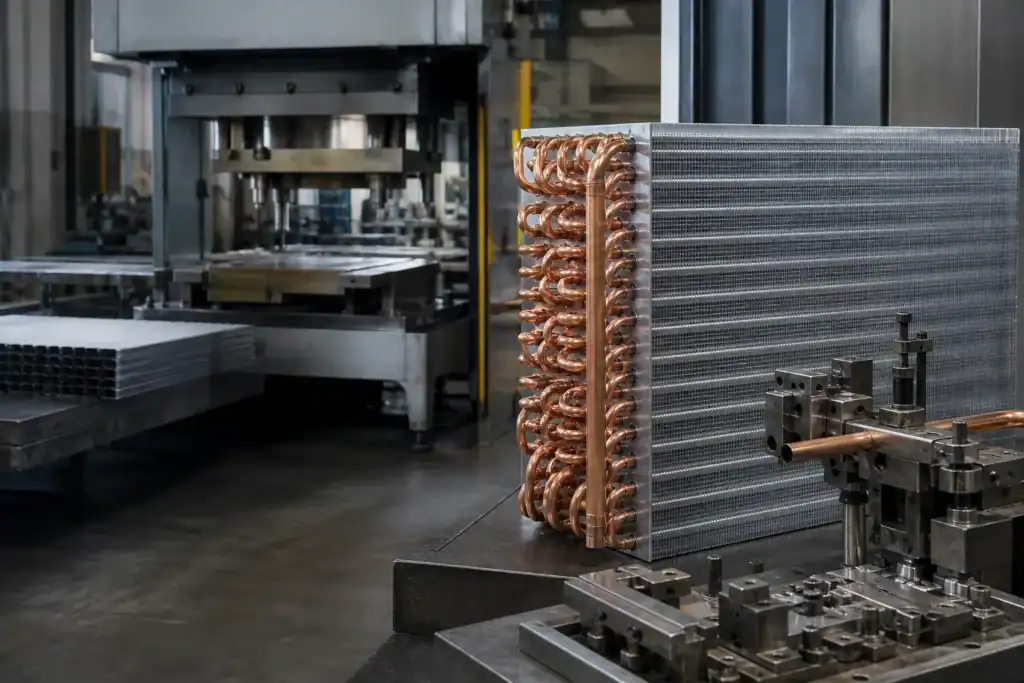
Industrial refrigeration unit with copper coils in a manufacturing facility.

FIN STAMPING

Fin Stamping Precision for Stable Heat Transfer

Fin geometry affects airflow resistance, heat exchange area and coil consistency. Controlled fin stamping helps maintain fin pitch, hole position, edge quality and repeated production stability for HVAC coils, evaporator coils, condenser coils and industrial heat exchangers.

Fin Pitch Consistency

Consistent fin pitch supports stable airflow and predictable heat transfer performance.

Hole Position Accuracy

Accurate tube hole positioning helps improve tube insertion, expansion and assembly alignment.

Batch Repeatability

Repeatable fin stamping supports OEM production and long-term supply consistency.

BRAZING CONTROL

Brazing Furnace Temperature Curve Control
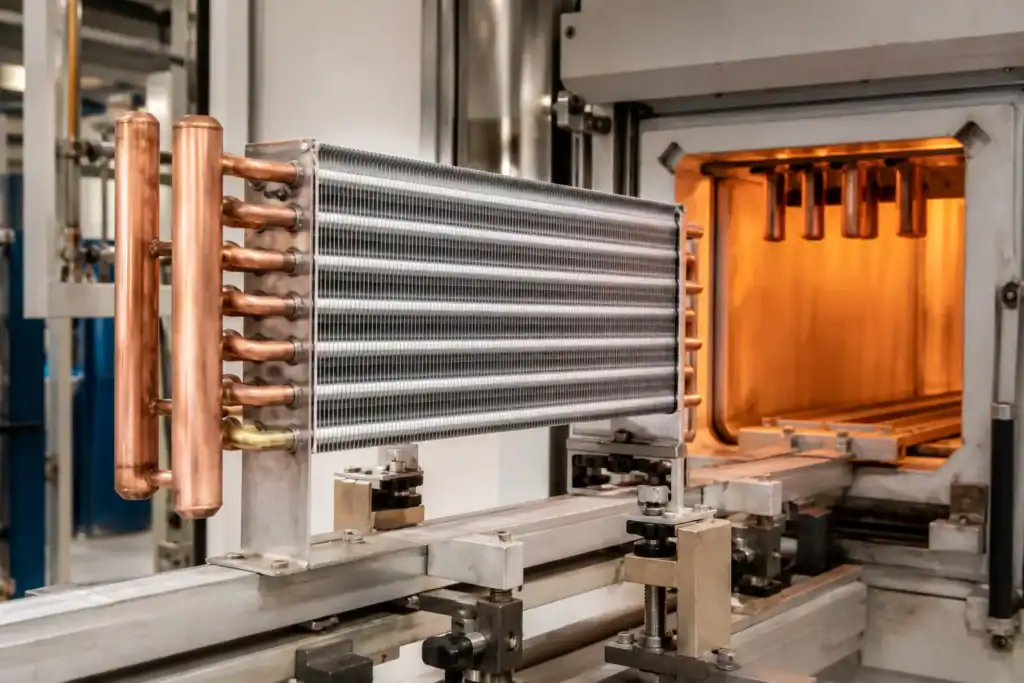
Brazing quality directly affects joint strength, leakage resistance and long-term product reliability. Furnace temperature curve control helps stabilize heating, soaking and cooling conditions during brazing or joint processing.
Commercial refrigeration system with copper pipes and cooling coils.

Heating Zone

Controlled heating helps reduce thermal shock and prepares the assembly for stable brazing.

Soaking Zone

The soaking stage helps maintain temperature uniformity across the heat exchanger assembly.

Brazing Zone

The brazing zone should be controlled according to material, filler metal and joint structure.

Cooling Zone

Controlled cooling helps reduce deformation risk and supports consistent product quality.

LEAK TESTING

Helium Mass Spectrometer Leak Testing Workflow

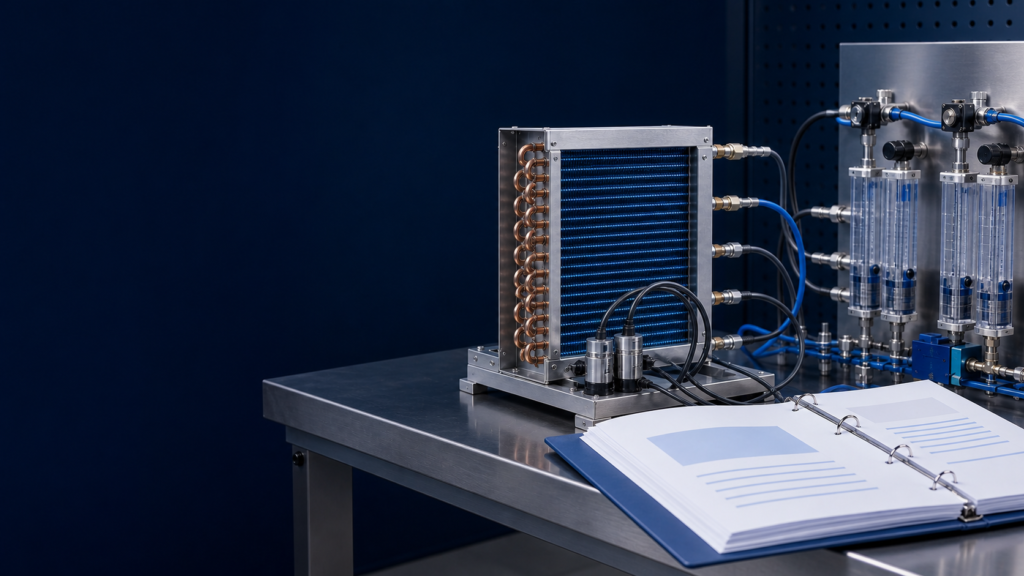
Leak testing is one of the most important quality control steps for refrigeration coils, condensers, evaporators and heat exchangers. Helium mass spectrometer leak testing may be used for applications requiring high leak detection sensitivity, depending on project requirements and available equipment.

Helium Leak Testing Workflow

Thermal performance testing report template for custom heat exchanger projects

Sealing and Connection Preparation

The product is connected to the test setup according to the coil or heat exchanger structure.

Pressure or Vacuum Preparation

The test condition is prepared according to the selected leak testing method and project requirement.

Helium Detection Process

Helium detection can help identify small leakage points in joints, tubes or connections where required.

Test Record and Review

Test data or pass/fail records may be documented according to customer requirement and inspection plan.

VISUAL QC

Visual Inspection and Batch Quality Control
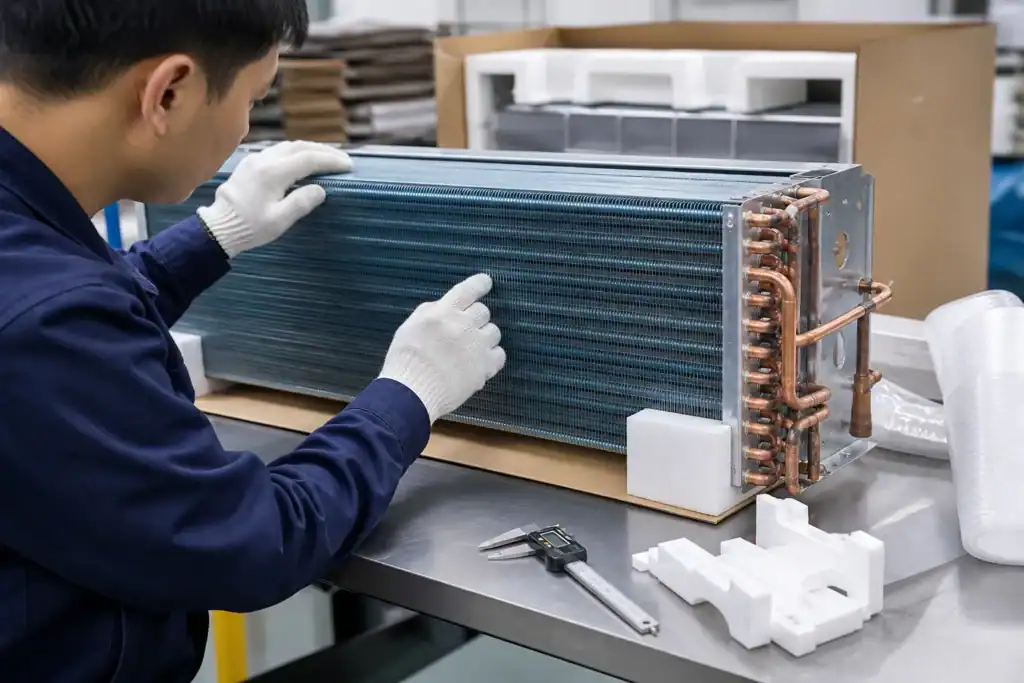
Visual inspection can support batch consistency by checking surface appearance, fin damage, tube position, connection areas, coating condition and packaging-related risks. Automated visual inspection should be claimed only when real equipment and process data are verified.
Technician inspecting a commercial refrigeration coil for optimal performance.

Surface Appearance

Checks visible defects, stains, scratches, coating issues or surface inconsistency.

Fin and Tube Alignment

Reviews whether fins, tubes and coil structures are properly aligned.

Joint and Connection Area

Inspects brazed, welded or connected areas for visible quality issues.

Packaging Risk Check

Confirms whether fins, tubes and connection points need additional protection before shipment.

QUALITY CONTROL

Quality Checkpoints Across the Manufacturing Process

Incoming Material Review

Reviews materials before production.

Buyer Value: Helps reduce material mismatch and surface defect risk before production.

Fin Stamping Check

Checks fin pitch, holes and edge quality.

Buyer Value: Supports fin pitch, hole position and batch repeatability.

Tube Forming Review

Reviews bending, forming and connection areas.

Buyer Value: Helps reduce deformation, incorrect bending and connection mismatch.

Assembly Fixture Check

Checks product positioning during assembly.

Buyer Value: Supports dimensional consistency and installation fit-up.

Brazing / Welding Inspection

Reviews joint areas after processing.

Buyer Value: Helps reduce joint instability and leakage risk.

Leak Testing

Reviews pressure, vacuum or helium testing needs.

Buyer Value: Supports product reliability before shipment.

Appearance Inspection

Checks visible condition and handling risks.

Buyer Value: Helps identify visible defects, fin damage and handling issues.

Packaging Inspection

Reviews cartons, pallets, crates and supports.
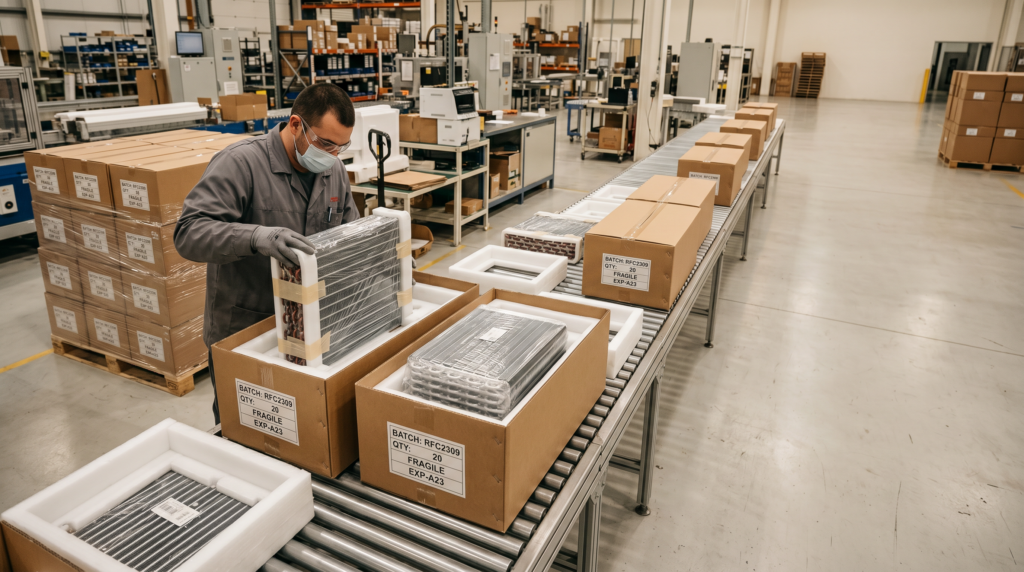
Buyer Value: Helps protect products from deformation during export transport.
Export packaging and batch production for residential refrigeration coils

EXPORT PROTECTION

Packaging Protection for Fins, Tubes and Connection Points

Export packaging is part of manufacturing reliability because fins, tubes, headers and connection areas can be damaged after production if packaging is not planned around the product structure.

Fin Protection

Fins are easily deformed during handling and shipment. Packaging should reduce pressure on exposed fin surfaces.

Tube and Header Protection

Tubes, headers and connection points require protection against impact, bending and vibration.

Carton, Pallet or Crate Planning

Packaging method should be selected based on product size, weight, quantity, transport route and destination.

Labeling and Handling Guidance

Clear labels, orientation marks and handling instructions help reduce damage risk during export logistics.

PROJECT REVIEW

What Information Helps Us Review Your Manufacturing Requirement?

Clear drawings, sample photos and operating details help the engineering and production team evaluate coil structure, process route, testing plan and export packaging before quotation or sample development.

INTERNAL PATHS

Related Manufacturing and Quality Paths

Custom coil fabrication

Internal path for buyers evaluating custom coil fabrication.

Engineering capabilities

Internal path for buyers evaluating engineering capabilities.

Testing laboratory

Internal path for buyers evaluating testing laboratory.

Quality certifications

Internal path for buyers evaluating quality certifications.

Heat exchanger manufacturing process

Internal path for buyers evaluating heat exchanger manufacturing process.

Commercial refrigeration solutions

Internal path for buyers evaluating commercial refrigeration solutions.

HVAC and heat pump solutions

Internal path for buyers evaluating HVAC and heat pump solutions.

Industrial refrigeration solutions

Internal path for buyers evaluating industrial refrigeration solutions.

Contact Domi manufacturing team

Internal path for buyers evaluating contact Domi manufacturing team.

BUYER CONFIDENCE

Why Buyers Trust Domi's Manufacturing Process

The page uses cautious B2B manufacturing language and avoids publishing exact tolerance, fixed testing ratio, exact defect rate, fixed capacity, certified automation, full traceability or guaranteed lead time until the client provides confirmed documentation.

FAQ

Manufacturing Process FAQ

The coil manufacturing process may include material preparation, fin stamping, tube cutting and forming, assembly, brazing or welding, leak testing, visual inspection and export packaging.
Fin stamping precision affects fin pitch, tube hole position, airflow resistance and heat transfer consistency. Stable fin production supports better coil performance and assembly fit-up.
Brazing furnace temperature curve control refers to managing heating, soaking, brazing and cooling stages during the brazing process to support joint consistency and reduce quality variation.
Domi can review leak testing requirements based on product structure and customer specifications. If 100% helium leak testing is required, this must be confirmed with project and factory capability documents.
Please provide product type, drawings, dimensions, tube material, fin material, refrigerant or working fluid, pressure requirement, quantity, testing requirement and packaging requirement.
Domi can review old sample photos, dimensions, connection positions and application requirements to evaluate whether custom coil reproduction or replacement support is feasible.
Visual inspection helps identify surface defects, fin damage, tube alignment issues, joint problems and packaging risks before shipment.
Refrigeration coils should be packed to protect fins, tubes, headers and connection points from deformation, scratches and impact during transport. Packaging depends on size, weight, quantity and destination.
Domi can review OEM/ODM coil projects based on drawings, samples, specifications, quantity, testing requirements and packaging needs.
Yes. Buyers can contact Domi to request available manufacturing process photos, inspection information or project-specific documentation, subject to availability and client approval.

REQUEST REVIEW

Need a Reliable Manufacturing Partner for Custom Coils or Heat Exchangers?

Send your drawing, sample photo, product type, dimensions, material requirements, testing requirements and quantity. Domi Refrigeration can help review your coil manufacturing process, quality control needs and export packaging requirements.

Send an Inquiry

Send your drawing, sample photo, material, quantity and inspection requirements for a manufacturing feasibility review.

REQUEST A QUOTE
Scroll to Top
REQUEST A QUOTE