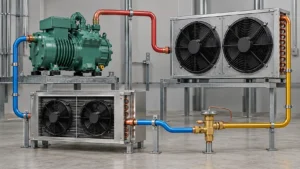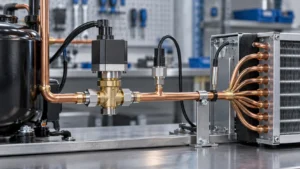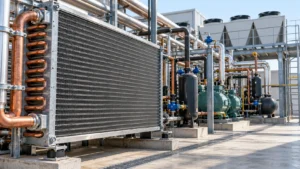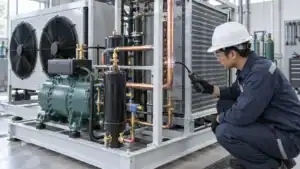

A condensing unit is the outdoor or remote section of a cooling system. It houses the compressor, condenser coil, and fan, and its job is to compress refrigerant and reject heat so the refrigerant can cycle back inside to absorb more — used in central AC, heat pumps, and commercial refrigeration alike.
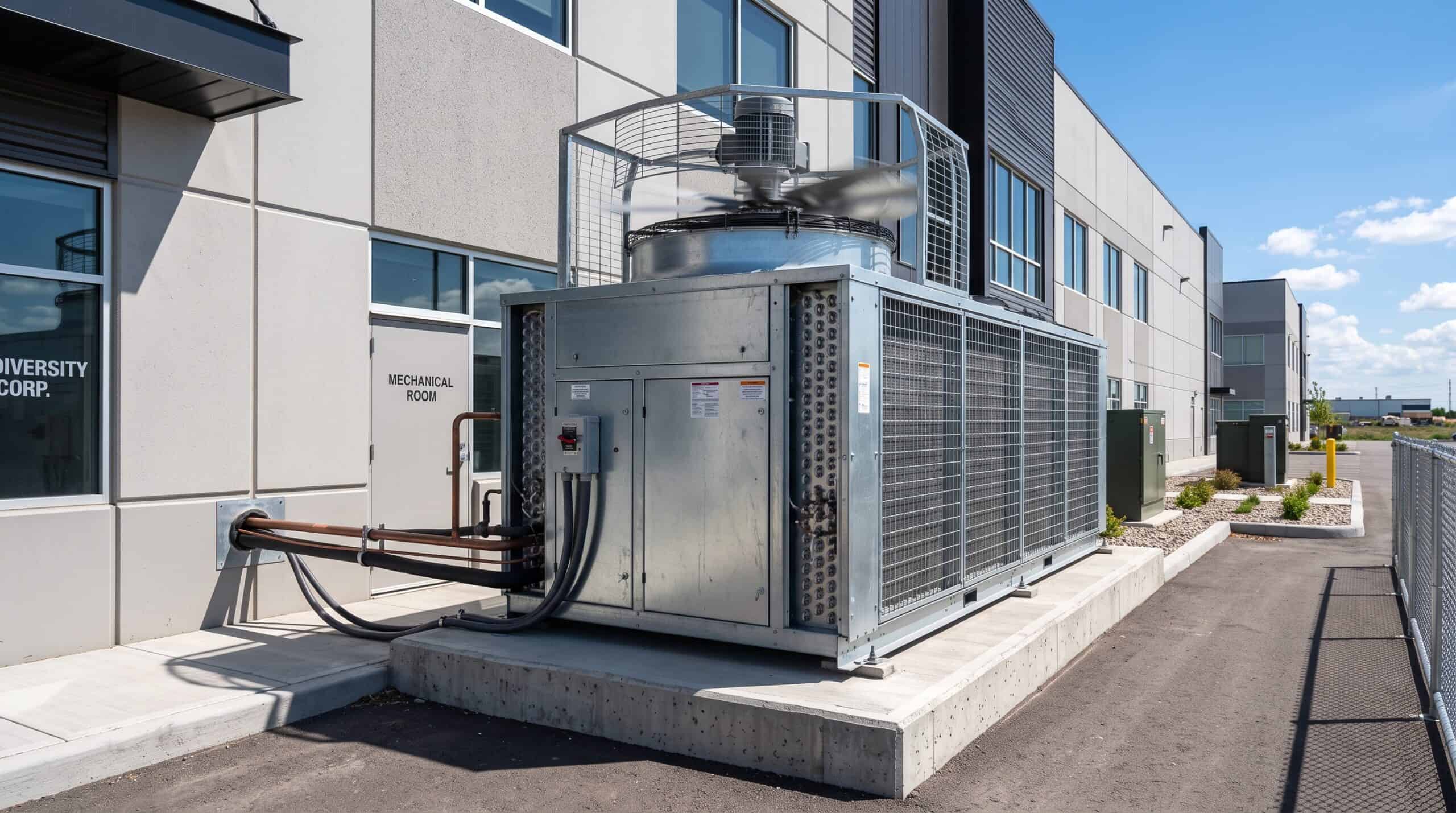
An HVAC technician once described the condensing unit to me this way: “The indoor coil steals heat from the building. The condensing unit throws it outside.” That’s the whole job. But the hardware that does that job ranges from the white metal box on your neighbor’s patio to a multi-compressor ammonia rack the size of a shipping container, and choosing the wrong type for an application is expensive to undo.
This guide covers what a condensing unit actually is and how it differs from a condenser, the main types and configurations, how HVAC and commercial refrigeration condensing units differ, how to size and select one, what it costs, how to maintain it, and where the market is heading in 2026. If you’re troubleshooting a specific failure, jump to maintenance and common failures.
What is a condensing unit?
A condensing unit is the outdoor or remote assembly of a vapor-compression refrigeration or air conditioning system. It combines three components (compressor, condenser coil, and fan) into a single weatherproof housing, and its one job is to reject heat so refrigerant can cool down and re-enter the indoor section to absorb more heat. Without a functioning condensing unit, no cooling cycle can run.
Compressor, condenser coil, and fan: how the three components work together
The compressor is the engine. It draws in low-pressure refrigerant vapor from the evaporator (the indoor coil), compresses it to high pressure, and sends hot, high-pressure gas into the condenser coil. Compression raises the refrigerant’s temperature dramatically, sometimes to 150°F or higher in a residential AC system.
The condenser coil is a network of copper or aluminum tubing with thin aluminum fins attached. Hot refrigerant gas flows through the tubing while the condenser fan blows outdoor air across the fins, pulling heat out of the refrigerant. As the refrigerant loses heat, it cools enough to condense from a gas back into a liquid. This phase change releases a significant amount of heat (called the latent heat of condensation), which is what gets pushed out of the building.
The fan moves that heat away. Without adequate airflow across the coil, refrigerant can’t shed heat efficiently, condensing pressure rises, and the compressor either cycles off on high-pressure protection or runs hot until it fails. Airflow clearance around the condensing unit matters as much as the refrigerant charge.
Condensing unit vs. condenser vs. evaporator: what’s actually different
This is the question the top search results skip. A condenser is one component — the coil. A condensing unit is the full outdoor assembly: condenser coil plus compressor plus fan. An evaporator is the indoor coil where refrigerant absorbs heat rather than rejecting it. All three terms refer to distinct things, and confusing them leads to wrong part orders and incorrect system descriptions.
| Component | Location | Primary function | Can fail independently |
|---|---|---|---|
| Condenser coil | Inside the condensing unit | Rejects heat from refrigerant to outdoor air | Yes: refrigerant leaks, fin damage |
| Condensing unit | Outdoors or remote | Full assembly: compress refrigerant and reject heat | Yes: compressor, fan, or coil each fail separately |
| Evaporator coil | Indoors (air handler or display case) | Absorbs heat from indoor air into refrigerant | Yes: coil leaks, icing, dirty filters |
Types of condensing units
Condensing units split into two primary categories by how they reject heat (air-cooled vs. water-cooled), and into three categories by compressor type (hermetic, semi-hermetic, open). Choosing wrong between these affects serviceability, operating cost, and installation requirements significantly.
Air-cooled condensing units: residential through commercial
Air-cooled condensing units are the dominant type for residential and light commercial applications. The condenser fan pulls or pushes ambient outdoor air across the coil fins to reject heat. Installation is straightforward: the unit goes outside, connects to the indoor system via refrigerant lineset, and requires only clearance for airflow.
For residential use, air-cooled condensing units are the standard. A 2-ton unit for roughly 1,000 square feet, 3-ton for 1,500 square feet, 5-ton for a large home or small commercial space (those are rules of thumb, not substitutes for a load calculation). Commercial air-cooled condensing units scale into multi-compressor rack systems for supermarkets and distribution centers.
The trade-off with air-cooled units: efficiency drops in high ambient temperatures. A condensing unit rated at a certain SEER2 rating will underperform on a 105°F day compared to a 75°F day. Installations in enclosed mechanical rooms, rooftop spaces with limited airflow, or desert climates need careful attention to the ambient temperature rating in the spec sheet.
Water-cooled and evaporative condensing units
Water-cooled condensing units use a water supply (chilled water loop, cooling tower, or municipal water) rather than air to remove heat from the refrigerant. They’re more efficient than air-cooled units in hot climates because water transfers heat more effectively than air, and water temperature is generally lower and more stable than summer ambient air.
The installation overhead is higher: water supply and return piping, a cooling tower or heat exchanger, and water treatment to prevent scale and biological growth in the circuit. This makes water-cooled systems standard in large commercial buildings (office towers, hospitals, hotels) but rare in residential settings.
Evaporative condensing units are a middle path. They spray a small amount of water over the condenser coil surface, using evaporation energy to cool the coil more effectively than air alone. They reduce energy consumption compared to air-cooled at a fraction of the complexity of full water-cooled systems, and they’re common in industrial refrigeration and dry-climate commercial applications.
Hermetic, semi-hermetic, and open compressor configurations
The compressor is the most expensive component in any condensing unit, and its configuration determines how serviceable the unit is when it fails.
Hermetic compressors are sealed in a welded shell. The motor and compressor mechanism share the same refrigerant atmosphere; there is no way to access the internals without cutting the shell. All residential and most light commercial condensing units use hermetic compressors. When they fail, replacement is the only option.
Semi-hermetic compressors have a bolted housing that technicians can open. Valves, pistons, and motor windings are accessible for repair or rebuild. This makes them common in commercial refrigeration condensing units used for walk-in coolers, freezer cases, and display cases, where downtime costs are high and compressor size justifies repair over replacement.
Open compressors are externally driven by a separate motor connected via belt or direct drive. They’re the most serviceable configuration but require shaft seals to prevent refrigerant leakage around the drive shaft. Almost exclusively found in large industrial and ammonia refrigeration systems.
| Compressor type | Serviceability | Typical condensing unit application | Efficiency metric |
|---|---|---|---|
| Hermetic (sealed) | None: replace only | Residential AC, light commercial | SEER2 / EER2 |
| Semi-hermetic (bolted) | Full rebuild possible | Commercial refrigeration, walk-ins, display cases | kW/ton, COP |
| Open (external drive) | Full rebuild possible | Industrial ammonia, large-capacity systems | kW/ton, HP |
HVAC vs. commercial refrigeration condensing units
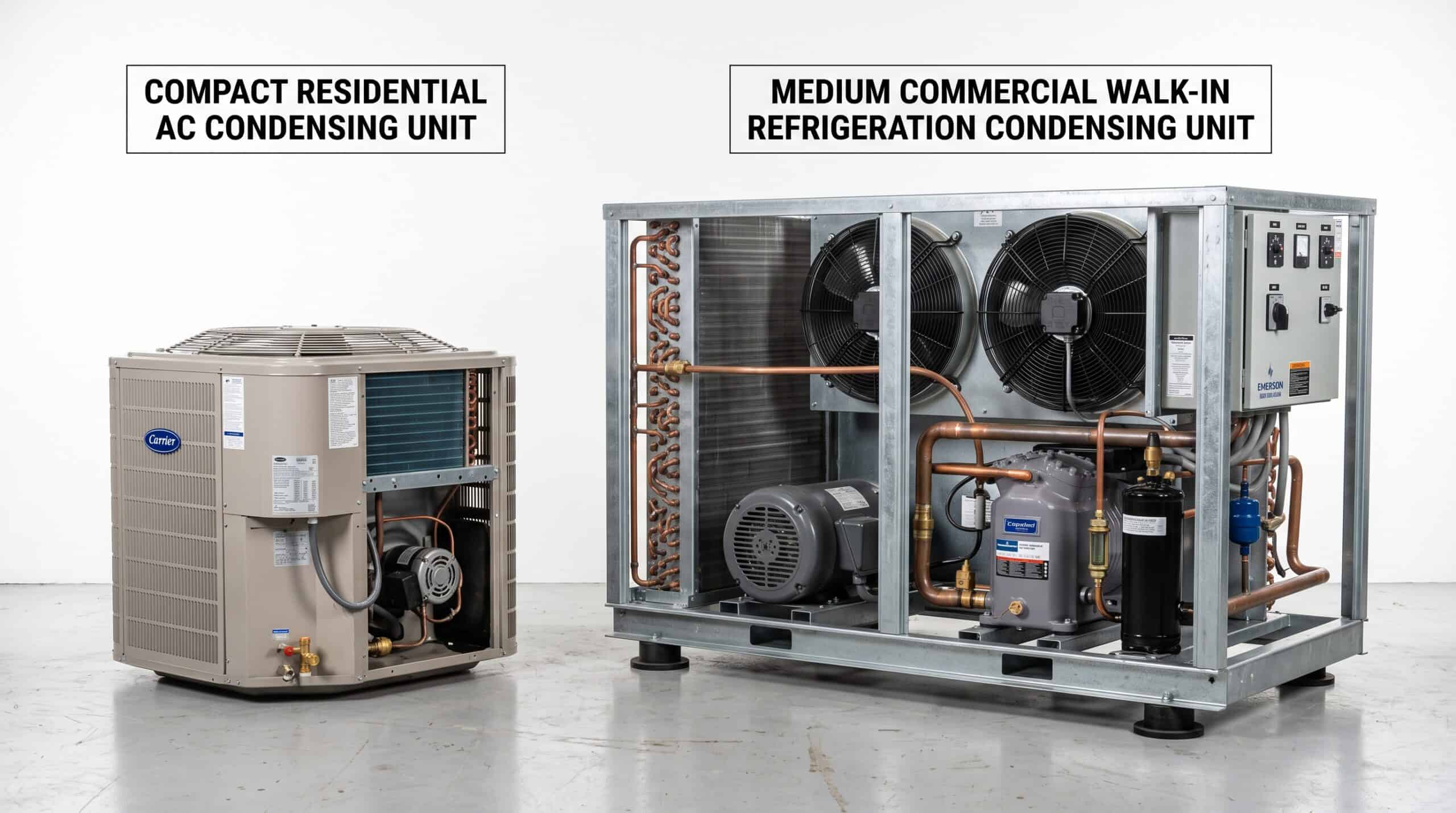
A condensing unit used in residential central AC and a condensing unit used in a walk-in freezer are both condensing units. They are not interchangeable. They’re designed for fundamentally different operating temperatures, and selecting one for the other’s application is a specification error that shows up fast.
Central AC and heat pump outdoor units
The residential AC condensing unit is what most people picture: a square metal cabinet on a concrete pad beside the house, usually with a vertical discharge fan on top. It connects to an indoor air handler via a refrigerant lineset, and together the two units form a split system.
Heat pump condensing units do the same job but add a reversing valve that lets them absorb heat from outdoor air in winter to heat the building as well as cool in summer. In moderate climates, a heat pump condensing unit delivers 2-3 BTUs of heating energy per BTU of electricity consumed. According to ENERGY STAR’s heat pump efficiency guidance, properly sized heat pump systems can reduce heating energy use by up to 65% compared to electric resistance heat.
Minimum efficiency requirements for new AC condensing units in the United States are set by DOE region. As of 2023, the South region requires 15 SEER2; the North requires 14 SEER2. Most buyers in hot climates target 16-18 SEER2 to justify the efficiency premium through energy savings over the system’s 15-20 year life.
The evaporator coil paired with a residential condensing unit determines the matched system efficiency; Domirefrigeration’s residential refrigeration coil products cover how to select and specify indoor coils for split system applications.
Walk-in cooler and freezer condensing units
Commercial refrigeration condensing units operate at lower evaporating temperatures than HVAC systems. An AC evaporator runs at 40-50°F suction. A walk-in cooler condensing unit runs at 20-25°F suction. A walk-in freezer runs at -20 to 0°F suction. These colder conditions create more compression work, require different refrigerants, different oil formulations, and different compressor designs than anything used in residential AC.
Capacity for commercial refrigeration condensing units is quoted in BTU/hr at a specific evaporating and condensing temperature. A unit rated at 8,000 BTU/hr at 20°F evaporating and 90°F condensing will deliver less capacity at higher ambient temperatures. The ambient temperature rating in the spec sheet matters as much as the nominal capacity.
Refrigerant choice is critical in this segment. Most commercial refrigeration condensing units designed after 2020 use R-404A, R-448A, or R-449A rather than R-22 (fully phased out) or R-404A for new-builds (facing phase-down due to its GWP of 3,922 under EPA regulations). The EPA’s SNAP program for refrigerant substitutes maintains the approved substitute list for commercial refrigeration by application temperature; any condensing unit replacement in this category should be cross-checked against current SNAP approvals.
The evaporator coil specification for a commercial walk-in condensing unit is matched by evaporating temperature, refrigerant, and BTU/hr capacity. Domirefrigeration’s evaporator coil resources cover how coil selection interacts with condensing unit performance for walk-in and display case applications.
Supermarket display cases and industrial refrigeration
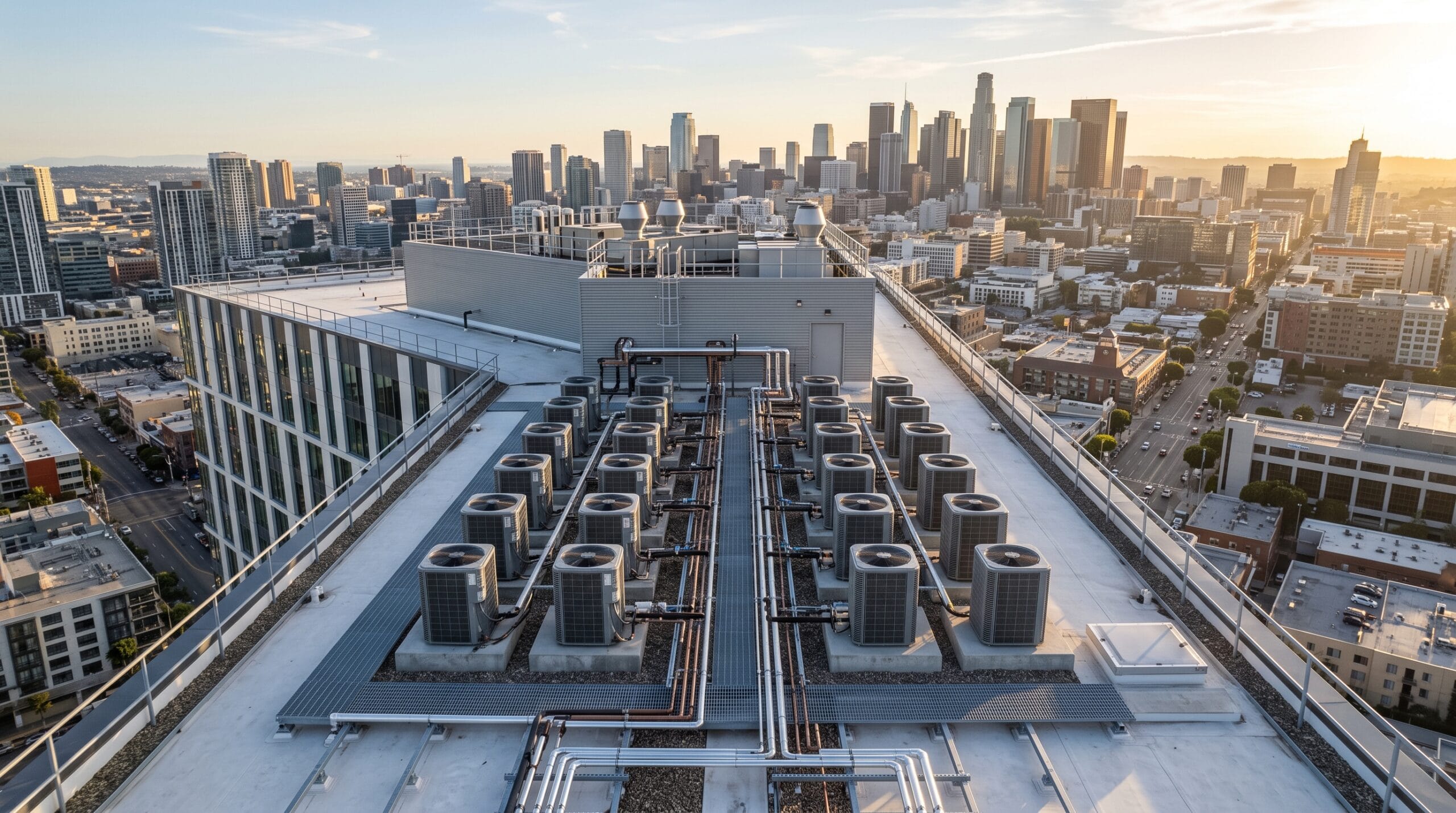
Large supermarkets typically don’t use individual condensing units for each display case. Instead, centralized refrigeration rack systems run multiple compressors feeding dozens of cases from a remote machine room condensing section. The condensing section is often a rooftop array of multiple condenser coils and fans, while compressor racks sit indoors in a climate-controlled machine room.
Industrial refrigeration uses the largest condensing units: multi-compressor systems in ammonia or CO2, with open compressors, large-diameter condenser sections, and cooling towers. According to ASHRAE refrigeration system standards, large industrial condensing equipment is typically designed for the 99th-percentile ambient temperature at the installation location, not average summer conditions, because system failure during peak heat events is the worst-case scenario.
Sizing and selecting a condensing unit
Correct sizing is the most commonly skipped step and the most common cause of early system failures and callbacks. Both undersizing and oversizing create problems. Undersized systems run continuously without reaching setpoint and wear out early. Oversized systems short-cycle, which is hard on compressors and leaves humidity control incomplete in HVAC applications.
BTU/ton and tonnage for HVAC
HVAC condensing units are sized in tons. One ton of cooling equals 12,000 BTU/hr (historically, the amount of heat to melt one ton of ice per day). General residential rules of thumb run 400-600 square feet per ton, adjusted for insulation quality, climate zone, window area, and occupancy.
For commercial spaces, a proper Manual J or Manual N load calculation matters more than square footage estimates. A restaurant kitchen, a server room, and a retail showroom of the same square footage have wildly different cooling loads. Sizing from area alone in commercial settings routinely produces oversized equipment and humidity problems.
Refrigerant type: R-410A, R-454B, R-404A, and legacy refrigerants
Refrigerant selection is more constrained in 2026 than five years ago. The Kigali Amendment and the EPA’s AIM Act have accelerated HFC phase-downs, and the choice of refrigerant affects both new equipment selection and the total cost of ownership for existing systems.
R-410A is still installed in systems manufactured before 2025, but production of new R-410A equipment has ended or is ending for most manufacturers. GWP of 2,088. Existing R-410A systems can continue operating during the transition period, but supply tightens and prices rise each year.
R-454B is the primary replacement refrigerant for residential and light commercial AC. GWP of 466 (roughly 78% lower than R-410A). Most major manufacturers have transitioned their residential condensing unit lines to R-454B by 2025-2026. R-454B is classified A2L (mildly flammable), which requires updated service procedures and in some jurisdictions updated installation code compliance.
R-404A is common in commercial refrigeration from the 2000s and 2010s, but its GWP of 3,922 has put it under active EPA phase-down. New commercial refrigeration condensing units in 2026 should be specified with R-448A, R-449A, R-452A, or CO2 as alternatives. A walk-in cooler condensing unit purchased in 2026 should not be specified with R-404A for new builds.
R-22 is fully phased out. Reclaimed R-22 exists but costs $40-100+ per pound and supply is declining each year. A system that needs new refrigerant and runs R-22 either needs a full conversion or replacement.
The AHRI certified directory publishes efficiency ratings for condensing units by refrigerant type; always verify published ratings against AHRI certification before specifying any unit.
SEER2 and EER2 for HVAC; kW/ton for commercial refrigeration
SEER2 is the DOE’s seasonal efficiency metric for residential AC condensing units, updated in 2023 to reflect real-world ductwork pressure drops. A higher SEER2 means lower operating cost over a season. EER2 is the peak-load metric tested at 95°F outdoor temperature; it matters more than SEER2 in climates where peak summer temperatures regularly exceed 100°F, because SEER2’s seasonal weighting underrepresents the hottest days.
Commercial refrigeration uses kW/ton or COP (coefficient of performance). A COP of 3.0 means 3 BTUs of cooling delivered per BTU of electricity consumed. At a given electricity rate, a higher COP directly reduces operating cost, and in 24/7 commercial refrigeration applications, the operating cost difference between a COP of 2.0 and 2.5 over 10 years typically dwarfs the upfront equipment price difference.
Ambient temperature ratings and installation location
Every condensing unit has a maximum allowable ambient temperature in its spec sheet, typically 115-125°F for residential units, with derating curves as the ambient approaches the limit. Installations in enclosed mechanical rooms, rooftop spaces with limited airflow, or climates with ambient temperatures regularly above 110°F need careful attention to this spec and often require low-ambient or high-ambient kits.
Minimum ambient temperature matters for heat pumps and some commercial units. Heat pump condensing units have minimum heating-operation ambient limits, below which they switch to backup electric resistance heat. Units without low-ambient kits lose heating capacity rapidly as outdoor temperature drops below 35-40°F.
Condensing unit cost and the $5000 HVAC rule
Pricing a condensing unit depends on type, capacity, and efficiency tier. The equipment cost and the installed cost can be quite different.
New condensing unit price ranges by type and size
Residential AC condensing units (1.5-5 tons) run roughly $800-$2,500 for the equipment alone. Add refrigerant, lineset, electrical, permits, and labor, and installed costs land between $1,800 and $5,500 depending on region and unit size. High-efficiency units (18+ SEER2) sit at the top of that range. Budget units meet minimum efficiency requirements and cost less upfront, but the operating cost difference compounds significantly over a 15-year lifespan in hot climates.
Commercial refrigeration condensing units for walk-in coolers (1-5 HP) range from $800 to $4,000+ for the condensing unit itself, with highly variable installation costs depending on existing refrigerant piping, electrical service, and the complexity of matching the unit to an existing or new evaporator coil. Custom coil builds for specific commercial applications are available through Domirefrigeration’s custom coil fabrication services.
The $5000 rule: when to repair vs. replace
The $5000 rule is a contractor’s shorthand for HVAC replacement decisions: multiply the system’s age in years by the cost of the proposed repair. If the result is over $5,000, replace rather than repair.
A 15-year-old condensing unit needs a $400 capacitor replacement: 15 x $400 = $6,000. The rule points toward replacement. A 5-year-old unit with the same repair: 5 x $400 = $2,000. Repair it.
This rule doesn’t account for energy savings from a newer, more efficient replacement or refrigerant transition considerations. But as a quick filter for “is this repair worth starting?”, it works well. According to the U.S. Department of Energy’s HVAC efficiency guidance, upgrading from a 10 SEER unit to a 16 SEER unit can reduce cooling energy costs by 35-40%, which changes the repair-vs-replace math on older systems even when the $5000 rule says repair.
Maintenance and common failures
A well-maintained residential condensing unit runs 15-20 years. One that gets no attention may last 8-10. Commercial refrigeration condensing units in high-duty-cycle applications may need compressor service at 7-12 years even with maintenance. The difference between those outcomes is mostly predictable and mostly preventable.
Cleaning condenser coils and fins (quarterly schedule)
The condenser coil is a heat exchanger, and its performance degrades in proportion to how dirty it gets. Dirty fins mean the refrigerant can’t shed heat, condensing pressure rises, and the compressor works harder and runs hotter. A coil that’s 25% restricted by dirt can raise the condensing pressure enough to reduce compressor lifespan significantly over a single season.
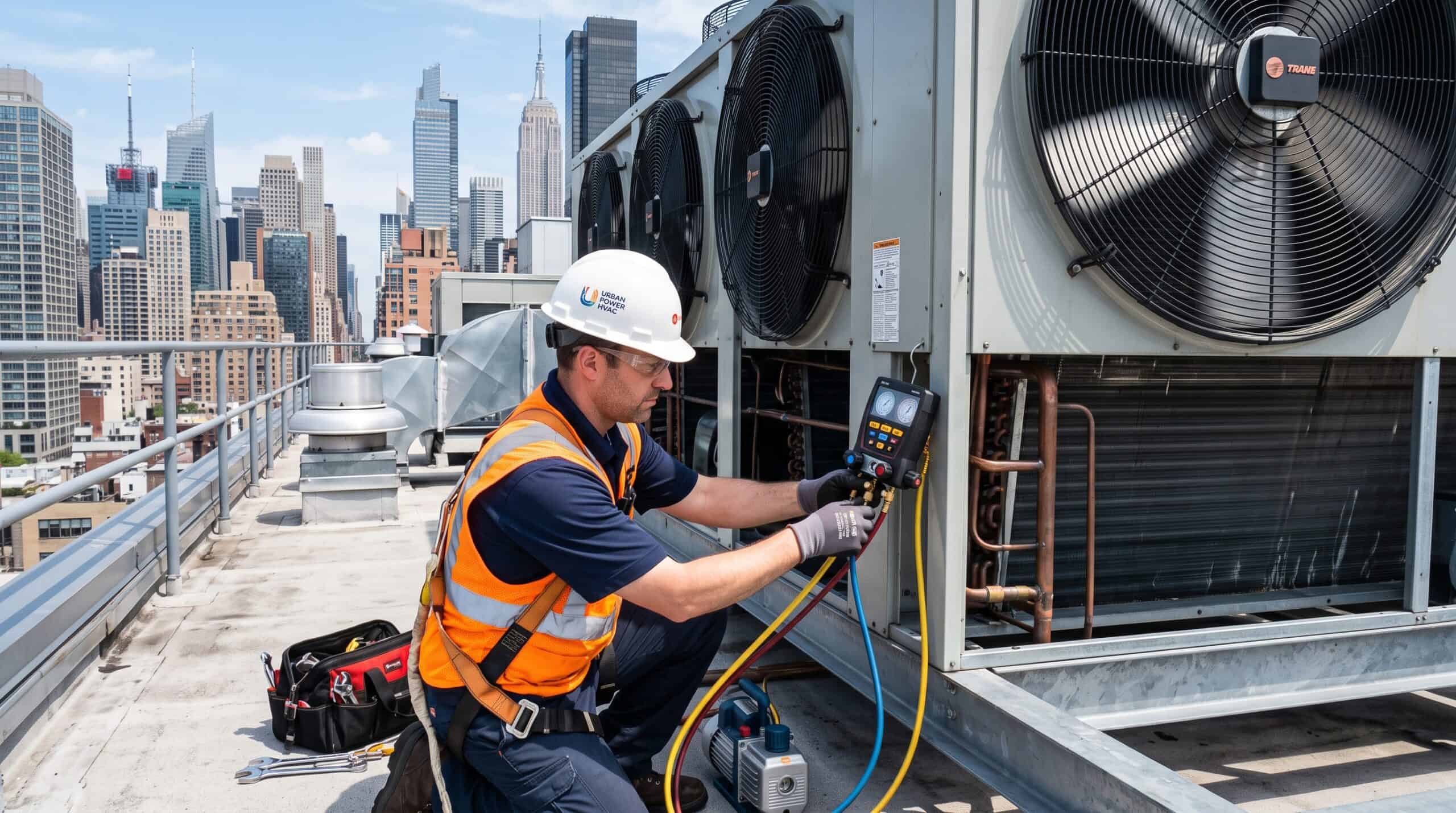
For outdoor residential condensing units: turn off power at the disconnect and rinse the coil with a garden hose from the inside out, not a pressure washer. Pressure washing bends the fins and reduces airflow. For commercial refrigeration condensing units in dusty or greasy environments near restaurant exhaust or in industrial facilities, monthly cleaning may be necessary.
Annual: inspect the fan blade for cracks and debris, check motor shaft bearings, and verify electrical connections at the contactor and capacitor are tight. Capacitors are the most common cause of condensing unit failure and cost $15-50 to replace. Catching a failing capacitor during a maintenance visit costs far less than the service call for a unit that won’t start on the hottest day of the year.
Compressor and condenser fan motor failures
Compressor failure is the most expensive single condensing unit repair. Replacement costs $400-1,500 for residential hermetic compressors, $2,000-8,000 for commercial semi-hermetic compressors, plus refrigerant recovery, labor, and vacuum/recharge. This is usually when the $5000 rule applies most directly.
Common compressor failure modes include winding burnout from overheating (usually caused by a dirty coil or low refrigerant charge running suction pressure too low), liquid slugging (refrigerant flooding back to the compressor in liquid form), and mechanical seizure from lubrication failure. Dirty coils and refrigerant charge problems cause the majority of early failures, which is why those two maintenance items matter so much.
Condenser fan motor failures are far cheaper ($100-400 installed) but cause compressor damage if left running. A condensing unit with a failed fan motor runs until the high-pressure protection trips or the compressor overheats. Replace fan motors quickly.
Condensing unit trends (2026 and beyond)
The condensing unit market is changing on two fronts at once: refrigerant regulations forcing a hardware transition, and compressor technology offering significantly better efficiency at lower cost than even five years ago.
Low-GWP refrigerants under EPA and Kigali timelines
The EPA’s Technology Transitions Rule under the AIM Act sets declining annual production caps on HFCs through 2036. By 2028, the sector-wide HFC cap drops to 40% of the 2011-2013 baseline, putting real pressure on supply for systems still using R-410A and R-404A.
In practice: R-410A supply tightens and prices rise each year; any commercial refrigeration condensing unit on R-404A becomes a growing budget liability as service costs increase. According to EPA guidance on HFC reduction alternatives, the transition to A2L refrigerants (R-454B, R-32) and natural refrigerants (CO2, ammonia, propane for small applications) is accelerating faster than original projections.
For 2026 buyers, the practical takeaway: specify the lowest available GWP refrigerant compatible with the application. For residential AC, that’s R-454B. For commercial medium-temperature refrigeration, R-448A or R-449A. For low-temperature commercial applications, R-452A or CO2.
Inverter compressors and variable-speed condensing technology
Traditional condensing units run a single-speed compressor at full load or not at all. Variable-speed (inverter) condensing units modulate compressor speed to match actual cooling load, which does two things: improves part-load efficiency and delivers more stable temperature control.
For residential AC, inverter condensing units achieve SEER2 ratings of 20-28 compared to 15-18 for single-stage equivalents. For commercial refrigeration, variable-speed condensing units reduce temperature swings in walk-in coolers, extending food shelf life and reducing defrost frequency.
The 2026 shift is the adoption of variable-speed technology in the mid-tier commercial segment. Falling inverter drive costs (down roughly 40% in five years) are making it economically viable in commercial refrigeration condensing units that would previously have been single-stage only.
| Trend | Current State (2026) | Likely Trajectory |
|---|---|---|
| R-454B in residential AC | Mainstream in new equipment | Universal by 2027 |
| R-404A phase-down | Active, supply tightening | Severely limited by 2028 |
| Variable-speed in commercial | Premium commercial only | Mid-tier adoption by 2027-2028 |
| CO2 transcritical systems | Supermarket refrigeration | Expanding to convenience stores and food service |
| IoT monitoring and diagnostics | Available, not standard | Spec requirement in commercial by 2028 |
FAQ: condensing unit questions
Q1: What is the condensing unit?
The condensing unit is the outdoor or remote section of an air conditioning or refrigeration system. It houses the compressor, condenser coil, and fan. The compressor pressurizes refrigerant gas; the condenser coil and fan reject heat to outdoor air; the liquid refrigerant flows back indoors to the evaporator to absorb more heat and start the cycle over. Without it, no cooling cycle runs.
Q2: Is a condenser the same as an AC unit?
No. A condenser is the coil inside the condensing unit where refrigerant rejects heat. A condensing unit is the full outdoor assembly: compressor, condenser coil, and fan together. When people say “AC unit” colloquially, they often mean the condensing unit (the outdoor box), but technically the complete air conditioning system includes both the outdoor condensing unit and the indoor evaporator and air handler.
Q3: What is the $5000 rule for HVAC?
The $5000 rule is a quick filter for repair-vs-replace decisions: multiply the system’s age in years by the cost of the proposed repair. If the result exceeds $5,000, replace the equipment. A 12-year-old condensing unit needing a $500 capacitor and refrigerant charge: 12 x $500 = $6,000, which points toward replacement. The rule doesn’t override good judgment on a well-maintained unit, but it filters the obvious cases quickly.
Q4: How much does a new AC condenser unit cost?
A residential AC condensing unit costs $800-$2,500 for the equipment alone, depending on size (tons) and efficiency (SEER2). Full installed cost including labor, refrigerant, and electrical work typically runs $1,800-$5,500. Commercial refrigeration condensing units for walk-in coolers range from $800 to $4,000 for the unit, with installation costs that vary widely by existing infrastructure.
Q5: What refrigerant do condensing units use in 2026?
For new residential and light commercial AC: R-454B, which replaced R-410A in most manufacturers’ lineups by 2025-2026. For commercial medium-temperature refrigeration: R-448A or R-449A. For low-temperature commercial (freezers): R-452A or CO2. R-22 is fully phased out. R-404A is in active phase-down and should not be specified for new equipment.
Q6: What is the difference between HVAC and refrigeration condensing units?
Operating temperature. HVAC condensing units pair with evaporators running at 40-50°F suction. Commercial refrigeration condensing units for walk-in coolers run at 20-25°F suction; for freezers, at -20 to 0°F. Lower evaporating temperatures mean higher compression ratios, different refrigerant choices, different oil formulations, and different compressor designs. They are not interchangeable.
Q7: How long does a condensing unit last?
15-20 years for a residential AC condensing unit with regular maintenance (annual tune-up, quarterly coil cleaning). 7-15 years for commercial refrigeration condensing units in high-duty-cycle applications. The compressor defines the economic life of the unit in most cases: a failed compressor on a 12-year-old unit often costs more to replace than new equipment.
Q8: Can I replace just the condensing unit?
Sometimes, with caveats. Replacing only the outdoor condensing unit while keeping an existing indoor coil works if the coil is compatible with the new unit’s refrigerant, matched in capacity, and not itself due for replacement. When refrigerant types differ (R-410A vs. R-454B), the lineset may need inspection. Mismatched coils reduce efficiency or cause reliability problems. A matched system replacement (condensing unit plus indoor coil together) costs more upfront but avoids compatibility issues.
Choosing the right condensing unit for your application
For residential central AC: match the tonnage to a proper load calculation, choose R-454B equipment for refrigerant transition compatibility, and target at least 16 SEER2 in warm climates for reasonable energy cost payback. In hot climates where summer peaks regularly exceed 100°F, the EER2 rating matters more than the SEER2.
For commercial refrigeration: start with the evaporating temperature (cooler vs. freezer), then capacity in BTU/hr at actual evaporating and condensing conditions, then refrigerant compatibility with the evaporator coil you’re pairing. Don’t size from nominal rating; verify at actual operating conditions. For applications requiring custom evaporator coil builds matched to a specific condensing unit, Domirefrigeration’s custom coil fabrication services handle commercial-grade coil specifications for walk-in and refrigeration rack applications.
Across both categories, two practices determine how long a condensing unit lasts: keeping the condenser coil clean, and catching refrigerant undercharge before the compressor absorbs the stress of running hot. By the time a unit visibly struggles to hold setpoint, the compressor has already logged thousands of run hours of degraded conditions. The hardware is reliable. The maintenance schedule around it is where the outcome gets decided.