
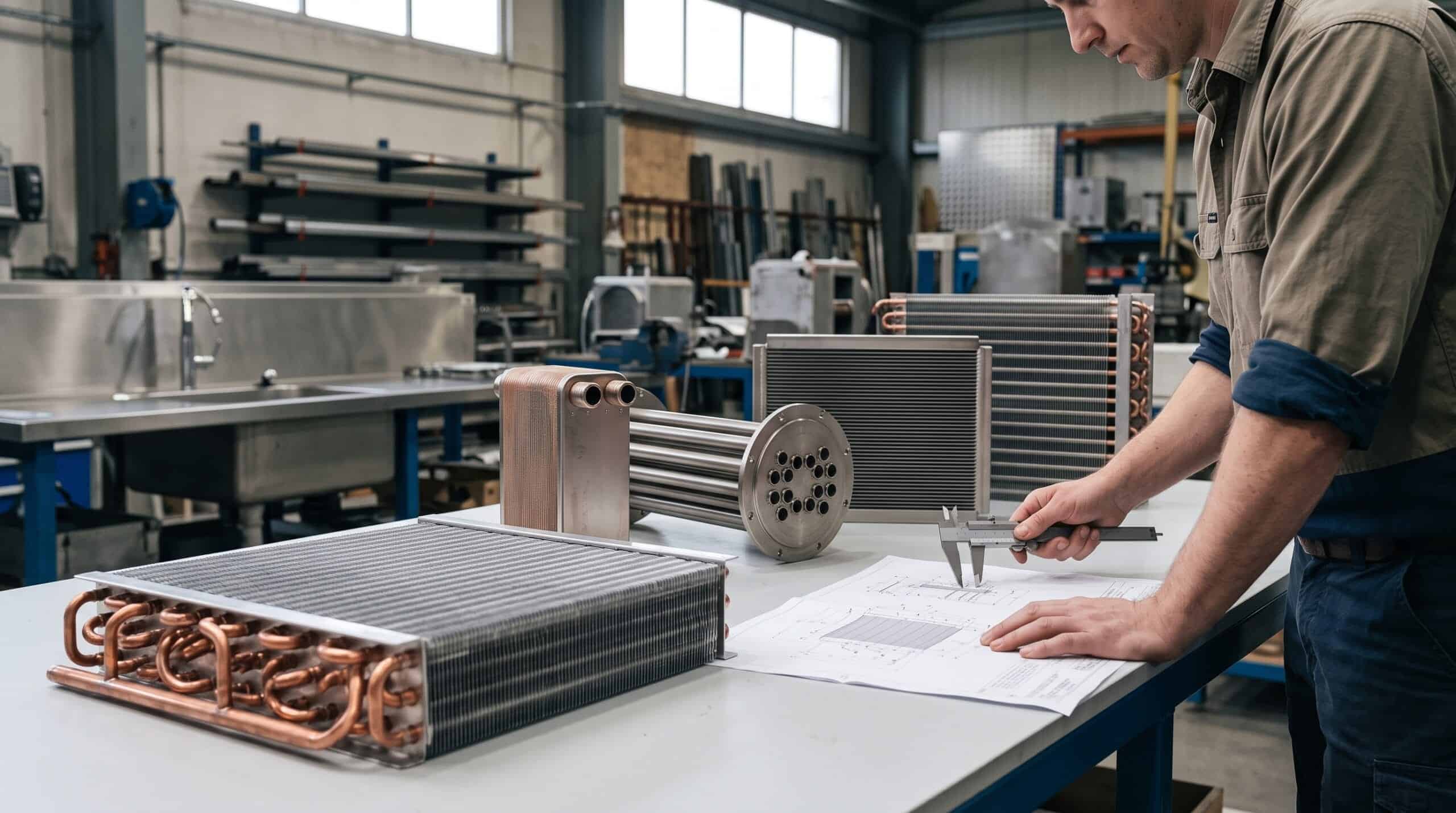
Quick answer: The main types of heat exchangers are shell-and-tube, plate, finned-tube, microchannel, plate-fin, double-pipe, wire-on-tube, tube-on-plate, roll-bond, and several specialty process designs. The right type depends on the two media, heat duty, temperature approach, flow rate, pressure drop, size limit, material exposure, service access, and required validation.
Searching for heat exchanger types usually means one of two things. A student wants the names and basic differences. An engineer or buyer needs to decide whether a coil, plate unit, shell-and-tube bundle, or compact core can work in a real machine. This page covers both jobs. It starts with a 112-name reference list, then explains how to narrow the list to a buildable specification for refrigeration, HVAC, appliance, and industrial equipment.
The short definition is simple: a heat exchanger moves thermal energy between two fluids, or between a fluid and air, through a controlled surface. The fluids normally remain separate. The construction determines how much area is available, how the streams move, how easily the unit can be cleaned, and how well it fits the equipment.
Heat exchanger types at a glance
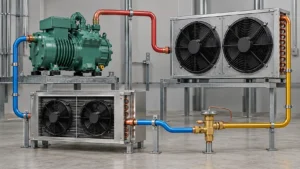
The same device can have more than one name. For example, a finned-tube coil may also be called an air coil, an evaporator coil, a condenser coil, or a tube-and-fin heat exchanger. One name may describe construction, while another describes its role in the refrigeration cycle. That is why a useful list has to group terms by both physical design and application.
| Family | Typical media | Where it appears | Main selection concern |
|---|---|---|---|
| Finned-tube and air coils | Air with refrigerant, water, glycol, or steam | Evaporators, condensers, fan coils, air handlers | Airflow, fin spacing, frost, drainage, corrosion |
| Shell-and-tube | Water, glycol, oil, refrigerant, process fluids | Chillers, condensers, process skids, heat recovery | Pressure, fouling, tube access, bundle design |
| Plate and plate-fin | Clean liquids, gases, refrigerant, cryogenic fluids | Hydronic HVAC, heat pumps, compact process equipment | Channel size, gasket or braze route, fluid cleanliness |
| Microchannel and compact cores | Air with refrigerant or coolant | Outdoor HVAC, vehicles, compact condensers | Flow distribution, small passages, repair, coatings |
| Appliance and refrigeration exchangers | Refrigerant with cabinet or room air | Refrigerators, freezers, beverage equipment, ice machines | Available envelope, sound, mounting, defrost, charge |
| Specialty and process exchangers | Process liquids, gases, vapor, combustion gas | Food, chemical, energy recovery, industrial systems | Compatibility, cleaning, pressure, phase change |
The 112 heat exchanger types and names
The entries below are names you may see in engineering specifications, product catalogs, service manuals, and supplier quotations. Some describe a complete exchanger. Others describe a construction, a coil role, or an application-specific version of a broader family. Use them as a vocabulary map, not as a substitute for thermal design data.
Air-cooled and finned-tube heat exchangers
These exchangers use an extended airside surface. A tube carries refrigerant, water, glycol, steam, oil, or another fluid, while fins increase the surface available to moving air.
- Plain-tube heat exchanger. A bare tube transfers heat directly to the surrounding fluid. It is simple and easy to clean, but it needs more surface area than a finned coil when the airside resistance is high.
- Finned-tube heat exchanger. External fins increase airside area around the tubes. This is the basic construction behind many HVAC and refrigeration coils.
- Copper-tube aluminum-fin coil. Copper carries the internal fluid and aluminum fins provide the airside surface. It remains common because the materials balance thermal performance, formability, and cost.
- Aluminum-tube aluminum-fin coil. Aluminum is used for both tubes and fins. It can reduce weight, but joining, corrosion exposure, and pressure requirements need careful review.
- Steel-tube steel-fin coil. Steel construction is used where strength, temperature, or cost conditions justify it. Coating and corrosion protection are important parts of the specification.
- Serpentine coil. One continuous tube follows a repeated path through the air stream. It suits simple circuits and small equipment, although pressure drop can increase with long tube length.
- Staggered-tube coil. Tube rows are offset so air meets a dense pattern of tubes. The arrangement can improve heat transfer, but it also changes pressure drop and cleanability.
- Continuous-fin coil. A continuous sheet of fin material joins many tubes. The fin pack gives a large surface area with fewer individual fin collars.
- Plate-fin air coil. Flat plates or fins create air passages around tubes or channels. This term is common in compact gas-to-fluid equipment and aviation or cryogenic designs.
- Draw-through evaporator coil. A fan pulls air through the coil. The arrangement can provide an even face velocity when the fan and cabinet are designed together.
- Blow-through evaporator coil. A fan pushes air across the coil. The fan position affects temperature distribution, condensate behavior, and service access.
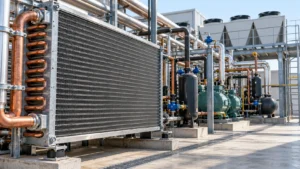
- Air-cooled condenser coil. Refrigerant rejects heat to ambient air as it condenses. Fin spacing, outdoor fouling, ambient temperature, and fan performance control the result.
- Evaporator coil. Refrigerant absorbs heat while evaporating inside the tubes or channels. The airside design must also handle moisture, condensate, and possible frost.
- Unit cooler coil. A finned evaporator is paired with a fan for a cold room, freezer, or process enclosure. Drainage and defrost are as important as nominal capacity.
- Fan coil heat exchanger. A coil and fan assembly heats or cools room air. Water, glycol, refrigerant, and steam versions exist.
- Air-handler coil. A coil installed inside an air-handling unit conditions a larger air stream. Face area, casing fit, filter loading, and service clearance matter.
- Chilled-water coil. Chilled water or glycol absorbs heat from air. The coil must be checked for leaving-air temperature, condensation, valve control, and freeze risk.
- Hot-water coil. Heated water transfers energy to air in a unit heater, air handler, or process cabinet. Flow control and air venting affect performance.
- Steam coil. Steam condenses inside tubes and releases latent heat. Tube pitch, condensate drainage, control valves, and freeze protection need review.
- Heat-recovery coil. A coil captures heat from one air or fluid stream and transfers it to another part of the system. The required temperature approach determines size.
Shell-and-tube and tube-bundle exchangers
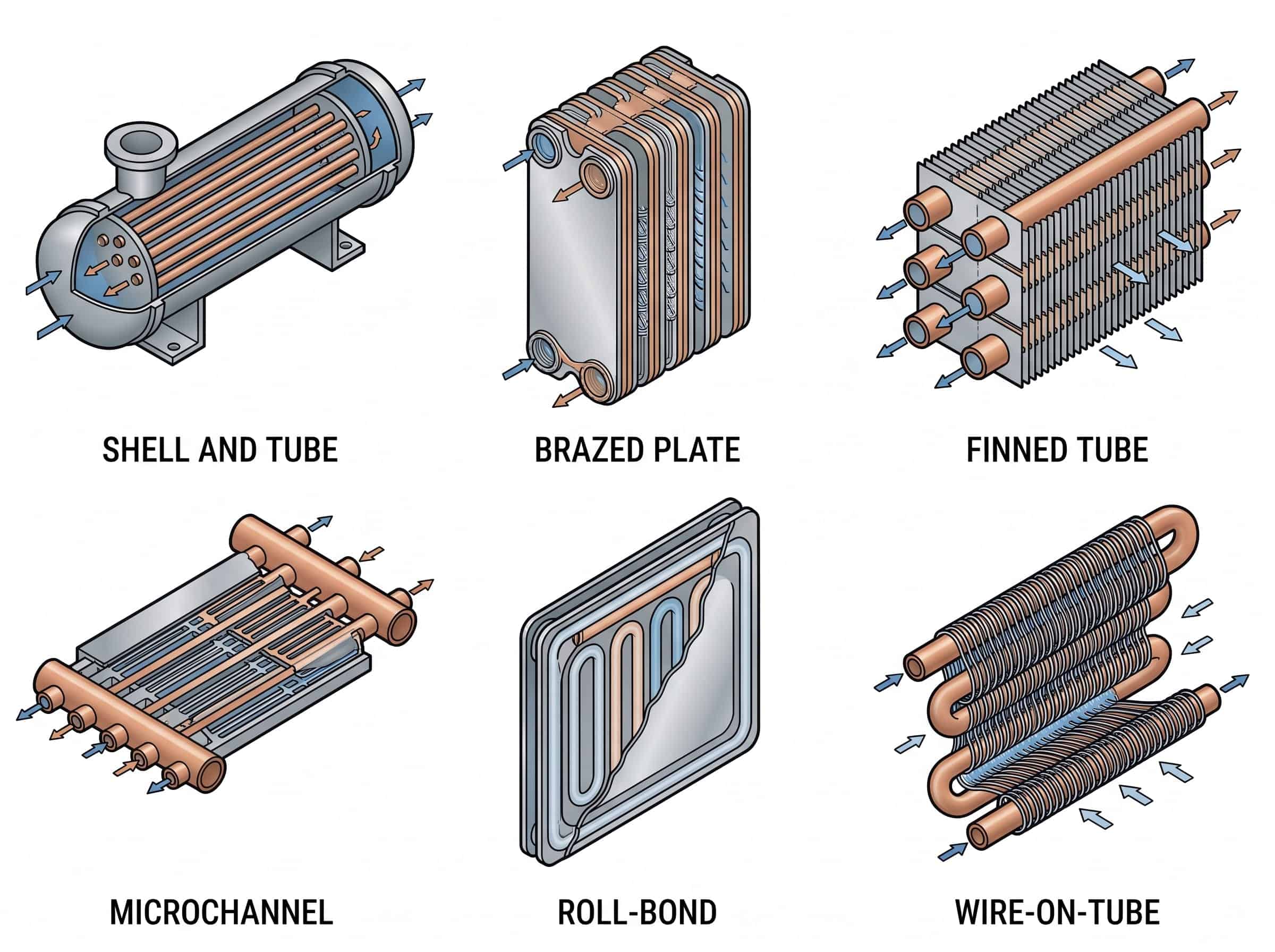
Shell-and-tube designs place tubes inside a shell. Baffles guide shell-side flow, while tube passes control the tube-side path. This family is common where the fluids are pressurized, dirty, hot, or likely to require mechanical cleaning.
- Fixed-tube-sheet exchanger. The tube sheets are attached to the shell. It is structurally straightforward, but shell-side cleaning access is limited.
- U-tube exchanger. Tubes bend into a U shape inside the shell. The design handles thermal expansion well and reduces the number of tube-sheet joints.
- Floating-head exchanger. One tube sheet can move relative to the shell. This improves thermal expansion management and can make bundle maintenance easier.
- Removable-bundle exchanger. The tube bundle can be pulled from the shell for inspection or cleaning. The layout needs enough service space around the equipment.
- Double-pipe heat exchanger. One pipe sits inside another, with one fluid in the inner pipe and the other in the annular space. It suits smaller duties and modular installations.
- Hairpin heat exchanger. A U-shaped or hairpin assembly creates a compact double-pipe path. Multiple hairpins can be arranged in series or parallel.
- Multitube exchanger. Several straight or U-shaped tubes carry one stream while the second stream flows around them. The term describes the bundle rather than a single standard geometry.
- Kettle reboiler. A shell holds a boiling liquid while a tube bundle supplies heat. Vapor disengagement and liquid level control are important.
- Thermosyphon reboiler. Natural circulation moves liquid through a heated bundle and returns vapor or liquid to the process vessel. Elevation and pressure balance affect circulation.
- Forced-circulation reboiler. A pump drives liquid through the exchanger. This suits services where natural circulation is insufficient or difficult to control.
- Shell-and-coil exchanger. A coiled tube sits inside a shell or vessel. The coil gives a long path in a compact footprint.
- Baffled shell-and-tube exchanger. Baffles direct shell-side fluid across the tubes. Spacing changes heat transfer, vibration risk, and pressure drop.
- Single-pass shell-and-tube exchanger. Each stream makes one main pass through the equipment. It can simplify piping and reduce pressure drop.
- Multipass shell-and-tube exchanger. The tube or shell stream changes direction through multiple passes. The arrangement increases contact length but also increases pressure loss.
- Shell-and-tube condenser. Vapor condenses on one side while a cooling fluid removes heat on the other. Non-condensable gas and condensate drainage can affect duty.
- Shell-and-tube evaporator. A liquid or refrigerant evaporates while the other fluid supplies heat. Boiling stability, oil return, and dry-out need review.
- Water-cooled condenser. Cooling water removes heat from a condensing refrigerant or process vapor. Water quality and fouling control are part of the design.
- Flooded evaporator. The heat-transfer surface remains wetted by a liquid refrigerant inventory. Oil return, level control, and operating charge are important.
Plate, plate-fin, and compact surface exchangers
Plate designs build many channels into a small volume. Corrugations create turbulence and support the plates. The unit may be gasketed, brazed, welded, diffusion bonded, or assembled as a plate-fin core.
- Gasketed plate heat exchanger. Gaskets separate alternating channels and allow the plate pack to open for cleaning or capacity changes.
- Brazed plate heat exchanger. Copper or nickel brazing seals the plate pack. The compact unit has no replaceable gasket, so fluid cleanliness and service strategy matter.
- Welded plate heat exchanger. Welded seams replace gaskets in selected flow paths. It is used where pressure, temperature, or chemical compatibility makes gasketed construction unsuitable.
- Semi-welded plate exchanger. Some channels are welded while others use gaskets. It can combine chemical resistance with service access on the gasketed side.
- Double-wall plate exchanger. Two plates separate the fluids so an internal leak can be detected before cross-contamination becomes severe.
- Plate-and-frame exchanger. A removable plate pack is clamped inside a frame. The frame supports maintenance, inspection, and future plate changes.
- Plate-fin heat exchanger. Flat plates and fins form many small passages. It offers high surface density and is common in gas, cryogenic, and compact process duties.
- Brazed aluminum plate-fin exchanger. Aluminum plates and fins are brazed into a compact core. The low weight is useful, but pressure, joining quality, and cleaning access need review.
- Diffusion-bonded plate-fin exchanger. Heat and pressure bond plates and fins into a solid block. It suits demanding compact duties where internal access is limited.
- Printed circuit heat exchanger. Small etched channels are diffusion bonded into metal plates. High pressure and temperature capability are possible, but manufacturing and inspection requirements are specialized.
- Compact plate heat exchanger. The term covers small plate units with high area per volume. The actual selection still depends on channel pattern and fluid conditions.
- Spiral plate heat exchanger. Two long channels wind around a central core. The flow can create useful shear for some fluids and the shape can reduce dead zones.
- Plate coil exchanger. A formed or welded plate creates a heat-transfer surface inside a tank or vessel. It is used for liquid heating and cooling.
- Dimpled-plate exchanger. Dimple patterns hold two plates apart and create turbulence. The design is often used for tanks, jackets, and hygienic process equipment.
- Pillow-plate exchanger. Two sheets are welded and inflated to form channels. It provides a large surface with a relatively cleanable exterior.
- Wide-gap plate exchanger. Enlarged channels allow fluids containing fibers, particles, or higher viscosity to pass with lower plugging risk.
- Hygienic plate exchanger. Sanitary connections, surface finishes, drainage, and clean-in-place requirements govern the construction.
- Free-flow plate exchanger. The channel is designed with a large opening for fluids that contain solids or fibers. It trades compactness for lower blockage risk.
- Vacuum-brazed plate exchanger. Controlled-atmosphere brazing joins the plates without a gasket. It is common in compact refrigerant and liquid circuits.
- Plate-type evaporator. A plate pack provides the boiling surface for refrigerant or another fluid. Distribution and dry-out control determine the usable area.
- Plate-type condenser. A plate pack removes latent heat from a condensing vapor. Drainage, non-condensables, and pressure drop need to be included in the review.
- Liquid-to-liquid plate exchanger. Two liquid streams pass through alternating channels. It is widely used for hydronic and process heat recovery.
- Gas-to-liquid plate exchanger. A gas stream gives or receives heat through a plate surface while a liquid flows on the other side. The gas-side pressure drop can dominate.
Microchannel, minichannel, and vehicle thermal exchangers
Microchannel and minichannel designs use flat multiport tubes, small passages, and compact fin packs. They can save space and reduce internal volume, but the distribution header and joining process must be controlled closely.
- Microchannel condenser. Refrigerant condenses inside flat multiport tubes while air crosses the fin pack. It is common in compact air-cooled outdoor units.
- Microchannel evaporator. Refrigerant evaporates inside multiple small passages. The distributor, circuit balance, frost behavior, and cleaning method require attention.
- Parallel-flow microchannel exchanger. Multiple ports run in parallel through a flat tube. The header must divide refrigerant or coolant evenly.
- Serpentine microchannel exchanger. The fluid follows a repeated path through compact passages. It can suit a small package but may create additional pressure loss.
- Multiport flat-tube exchanger. A flat tube contains several internal channels. The geometry provides a large perimeter in a shallow package.
- Minichannel exchanger. The passages are larger than many microchannel passages but smaller than conventional tubes. It can balance distribution and compactness.
- Compact tube-fin exchanger. Small tubes and dense fins create a compact air coil. The selection must include fan power and cleanability.
- Automotive radiator core. Coolant passes through tubes while vehicle air removes heat. Vibration, road debris, corrosion, and pressure pulses affect durability.
- Charge-air cooler. Compressed intake air is cooled before it reaches an engine or process chamber. Airside restriction and condensate control may matter.
- Intercooler. A staged compression system uses an exchanger between compression stages. The design reduces gas temperature before the next stage.
- Oil cooler. Oil transfers heat to air, water, or coolant. Oil viscosity at startup and pressure drop through the cooler deserve review.
- Battery cold plate. A fluid channel removes heat from a battery module or electronics plate. Contact resistance and flow balance are central design variables.
- Refrigerant-to-coolant chiller. Refrigerant cools water or glycol in a sealed compact exchanger. Freeze protection and leaving-fluid control are important.
- Water-cooled charge-air cooler. A liquid circuit removes heat from compressed air. It is useful where the installation cannot provide enough direct air flow.
- Stacked-plate oil cooler. Stamped plates form alternating oil and coolant channels. The compact stack needs clean fluid and a reliable seal path.
- Brazed bar-and-plate exchanger. Bars and plates create a compact core for oil, air, or coolant. The design is common in mobile and industrial equipment.
- Aluminum bar-and-plate exchanger. Aluminum plates and bars are brazed into a lightweight core. Pressure and vibration conditions determine where it is suitable.
- Shell-and-plate exchanger. A plate pack sits inside a shell or vessel. It combines a plate surface with a shell-side containment arrangement.
- Manifold microchannel exchanger. Headers and branch passages distribute flow to many small channels. Maldistribution can reduce capacity even when the total area looks adequate.
- Microtube heat exchanger. Small-diameter tubes create high surface area in a compact bundle. Fouling and pressure drop become more sensitive as diameter falls.
Appliance, refrigeration, and heat-pump exchangers
These terms appear often in domestic refrigeration, commercial refrigeration, air conditioning, and heat-pump specifications. Some are construction names. Others describe the coil’s position or job in the system.
- Wire-on-tube condenser. Tubing is attached to a wire grid that rejects heat to surrounding air. It is common in household refrigerator and freezer cabinets.
- Tube-on-plate condenser. Tubing is bonded or fixed to a metal plate that spreads heat. The plate also helps with mounting and cabinet integration.
- Skin condenser. A condenser transfers heat through or along the appliance cabinet skin. The cabinet becomes part of the heat-rejection surface.
- Hot-wall condenser. A tube or channel warms a cabinet perimeter to reduce sweating or condensation on the outside surface.
- Roll-bond evaporator. Printed channels are formed between two aluminum sheets and bonded under pressure. It creates a thin plate evaporator for appliances and compact equipment.
- Aluminum roll-bond plate. The same roll-bond process produces a shaped aluminum plate with internal refrigerant passages. Forming and leak testing are part of the manufacturing route.
- Tube-in-tube evaporator. One tube or channel carries refrigerant inside another fluid path. It can serve small liquid-cooling duties and compact systems.
- Cabinet evaporator. An evaporator installed inside or around a refrigerated cabinet absorbs heat from stored products and cabinet air.
- Plate evaporator. A plate surface absorbs heat from a cabinet, shelf, mold, or fluid. The contact pattern and refrigerant distribution set the usable area.
- Finned evaporator. Refrigerant tubes and fins cool moving air. The fin pitch must balance capacity, frost tolerance, fan power, and cleaning.
- Static evaporator. Natural convection moves air across the evaporator without a dedicated fan. Surface temperature and cabinet air movement determine uniformity.
- Forced-air evaporator. A fan moves cabinet or room air across the coil. Fan selection, noise, frost, and condensate control become part of the exchanger design.
- Ice-machine evaporator. A shaped evaporator freezes water on a mold, plate, tube, or surface. Release, water distribution, and defrost timing are part of the design.
- Beverage-cooler evaporator. A compact air coil cools drinks and cabinet air. It usually needs a balance between low temperature, moisture control, and display space.
- Display-case evaporator. The coil is designed for a retail case with frequent door or curtain openings and controlled product temperatures.
- Walk-in cooler evaporator. A unit cooler cools a larger cold-room volume. Drain pan, defrost, fan throw, and service access are important.
- Blast-freezer evaporator. A high-airflow evaporator removes heat rapidly from products. Frost accumulation and airflow distribution need a clear operating plan.
- Defrosting evaporator. The evaporator includes a method to remove frost, such as electric heat, hot gas, water, or an off-cycle period.
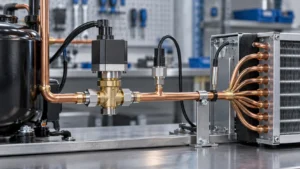
- Suction-line heat exchanger. The suction gas and liquid line exchange heat before the refrigerant reaches the compressor or expansion device. The effect on subcooling, superheat, and compressor protection must be calculated.
- Liquid-suction heat exchanger. Liquid refrigerant is cooled by returning suction gas in a compact counterflow device. It can improve liquid-line condition but may increase suction temperature.
Specialty and process heat exchangers
The final group covers equipment used for process heating, gas handling, energy recovery, and difficult fluid services. These names are useful when a buyer is looking beyond a standard refrigeration coil.
- Spiral heat exchanger. Two channels wind around a core and exchange heat through a separating wall. The geometry can limit dead zones and suit some fouling services.
- Helical-coil heat exchanger. A coiled tube provides a long heat-transfer path in a vessel or shell. The coil diameter and pitch affect flow and cleanability.
- Jacketed-vessel heat exchanger. A jacket around a tank transfers heat to or from the vessel contents. Agitation, wall contact, and temperature uniformity matter.
- Scraped-surface heat exchanger. Rotating blades remove product from the heat-transfer wall. It is used for viscous or fouling food and process products.
- Direct-contact heat exchanger. Two fluids meet directly and exchange heat without a separating wall. The streams must be compatible with the intended mixing.
- Air-to-air plate exchanger. Two air streams pass through separate plate channels. It can transfer sensible heat in ventilation and energy-recovery systems.
- Rotary wheel heat exchanger. A rotating matrix carries heat between exhaust and supply air streams. Seal leakage, wheel speed, carryover, and hygiene affect performance.
- Heat-pipe heat exchanger. Sealed heat pipes move heat through evaporation and condensation inside a wick and working-fluid system. The orientation and temperature range are important.
- Run-around coil system. Separate coils connected by a pumped fluid loop transfer heat between air streams that cannot share a direct core.
- Recuperator. A recuperator transfers heat continuously from a hot exhaust stream to a colder incoming stream through a wall or compact matrix.
- Regenerator. A matrix stores heat during one part of a cycle and releases it during another. The matrix material, switching timing, and carryover determine performance.
How to classify heat exchanger types without mixing up the names
Most confusion comes from using one label for several different ideas. A useful specification separates at least four layers.
1. Construction
Construction answers what physically holds the fluids apart. The options include tubes, plates, fins, flat multiport tubes, bonded sheets, channels, and a direct-contact chamber. This is the layer used in phrases such as shell-and-tube, brazed plate, roll-bond, and microchannel.
2. Flow arrangement
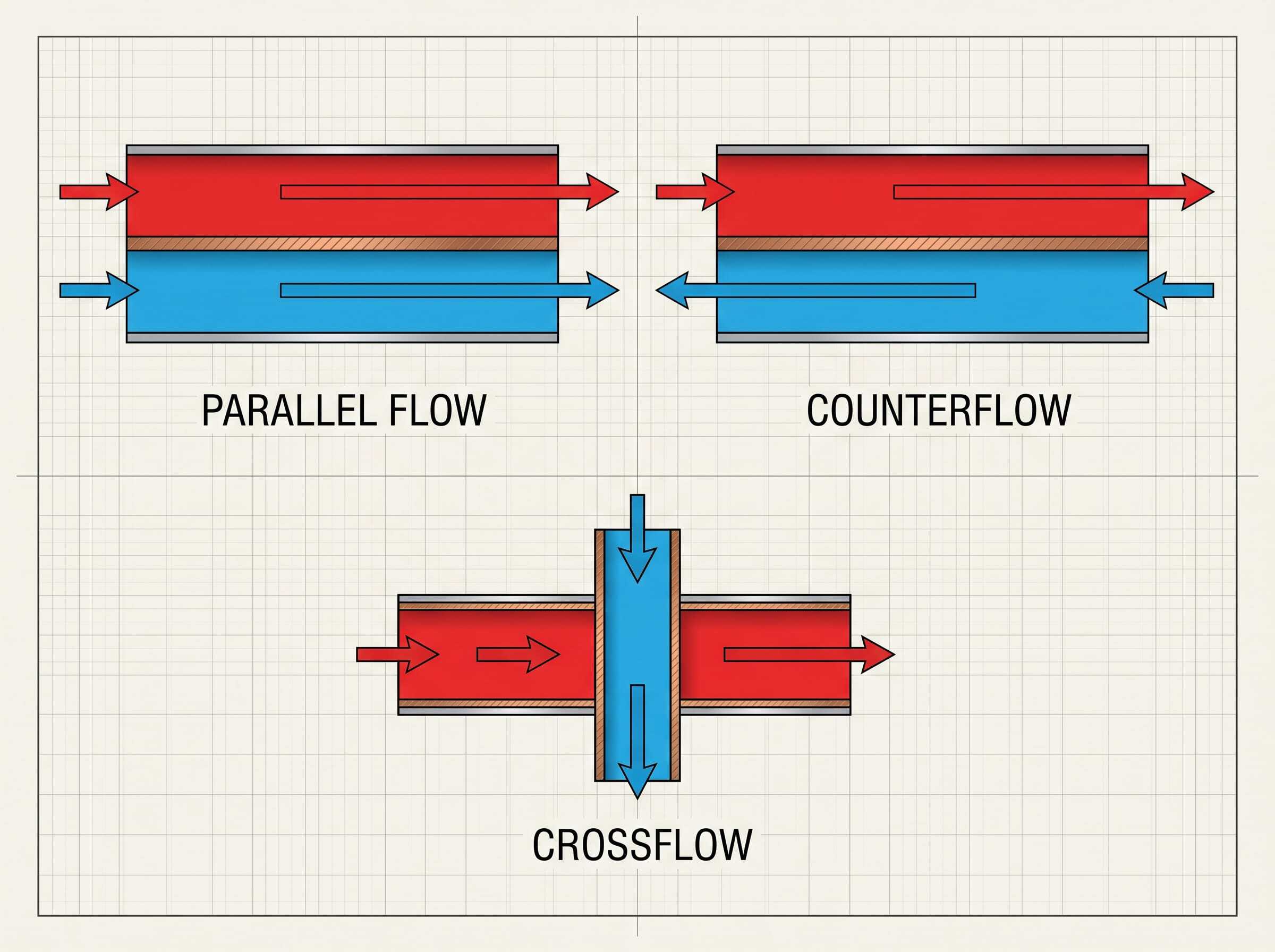
Flow arrangement answers how the streams move relative to each other. Parallel flow sends both streams in the same direction. Counterflow sends them in opposite directions. Crossflow sends one stream across the other. A finned air coil is usually a crossflow exchanger, while a plate unit may be counterflow.
3. Heat-transfer duty
Duty answers what the exchanger does in the system. It may be an evaporator, condenser, gas cooler, desuperheater, reheater, intercooler, oil cooler, or heat-recovery unit. The same construction can perform different duties under different operating conditions.
4. Application
Application answers where the exchanger is installed. A display-case evaporator, walk-in cooler evaporator, residential air-handler coil, and industrial ammonia coil may all be finned-tube exchangers, but they do not share the same design envelope.
This four-layer description is more useful than asking for a “standard heat exchanger.” For example, a buyer might specify an air-cooled, crossflow, finned-tube evaporator for a low-temperature display case, or a brazed plate, counterflow, liquid-to-liquid exchanger for a heat-pump loop.
The heat exchanger overview on Wikipedia provides a neutral starting classification. For engineering work, compare the construction with a reference such as Thermopedia’s heat exchanger entry and then confirm the actual duty with operating data.
Heat exchanger types compared by practical trade-offs
There is no universal winner. A compact plate or microchannel unit may save space while being less forgiving of fouling or repair. A shell-and-tube unit may be easier to service while taking more room. A finned coil may fit the airside package while requiring careful control of frost, condensate, and fin damage.
| Type family | Why engineers choose it | What can go wrong | Questions for a supplier |
|---|---|---|---|
| Finned-tube coil | Flexible geometry and familiar airside service | Fouling, frost, bypass air, bent fins, poor drainage | What are the airflow, fin pitch, rows, circuiting, and face dimensions? |
| Shell-and-tube | Robust construction and serviceable tube bundle | Scale, vibration, bundle fouling, large footprint | What are the design pressure, cleaning route, passes, and water quality? |
| Gasketed plate | Compact size and access for cleaning | Gasket aging, channel plugging, leakage | Can the plate pack be opened, and what is the allowable pressure drop? |
| Brazed plate | Small package with sealed joints | Internal fouling is harder to remove, braze damage | What fluid cleanliness, freeze protection, and pressure test are required? |
| Microchannel | Compact core and potentially lower internal volume | Flow maldistribution, corrosion, small passages, limited repair | How are headers, coatings, cleaning, and field repairs handled? |
| Wire-on-tube or tube-on-plate | Appliance-friendly shape and economical integration | Limited area, airflow restriction, cabinet heat loss | What cabinet envelope, ambient condition, sound target, and mounting points apply? |
| Roll-bond plate | Thin formed surface for appliance and compact designs | Channel forming, leaks, poor contact, difficult replacement | What is the channel pattern, forming tolerance, test pressure, and plate contact? |
How heat exchangers work in refrigeration and HVAC
In a refrigeration cycle, the evaporator absorbs heat from the cooled space and the condenser rejects heat to air or water. A receiver, suction-line heat exchanger, economizer, or desuperheater may add another heat-transfer duty. The refrigerant cycle guide shows how the evaporator and condenser fit into the four main stages.
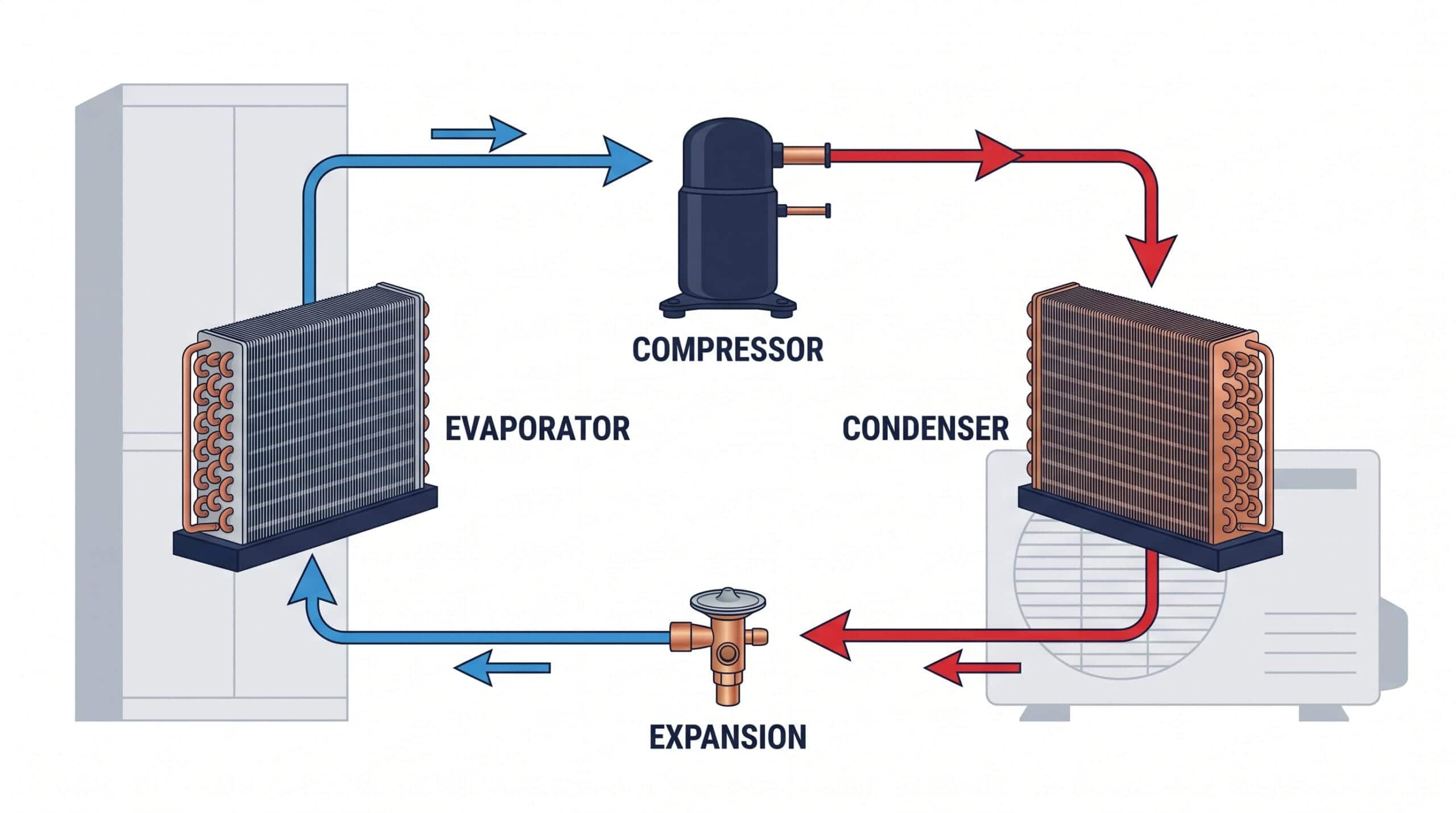
The construction is not interchangeable. A finned evaporator needs enough airside area and an operating plan for condensate or frost. A condenser needs enough surface and airflow to reject heat at the design ambient. A water-cooled exchanger needs acceptable water quality and pump capacity. A suction-line heat exchanger changes the refrigerant condition on two sides of the system and therefore needs a system-level calculation.
For HVAC and heat pumps, the same coil may work in cooling mode and heating mode, but the operating conditions can change when the flow reverses. The supplier needs to know the refrigerant, entering and leaving temperatures, airflow, design pressure, defrost or reverse-cycle behavior, and the required connection layout. Domi’s HVAC and heat-pump solutions page is the relevant commercial path for this type of review.
An air conditioner condenser is also a useful naming example. A complete condensing unit may include a compressor, fan, controls, enclosure, and coil. The condenser coil is only the heat-transfer part. A request that says “AC condenser” without clarifying whether it needs a bare coil or a complete unit can lead to the wrong quotation.
Where the main heat exchanger types are used
The application changes the design priorities. A clean water-to-water heat pump exchanger can use a compact plate design. A dusty outdoor condenser may need wider fin spacing and more cleaning access. A freezer evaporator may need a lower fin density, a drain pan, and a planned defrost method.
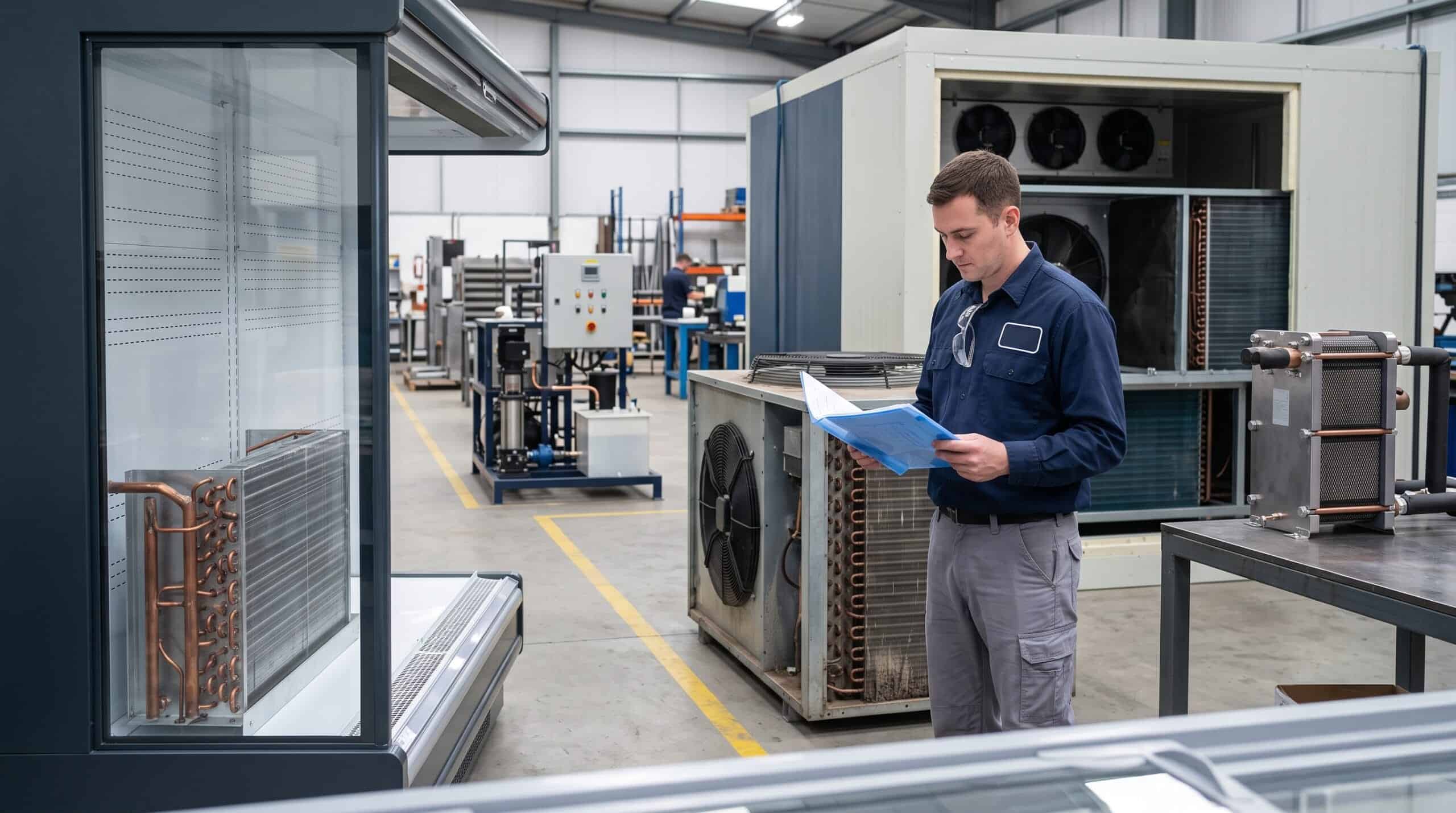
| Application | Common exchanger types | Design details that usually decide the result |
|---|---|---|
| Household refrigerator | Wire-on-tube condenser, tube-on-plate condenser, roll-bond evaporator | Cabinet envelope, ambient air, noise, mounting, charge, heat leakage |
| Beverage cooler | Finned evaporator, wire-on-tube or finned condenser | Display temperature, moisture, fan noise, door openings, service space |
| Walk-in cold room | Unit cooler, finned evaporator, air-cooled condenser | Room volume, product load, defrost, drain, fan throw, corrosion |
| Commercial display case | Forced-air evaporator, low-profile coil, remote condenser coil | Case airflow, shelf clearance, frost, condensate, product temperature |
| Heat pump | Brazed plate, finned coil, microchannel, refrigerant-to-water chiller | Reversible flow, freeze protection, pressure, seasonal operating range |
| Industrial refrigeration | Shell-and-tube, flooded evaporator, finned coil, plate exchanger | Refrigerant, design pressure, oil return, safety, cleaning, plant controls |
| Process cooling | Shell-and-tube, plate, spiral, scraped-surface, jacketed vessel | Fluid chemistry, solids, viscosity, sanitation, phase change, clean-in-place |
| Energy recovery | Air-to-air plate, rotary wheel, run-around coil, heat pipe | Air leakage, carryover, humidity, controls, pressure drop, maintenance |
What data selects the right type of heat exchanger?
The keyword phrase is broad, but a quotation cannot be broad. A manufacturer normally needs the following data before it can compare types or confirm a replacement.
Thermal duty and temperature conditions
State the required heat-transfer rate in watts, kilowatts, BTU/h, tons of refrigeration, or another clear unit. Include entering and leaving temperatures for both media. If the duty changes with ambient temperature, product load, or operating mode, provide the range rather than one best-case number.
Fluids and thermophysical properties
Name the refrigerant, water, glycol mixture, oil, air, steam, gas, or process fluid. State concentration and additives when relevant. Viscosity, density, specific heat, phase change, and fouling tendency affect the calculation. The NIST Thermophysical Properties of Fluid Systems is a useful reference for property data, but the final design should use the project’s approved fluid conditions.
Flow rate and allowable pressure drop
Provide mass flow, volumetric flow, or airflow. State the maximum pressure drop on each side. More rows, tighter fins, smaller channels, and longer flow paths can increase heat transfer, but they also demand more fan or pump power and may change the system operating point.
Envelope, connections, and mounting
Send width, height, depth, tube or plate orientation, connection type, connection location, mounting holes, drain outlet, fan clearance, and service access. A coil with the correct capacity but the wrong connection position is not a drop-in replacement.
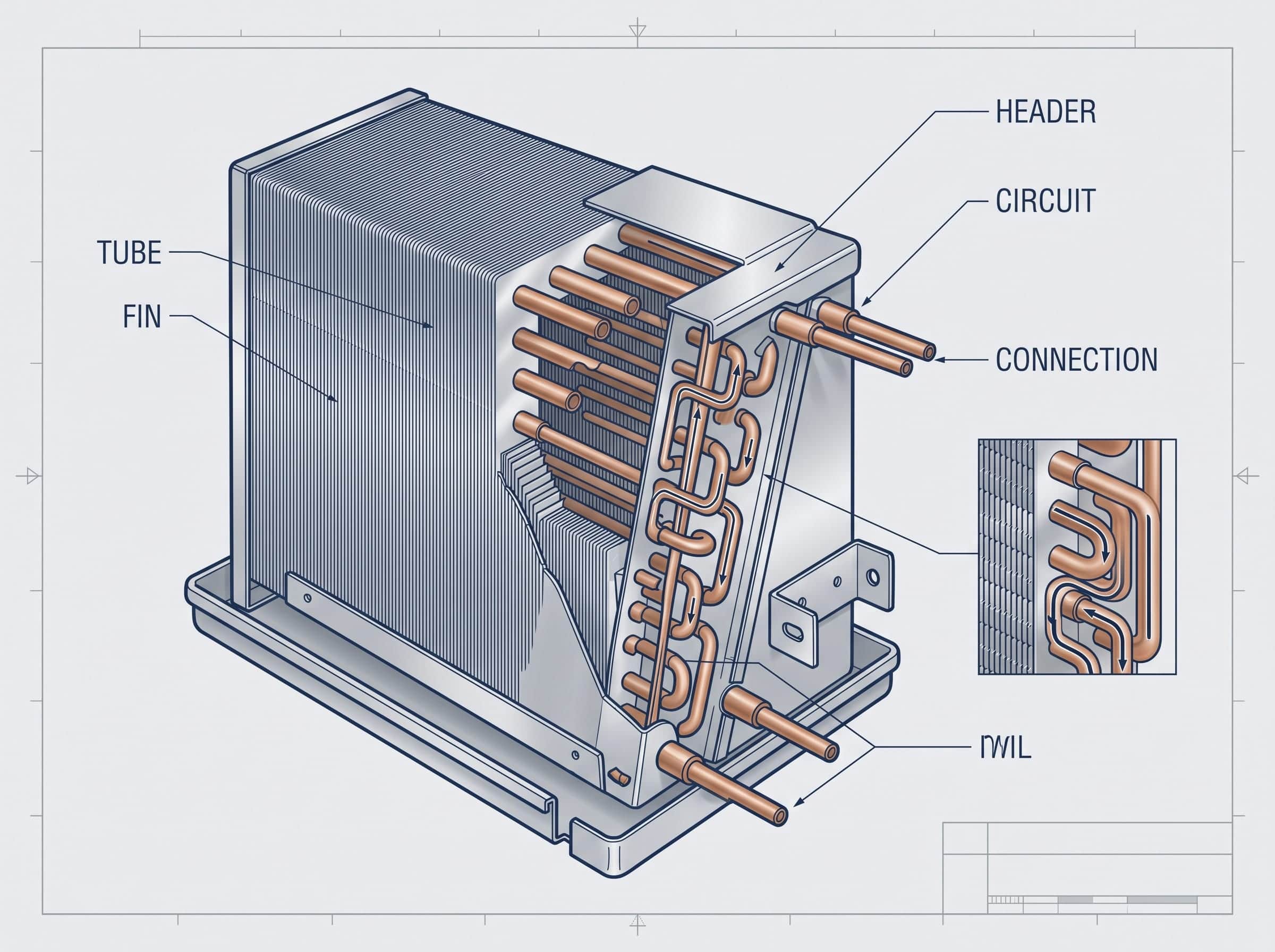
Environment, materials, and cleaning
Describe humidity, salt, dust, oil, chemical exposure, washdown, vibration, outdoor weather, and expected service life. Copper and aluminum are common in refrigeration coils, but coating, fin stock, tube wall, joining method, and galvanic contact may change the correct choice.
Validation and documents
State whether the quotation needs a drawing, sample, pressure test, leak test, burst test, thermal test, inspection record, material statement, packaging specification, or revision-controlled approval package. Domi’s testing laboratory and coil manufacturing process pages are useful starting points for an engineering discussion, but the project acceptance criteria should be agreed before production.
| RFQ input | Example | Why it prevents a wrong type |
|---|---|---|
| Role | Remote evaporator for a display case | Separates a refrigeration coil request from a complete condensing-unit request |
| Media | R-290 on the tube side and cabinet air on the air side | Sets material, safety, operating pressure, and circuit review |
| Duty | Specified capacity at entering and leaving conditions | Prevents comparison by nominal size alone |
| Flow | Airflow, refrigerant mass flow, or water and glycol flow | Controls heat-transfer coefficient and pressure drop |
| Envelope | Face size, depth, connection locations, drain, and mounting | Confirms that the part can fit and be serviced |
| Environment | Humid cold room or coastal outdoor installation | Guides fin pitch, coating, material, and corrosion review |
| Acceptance | Drawing approval, leak test, pressure test, and sample inspection | Creates a clear release gate for OEM production |
How performance declines after installation
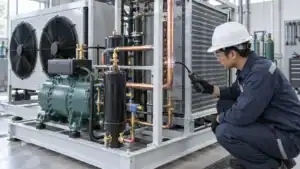
Different heat exchanger types fail in different ways, but the symptoms overlap. A capacity shortfall can come from dirty fins, scale, frost, poor airflow, refrigerant undercharge, water flow loss, incorrect circuiting, a blocked filter, or a control problem. Replacing the exchanger before identifying the cause can repeat the failure.
Air coils are sensitive to dust, grease, lint, bent fins, air bypass, retained condensate, and frost. A condenser may run at a high condensing temperature when the outdoor coil is dirty or the fan is not moving the required air. An evaporator can lose capacity when frost closes the fin passages or when condensate cannot drain.
Plate and shell-and-tube units are sensitive to scale, suspended solids, biological growth, corrosion, gasket damage, vibration, and poor water treatment. Small channels can transfer heat well but become less tolerant of contamination. Large tube bundles may be more serviceable, but they still need inspection and an appropriate cleaning route.
Furnace heat exchanger concerns require a separate safety response. Suspected cracks, combustion problems, venting issues, or carbon-monoxide concerns should be assessed by a qualified HVAC professional. Refrigerant recovery and service work should follow applicable requirements. In the United States, the EPA Section 608 resource is the starting point for refrigerant management information.
How heat exchanger design is changing in 2026
Current equipment programs are placing more attention on compact cores, lower refrigerant volume, corrosion exposure, alternative refrigerants, and evidence from prototype testing. These trends do not make one type universally better. They make the operating envelope and validation plan more important.
Microchannel and compact plate designs can reduce package size, but header distribution, small passages, repair strategy, and coating compatibility deserve early review. Finned-tube coils remain useful because the geometry can be adapted to a cabinet, air handler, cold room, or outdoor condenser. In many OEM projects, a better result comes from changing circuiting, fin spacing, connection layout, or coating rather than replacing the whole construction family.
For HVAC projects, standards and safety classifications should be checked against the actual refrigerant and equipment type. The ASHRAE handbook reference provides a useful technical starting point, but it does not replace the project specification or applicable local requirements.
Digital simulation helps compare airflow, circuiting, pressure drop, and temperature approach before tooling. Physical samples still matter. A model cannot correct an incorrect airflow assumption, an unrecorded cabinet leak, an inaccurate material condition, or a connection that cannot be assembled in the real product.
Frequently asked questions about heat exchanger types
What are the main types of heat exchangers?
The main families are shell-and-tube, plate, finned-tube, microchannel, plate-fin, double-pipe, wire-on-tube, tube-on-plate, roll-bond, and specialty process exchangers. The best choice depends on media, duty, pressure, flow, space, cleaning, and environment. A category narrows the search, but it does not replace operating data.
What are the four common types of heat exchangers?
Many introductory references name shell-and-tube, plate, finned-tube, and double-pipe exchangers as four common families. In modern refrigeration and HVAC work, microchannel is also a major family. The answer changes slightly by industry because appliance, process, automotive, and HVAC engineers use different construction families most often.
What is the difference between an evaporator and a condenser?
An evaporator absorbs heat while a refrigerant or another fluid changes from liquid to vapor. A condenser rejects heat while a vapor changes to liquid. Both are heat exchangers, but they operate at different pressures, temperatures, flow conditions, and control points.
Is a refrigeration coil a heat exchanger?
Yes. A refrigeration coil is a heat exchanger designed for a particular refrigerant duty and air or liquid condition. An evaporator coil absorbs heat. A condenser coil rejects heat. The coil shape, circuiting, fin pitch, connection arrangement, and materials must match the system.
What is the most efficient heat exchanger type?
There is no single most efficient type for every application. Counterflow plate and compact exchangers can achieve a close temperature approach in clean liquid duties. Finned-tube coils may be the practical choice for air systems. Shell-and-tube may offer a better service life when fluids are dirty or cleaning access matters.
Which heat exchanger type is easiest to clean?
The answer depends on the fouling source and the access route. Gasketed plate exchangers can be opened. Removable-bundle shell-and-tube units can support mechanical cleaning. Air coils can be brushed or washed when the fin pack and coating allow it. Brazed plate, microchannel, and roll-bond units need a cleaning plan before installation because internal access is limited.
What information is needed to replace a heat exchanger?
Provide the original model or drawing, application, media, duty, entering and leaving temperatures, flow rates, design pressure, envelope, connections, mounting, environment, and test requirements. Photos help with identification, but they do not reveal circuiting, wall thickness, fin geometry, or the actual operating duty.
Can a shell-and-tube exchanger be replaced with a plate exchanger?
Sometimes, but it is not a direct name-for-name swap. The replacement must meet the duty, pressure, temperature, fluid compatibility, pressure drop, cleaning route, connection arrangement, and control requirements. Fouling, solids, vibration, and service access may make the original shell-and-tube design the safer option.
Are microchannel heat exchangers better than finned-tube coils?
Microchannel units can be compact and may use less internal refrigerant volume. Finned-tube coils offer flexible geometry, familiar repair methods, and a broad range of airside configurations. Compare the two using distribution, corrosion, cleaning, repair, pressure drop, and installation constraints rather than choosing by product label.
How do I request a custom heat exchanger review?
Send the application, media, thermal duty, operating temperatures, flow rates, pressure, dimensional envelope, connections, mounting, environment, and required tests. Include a drawing, sample, or clear photos when available. A supplier can then decide whether a standard finned coil, microchannel, plate, shell-and-tube, roll-bond, or another construction is appropriate.
From a name list to a buildable specification
A list of heat exchanger types is useful when it helps a buyer ask better questions. The next step is to identify the duty, media, flow path, available space, pressure limits, cleaning method, and acceptance test. That information turns a general search for heat exchanger types into a reviewable engineering request.
For an OEM or replacement project, send Domi the drawing or sample information together with the operating conditions. The custom heat exchanger fabrication page is the appropriate starting point for a coil review. The request should state whether you need a bare coil, a complete assembly, a sample, or a repeat-production quotation.
Send Your Operating Conditions and Drawing for Review