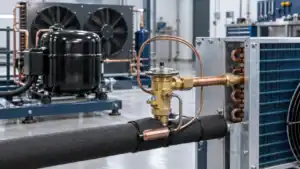


A fan coil unit combines an air-side coil, fan, casing, controls, filtration, and condensate management. This equipment is also sometimes entered as the search variant “fancoil unit”; technical documentation normally uses “fan coil unit”. The coil cannot be selected by itself. A commercial fan coil unit review should match the medium, entering and leaving conditions, airflow, available static pressure, face area, connections, drainage, sound limits, service access, and control interface.
The term fan coil unit can describe a compact terminal unit, a concealed ceiling unit, a vertical cabinet, a horizontal air handler, or a custom equipment assembly. The equipment may use chilled water, glycol, hot water, steam, or a direct-expansion refrigerant circuit. Some units provide cooling only. Others provide heating and cooling through separate coils or a changeover control sequence.
Search results often explain a fan coil unit from a homeowner or building-operator perspective. Commercial buyers need a more detailed specification. They need to know what the coil must do, what the fan can deliver, how condensate will drain, how the unit will be installed, and how a supplier will document the design. This guide focuses on those decisions.
The phrase fan coil unit also creates a scope question for a coil manufacturer. A supplier may quote a coil component, a complete terminal assembly, a motor and fan package, or only engineering support. The buyer should define the requested scope. Domi’s public commercial cooling coils page lists commercial cooling components and should be used as the product starting point. The business must confirm whether a specific project requires a coil component or a complete fan coil unit.
What is a fan coil unit?
A fan coil unit moves air across a heat-transfer coil. The fan provides the air movement. The coil adds or removes heat. The casing controls the air path and provides mounting. Controls open valves, change speed, respond to sensors, and manage the operating sequence. Filters protect the coil and air path. A drain pan and drain line carry condensate away when the coil surface is below the air dew point.
The unit may be installed inside a room, above a ceiling, inside a cabinet, or within larger air-handling equipment. Access can be from the front, side, bottom, or a removable panel. That access changes how the coil is cleaned, removed, tested, and replaced.
Hydronic fan coil unit
A hydronic fan coil unit uses chilled water, glycol, hot water, or a water changeover circuit. The coil rating depends on fluid flow, entering fluid temperature, leaving fluid temperature, air condition, airflow, and pressure drop. A valve and control system regulate flow. Air may need a vent, and the circuit may need freeze protection depending on the site and fluid.
Direct-expansion fan coil unit
A DX fan coil unit uses refrigerant in the coil. The design must account for evaporating condition, superheat, distributor or expansion device, circuiting, pressure drop, refrigerant compatibility, condensate, and system controls. The compressor, condenser, expansion device, and indoor coil form a system. The fan coil unit cannot be rated as an isolated box without the system conditions.
Heating and changeover arrangements
Some equipment uses a separate heating coil. Other designs use a two-pipe changeover system, a four-pipe system, an electric heater, a steam coil, or a reversible heat-pump circuit. The buyer should state the modes and sequence. A fan coil unit that operates in both heating and cooling may need different drain, control, freeze, and airflow checks in each mode.
| Fan coil unit arrangement | Medium | Main coil inputs | Design issue to confirm |
|---|---|---|---|
| Chilled-water cooling | Chilled water or glycol | Flow, entering and leaving fluid temperature, air condition, airflow | Valve, pressure drop, condensate, freeze protection, and drain access |
| DX cooling | Refrigerant | Refrigerant, evaporating condition, superheat, air condition, airflow | Distributor, circuiting, pressure, controls, condensate, and system match |
| Four-pipe heating and cooling | Separate hot and chilled water circuits | Both fluid circuits, airflow, modes, pressure drops | Coil spacing, valve arrangement, service access, and control sequence |
| Two-pipe changeover | One water circuit used for heating or cooling | Mode temperatures, flow, changeover sequence, airflow | Coil and control behavior when the medium changes |
| Heat-pump terminal | Refrigerant or water, depending on design | Both operating modes, ambient or loop conditions, controls | Frost, defrost, reversing, drainage, and mode validation |
The arrangement should appear on the equipment schedule and the RFQ. If the buyer writes only fan coil unit, the supplier may have to make an assumption about the medium and duty.
Start with the room or equipment duty
The coil selection starts with the load and operating conditions. A room terminal may need sensible cooling, latent cooling, heating, or a mixture. A process unit may need a fixed outlet temperature. An equipment integrator may need a coil that meets several rating points with the same cabinet and fan.
State the design load or target capacity, but also state the conditions used to create it. Include indoor or process air temperature, humidity, outdoor or source conditions, airflow, operating schedule, and control range. For a water system, include fluid temperatures, concentration, flow, and available pump pressure. For a DX system, include refrigerant, evaporating condition, superheat, and the expansion-device basis.
When the fan coil unit must run at several speeds, provide the airflow at each speed or identify the speed used for approval. A coil can produce a different capacity and pressure drop at low, medium, and high speed. The lowest speed may create poor air distribution. The highest speed may create noise or carryover.
Sensible and latent cooling
Sensible cooling lowers air temperature. Latent cooling removes moisture when the coil surface is below the dew point. A fan coil unit that must dehumidify needs entering humidity and a drain arrangement. The coil face, fin spacing, airflow, pan, slope, and unit orientation all affect condensate management.
Do not promise a fixed humidity result from a generic coil selection. The actual result also depends on room load, air mixing, fan operation, control logic, and the condition of the air entering the coil. Ask the supplier to identify which values are rated and which remain system-level responsibilities.
Airflow and static pressure
Airflow is the link between the fan and coil. The fan must deliver the required air volume at the external static pressure created by the coil, filter, grille, duct, diffuser, casing, and field installation. A catalog airflow at zero external static pressure does not represent every installed fan coil unit.
Record the fan type, motor, speed range, control signal, rated power, sound limit, and available static pressure. If the buyer expects an electronically commutated motor or another motor type, identify it in the equipment specification. A change in motor or fan curve can change coil face velocity and the measured capacity.
Sound and vibration
Sound is influenced by fan speed, blade design, motor, airflow, grille, casing, mounting, and pressure drop. Vibration may come from imbalance, loose panels, soft mounts, piping, or a fan that is operating away from its intended range. A fan coil unit quote should identify the sound test basis if sound is a contractual requirement.
Choose the coil and fan as a pair
The coil face area, depth, rows, fin spacing, circuiting, and pressure drop affect the fan selection. The fan curve then determines how much air crosses the face. This interaction should be reviewed before the cabinet is released.
A large coil may reduce required surface temperature or improve capacity under one condition, but it can raise cost, weight, and pressure drop. A small coil may fit a narrow cabinet but need more airflow or a lower entering fluid temperature. The correct choice is the one that meets the duty and equipment limits under the stated conditions.
Fin spacing should match the air quality and maintenance plan. A unit in a clean office may use a different surface arrangement from a food-service space, workshop, or process area. Dust, grease, fibers, and moisture can block the air path. Include the filter and cleaning method when reviewing the coil.

| Fan coil unit review item | What the buyer should state | What the supplier should show |
|---|---|---|
| Coil duty | Cooling, heating, latent requirement, rating points | Capacity basis, medium, entering and leaving conditions |
| Air path | Airflow, face area, filter, grille, external static pressure | Face velocity, air-side pressure drop, carryover and drainage considerations |
| Fan and motor | Fan type, speed, motor, control signal, sound target | Fan curve, operating point, motor data, control assumptions |
| Fluid or refrigerant circuit | Medium, flow or refrigerant condition, connections | Circuiting, distributor or valve interface, pressure drop, design pressure |
| Cabinet and service | Width, height, depth, access, mounting, removal path | Coil frame, drain pan, connection clearance, access and installation notes |
The supplier response should distinguish an HVAC coil rating from a complete fan coil unit rating. If the buyer requests only the coil component, the fan curve and control details may remain the equipment integrator’s responsibility. If the buyer requests a complete unit, the scope should include the fan, casing, controls, filters, drain, wiring, and test plan that apply to that project.
Coordinate valves, sensors, and controls
A fan coil unit can have a good coil rating and still respond poorly if the control interface is not defined. State whether the unit uses a two-way or three-way valve, a variable-speed fan, a thermostat, a building-management signal, a temperature sensor, a humidity sensor, or another control. Show sensor locations and the conditions that start, modulate, and stop the unit.
For a hydronic unit, valve authority and flow range can affect the coil result. The valve, actuator, pipe, strainer, balancing device, and pump should be considered together. If the coil is controlled by a leaving-air or room sensor, note where that sensor is installed and how the air mixes after the coil. If the coil is controlled by entering or leaving fluid temperature, record the intended sequence.
For a DX fan coil unit, identify the expansion device, distributor, suction connection, liquid line, and superheat control. A coil supplier can define the component interface, but the system designer must confirm the expansion and compressor arrangement. A change in circuiting or distributor can alter control stability even when the outside dimensions remain unchanged.
The control record should also cover restart, low-temperature protection, condensate alarm, filter alarm, fan failure, and service mode where applicable. Do not claim that a particular control function is included unless the equipment scope confirms it. If the project needs a controller, BACnet point list, alarm logic, or certification that has not been confirmed, mark it REQUIRES BUSINESS INPUT.
Check the full airflow path
The coil face is only one part of the air path. A grille, filter, bend, transition, silencer, diffuser, duct, or cabinet opening can change the air distribution and static pressure. A fan coil unit that is rated with an open inlet may behave differently when installed behind a restrictive grille or a dirty filter.
Ask how the rating was made. Was the fan installed? Was the filter clean? Was the casing sealed? Was the air distributed evenly across the face? Were the sound and vibration measured at the same operating point? These questions help distinguish a component result from a complete-unit result.
The airflow path also affects maintenance. A filter that is difficult to remove may be left in service too long. A coil that cannot be reached may collect dirt. A concealed unit that has no inspection panel may turn a minor blockage into a major service job. Include the routine cleaning and replacement path in the equipment drawing.

Review drainage and condensate management
Condensate is a design input, not an afterthought. When the fan coil unit operates below the entering air dew point, water forms on the coil surface. The drain pan must capture the water. The slope, outlet, trap, insulation, and drain line must move it away from the equipment without carryover or standing water.
Check unit orientation. A horizontal concealed unit may need a different pan or drain arrangement from a vertical cabinet. If the unit can be installed in more than one orientation, the drain design and approval need to cover each orientation or clearly limit the installation.
Carryover can result from high face velocity, poor pan geometry, airflow turbulence, a blocked drain, or a fan operating above the rated point. A coil with a suitable thermal rating can still produce a field problem if water leaves the pan. Include drain inspection in the sample or prototype plan.
Match materials and operating environment
Material selection should reflect humidity, salt, chemicals, cleaning, temperature, dissimilar metals, and service access. Copper tubes and aluminum fins are common, but they are not the only possible construction. The frame, brazed joints, drain pan, fasteners, and coating may have different environmental demands.
The buyer should describe the actual environment rather than use a broad label such as outdoor or corrosive. A coastal air handler, a food-service unit cleaned with chemicals, and a dry office terminal face different exposures. Ask the supplier what material or coating options are available and what evidence supports the proposed option.
Do not call a coating permanent or universal without project evidence. Confirm surface preparation, coverage, edges, joints, adhesion, corrosion test method, cleaning compatibility, repair process, and sample approval. If the customer needs a named coating or certification that has not been confirmed, use REQUIRES BUSINESS INPUT.
The ASHRAE standards and guidelines resource can help the engineering team locate applicable HVAC references. The U.S. Department of Energy commercial buildings resource provides broader context for equipment and building-system decisions. These resources do not replace the project rating or equipment approval.
Fan coil unit installation and service access
Installation constraints can change the coil design. Show the lifting path, service door, panel removal, valve access, drain connection, electrical access, filter path, and replacement path. A concealed unit above a ceiling may need a removable section large enough for the coil and fan. A vertical unit may need front access for filter and coil cleaning.
Service access should be considered before reducing cabinet depth. A compact fan coil unit is not useful if the filter cannot be removed or the coil cannot be cleaned. Include the required working clearance in the drawing. If a field modification is permitted, identify who is responsible for it and how it affects the warranty or approval.
Piping and electrical routing also need clear boundaries. Show where the water or refrigerant connections enter, where the drain leaves, where sensors mount, and where the control panel is located. A component supplier can check its part interface, but the equipment integrator still owns the complete unit layout unless the quotation says otherwise.
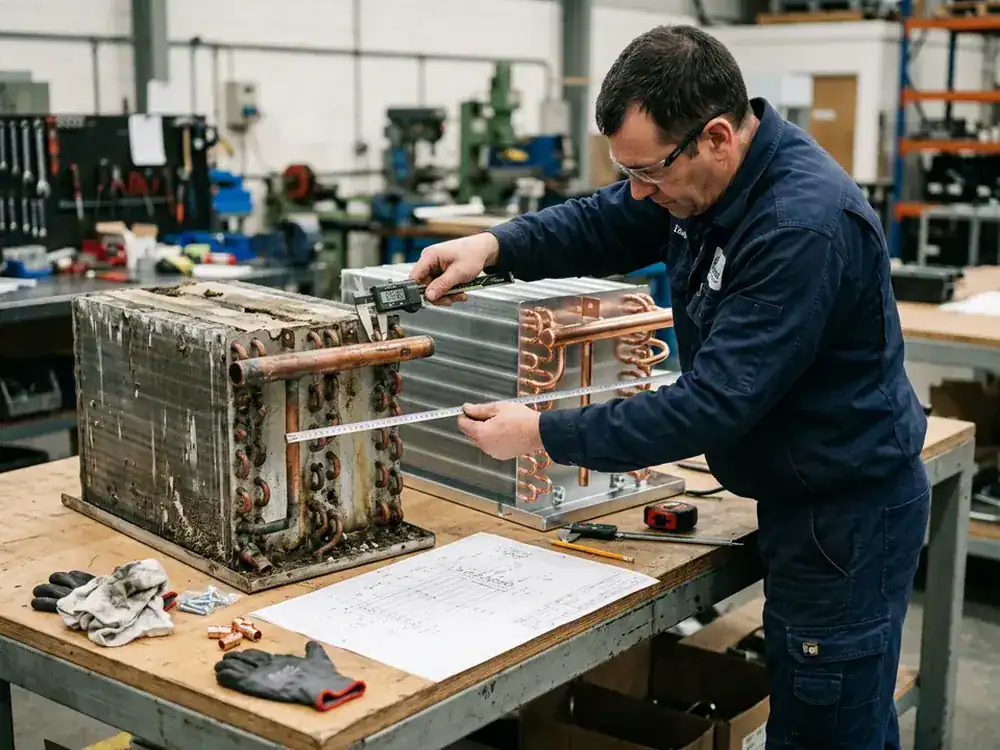
Build a fan coil unit RFQ
The RFQ should state whether the request is for a complete fan coil unit, a coil component, a replacement, or a design review. Include the equipment duty, operating modes, working medium, airflow, static pressure, dimensions, connections, drain, controls, materials, environment, quantity, destination, and deliverables.
For the coil, ask for a rating sheet, drawing, material callouts, connection details, pressure drop, condensate assumptions, and inspection points. For the fan, ask for the fan curve, motor, speed range, control signal, sound basis, vibration plan, and power data if the fan is in scope. For the full unit, ask for the complete equipment schedule and a test procedure.
Do not copy a residential fan coil price or capacity into a commercial quote. Commercial equipment may have different casing, filtration, sound, controls, duty, service, documentation, and repeat-order requirements. The DataForSEO keyword is broad. The article and RFQ need to be precise.
| RFQ phase | Requested evidence | Buyer decision |
|---|---|---|
| Scope definition | Component or complete unit, application, operating modes | Is the supplier responsible for the coil, fan, unit, or only review? |
| Preliminary design | Coil and fan arrangement, rating basis, dimensions | Does the proposed unit fit and meet the stated duty? |
| Interface review | Connections, drain, controls, mounting, access | Can the equipment integrator connect and service it? |
| Sample or prototype | Fit check, airflow, condensate, sound, inspection record | Does the sample represent the approved design? |
| Production release | Controlled drawings, BOM, inspection, packaging, change process | Can the unit or coil be ordered consistently? |
The final quote should also list exclusions. If a control valve, fan, motor, filter, thermostat, drain trap, coating, certification, or testing service is not included, say so. Clear exclusions help procurement avoid treating a component quote as a complete fan coil unit offer.
Prototype and test checks
Test planning should follow the equipment risk. A coil component may need dimensional, leak, pressure, thermal, airflow, pressure-drop, coating, or drain checks. A complete fan coil unit may also need sound, vibration, power, control response, filter access, and condensate observation.
Define the test conditions before the sample is built. Record air temperature and humidity, airflow, fluid temperature and flow, refrigerant conditions, fan speed, filter state, sensor locations, instrument method, and acceptance criteria. If a value is only a target, call it a target. Do not turn an assumed capacity or sound value into a supplier promise.
The Domi testing laboratory page describes public testing capability and context. Project-specific test methods and results must be confirmed. The AHRI 410 performance rating resource may apply to some coil ratings, but its scope and exclusions must be checked before use.
Keep sample approval tied to the drawing revision. If the supplier changes fin spacing, tube diameter, circuiting, connection position, motor, fan, coating, or drain after a test, review the effect and issue a new revision. A small change can alter airflow, pressure drop, condensate, or controls.
A practical fan coil unit selection checklist
Before requesting a quote, gather:
- Application, room or process duty, operating schedule, and equipment location.
- Cooling, heating, dehumidification, or changeover modes.
- Chilled water, glycol, hot water, steam, refrigerant, or other medium.
- Entering and leaving air conditions, humidity, airflow, and external static pressure.
- Fluid flow, refrigerant condition, allowable pressure drops, design pressure, and connections.
- Fan type, motor, speed range, control signal, sound target, and vibration constraints.
- Face width, height, depth, rows, fin spacing, frame, filter, cabinet, mounting, and access.
- Drain pan, outlet, trap, slope, insulation, condensate route, and installation orientation.
- Materials, salt, chemicals, wash-down, dust, cleaning, frost, and corrosion exposure.
- Required drawing, rating, test, inspection, packaging, quantity, destination, and change-control documents.
- Any missing capacity, coating, certification, MOQ, lead time, or test information marked
REQUIRES BUSINESS INPUT.
How Domi can support the component discussion
Domi’s commercial cooling coils page provides the relevant commercial cooling component context. A buyer requesting a coil for a fan coil unit should send the equipment drawing, medium, air conditions, airflow, pressure limits, dimensions, connections, drain details, quantity, and destination.
The HVAC and heat-pump solutions page can be used as a related product and engineering resource. The engineering capabilities page provides a route for a drawing-led conversation. Domi’s exact supply scope must be confirmed for the project. This article does not state that Domi supplies every complete fan coil unit configuration.
If the buyer needs a coil-only replacement, identify the fan curve and cabinet limits anyway. The coil has to work with the equipment that will use it. If the buyer needs a complete unit, send the full schedule and state which components are in scope. The more clearly the scope is separated, the easier it is to compare suppliers.
What changes when the unit is concealed
A concealed fan coil unit has less room for service correction after installation. The supplier and buyer should review the access path before the cabinet or coil is approved. Check how filters, motors, valves, drain pans, connections, and inspection points will be reached. A component that fits inside the ceiling void may still be difficult to remove through the available opening.
The installation orientation should be stated in the request. Airflow direction, coil face, drain side, valve side, fan access, and control access can change when the same unit family is used in a different room layout. Mark these items on the drawing instead of relying on a general model name. If a unit can be installed in more than one orientation, each allowed configuration should have a clear instruction and drain requirement.
Condensate deserves a specific review. State the drain pan material, outlet position, slope, trap arrangement, insulation, overflow approach, and expected maintenance access. A fan coil unit that performs well thermally can still create a field problem if water cannot leave the pan or if the drain path is not compatible with the installation. The supplier should identify assumptions about the trap, external slope, and site connection.
Sound and vibration should also be tied to conditions. Ask whether the target applies at a stated fan speed, airflow, external static pressure, room condition, or distance. Review motor mounting, fan balance, cabinet panels, flexible connections, and isolation points. Do not compare a sound value from one operating point with a value from another and treat them as equivalent.
Keep the specification readable for procurement
An equipment schedule may be prepared by an engineer, but it will often be quoted, ordered, inspected, and serviced by several teams. Use one line for the unit type and separate lines for duty, medium, airflow, pressure, dimensions, connections, controls, materials, drain, sound, quantity, and documents. This structure makes it easier to compare two offers without losing an important assumption in a paragraph.
The schedule should distinguish required values from preferred values. For example, a maximum depth or connection location may be a hard interface limit, while a fin material or control signal may be an option that needs review. Mark open items as REQUIRES BUSINESS INPUT. A supplier can propose an alternative, but the alternative should remain visible until the buyer approves it.
When the scope is a coil only, list the existing fan, cabinet, filter, control, and drain interfaces. When the scope is a complete fan coil unit, list which of those items the supplier must provide. This distinction prevents a quotation for a bare coil from being compared with a quotation for a complete assembly. It also avoids using fan coil unit as a product label when the actual requirement is a custom replacement coil.
For a multi-model project, prepare a variant matrix. Include model identifier, face size, depth, circuiting, connection side, motor, fan, control, drain, material, and approved revision. A clean matrix is useful during production, packing, installation, and service. It also gives the supplier a place to flag which values are common and which must change by model.
Before release, read the final drawing as an installer would. Can the unit be lifted, positioned, connected, drained, wired, cleaned, and removed? Can a technician reach the service items without damaging the ceiling or adjacent equipment? That practical review often finds a problem that a capacity calculation cannot show.
Fan coil unit FAQ
What does a fan coil unit include?
A fan coil unit normally includes an air-side coil, fan, casing, controls, filter or filter track, and condensate management when cooling can create water. The exact assembly varies by application. The RFQ should state whether the request covers the complete unit or only the coil component.
Is a fan coil unit the same as an air conditioner?
Not always. A fan coil unit is an indoor air-moving and heat-transfer assembly. It may use chilled water, glycol, or refrigerant and may connect to a separate chiller, boiler, or condensing system. A complete air-conditioning system also includes the source, controls, piping, and other equipment.
What information is needed to select a fan coil unit coil?
Provide duty, medium, entering and leaving conditions, airflow, static pressure, face area, pressure-drop limit, dimensions, connections, drain, operating modes, environment, quantity, and service constraints. For a replacement, add old-part photos and a dimensioned drawing.
How do airflow and coil pressure drop affect a fan coil unit?
The fan must provide the required airflow through the coil, filter, casing, grille, and field ductwork. Higher coil pressure drop can reduce airflow, increase sound, or change fan power. Review the fan curve and coil rating together at the actual external static pressure.
Does a hydronic fan coil unit use refrigerant?
Usually not in the indoor coil. A hydronic unit uses chilled water, glycol, hot water, or another fluid. The chiller or heat source may use refrigerant elsewhere in the system. A DX fan coil unit has refrigerant in the coil and needs a different circuit and control review.
How should condensate be handled?
Use a suitable pan, slope, outlet, trap, drain line, insulation, and access arrangement. Check airflow and carryover at the operating point. The installation orientation and service access should be included in the drawing and prototype review.
Can one fan coil unit coil work in heating and cooling modes?
It can in some system designs, but the coil, circuit, controls, drainage, frost, and mode conditions must be reviewed. A two-pipe changeover system and a four-pipe system have different inputs. Do not assume that a cooling-only rating proves heating-mode performance.
Can Domi supply a complete fan coil unit?
The business scope must be confirmed for the specific project. Domi’s public commercial cooling page can support a component and application discussion. Send the equipment schedule, coil requirements, fan and control scope, quantity, and destination so the requested supply boundary can be reviewed.