
A heat exchanger for HVAC transfers heat between air and a refrigerant, water, glycol, steam, or another medium. The right architecture depends on heat duty, entering and leaving conditions, airflow or fluid flow, temperature approach, pressure drop, materials, size, connections, corrosion exposure, drainage, service access, and the evidence required for approval.
The phrase heat exchanger for HVAC sounds specific, but it can describe several different components. An engineer may mean a direct-expansion coil, a chilled-water coil, a hot-water coil, an air-to-air core, a heat-pump coil, a fin-tube heat exchanger, or another device that transfers heat. A buyer may be looking for a replacement coil or a custom core for an air handler. The supplier needs the application and working medium before choosing a construction.
This guide is for HVAC OEMs, air-handler designers, equipment integrators, procurement teams, contractors, and project engineers. It explains how to define the duty and compare heat-transfer architectures without treating every heat exchanger for HVAC as the same product. It does not replace a thermal design, pressure review, code review, or final equipment approval.
Domi’s HVAC and heat-pump solutions page and commercial cooling coils page provide related product and engineering routes. A buyer should use the public pages as a starting point, then send the drawing, medium, duty, airflow or flow, pressure limits, quantity, and destination for a project-specific discussion.
What does heat exchanger for HVAC mean?
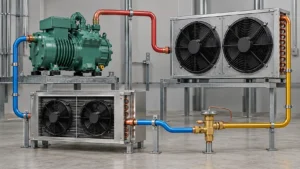
At a basic level, a heat exchanger for HVAC lets heat move from one stream to another without mixing the streams. The streams may be air and refrigerant, air and water, air and glycol, air and steam, or two air streams separated by a core. The heat-transfer surface may use tubes and fins, plates, flat multi-port tubes, a coil matrix, or another construction.
The architecture changes with the application. A direct-expansion evaporator absorbs heat from air into refrigerant. A condenser rejects refrigerant heat to air. A chilled-water coil transfers heat from air to water or glycol. A heat-recovery core transfers heat between air streams. A hot-water or steam coil adds heat to air.
The equipment schedule should state the architecture and medium. A request that says only heat exchanger for HVAC can lead to a quotation that is technically correct for a different application. Add the role, air path, fluid path, duty, dimensions, connections, and operating conditions.
| Heat exchanger for HVAC architecture | Streams | Typical application | Information that decides suitability |
|---|---|---|---|
| DX evaporator coil | Air and refrigerant | Air handlers, packaged systems, refrigeration equipment | Refrigerant, evaporating condition, superheat, airflow, humidity, drain |
| Air-cooled condenser coil | Refrigerant and ambient air | Condensing units, chillers, refrigeration systems | Heat rejection, condensing condition, ambient, fan, fouling, noise |
| Chilled-water or glycol coil | Air and liquid | Air handlers, process cooling, terminal units | Fluid concentration, flow, temperatures, pressure drop, connections |
| Hot-water coil | Air and heated liquid | Heating sections and air handlers | Flow, temperatures, pressure, control valve, freeze protection |
| Steam coil | Air and steam or condensate | Industrial and commercial heating | Steam condition, drainage, orientation, control, freeze protection |
| Air-to-air core | Two air streams | Ventilation and heat recovery | Airflow, temperature, humidity, leakage, pressure drop, cleaning |
The word heat exchanger for HVAC is therefore an application label, not a complete product specification.
Define the thermal duty
Begin with the amount of heat that must move and the conditions at which it must move. State whether the duty is cooling, heating, heat recovery, dehumidification, condensing, evaporating, or a combination of modes. Provide the design points and the expected operating range.
Air-side inputs
Air-side inputs include airflow, entering temperature, leaving target, humidity, altitude, air direction, filter, grille, duct, external static pressure, and operating schedule. If the heat exchanger for HVAC is expected to remove moisture, provide dew point or humidity and state the drain arrangement.
A fan curve is valuable because the coil pressure drop changes the installed airflow. A rating at a catalog airflow may not represent the actual fan, filter, casing, or field duct. If the equipment has several fan speeds, provide the design point for each speed that matters.
Fluid-side or refrigerant-side inputs
For water or glycol, state the fluid, concentration, entering temperature, leaving temperature, flow, pressure, and design pressure. For refrigerant, state designation, pressure or saturation condition, superheat or subcooling, compressor or expansion-device interface, and operating modes.
For steam, state pressure, temperature, condensate path, control valve, orientation, and freeze risk. For an air-to-air core, state supply and exhaust airflow, temperature and humidity, leakage requirement, contamination, and pressure-drop limit.
Temperature approach and pressure drop
Temperature approach describes how close the two streams can get under the design condition. It affects surface area, rows, circuits, flow, control, and cost. Pressure drop affects fan, pump, compressor, sound, energy, and system stability. A design with a large surface area but excessive pressure drop may not work in the installed equipment.
Do not request the smallest possible pressure drop without stating the duty. The supplier needs to balance heat transfer, surface size, circuiting, airflow, flow rate, and available fan or pump power. If the equipment has a hard limit, state it. If the limit is not known, mark it as an open point rather than assuming a value.

Choose the heat-transfer architecture
Fin-tube coils
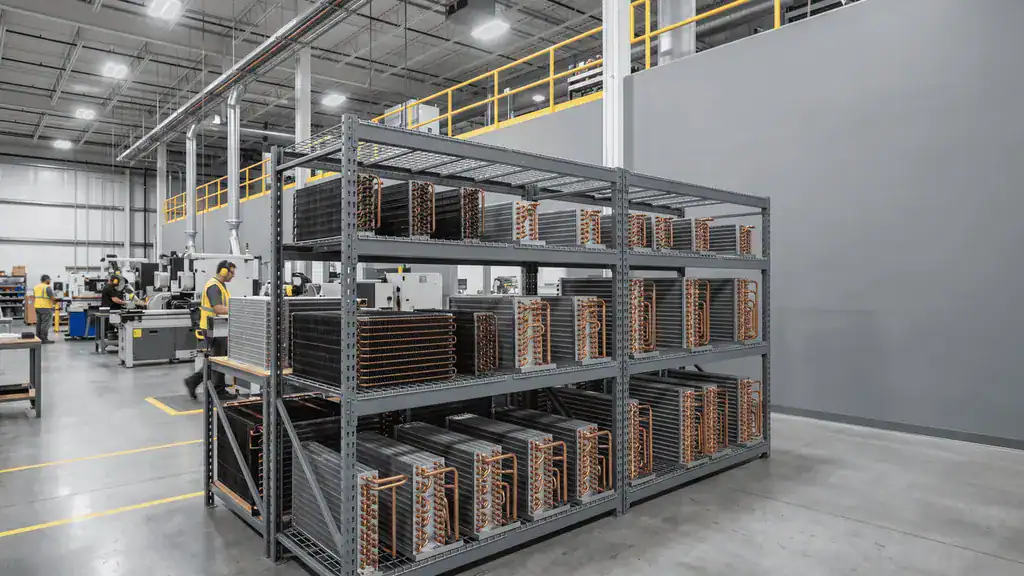
Fin-tube coils use tubes and fins to increase air-side surface. They can be configured for refrigerant, water, glycol, hot water, steam, or other applications. The tube diameter, fin material, spacing, rows, pattern, circuiting, header, and frame affect capacity, pressure drop, cleaning, and fit.
Fin-tube construction is often practical when the buyer needs custom dimensions, a known service method, a specific connection layout, or an established replacement family. The actual material and circuit arrangement still need a project review.
Microchannel cores
Microchannel cores use flat multi-port tubes and fins. They can offer a different balance of compactness, refrigerant distribution, material, air-side pressure drop, charge, service, and corrosion exposure. They are not automatically a replacement for fin-tube HVAC coils with similar outside dimensions.
Compare the two constructions under the same duty and conditions. Include cleaning, repair, header, connection, coating, and availability. The rating method must match the construction. The AHRI 410 performance rating resource has a defined scope and exclusions.
Air-to-air heat recovery
An air-to-air heat exchanger for HVAC transfers heat between two air streams. It may be a plate core, wheel, heat pipe, or another design. The buyer needs to state supply and exhaust air, temperature, humidity, leakage, pressure drop, contamination, cleaning, and service requirements. It should not be rated like a refrigerant or hydronic coil.
Plate and other heat exchangers
Some HVAC systems use plate, brazed, shell-and-tube, or other heat exchangers on the fluid side. Those components have different flow paths, pressure boundaries, fouling, cleaning, gasket, brazing, or service requirements. If the buyer needs a plate or shell-and-tube device, name it. Do not use the generic heat exchanger for HVAC term as the whole specification.
| Architecture | Strengths to investigate | Questions before selecting |
|---|---|---|
| Fin-tube coil | Flexible face and depth, familiar service, custom connections | What tube, fin, rows, circuiting, material, and drain are required? |
| Microchannel core | Compact construction and different refrigerant-side arrangement | What are distribution, corrosion, cleaning, repair, and rating limits? |
| Air-to-air core | Heat recovery without mixing the two streams when designed correctly | What are leakage, pressure drop, humidity, contamination, and service requirements? |
| Plate or brazed exchanger | Compact fluid-side heat transfer in defined flow circuits | What are fluid, pressure, temperature, fouling, cleaning, and joining requirements? |
| Shell-and-tube exchanger | Robust fluid-side equipment for selected process duties | What are tube bundle, shell, baffles, pressure, fouling, and maintenance needs? |
The table helps the buyer start the discussion, but the selected architecture needs an application-specific rating and mechanical review.
Match materials and environment
Material selection includes tubes, fins, plates, headers, frame, fasteners, seals, joints, drain pan, and coating. Consider working medium, pressure, temperature, humidity, salt, dust, chemicals, wash-down, dissimilar metals, cleaning, service, and production method.
A coastal air handler may need corrosion questions. A process unit may need chemical compatibility. A wet evaporator may need drainage and cleaning. A dry indoor coil may need a different balance. The phrase heat exchanger for HVAC does not identify the environment.
Coatings can be useful in a defined environment, but the buyer should ask for surface preparation, coverage, edges, joints, adhesion, test method, cleaning compatibility, and repair. Do not claim permanent protection, fixed service life, or universal salt resistance without a verified product and project record. Use REQUIRES BUSINESS INPUT for an unconfirmed coating, certification, or test requirement.
Fin spacing is also tied to the environment. Tight fins increase surface density but can hold more dirt or frost. Wider fins can help cleaning and frost clearance but may require more face area. A heat exchanger for HVAC in a clean office and one in a food-service or industrial area should not automatically share the same fin arrangement.
Review air and fluid interfaces
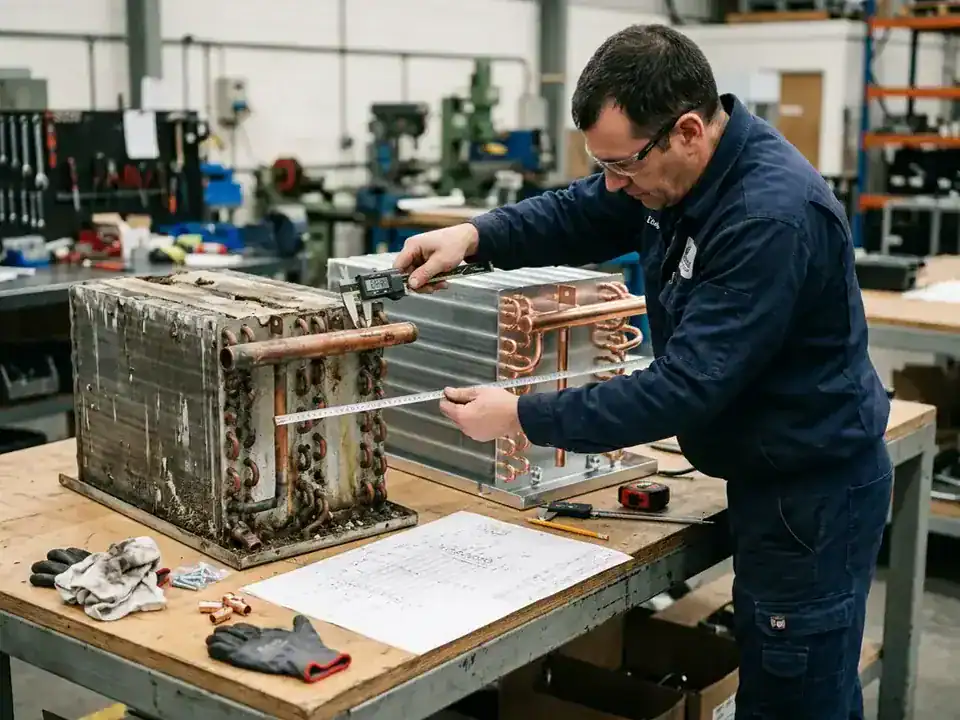
The heat-transfer core must connect to the equipment. Show airflow direction, inlet and outlet, face area, casing, frame, mounting, service opening, connections, valves, drain, trap, sensor pockets, insulation, and removal path.
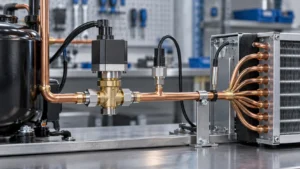
For a hydronic coil, show same-end or opposite-end connections, connection size, location, air vent, drain, valve, and flow direction. For a DX coil, show distributor, expansion device, inlet and outlet, header, circuiting, and suction or liquid line. For an air-to-air core, show seals, bypass, filter, access, and the relationship to fans.
The service path is often missed. A coil may fit the opening but not pass through the access door. A header may clear one panel but interfere with a valve or fan. A drain outlet may be inaccessible after installation. Add the removal path to the drawing.
Build the RFQ around measurable inputs
The RFQ should name the architecture, medium, duty, operating points, dimensions, pressure limits, materials, environment, quantity, and requested documents. Avoid asking for a heat exchanger for HVAC by keyword alone.
Ask the supplier to return a rating sheet that identifies the conditions and assumptions. Request a drawing showing dimensions, connections, circuiting, mounting, drain, material, coating if applicable, and revision. If a prototype is needed, state the sample quantity, test conditions, acceptance criteria, and approval owner.
Separate the coil or core from the complete equipment scope. A supplier may be responsible for the heat-transfer component, while the equipment integrator owns the fan, pump, controls, casing, cabinet, duct, and system rating. If the supplier is asked to deliver a complete assembly, list each component and document in the scope.
| RFQ section | Buyer provides | Supplier should return |
|---|---|---|
| Application | Equipment, duty, medium, operating modes, site | Interpretation, open questions, rating boundary |
| Thermal design | Air and fluid or refrigerant conditions, flow, pressure limits | Capacity, approach, pressure drop, assumptions |
| Mechanical design | Face, depth, rows, fins, connections, mounting, drain | Controlled drawing, materials, circuiting, interfaces |
| Environment and service | Salt, dust, chemical, cleaning, access, replacement path | Surface option, maintenance notes, inspection points |
| Approval and supply | Quantity, prototype, tests, packaging, destination, documents | Sample plan, test record, final drawing, change process |
If the buyer does not know a value, write pending or REQUIRES BUSINESS INPUT. That is better than putting a generic number in a purchase document.
Use standards, calculations, and tests with the right boundary
The ASHRAE standards and guidelines resource can help the team locate HVAC references. The U.S. Department of Energy commercial buildings resource provides broader building-system context. The applicable standard or calculation method should be named in the project record.
If the heat exchanger for HVAC is part of a refrigerant system, include the responsible engineer’s refrigerant and safety review. The U.S. EPA refrigerant management page provides public information about Section 608 requirements in the United States. A public article cannot approve a refrigerant, design pressure, charge, or code result for a specific system.
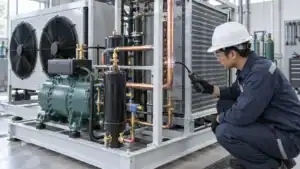
Testing may include dimensions, leak, pressure, thermal performance, airflow, pressure drop, condensate, frost, defrost, corrosion, coating, sound, vibration, or control response. Select tests based on the architecture and risk. A hydronic coil, DX coil, air-to-air core, and plate exchanger do not share one universal test package.
The Domi testing laboratory page provides public context for testing discussions. Any project-specific method, instrument, result, certificate, or acceptance value must be confirmed. Keep the sample revision and test conditions with the final drawing.

Common mistakes in HVAC heat exchanger selection
The first mistake is choosing by keyword. A buyer searches for heat exchanger for HVAC and selects a component without defining whether the medium is refrigerant, water, glycol, steam, or air. The supplier then has to infer the application.
The second mistake is comparing capacity under different air or fluid conditions. Capacity is meaningful only with the rating point, flow, pressure drop, and architecture. Ask for a common basis.
The third mistake is treating pressure drop as a small detail. A fan or pump with limited margin may not deliver the required flow through a high-resistance core. Include fan and pump information.
The fourth mistake is ignoring condensation, drainage, or frost. A wet air coil needs a pan and drain. A low-temperature evaporator may need defrost. A heat recovery core may need frost control. Include the air condition and operating sequence.
The fifth mistake is changing materials without reviewing joints, cleaning, corrosion, and service. A new fin or coating may change the interface or maintenance plan. Put the change on the drawing and test record.
The sixth mistake is asking a component supplier to guarantee the full equipment result without giving the fan, controls, cabinet, piping, or system conditions. Separate component scope from system scope.
Heat exchanger for HVAC selection checklist
Prepare this information before the RFQ:
- Heat-transfer role: evaporator, condenser, chilled water, glycol, hot water, steam, air-to-air, or another architecture.
- Working medium, concentration, refrigerant, pressure, temperature, superheat, subcooling, or steam condition.
- Duty, rating points, entering and leaving air, humidity, airflow, fluid flow, temperature approach, and operating schedule.
- Air-side and fluid-side pressure-drop limits, fan or pump data, filters, ducts, grilles, and available margin.
- Face width, height, depth, rows, fin spacing, tube or plate details, headers, circuits, connections, mounting, frame, drain, and service path.
- Salt, moisture, chemicals, dust, grease, wash-down, frost, condensation, cleaning method, and coating needs.
- Quantity, prototype or sample, drawing format, test, inspection, packaging, destination, and change-control documents.
- Missing capacity, material, certification, coating, MOQ, lead-time, or test information marked
REQUIRES BUSINESS INPUT.
The engineering capabilities page and custom coil fabrication page can be included in the internal buyer path. The requested project scope still needs to be confirmed.
How Domi can support the heat-transfer review
Domi’s HVAC and heat-pump solutions page is a relevant product hub for HVAC heat-transfer questions. The commercial cooling coils page is the better starting point when the project is a commercial cooling coil or related component.
Send the application, drawing, duty, medium, air and fluid conditions, pressure limits, environment, quantity, and destination. If the request concerns a replacement, add the old part, photos, connection sketch, failure area, and intended replacement goal. If the request concerns a new equipment family, add the required modes and design envelope.
The supplier can then separate the rating question from the interface question. A thermal design may be acceptable but not fit. A physical fit may be possible but not meet the duty. A coating may address one environment but not another. A controlled review keeps those questions visible.
Choose by HVAC application
The selection becomes easier when the application is stated before the component name. An air handler cooling section may need a chilled-water coil or DX evaporator. A rooftop package may need a condenser and an evaporator. A ventilation unit may need an air-to-air core. A process unit may need a glycol coil or another custom heat-transfer surface.
For a commercial office, the buyer may prioritize cleanability, sound, condensate, filter access, and part replacement. For a food-service space, grease, wash-down, and access may matter more. For a heat-pump system, both heating and cooling conditions, defrost, drain, and control transitions can matter. For an industrial process, temperature approach, pressure, material compatibility, and inspection can dominate the decision.
The term heat exchanger for HVAC should therefore be followed by an application phrase in the RFQ. Examples include chilled-water air-handler coil, DX evaporator for a packaged unit, air-cooled condenser for a refrigeration system, or air-to-air heat-recovery core. This reduces the chance that a supplier quotes a technically different architecture.
Review thermal calculations without hiding the assumptions
A thermal calculation should identify the method and inputs. It may be a supplier rating, an equipment selection, a heat-load estimate, a simulation, or a test correlation. Record air temperatures, humidity, flow, fluid temperatures, refrigerant condition, geometry, material, and pressure-drop assumptions.
If the calculation uses a target instead of a measured value, label it. If the value comes from an old data sheet, record the source. If the result is preliminary, say so. A calculation is more useful when the next engineer can see which input would change the result.
For a heat exchanger for HVAC, it is common to compare several rating points. A cooling coil may need a design day point and a part-load point. A heat pump may need heating and cooling. An air-to-air core may need summer and winter conditions. A condenser may need mild and hot ambient. State which points are required for approval and which are only for screening.
Temperature approach and pressure drop should appear together. A smaller approach can require more surface or flow. More surface can increase pressure drop. Higher flow can increase pump or fan power. The design should balance those effects rather than chasing one number.
Plan documentation and change control
The drawing should identify the core or coil, revision, dimensions, connections, circuiting, materials, frame, mounting, drain, airflow direction, and inspection points. The rating should reference the drawing revision. The test report should reference the same sample and conditions.
For a custom heat exchanger for HVAC, keep a requirements record with the application, duty, medium, conditions, pressure limits, environment, quantity, and destination. Link the supplier’s questions and answers to the record. If the customer changes the airflow, medium, material, connection, fin pitch, or duty, open a design revision.
Change control does not mean every project needs a large document system. It means the buyer can answer which design was quoted, which sample was tested, and which production part was ordered. That is important when several coil variants share a family name.
The manufacturing process page and rapid prototyping page provide related internal paths for a drawing-led discussion. The exact process, sample, inspection, packaging, and production scope must be confirmed for the project.
Use service history to improve the next design
The best replacement review uses field evidence. Record leakage, corrosion, dirt, frost, carryover, vibration, high pressure drop, low capacity, drain blockage, or connection failure. Photograph the area and note when the symptom appeared. A failed part can reveal a design or maintenance issue that a new rating will not show.
If the coil was difficult to clean, consider fin spacing and access. If water stayed in the pan, review slope, outlet, trap, and insulation. If the fan could not maintain airflow, check pressure drop, filter, grille, and motor. If a coating failed, inspect the surface preparation, edges, chemical exposure, and cleaning method.
Do not promise that a new material or coating will solve a field problem without evidence. State the proposed change, the expected boundary, the test or inspection needed, and the party responsible for approval. Use REQUIRES BUSINESS INPUT when the business has not confirmed a performance or certification statement.
Review an HVAC heat exchanger quotation
A useful quotation should let the buyer compare the proposed heat exchanger for HVAC with the actual equipment requirement. Ask the supplier to identify the architecture, working medium on each side, duty, rating points, dimensions, connections, pressure limits, materials, and service orientation. If the request could be answered by several component types, ask the supplier to state which type is included and which alternatives were excluded.
Review the thermal basis before comparing price. A cooling coil may be rated at a design entering-air condition, a chilled-water flow, and a leaving-air target. A heat pump may need both heating and cooling points. An air-to-air core may need summer and winter conditions. A condenser may need more than one ambient condition. The quote should identify these points and distinguish calculated values from measured results.
Pressure drop needs the same attention. A low pressure drop may require more surface, a larger header, a different circuit, or a higher cost. A compact design may save space but increase fan or pump power. Ask which air-side and fluid-side flow rates were used, whether filters or grilles were included, and whether the value is clean or fouled. These assumptions should remain visible in the approval record.
The interfaces should be reviewed by someone who understands installation and service. Check connection side, centerlines, flange or brazed connection details, drain, trap, frame, mounting, access, insulation, sensors, and removal path. For a replacement heat exchanger for HVAC, compare the available opening with the full assembly, not only with the core face dimensions. A part that passes a thermal check can still be impossible to install or maintain.
Separate quote scope from project assumptions
The quotation should distinguish what the supplier is providing from what the customer must provide or approve. The scope may include a coil or core only, a framed assembly, a fan, a cabinet, a drain pan, a control package, a test, packaging, or documentation. Do not assume a complete heat exchanger for HVAC assembly is included because the product name sounds broad.
List one-time and recurring items separately when relevant. Prototype work, tooling, sample testing, drawing preparation, inspection, production, packaging, and freight can have different commercial treatment. Exact MOQ, lead time, warranty, certificates, and payment terms must be confirmed for the project. Use REQUIRES BUSINESS INPUT for any item that has not been verified.
An open-point list should have an owner and a due point. Engineering may confirm the rating condition. The buyer may confirm quantity and destination. Quality may confirm the inspection method. Installation may confirm access and drain. The supplier may need a sample, drawing, or service record. This structure prevents a missing input from being hidden inside a general approval sentence.
Before purchase release, compare the quotation, drawing, rating sheet, sample record, and inspection plan. They should describe the same revision. If the fin pitch, tube, circuiting, material, coating, connection, frame, or drain changes, request a new review. The strongest heat exchanger for HVAC process is the one that leaves a clear record of what was evaluated and what was actually ordered.
Heat exchanger for HVAC FAQ
What is a heat exchanger for HVAC?
It is a component that transfers heat between air and a refrigerant, water, glycol, steam, or another air stream. The term can describe an evaporator, condenser, hydronic coil, heating coil, steam coil, air-to-air core, or another architecture. The working medium and application should be stated.
How do I choose a heat exchanger for HVAC?
Define the duty, medium, entering and leaving conditions, airflow or fluid flow, temperature approach, pressure-drop limit, dimensions, connections, materials, environment, drainage, service access, quantity, and approval documents. Then compare a supplier rating and drawing against those inputs.
Is a heat exchanger for HVAC the same as a cooling coil?
A cooling coil is one type of HVAC heat-transfer component. It may use refrigerant, chilled water, or glycol. A heat exchanger for HVAC can also be a condenser, heating coil, steam coil, or air-to-air recovery core. The application and medium decide the architecture.
What is the difference between a DX coil and a chilled-water coil?
A DX coil carries refrigerant and connects to an expansion and compressor system. A chilled-water coil carries water or glycol and connects to a pump and cooling source. The flow, pressure, controls, circuiting, and rating conditions are different.
Why does pressure drop matter?
Air-side pressure drop affects fan airflow, sound, and power. Fluid-side pressure drop affects pump flow and control. Refrigerant-side pressure drop affects distribution, operating condition, and system stability. A capacity number without pressure-drop context is incomplete.
Does a larger heat exchanger always perform better?
Not necessarily. More surface can improve capacity at one condition, but it can also increase size, cost, weight, pressure drop, dirt retention, cleaning difficulty, or installation problems. The design should balance thermal, mechanical, service, and control requirements.
What should an HVAC heat exchanger drawing show?
Show revision, face and depth, rows or core details, fins or plates, circuiting, connections, airflow and flow direction, frame, mounting, drain, materials, coating if applicable, inspection points, and service access. The exact details depend on the architecture.
Can Domi quote a custom heat exchanger for HVAC?
Domi’s public HVAC, commercial cooling, engineering, and custom fabrication pages provide routes for a project discussion. Send the drawing, duty, medium, conditions, pressure limits, environment, quantity, and destination. The specific supply scope, design, testing, timing, and commercial terms need project confirmation.