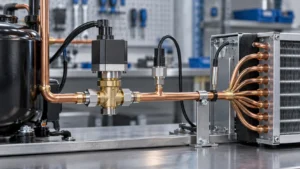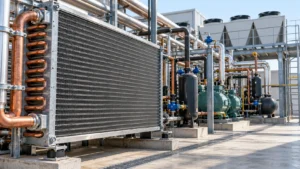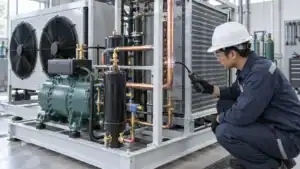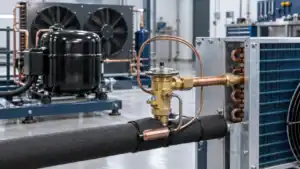

An AC condenser unit is the outdoor component of an air conditioning or refrigeration system that releases indoor heat to the outside air by converting high-pressure refrigerant gas back into liquid form.
Your entire cooling system depends on one box sitting outside in the heat. The AC condenser unit is where every BTU your evaporator coil pulled from your building’s air gets dumped outdoors. When it fails in July, you feel it within minutes. This guide covers what’s inside, how it works, the three major types, how to size one correctly, and exactly when to repair versus replace, for residential HVAC and commercial refrigeration alike.
What is an AC condenser unit?
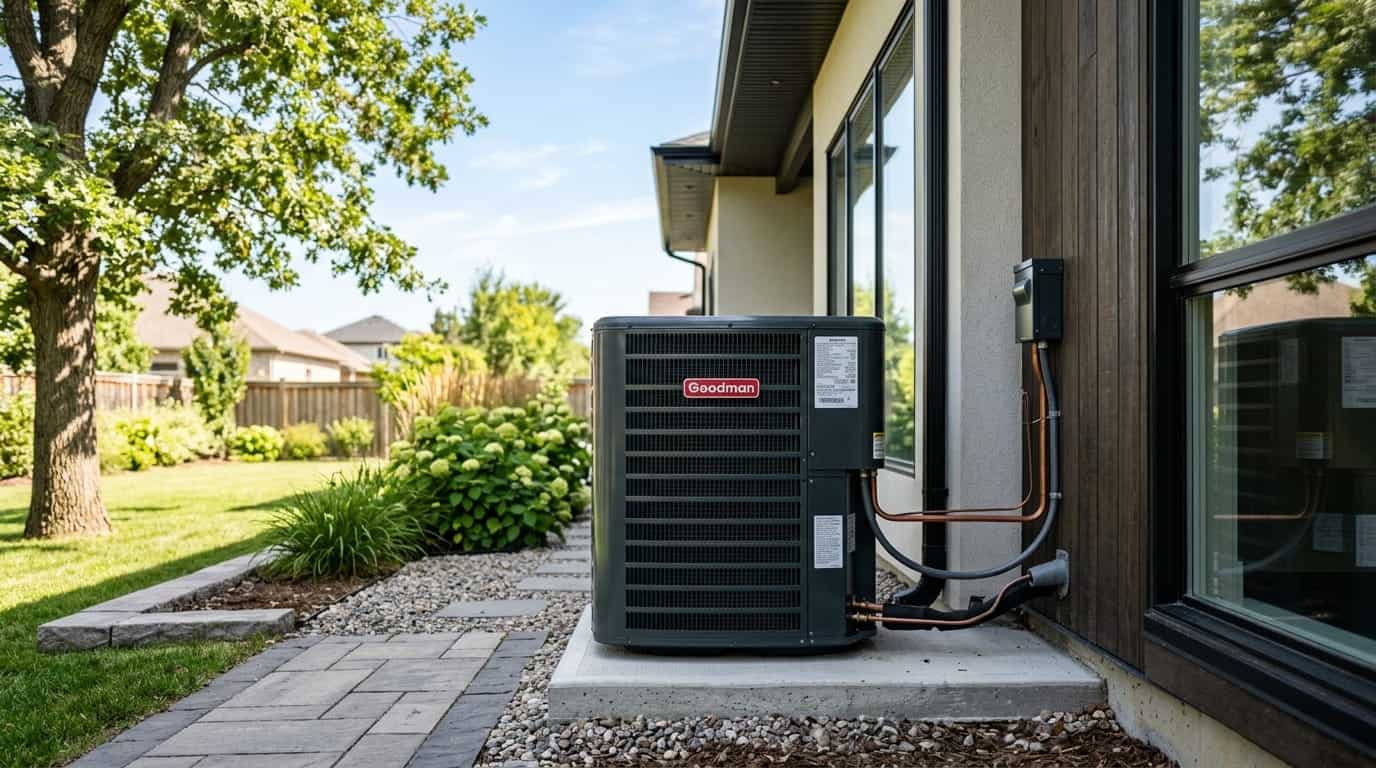
The AC condenser unit is the outdoor half of a split-system air conditioner or heat pump. Its job: take the heat your indoor evaporator coil extracted from the air inside your building and expel it outdoors, completing the refrigeration cycle and letting cool refrigerant loop back inside to start again.
It’s worth being precise on terminology, because “condenser” gets used for three different things in the field.
AC condenser vs. condenser coil: clearing up the confusion
The AC condenser unit is the full outdoor assembly: the cabinet, the compressor, the coil, the fan, and all associated electrical components. The condenser coil is just one part inside that unit, a network of copper or aluminum tubes surrounded by thin metal fins, where the actual heat transfer happens. Technicians often say “the condenser’s leaking” when they mean the coil specifically, and “the condenser’s dead” when they mean the whole outdoor unit. Context tells you which they mean.
Then there’s the heat exchanger, a broader term. Every condenser coil is a heat exchanger, but not every heat exchanger is a condenser coil. In commercial refrigeration (walk-in coolers, industrial chillers, process cooling), “heat exchanger” is the more common phrase even when the component does exactly what a condenser coil does.
| Component | Location | Function | Typical BTU Range |
|---|---|---|---|
| Condenser unit (full outdoor assembly) | Outside the building | Rejects heat from refrigerant to outdoor air | 6,000 to 600,000+ BTU/hr |
| Evaporator unit (indoor coil + air handler) | Inside the building | Absorbs heat from indoor air into refrigerant | Matched to condenser |
| Air handler / furnace | Inside the building | Moves air across the evaporator coil | N/A (fan only) |
Where the condenser fits in the refrigeration cycle
The refrigeration cycle has four main components: compressor, condenser, expansion valve, and evaporator. The condenser unit houses two of those four, the compressor and the condenser coil, plus the electrical controls. So the entire “reject heat” side of the cycle lives in that one outdoor box.
The U.S. Department of Energy notes in its residential HVAC efficiency guidance that the condenser is the primary driver of a system’s seasonal efficiency rating (SEER2). A correctly sized, well-maintained condenser is the difference between a unit that hits its rated efficiency and one that runs constantly and still underperforms.
How an AC condenser unit works
Refrigerant gas enters hot. A fan forces air across the coils to pull out heat. The gas condenses into cool liquid and flows back indoors. That’s the short version; the compressor pressurizing the refrigerant is only step one.
The five-stage heat transfer process
Compression. The compressor, typically a scroll or reciprocating type in residential units, pulls in low-pressure refrigerant vapor from the evaporator return line and compresses it. Compression raises both pressure and temperature. At this stage, the refrigerant is a superheated gas at roughly 140 to 180°F and 250 to 400 PSI, depending on refrigerant type and ambient temperature.
Superheat dissipation. The hot gas enters the top of the condenser coil. The first several passes of tubing make up the desuperheating zone: the refrigerant hasn’t started condensing yet, it’s simply cooling from superheated gas toward saturation temperature. A fan blowing outdoor air across the fins pulls this heat out.
Condensation. Once the refrigerant hits its saturation temperature, it starts changing phase from gas to liquid. This is where most of the heat transfer happens. The refrigerant releases its latent heat to the outdoor air moving across the fins. R-410A, the most common residential refrigerant until recently, releases approximately 105 BTU/lb at this stage.
Subcooling. The bottom passes of the condenser coil subcool the now-liquid refrigerant, dropping it a few degrees below saturation temperature. Subcooling prevents flash gas from forming in the liquid line before the refrigerant reaches the expansion valve, which would hurt system efficiency. Typical subcooling target: 10 to 15°F below saturation.
Exit to expansion valve. Subcooled liquid refrigerant exits the condenser unit through the liquid service valve and travels to the expansion valve, which drops its pressure and sends it into the evaporator coil to start absorbing heat again.
How the fan, coil, and compressor coordinate
The fan on top of the condenser cabinet is sized to pull a specific CFM of air across the coil surface. Too little airflow and the refrigerant can’t shed heat fast enough: head pressure climbs, the compressor works harder, and efficiency drops. Too much airflow and the motor draws more power than the system saves.
| Stage | Refrigerant State | Approx. Pressure (R-410A) | Approx. Temp. |
|---|---|---|---|
| Entering condenser coil | Superheated gas | 400 to 450 PSI | 150 to 180°F |
| Mid-coil condensation zone | Saturated mixture | ~380 PSI | 105 to 115°F |
| Exiting condenser (subcooled liquid) | Subcooled liquid | ~375 PSI | 90 to 100°F |
| After expansion valve (entering evaporator) | Low-pressure mixture | 120 to 140 PSI | 35 to 45°F |
Key components inside an AC condenser unit
Six core parts make up a typical AC condenser unit: compressor, condenser coil, fan motor, capacitor, contactor, and refrigerant lines. Knowing what each one does tells you where to look first when things fail.
The compressor is the heart of the system
The compressor is the most expensive component in the AC condenser unit, typically 30 to 50% of the total unit replacement cost on its own. It’s a motor-driven pump that raises refrigerant pressure, which drives the entire heat transfer cycle.
Modern residential systems use one of three compressor types:
– Reciprocating: Older piston-based design. Reliable, but increasingly uncommon in new residential equipment.
– Scroll: Now dominant in residential and light commercial. Quieter and more efficient, with fewer moving parts than reciprocating.
– Variable-speed scroll (inverter-driven): Adjusts output to match load instead of cycling on and off at 100%. This is why modern high-efficiency units reach SEER2 ratings of 20+. Eliminating the constant start-stop cycle cuts both energy use and compressor wear.
Condenser coil, fins, and the fan motor
The condenser coil is a serpentine tube (copper or aluminum) surrounded by thousands of thin aluminum fins. Those fins increase the surface area available for heat transfer without increasing the unit’s physical footprint. A typical 3-ton residential condenser coil exposes roughly 25 to 40 square feet of fin surface to airflow.
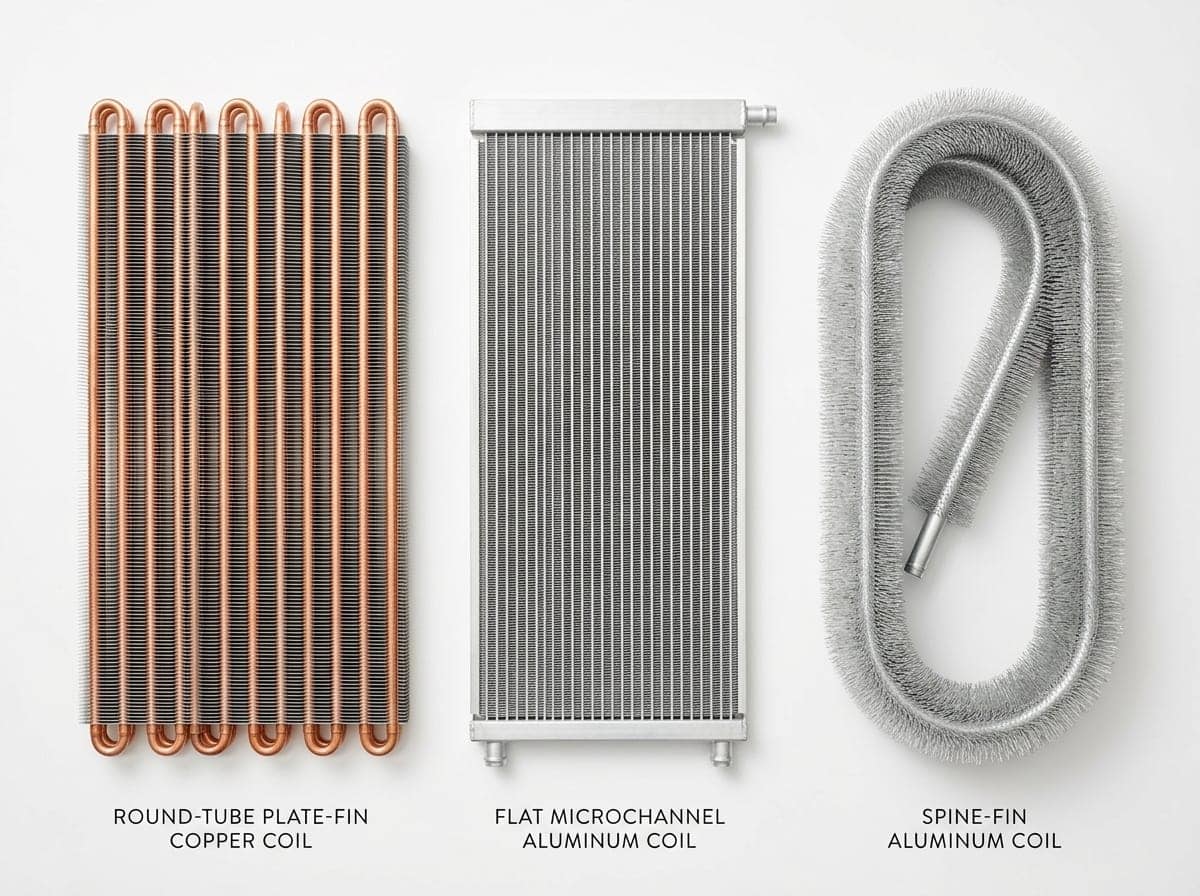
Three coil construction types you’ll encounter in the field:
– Round-tube plate-fin (RTPF): Traditional construction, individual copper tubes run through stacked aluminum fins. Easiest to clean and field-repair. Standard in most residential and commercial units through 2020.
– Microchannel (MCHX): Flat aluminum multi-port tubes with brazed-on aluminum fins. More efficient heat transfer, lighter weight, lower refrigerant charge. Most new residential units use this. Not field-repairable; if it leaks, it gets replaced.
– Spine-fin: Aluminum spine extruded directly onto tubing, used primarily by Carrier and subsidiaries. More surface area per unit volume than RTPF.
The condenser fan motor drives either a propeller fan (residential standard) or an axial fan (commercial packaged units). It’s wired to run whenever the compressor runs, pulling air across the coil. Single-speed motors are the norm; ECM (electronically commutated motor) fans appear on higher-SEER2 units and draw noticeably less power at partial load.
Capacitor, contactor, and electrical controls
The run capacitor stores electrical energy and provides the phase-shift current that the compressor and fan motors need to start and run. A failed capacitor is one of the most common AC condenser unit service calls: symptoms are a humming compressor that won’t start, or a fan that barely turns.
The contactor is a heavy-duty relay that closes the 240V circuit to the compressor and fan when the thermostat signal arrives. Contactors wear out. Pitting on the contact pads causes voltage drop and heat, eventually welding the contacts closed (unit won’t shut off) or failing to close (no start at all). Replacement parts run $15 to $40, and an experienced homeowner can swap one safely.
Types of AC condenser units
Three main types exist: air-cooled, water-cooled, and evaporative. Each uses a different heat-rejection mechanism, chosen by application, climate, and load size, which drives everything from installed efficiency to first cost.
Air-cooled condensers
Air-cooled condensers reject heat directly to outdoor air using a fan-driven coil. They’re the default for residential HVAC, light commercial, and most refrigeration applications under 100 tons. The advantages are simple installation, no water supply required, and low maintenance. The tradeoff is that efficiency drops on hot days, since there’s less temperature differential between refrigerant and ambient air, and the unit needs adequate clearance around the cabinet for airflow.
The ENERGY STAR program requires central AC condenser units to meet a minimum SEER2 of 14.3 (northern states) or 15.2 (southeastern U.S.) under the 2023 regulatory update, thresholds that filter out older, inefficient designs.
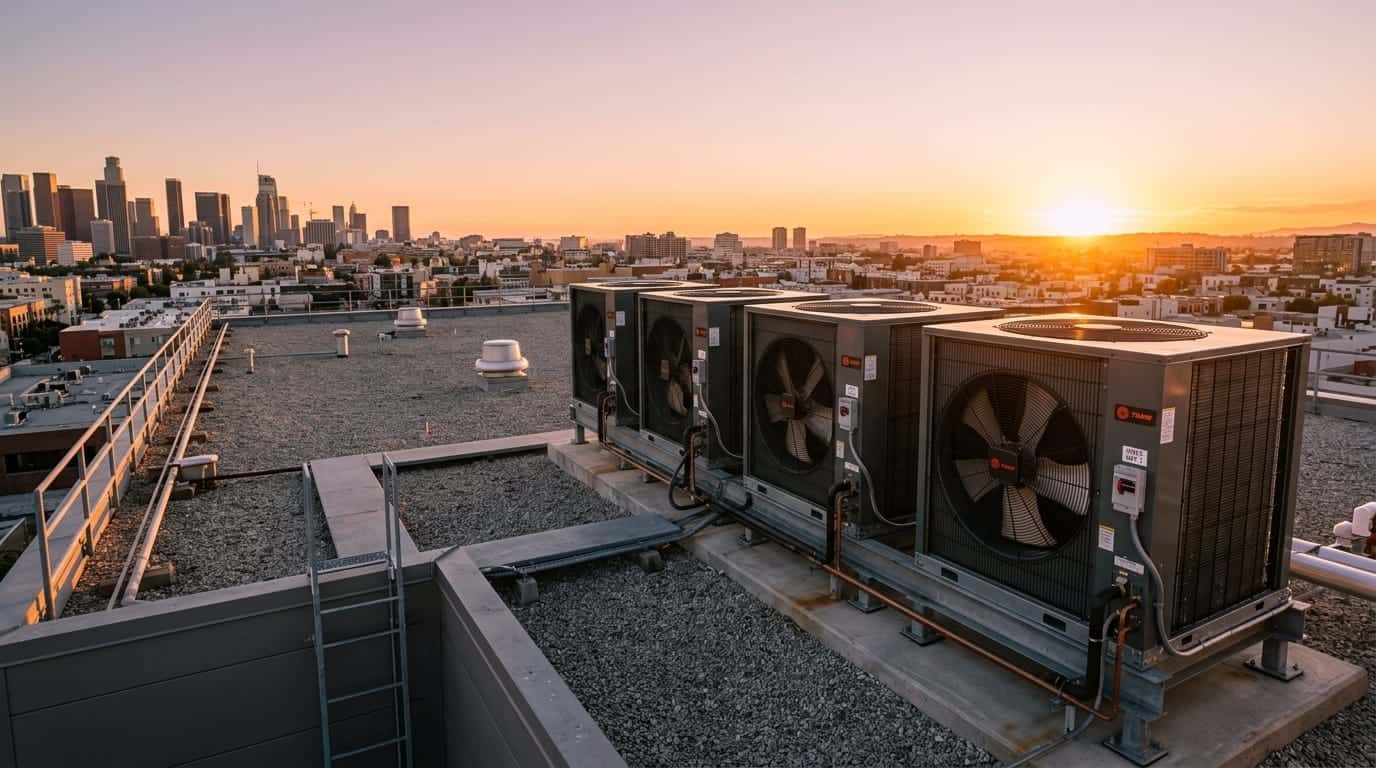
For refrigeration applications, think walk-in coolers, display cases, and commercial freezers, air-cooled condenser units are available as remote condensers, where the unit sits on the roof or outside the building while connecting to indoor evaporators via refrigerant lines. Domirefrigeration manufactures a range of commercial remote condensers for these applications, including configurations for R-404A, R-448A, and R-449A refrigerants.
Water-cooled condensers
Water-cooled condensers use water as the heat-rejection medium. A water-cooled condenser coil sits inside a shell-and-tube or plate heat exchanger; building supply water (or cooling tower water) flows through one side while refrigerant flows through the other.
Water carries heat far more effectively than air, and building supply water is typically cooler than outdoor summer air. A water-cooled chiller can hit an EER of 12 to 15+, compared to 10 to 12 for air-cooled equivalents.
The tradeoffs: you need a water supply and drain (or a cooling tower), the installed cost runs higher, and you’ll need water treatment to prevent scale and biological growth. Water-cooled condensers show up most in commercial buildings, hospitals, and data centers, where indoor installation, noise, and peak-day efficiency matter most.
Evaporative condensers
Evaporative condensers combine air and water evaporation for heat rejection. Refrigerant coils are sprayed with water; a fan pulls air across the wet surface. Evaporating water removes heat far more effectively than dry airflow alone, landing efficiencies between air-cooled and water-cooled at lower water consumption than a full cooling tower.
Common applications include large commercial refrigeration (ice rinks, food processing, cold storage), industrial process cooling, and large HVAC plants in hot, dry climates.
| Feature | Air-Cooled | Water-Cooled | Evaporative |
|---|---|---|---|
| Heat rejection method | Fan + fin-coil | Water through heat exchanger | Water evaporation + airflow |
| Typical efficiency | SEER2 14 to 22 | EER 12 to 18 | EER 14 to 20 |
| Water consumption | None | High (without closed loop) | Moderate |
| Best application | Residential / light commercial | Large commercial, data centers | Cold storage, food processing |
| Typical tonnage range | 1 to 100+ tons | 5 to 1,000+ tons | 20 to 500+ tons |
| Outdoor footprint required | Yes | No (indoor install possible) | Yes (roof or pad) |
Residential vs. commercial AC condenser units
Commercial units run larger tonnage, heavier-gauge coils, and modular multi-circuit designs. Residential units prioritize quiet operation and straightforward installation. The distinction matters when you’re specifying equipment, not just replacing it.
Capacity, construction, and application differences
A residential AC condenser unit typically runs from 1 to 5 tons (12,000 to 60,000 BTU/hr): single refrigerant circuit, one compressor, one fan, rated and matched under ARI/AHRI standards.
Commercial condensers start around 5 tons and scale to hundreds of tons in multi-circuit, multi-compressor configurations. Commercial-grade construction means heavier-gauge coil tubing (often 3/8″ OD vs. residential 5/16″), stainless or epoxy-coated steel cabinets for corrosion resistance in industrial environments, multiple fan motors for staged airflow control, and service valves on every circuit so one can be isolated for service without shutting down the entire system.
Operating environment matters just as much as capacity. A restaurant walk-in condenser sits on a grease-laden roof. A marine refrigeration condenser handles salt air. A pharmaceutical cold room condenser has to hold tighter temperature tolerances (±1°F vs. ±3 to 5°F typical residential). Each application pushes the specification in a different direction.
OEM and custom coil specifications for industrial use
B2B and OEM buyers, refrigeration equipment manufacturers, HVAC system integrators, and cold-chain operators typically need condensers specified around the refrigerant circuit, not a cabinet size. Parameters that drive the spec:
- Refrigerant type: R-410A, R-32, R-454B, R-404A, R-448A, R-407A, or CO₂ in transcritical applications
- Condensing temperature at design ambient, not just nominal capacity
- Subcooling target matched to liquid line length and expansion device type
- Coil material: Copper/aluminum standard; cupronickel or aluminum-brass for corrosive environments
- Fan airflow and static pressure for the installation configuration
Custom coil fabrication, cutting a condenser coil to a specific circuit count, face dimensions, and tube pitch, is a standard OEM requirement. Domirefrigeration’s custom coil fabrication capabilities cover these specs, including non-standard refrigerant applications. Standard coil options for residential refrigeration applications are available through their residential refrigeration coils catalog.
How to size an AC condenser unit
Match tonnage to the building’s actual heat load, roughly 1 ton per 500 to 600 sq ft for residential as a starting point, with commercial loads requiring Manual J or full heat-gain calculations. Oversizing causes as many problems as undersizing, just different ones.
BTU, tonnage, and SEER2 explained
Tonnage is the traditional capacity unit: 1 ton of cooling equals 12,000 BTU/hr, derived from the heat required to melt one ton of ice in 24 hours. A 3-ton AC condenser unit handles 36,000 BTU/hr of heat rejection.
SEER2 (Seasonal Energy Efficiency Ratio, version 2) measures how many BTU of cooling a unit delivers per watt-hour of electricity over a full cooling season. SEER2 replaced the original SEER metric in January 2023 under an updated DOE/EPA test procedure that adds external static pressure to the measurement. The practical effect: SEER2 numbers run 4 to 6% lower than legacy SEER ratings for the same physical unit. A SEER2-18 system uses roughly 28% less electricity than a SEER2-14 running the same hours.
EER2 measures efficiency at a single operating point, 95°F outdoor with 80°F/67°F indoor wet-bulb, rather than seasonally. It’s useful for comparing units in climates with consistently hot summers rather than mixed load profiles.
According to ENERGY STAR certification data, the average U.S. household running central air spends $300 to $500/year on cooling. Upgrading from a SEER2-14 to a SEER2-18 unit typically cuts that by 20 to 25%, real money over a 15-year equipment life.
For residential sizing, ACCA Manual J is the industry-standard load calculation method per ACCA’s quality installation standards. It accounts for:
– Conditioned floor area and ceiling height
– Insulation R-values (walls, ceiling, floor)
– Window area, orientation, and glazing type
– Local design temperatures (ASHRAE 99.6% design conditions)
– Infiltration rate and occupancy loads
Don’t use “square feet divided by 500” as your only reference. A 2,000 sq ft home in Phoenix needs a fundamentally different condenser than a 2,000 sq ft home in Minnesota. Design-day temperatures differ by 30 to 40°F between the two, and that gap changes the required tonnage significantly.
Common sizing mistakes that overload or underperform
Oversizing is the more common error, especially in residential replacement sales where contractors use rules of thumb or simply match what was there before.
An oversized AC condenser unit short-cycles: it reaches setpoint and shuts off before completing a full refrigeration cycle. The compressor barely gets up to operating temperature before it stops again. The results show up as higher indoor humidity, since the system doesn’t run long enough to dehumidify, more frequent compressor starts (mechanically the most stressful point in the cycle), higher energy bills from repeated inrush current at startup, and a shorter lifespan for the compressor specifically.
Undersizing means the unit runs constantly and never quite reaches setpoint on design days. It’s less mechanically damaging than oversizing, but the compressor runs hot and the occupant stays uncomfortable.
The American Society of Heating, Refrigerating and Air-Conditioning Engineers (ASHRAE) recommends residential systems be sized within 15% of Manual J calculated load, with a slight preference for undersizing over oversizing when the margin is close.
Signs your AC condenser unit is failing
Warm air output, refrigerant leaks, loud rattling, ice on coils, and high energy bills are the five clearest failure signals. Catching them early is the difference between a $40 capacitor and a $2,500 compressor.
Diagnostic checklist: what to test first
When an AC condenser unit stops cooling properly, work through this sequence before calling for replacement:
- Check the outdoor disconnect. A tripped breaker or pulled disconnect is a five-minute fix that occasionally gets misdiagnosed as compressor failure.
- Measure supply air temperature differential. Target ΔT of 16 to 22°F between return and supply. Under 14°F points to low refrigerant charge or airflow restriction. Over 22°F often means a blocked filter or frozen evaporator coil.
- Inspect the condenser coil externally. Debris such as cottonwood, grass clippings, or pet hair packed into the fins blocks airflow and drives head pressure up. A garden hose rinse (fins-out to fins-in) clears mild fouling; heavy buildup needs coil cleaner.
- Test the capacitor. A failed or weak capacitor is the most frequent AC condenser unit repair call. A $20 capacitor meter and a $15 to $30 replacement cap make this a realistic DIY fix with the unit de-energized.
- Listen to the contactor. The thermostat signal energizes it; you should hear a single clean click. Buzzing or intermittent contact means the pads are worn.
- Look for refrigerant oil. Refrigerant is colorless and odorless, but it carries compressor oil. Oily residue around service valves, coil joints, or Schrader ports points to a leak.
Repair vs. replace: the decision framework
The right answer depends on unit age, repair cost relative to replacement, and refrigerant type. R-22 systems are the critical variable here, since new R-22 production and import is prohibited under EPA regulations. Recovered stock costs $50 to $100+/lb, making even a modest leak repair expensive.
| Unit Age | Repair Cost vs. Replacement | Recommended Action |
|---|---|---|
| Under 8 years | Any percentage | Repair, well within useful life |
| 8 to 12 years | Under 20% | Repair, still cost-effective |
| 8 to 12 years | 20 to 40% | Evaluate refrigerant type; replace if R-22 |
| 8 to 12 years | Over 40% | Replace, approaching end of life |
| Over 12 years | Over 25% | Replace, factor in SEER2 energy savings |
| Any age | Compressor failure | Get a full-unit replacement quote |
Future of AC condenser technology (2026 and beyond)
Low-GWP refrigerants (R-32, R-454B) and variable-speed compressors are the two biggest forces reshaping condenser design, and both are already in mainstream production.
The R-410A phaseout and what replaces it
R-410A, the dominant residential refrigerant since the early 2000s, has a Global Warming Potential (GWP) of 2,088, more than 2,000 times the climate impact of CO₂ over a 100-year period. The EPA’s American Innovation and Manufacturing (AIM) Act phasedown set GWP limits that effectively require new equipment to use lower-impact alternatives starting in 2025.
Three refrigerants are absorbing most of the transition:
- R-32: GWP of 675, roughly 68% lower than R-410A. Already standard in most European and Asian residential equipment. Operates at slightly higher pressure than R-410A, which requires some component changes, but thermodynamic efficiency is similar or marginally better.
- R-454B (Puron Advance): GWP of 466. Adopted by Carrier for its residential lineup. Mildly flammable (A2L classification), so installation requires ignition-resistant motor controls and specific handling precautions.
- R-290 (propane): GWP of 3. Used in small commercial refrigeration and mini-splits in some markets. Excellent thermodynamic properties, though flammability limits per-circuit charge size (typically under 500g).
Equipment you specify today should handle R-454B or R-32. If you’re buying for a 15-year service life, refrigerant availability matters more than current list price.
Variable-speed compressors and smart HVAC integration
Fixed-speed compressors run at 100% capacity or not at all. Variable-speed (inverter-driven) compressors run at 10 to 100% of rated capacity, modulating to match the actual building load in real time. On a mild day when the building needs 40% of full capacity, the AC condenser unit runs at 40%: quieter, more efficient, and easier on the equipment.
Smart HVAC integration, connecting the condenser unit to building management systems (BMS) and predictive maintenance platforms, is moving from commercial-only into residential applications in 2026. Sensors embedded in the condenser monitor refrigerant pressure, compressor current draw, and fan motor performance, catching degradation before a failure occurs. Facilities teams that have adopted predictive maintenance on rooftop condensers commonly report 30 to 50% fewer unplanned failures compared to running purely reactive repair schedules.
| Technology | Adoption Stage (2026) | Efficiency Impact | Primary Market |
|---|---|---|---|
| Variable-speed compressor | Mainstream residential | +20 to 40% vs. fixed-speed | Residential, light commercial |
| A2L refrigerant (R-32 / R-454B) | Entering mainstream (new equipment) | Neutral to +5% | All new residential equipment |
| Microchannel coil | Standard new construction | +10 to 15% heat transfer vs. RTPF | Residential, commercial |
| Smart BMS integration | Common in commercial | Reduces failures 30 to 50% | Commercial, industrial |
| CO₂ transcritical | Commercial refrigeration | High efficiency in cold climates | Supermarkets, cold storage |
FAQ
What is the AC condenser unit?
The outdoor component of a split air conditioning system that releases refrigerant heat to outside air. It houses the compressor, condenser coil, and fan motor. Without it, refrigerant can’t shed the heat load it picked up indoors, and the cooling cycle stops entirely.
How much does an AC condenser unit cost?
Installed costs for residential units range from $1,500 to $4,500 for the condenser itself, plus $500 to $1,500 for labor depending on region and system complexity. High-efficiency units (SEER2 18+) sit at the upper end of that range. Commercial units scale from $3,000 for a small packaged condenser to $50,000+ for large multi-circuit installations. Compressor replacement alone runs $800 to $2,500 in parts before labor.
How do I tell if my AC condenser is bad?
Five signals: warm air from supply registers despite the system running, visible oil residue around coil fittings or service valves, the condenser fan not spinning while the compressor hums, ice building up on the outdoor coil or refrigerant lines, and the system tripping its breaker on hot days. Start with the capacitor and contactor; both are inexpensive and account for a large share of no-start calls.
What is the difference between a condenser and an evaporator?
They do opposite jobs. The evaporator coil sits indoors, absorbs heat from indoor air into the refrigerant, and cools the air supply. The condenser unit sits outdoors, pulls that heat out of the refrigerant, and rejects it to the outside air. Both are heat exchangers; one absorbs heat, the other rejects it.
How long does an AC condenser unit last?
15 to 20 years with regular maintenance: annual coil cleaning, filter changes, and electrical inspection. Units in coastal or industrial environments (salt air, grease, chemical exposure) can fail in 10 to 12 years from coil corrosion. Units that run for years with dirty coils or incorrect refrigerant charge often fail earlier because of the added compressor stress.
Can I replace just the condenser unit without replacing the whole system?
Sometimes, but with caveats. The indoor and outdoor units must be refrigerant-compatible. Replacing a newer condenser (under 8 years) with a matched indoor coil is usually straightforward. Crossing refrigerant types, say R-22 to R-410A or R-454B, requires a full system replacement. Mismatched systems run at reduced efficiency and void equipment warranties from both manufacturers.
What refrigerant does an AC condenser unit use?
New residential equipment shipped since 2024 uses R-410A or R-454B (Puron Advance), with R-32 increasingly common in mini-splits. Commercial refrigeration condensers may use R-404A, R-448A, R-407A, or CO₂ depending on the application and temperature range. R-22 is no longer produced or imported in the U.S.; systems still running on it use recovered stock, which is scarce and expensive.
Choosing your next AC condenser unit: the bottom line
The right AC condenser unit isn’t the biggest one, and it isn’t the cheapest one. It’s the one matched to your actual heat load, running a refrigerant with a viable supply future, and built for your operating environment.
For residential replacement, a properly sized SEER2-16 to SEER2-18 unit with a variable-speed compressor lands the sweet spot between upfront cost and long-term energy savings. For commercial and industrial applications, refrigerant type, condensing temperature at your design ambient, and coil material should drive the specification before list price ever enters the conversation.
If you’re evaluating commercial condensers, evaporator coils, or custom-fabricated heat exchanger components for OEM or refrigeration applications, the Domirefrigeration team can spec units across a range of refrigerants and operating conditions. Their commercial condenser lineup and evaporator coil catalog are built for system integrators and refrigeration equipment manufacturers who need consistent performance data and real engineering support.