
Ice machine evaporator corrosion, mineral scale and peeling plating require different responses. Scale is material deposited on a surface; corrosion damages the metal; plating loss exposes the layer underneath. Confirm the failure before choosing a cleaner or replacement material. Water analysis, the exact evaporator construction, approved cleaning instructions and inspection of the finished assembly should guide an OEM decision.
A plate that repeatedly holds ice can prompt an expensive material change. Yet the same symptom can come from deposits, damaged plating, poor water distribution, a seal defect or a harvest-control problem. Replacing the plate without identifying the mechanism can send the next production batch into the same service conditions.
This guide is for quality engineers, materials teams and buyers reviewing commercial ice-machine components. It provides a way to organize the investigation and supplier request. It does not select a universal alloy or authorize a field repair. All illustrations are original explanatory concepts, not photographs of actual Domi failures or measured test results.
Jump to failure types · cleaner compatibility · material choices · validation
Separate scale, corrosion and plating loss first
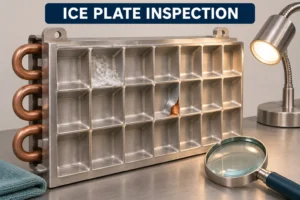
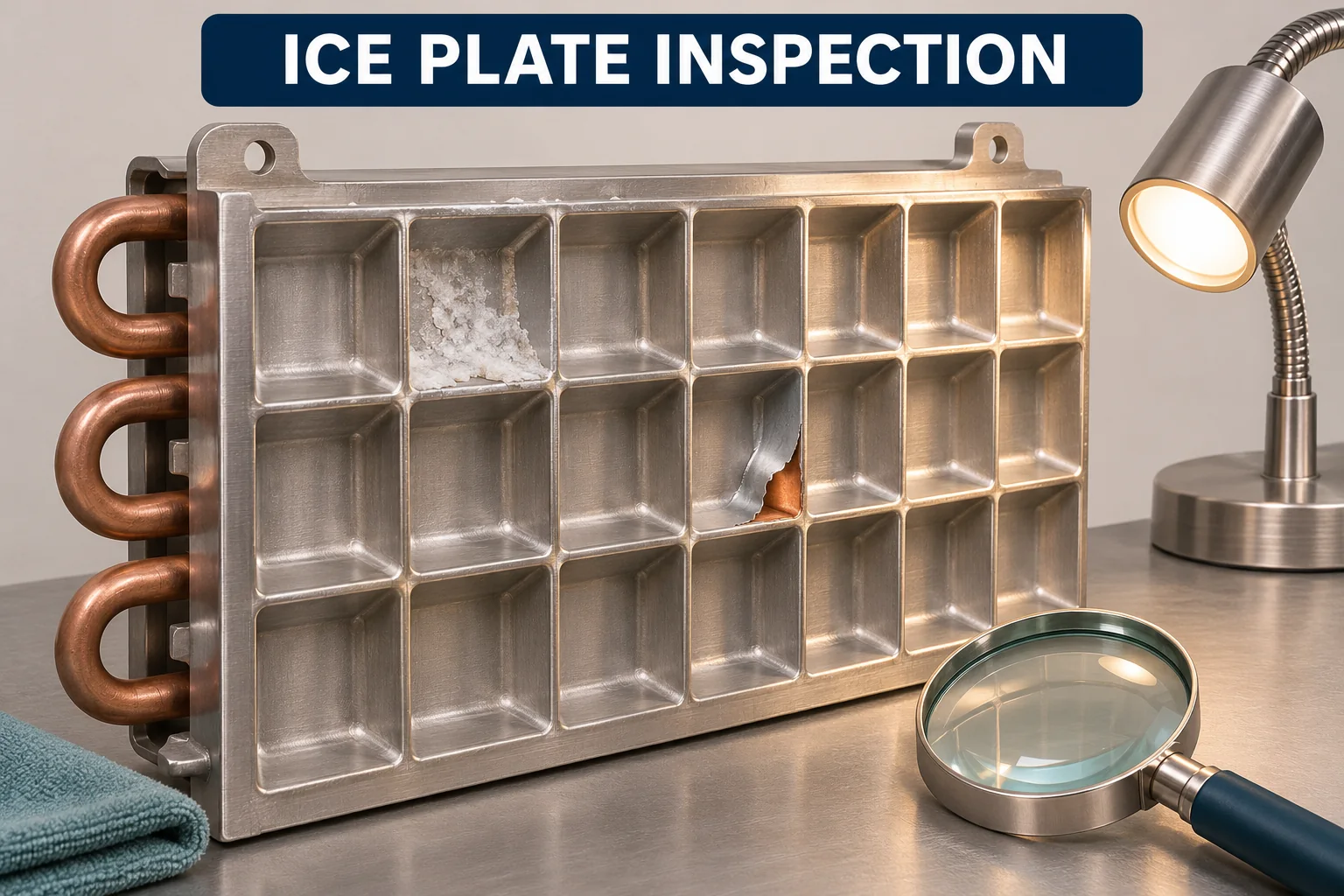
Begin with the surface condition, not the service ticket’s description of “bad water.” Photograph the dry surface before cleaning, under normal and angled light. Record where the problem appears: water entry, grid intersections, plate edges, joints, splash zones or an area that retains water after shutdown.
| Observation | First question |
|---|---|
| Raised white or chalky deposit | Is material accumulating above an intact surface? |
| A cavity or localized metal loss | Has the substrate been attacked? |
| A lifted film or flaking edge | Is the protective layer separating? |
| Ice repeatedly sticks in one area | Is the surface damaged, or is release affected elsewhere? |
These observations are screening clues. A photograph alone cannot identify every deposit or prove a corrosion mechanism. Scale can hide a damaged surface, and more than one failure can occur on the same plate.

Use a simple rule for the investigation: document the deposit, inspect the exposed surface using the approved procedure, then decide whether the remaining defect belongs to the metal, coating or machine operation. Do not classify a peeling layer as removable scale simply because both look pale when dry.
For the broader component definition and design inputs, see the ice machine evaporator coil guide. The focus here is the water-facing surface and its failure history.
What should the water report actually contain?
Hardness is useful, but it is not a complete corrosion specification. The USGS explanation of water hardness relates hardness mainly to dissolved calcium and magnesium. That tells a buyer something about scale-forming minerals; it does not identify the cleaner, the plate alloy or the condition of a plated joint.
Ask for a dated sample from the machine’s actual supply point. If practical, compare it with the upstream supply and record treatment equipment, cartridge age and operating flow. A municipal report may describe the source while missing changes introduced by the building or a neglected treatment unit.
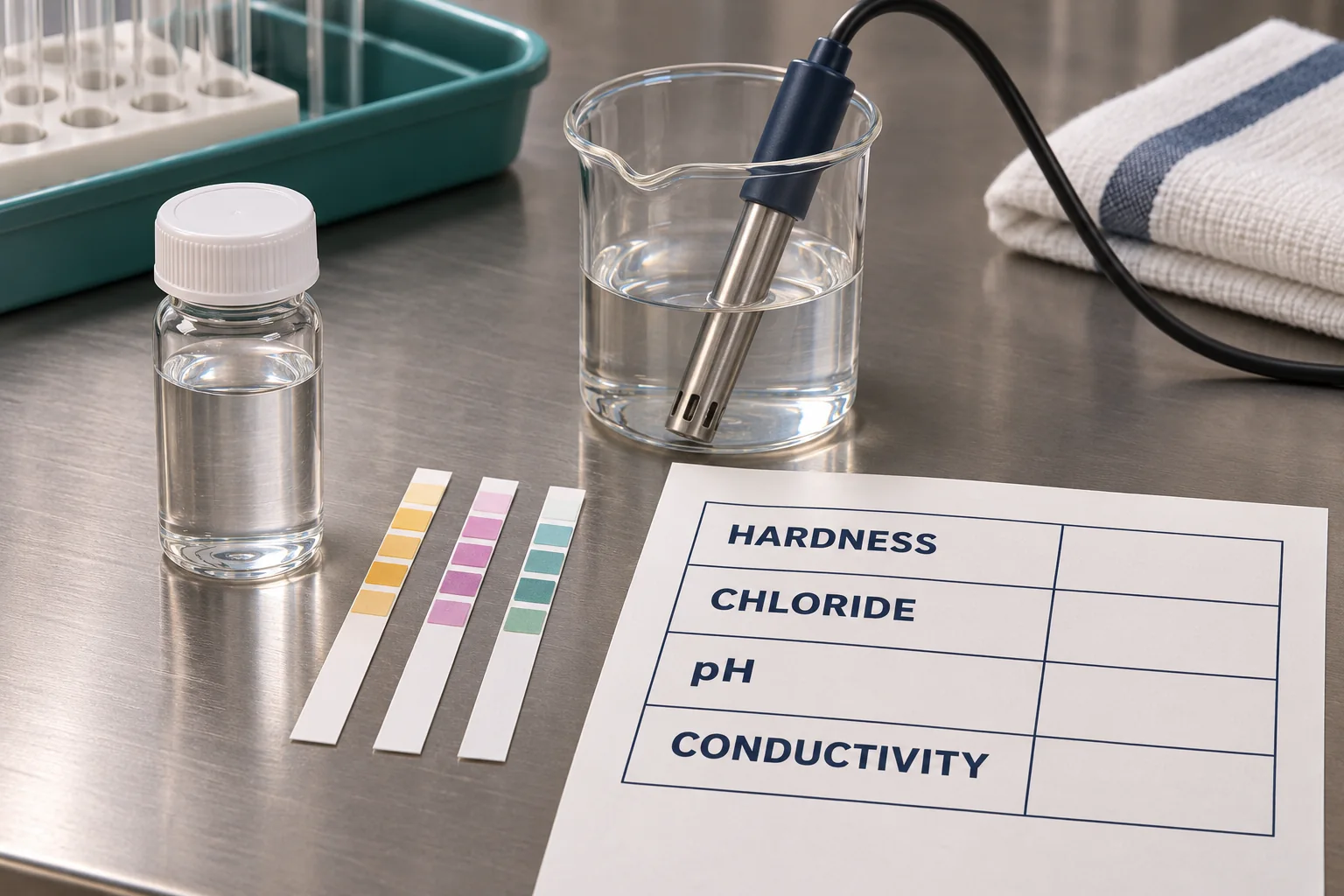
The review packet should identify hardness and its reporting basis, alkalinity, chloride, pH and conductivity or total dissolved solids. Add the disinfectant information and suspended-solids observations relevant to the site. Keep chloride concentration separate from chlorine-disinfectant measurements; the names sound similar but describe different information.
Record units with every result. “Hardness 180” is incomplete without units and the analytical basis. Mark missing tests as unknown instead of estimating them from the appearance of a filter.
For an OEM program, define who owns water acceptance, treatment selection and follow-up sampling. A component supplier cannot validate an unspecified range of site water merely by offering a different metal.
Why scale can return after an apparently successful cleaning
An ice machine continually changes the condition of its circulating water. Nu-Calgon’s nickel-safe cleaner bulletin explains how dissolved minerals can accumulate in the water left behind during ice formation and eventually deposit on the water circuit. A clean plate at service handover therefore does not establish that the operating water will remain suitable.
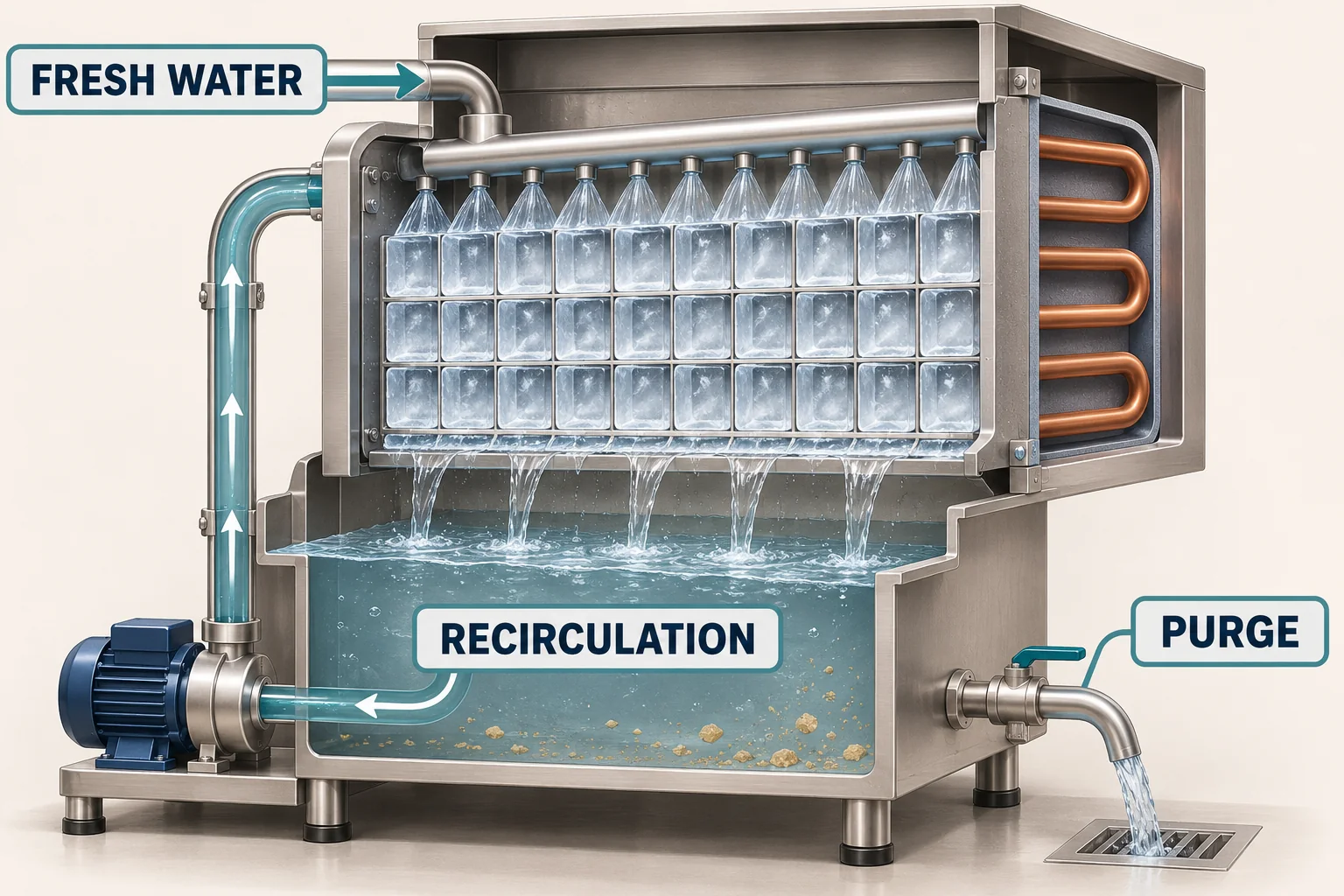
Trace the complete water path: inlet, treatment, distributor, evaporator, reservoir and the machine’s specified purge or drain arrangement. Look for uneven coverage, blocked openings, a changed flow setting or an overdue treatment service. Review the manufacturer’s intended operation before altering purge settings to save water.
A recurring deposit at the same location deserves a location-specific investigation. Compare that area with the distributor pattern and the places that stay wet or dry between cycles. Changing the whole plate material may leave that underlying pattern untouched.
Measure how long the machine operates acceptably before a defined problem returns. “Needs frequent cleaning” gives purchasing no test target. Record operating hours, water conditions, the inspection method and the symptom that triggered service.
Inspect the surface without creating another defect
Plan inspection before aggressive cleaning. Capture the plate model, revision, service age and position in the machine. Use scale references in photographs and retain a sample where laboratory identification would change the decision. Keep the failed part traceable to its operating and maintenance records.

A useful inspection compares the surface before and after an approved cleaning sequence. The comparison should distinguish what disappeared from what remains: a pit, blister, lifted edge, exposed base metal or a loose grid. Do not scrape an uncertain layer with a blade to see whether it is plating. The inspection would then introduce damage that is hard to separate from the original failure.
If metal or coating fragments are present in the ice or water path, stop treating the problem as routine descaling. Take the machine out of ice service and follow the equipment owner’s procedure for inspection, ice disposition and return to service. A smooth-looking patch after cleaning does not prove the food-contact surface is acceptable.
For a disputed failure, agree on evidence before cutting the part apart. The OEM, supplier and laboratory may need different views of the same edge or joint.
Cleaner compatibility is a model-specific requirement
Identify the water-contact material and surface treatment from the equipment documentation. A silver appearance does not establish whether the surface is stainless steel, nickel plated, tin plated or another construction. Cleaner selection should follow the machine and chemical instructions together.
Scotsman’s 2019 cleaning bulletin warns that the wrong chemical, incorrect dilution and excessive acid cleaning can affect evaporator life. That is a reason to preserve the specified product and procedure, not to write one dilution recipe for every ice maker.
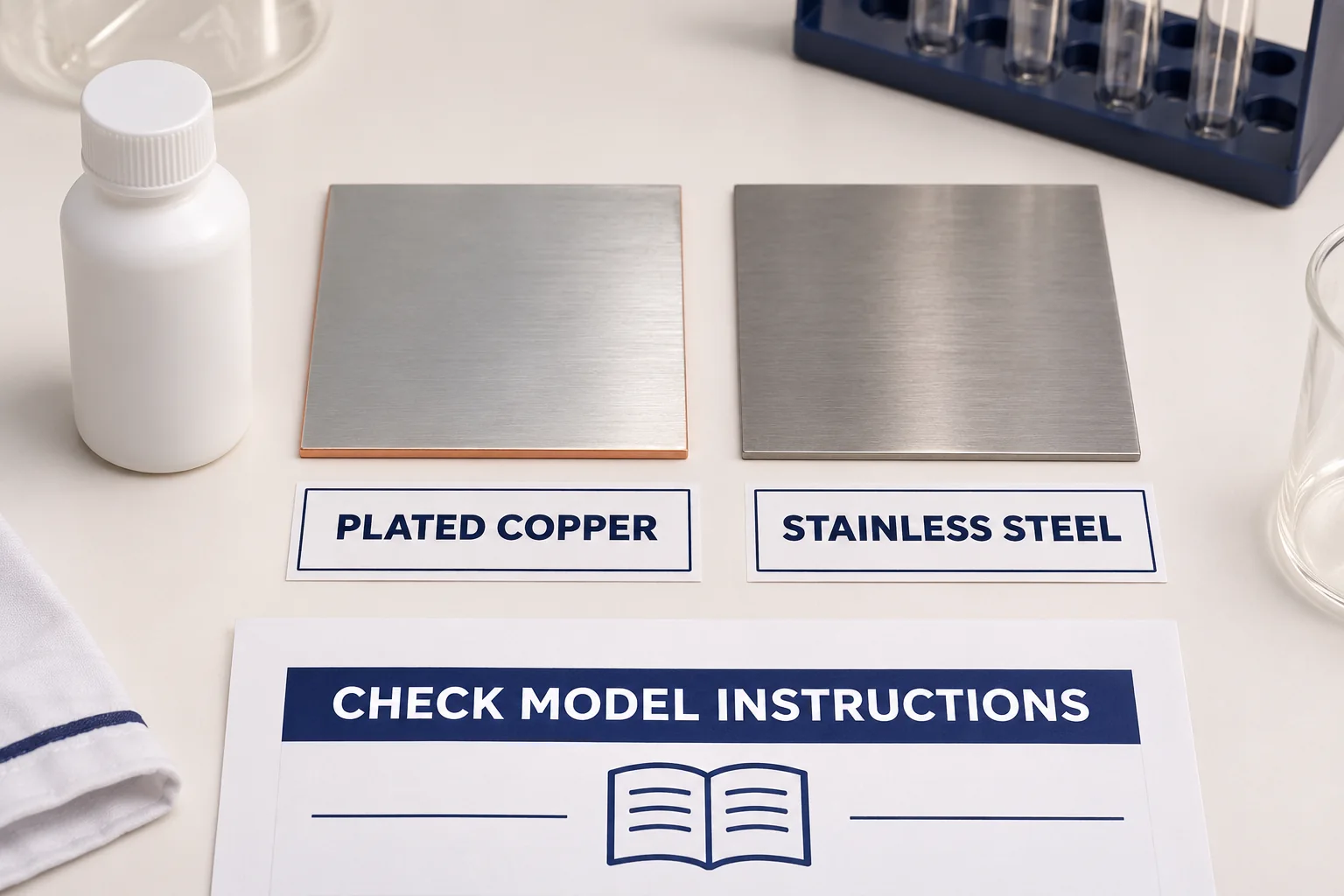
“Nickel-safe” on a bottle does not replace a check of the applicable instructions. Record the product, concentration, contact time, temperature, rinse sequence and frequency that the equipment manufacturer permits. Separate descaling from sanitizing: the two tasks address different problems and may use different procedures. Never mix chemicals or improvise a stronger treatment to shorten a service visit.
For an OEM validation program, test the proposed maintenance procedure as part of the surface specification. Include the worst permitted exposure, rather than a convenient short dip that says little about repeated service.
If the history is uncertain, obtain the actual service records. A statement that a machine was “cleaned normally” cannot establish chemical compatibility or rule out maintenance damage.
Which materials are worth comparing?
Compare a complete construction, including the water-contact face, base metal, joints and manufacturing route. “Stainless” and “plated copper” are starting descriptions. Neither is a purchase-ready specification or a promise of service life.
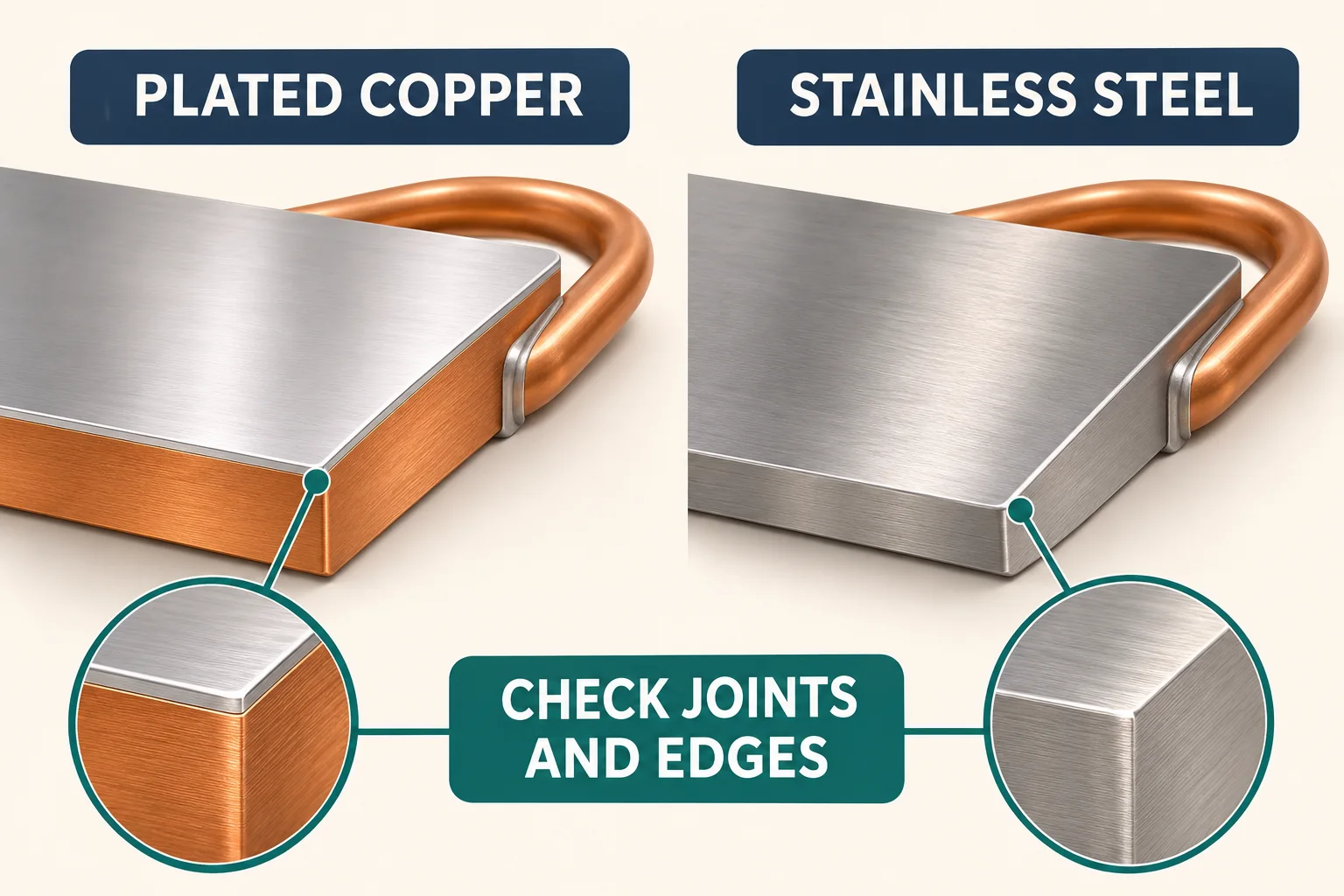
A plated construction needs a defined substrate, coating process, coverage and inspection method. Ask how the surface is controlled at corners and grid intersections, and what evidence supports compatibility with the approved cleaner. If a supplier proposes a coating change, request the process difference and validation plan instead of accepting a new trade name as proof.
A stainless-steel construction needs an identified alloy, surface condition and joining process. Stainless steel can still suffer localized corrosion. The SSINA guide to pitting and crevice corrosion explains the relevance of chlorides and crevices. An alloy change should therefore be reviewed with the actual chemistry and geometry, not described as making the part immune to water damage.
A different plate-and-tube assembly may also change thermal contact, forming limits, mass, attachment and harvest behavior. Do not assume a component with the same outline will behave identically in the refrigeration cycle.
Choose candidates by the failure being addressed. Where the evidence points to an incompatible cleaner, fix that exposure before claiming a more expensive alloy is necessary. Where coating continuity repeatedly fails at a particular joint, compare process control and geometry as well as coating chemistry. Thermal, corrosion and cleaning requirements have to be reviewed together.
Edges and joints belong in the approval sample
A flat coupon is useful for screening a material or treatment. It does not reproduce every feature of a fabricated evaporator. The finished component adds formed edges, grid intersections, joints, heat-affected areas and places where deposits or cleaning liquid may remain.

Ask the supplier to mark these features on the drawing. Define which surfaces require coverage, which interfaces have a different material, and where inspection will occur. Compare a production-representative sample with the actual process sequence; a separately prepared demonstration coupon should not quietly stand in for the finished assembly.
The commercial refrigeration coil coating guide covers broader coating boundaries. For an ice-making surface, also confirm the applicable food-contact, cleanability and complete-equipment requirements with the responsible compliance team. A refrigerant leak test answers a containment question; it does not establish that every water-contact surface is suitable.
Ice that will not release does not prove corrosion
Separate the observation “ice stays on the plate” from the explanation “the metal is damaged.” Check surface condition alongside water distribution, seals, sensors and the approved harvest sequence. Record cycle behavior before changing settings.
Scotsman’s PS-2-2025 bulletin for UC2724 and UC2024 machines illustrates the distinction: its checks include scale, evaporator defects and sealing around the plate, with additional model-specific control guidance. Those instructions apply to the named machines, not every commercial ice maker.
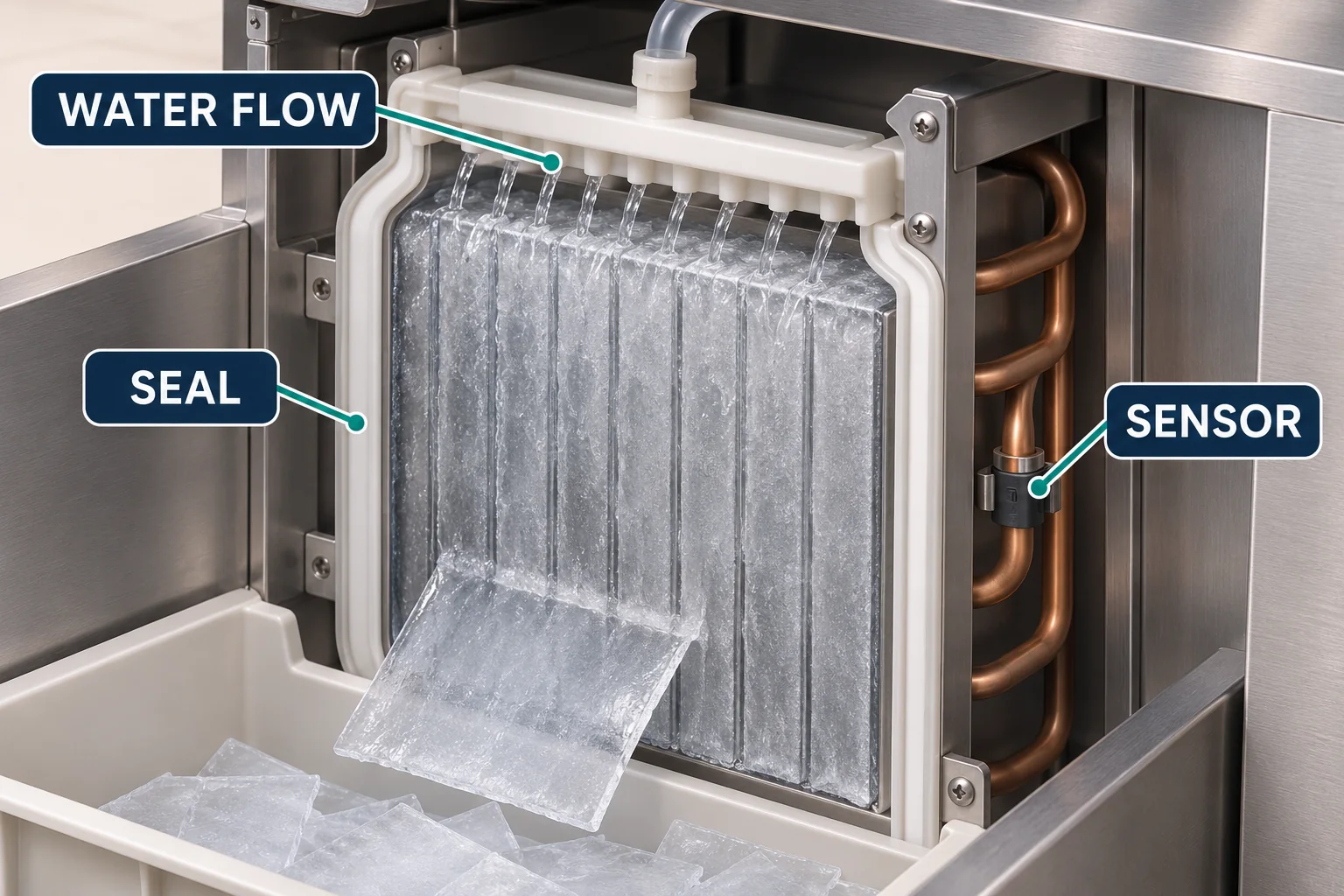
For a returned part, ask whether the same symptom appeared before and after cleaning, whether the defect location matches the stuck ice, and whether operating records show a control or supply problem. That comparison helps decide whether a surface investigation or a machine-level diagnosis should lead.
Condenser conditions also belong in a complete-machine review. The ice machine condenser selection guide explains the separate heat-rejection boundary. It should not be confused with the water-facing evaporator plate.
Validate the proposed change in three stages
Give each stage a separate acceptance decision. The following is a proposed OEM review framework, not a claim that Domi has completed these tests for a particular evaporator.
- Material screening: document the candidate substrate and treatment, then compare responses to the specified water and cleaning exposures. Preserve sample preparation, exposure conditions and inspection criteria.
- Finished-assembly checks: inspect representative edges and joints, dimensions, surface condition and refrigerant containment using the project’s agreed methods. Record deviations before machine installation.
- Machine validation: operate the approved assembly through freeze, harvest, cleaning and restart conditions. Compare release behavior, production, cycle timing and surface condition against the controlled baseline.

Write the acceptance limits before testing. A report that merely says “no obvious damage” is difficult to compare with a supplier’s different inspection method. State what is inspected, when it is inspected, the allowed change and who accepts the result. Keep measured results separate from design targets.
Record the drawing revision, material lot and treatment batch on each sample. A successful test on an earlier process does not automatically approve a later production change. The custom coil fabrication page is the relevant starting point for discussing a drawing-based project and its required scope.
Link the maintenance record to the replacement decision
Preserve water reports, filter or treatment service dates, cleaner records and photographs in one component history. Compare the exposure history with where the damage appeared and when it began. A stack of unlinked service invoices rarely does that.
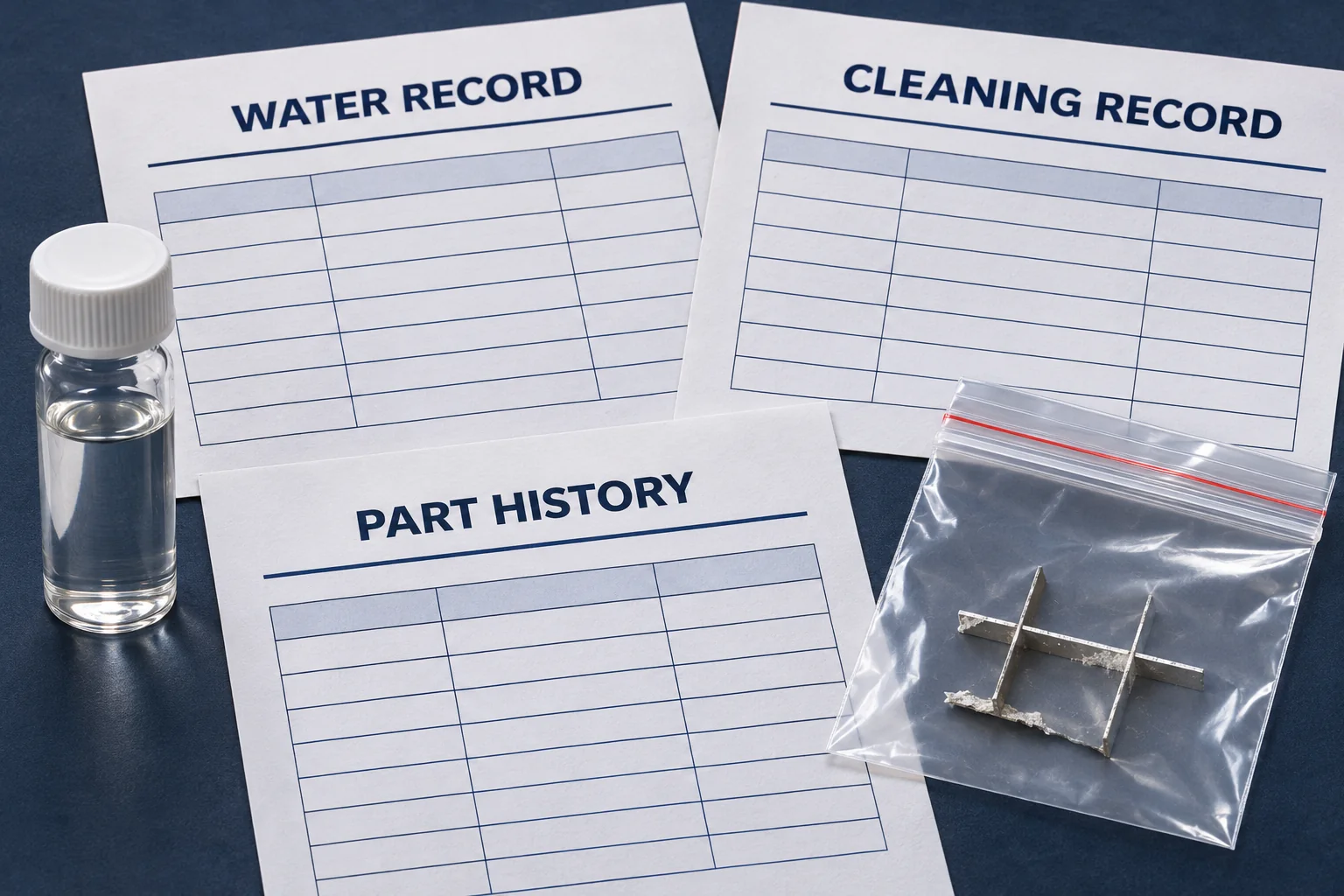
Consider two hypothetical returns. One plate has removable deposits over an intact surface and normal release after the approved procedure. The next step is a water-path and maintenance review. Another has lifted plating that remains after cleaning. That is a surface-integrity decision for the OEM, not a reason to repeat stronger acid cleaning.

Keep the replacement basis explicit: model, revision, defect, operating history and the manufacturer’s disposition. Do not use this article as permission to sand, replate or coat an installed food-contact component. Any proposed repair needs the equipment manufacturer’s approval and the applicable validation.
Frequently asked questions
Does hard water mean the evaporator is corroding?
No. Hardness can help explain mineral deposits, while corrosion means deterioration of the metal. Inspect the surface and review the relevant chemistry before assigning a mechanism. Both conditions can exist together.
Can scale and peeling plating look similar?
Yes. Deposits may cover a damaged layer, and dry surfaces can be hard to interpret. Photograph the original condition, use the approved inspection and cleaning procedure, and check what remains. Do not identify the material from color alone.
Is stainless steel always the best replacement?
No universal choice follows from the material name. The alloy, surface, joints, water chemistry, cleaning exposure and ice-release behavior all need review. Compare a defined assembly and test plan with the existing approved construction.
Will a nickel-safe cleaner repair damaged plating?
No. Removing a deposit does not rebuild a missing coating or restore its adhesion. A cleaner compatibility claim is separate from a repair claim. Have a damaged surface assessed under the machine manufacturer’s procedure.
Does a water filter remove the need for descaling?
Do not assume it does. Treatment systems have different functions, capacities and service requirements. Check what the installed equipment is intended to address, verify its condition, and retain the machine’s required inspection and maintenance procedure.
Why can ice still stick after the plate is clean?
A clean surface does not rule out damaged plating, a seal defect, poor water distribution or a harvest-control issue. Use the model-specific diagnostic sequence instead of repeatedly cleaning a machine whose symptom has another cause.
Can salt-spray hours predict evaporator life in hard water?
An unrelated exposure result does not establish life in the machine’s water and cleaning regime. Ask what a test represents, which assembly was tested and which failure it evaluates. Avoid converting a screening result into a guaranteed service life.
What information should an OEM send for a material review?
Send the controlled drawing, component construction, water analysis, approved cleaning specification, failed-part photographs, freeze and harvest conditions, quantity and required validation. Identify the actual decision: diagnosis, replacement matching or a new material/process candidate.
Send the failed-part evidence with the drawing
Give the supplier the defect and exposure records with the drawing. A request for a plate that “survives bad water” leaves the actual conditions undefined. Attach the water report, maintenance history and photographs to the evaporator drawing. Mark unknowns and explain which change the OEM is willing to evaluate.
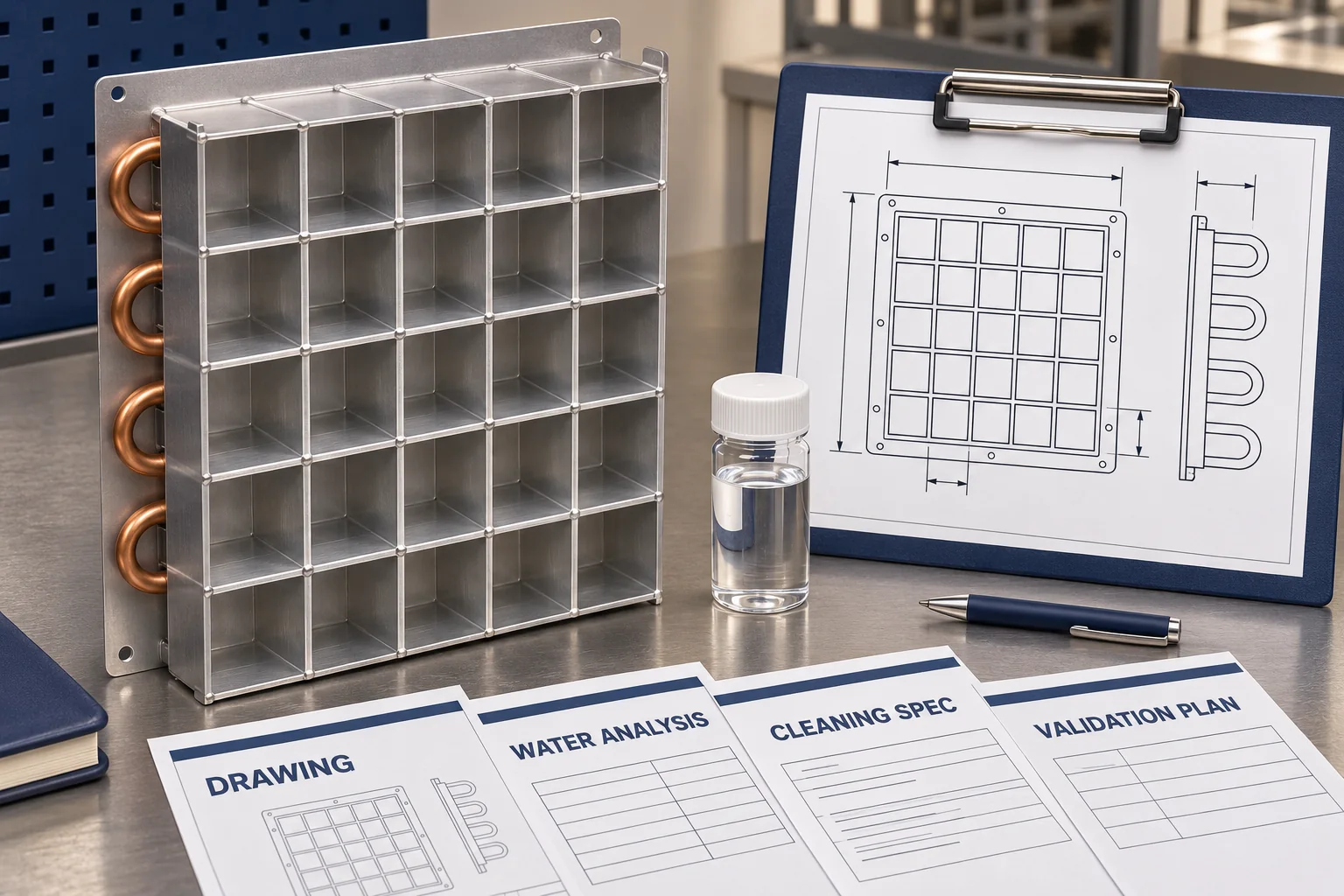
Domi’s contact page accepts technical requirements and custom coil inquiries. Ask the team to confirm whether the proposed evaporator construction, material process and validation scope fit the project before requesting samples. Final material compatibility and complete-machine approval remain project-specific.
Send Drawing for Material Review