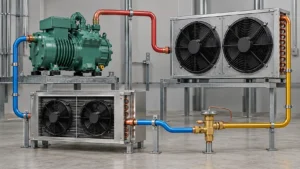

Microchannel coils suit compact, aluminum-based, production-focused designs, while fin-tube coils often offer broader repair familiarity and replacement flexibility; the right choice depends on the refrigerant, airflow, corrosion environment, service plan, and mechanical envelope.
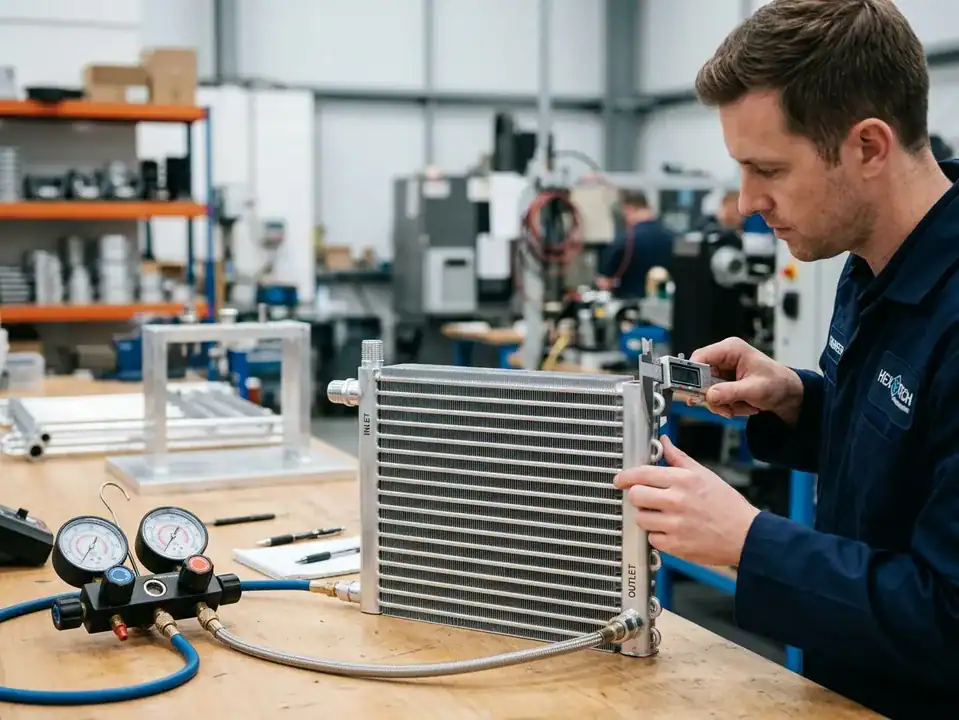
When an HVAC or heat pump OEM compares a microchannel coil vs fin tube coil, the decision is rarely just a question of which construction has the better headline efficiency. The coil is part of a system. Its circuiting, header arrangement, fin spacing, refrigerant, airflow, drain path, cabinet envelope, service method, and purchasing plan all influence whether it is a good fit.
Microchannel coils use flat multiport tubes, fins, and headers to create a compact heat-transfer core. A conventional fin-tube coil uses round tubes expanded or bonded into plate fins, often with copper tubes and aluminum fins, although other material combinations are possible. Both constructions can be engineered for condensers, evaporators, heat pump outdoor units, air handlers, and other HVAC equipment. The useful question is not “Which coil is always better?” It is “Which construction gives this equipment the right balance of thermal duty, package size, pressure-drop behavior, corrosion strategy, serviceability, and repeat production?”
For a custom discussion, start with Domi’s HVAC and heat pump heat exchanger solutions, then prepare the operating data and drawing details described in this guide. A supplier should be able to explain the assumptions behind the recommendation rather than offering a construction label without a design basis.
What is the difference between microchannel and fin-tube coils?
A microchannel coil normally contains flat aluminum tubes with several small internal passages. Refrigerant enters a header, divides through the ports, travels through the core, and returns through another header or circuit arrangement. The fins are assembled around the flat tubes. The flat profile can provide a large amount of tube perimeter in a relatively shallow core, but the result depends strongly on the port geometry, circuiting, header design, and air distribution.
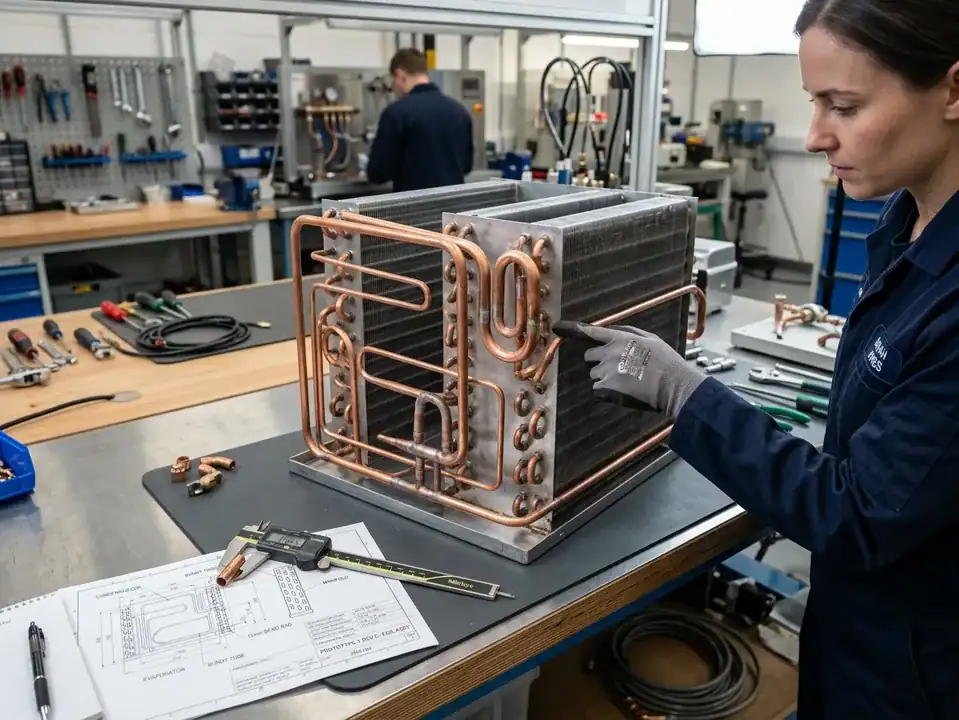
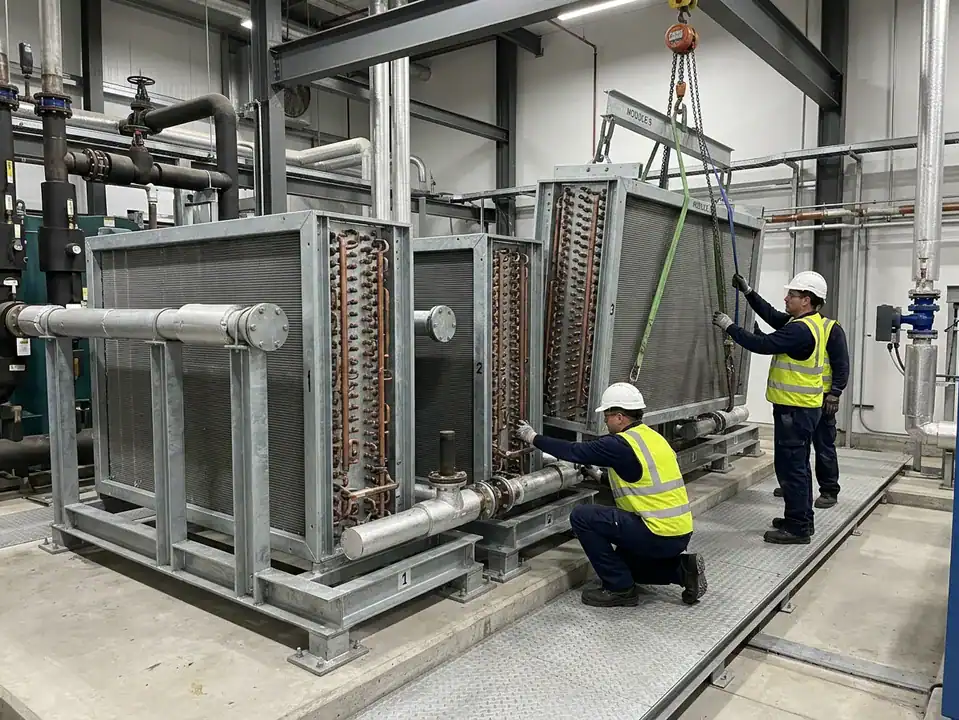
A fin-tube coil normally contains round tubes passing through or mechanically expanded into plate fins. The tubes can be arranged in rows and circuits, with return bends, manifolds, or headers connecting the refrigerant path. Tube and fin materials can be selected for the application. The construction is familiar across HVAC service networks and can be adapted to many replacement and custom configurations.
The two terms describe a family of constructions, not one fixed performance level. A well-designed fin-tube coil can outperform a poorly distributed microchannel coil in a specific system. A microchannel coil can be a poor choice if the air path is uneven, the header cannot be serviced, or the environment is aggressive and the protection plan is incomplete. The engineering comparison has to be made at the same duty, airflow, refrigerant, entering conditions, pressure limits, and allowable envelope.
Construction differences that matter to an OEM
| Design question | Microchannel coil | Fin-tube coil | Why the buyer should care |
|---|---|---|---|
| Tube form | Flat multiport tube | Round tube with plate fins | Changes circuiting, joining, cleaning, and repair approach |
| Typical material path | Often aluminum tube, header, and fin system | Often copper tube with aluminum fins, but not always | Creates different galvanic, forming, brazing, and coating questions |
| Core depth | Can be shallow for a required face area | Can use more rows or depth for the same envelope | Affects cabinet layout, fan position, and service access |
| Refrigerant distribution | Sensitive to header and port arrangement | Sensitive to circuit length, return bends, and manifolds | Uneven distribution can reduce usable core area |
| Field repair | Damaged flat tube sections may be difficult to isolate | Round tubes are familiar to many service technicians | Affects warranty strategy and replacement planning |
| Customization | Strong when the program fits an established flat-tube platform | Flexible for unusual tube sizes, rows, and connections | Determines tooling, sample time, and part-family commonality |
This table is a decision framework, not a specification. The final design still needs a thermal review, mechanical review, leak or pressure requirements, and any required system-level validation.
Microchannel coil vs fin tube coil: a practical engineering comparison
Package size and cabinet layout
The shallow core of a microchannel coil can be useful when an outdoor unit or packaged air conditioner has a tight depth envelope. It may allow the designer to reconsider fan clearance, service panels, and airflow paths. That advantage only exists if the headers, manifolds, end plates, and connection stubs also fit the cabinet. A shallow active core does not automatically create a shallow finished assembly.
Fin-tube coils can be built with a wide range of row counts and tube layouts. This can be helpful when a replacement coil has to match an existing cabinet, mounting frame, or service opening. The designer may have more familiar ways to adjust face area, rows, and circuit length. The trade-off is that adding rows can increase core depth and may affect air-side pressure drop, condensate management, or access for cleaning.
Before choosing a construction, create a package drawing that includes more than the active heat-transfer face. Show headers, return bends, connections, brackets, drain pans, fan clearance, insulation, service access, and the direction in which the coil will be inserted. Many “compact coil” projects fail at the interface rather than at the active core.
Refrigerant distribution and circuiting
A coil only uses its available surface effectively when refrigerant distribution and air distribution are reasonably matched. In a microchannel construction, header volume, port count, circuit length, and the position of inlet and outlet connections influence how the fluid divides. In a fin-tube construction, the number of circuits, tube length, return bends, and the path through each circuit matter.
For an evaporator, the supplier may need to manage two-phase flow and ensure that the circuiting is appropriate for the expected load. For a condenser, the design may need to accommodate desuperheating, condensation, and subcooling zones. A heat pump outdoor coil can change role with the operating mode. These details are why a supplier should request the refrigerant, mass flow or capacity target, entering conditions, and design operating envelope instead of sizing from the outside dimensions alone.
The AHRI 410 performance-rating scope is a useful reminder to identify the rating method and scope for an air coil. It is not a substitute for stating the actual appliance duty and acceptance criteria in an OEM RFQ.
Air-side pressure drop and distribution
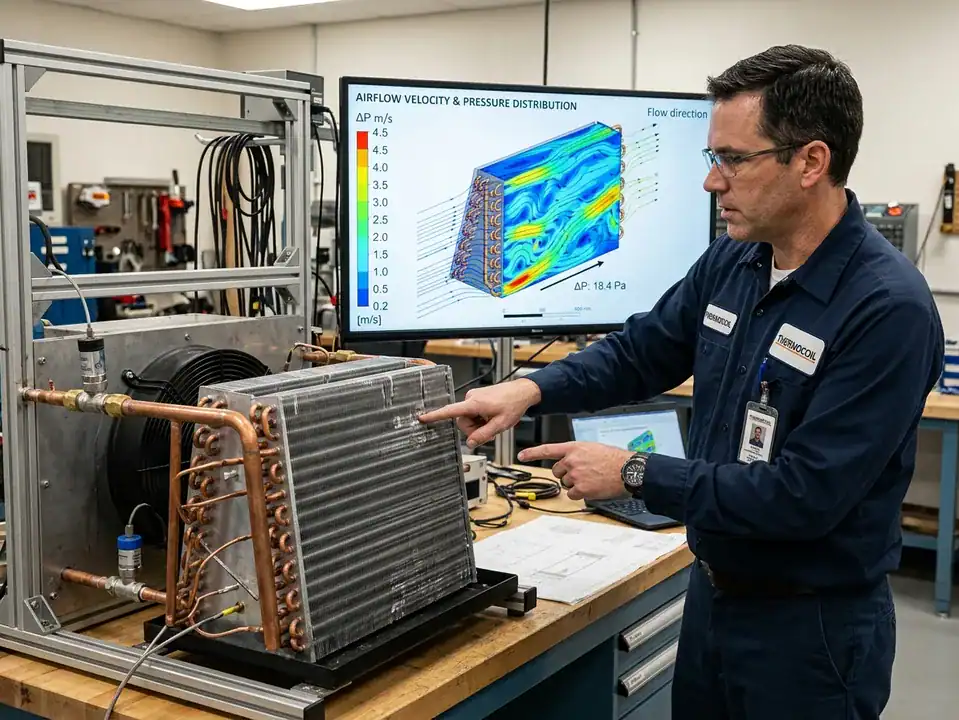
Fin spacing, face velocity, row count, louver geometry, core depth, and upstream obstructions influence air-side pressure drop. A comparison that only looks at heat-transfer surface can miss the effect on fan power and sound. A coil with a smaller frontal area may require a higher face velocity to deliver the same air volume, while a coil with more depth may increase resistance even when the face area is large.
Air distribution is equally important. A coil placed behind a fan, bend, filter, or grille may see nonuniform velocity. The supplier and OEM should review whether the core receives the assumed airflow. If the application uses a side-discharge outdoor unit, a slanted coil, or a multi-face wraparound assembly, the distribution problem becomes part of the coil design rather than a separate detail.
Do not publish an efficiency percentage or a pressure-drop number unless it belongs to a named design, tested at stated conditions, and approved for publication. The correct B2B explanation is conditional: the construction can support a certain design goal, but the result depends on the complete geometry and operating point.
Materials, joining, and corrosion
Aluminum microchannel assemblies can reduce mixed-metal interfaces inside the core, but the complete unit still includes connections, brackets, fasteners, drain components, and cabinet materials. Galvanic contact, condensate, salt, cleaning chemistry, and damaged coatings can change the field risk. A coating or material choice should therefore be selected together with the environment and service plan.
Fin-tube coils often combine copper and aluminum. That combination can be appropriate and widely serviceable, but the joint, fin contact, condensate path, and surrounding materials should be reviewed. The buyer should ask where dissimilar metals are exposed, how the assembly is protected during transport, and what cleaning agents are allowed.
The EPA refrigeration and air-conditioning substitutes page shows why refrigerant and end-use changes belong in the project record. A new refrigerant or equipment category can bring different safety, documentation, and component requirements. Do not assume that a coil can be reused merely because the footprint is unchanged.
Cleaning and field service
Field service teams may be more familiar with cleaning and repairing round-tube fin-tube coils. That familiarity can be valuable for distributed equipment, service replacement programs, and regions where specialized microchannel repair tools are not readily available. It does not mean a fin-tube coil is always the better choice; it means serviceability is a real lifecycle requirement and should be priced into the decision.
Microchannel coils can be cleaned, but the cleaning method must respect the flat tubes, fins, coatings, and pressure limits. Bent fins, blocked passages, impact damage, or aggressive chemicals can create a different repair problem from a damaged round tube. The OEM should define whether the strategy is field repair, module replacement, complete coil replacement, or a combination.
Ask the supplier for a maintenance note that covers approved cleaning methods, prohibited chemicals, fin combing or straightening limits, and the replacement route. If the supplier cannot provide a field service plan, the construction comparison is incomplete.
When a microchannel coil is a better fit
Microchannel is often worth serious consideration when several of the following conditions exist:
- The cabinet has a strict depth or weight constraint.
- The product is a repeat OEM platform rather than a one-off replacement.
- The engineering team can control the header, circuiting, airflow, and joining process.
- The program has a defined corrosion-protection and cleaning strategy.
- The buyer can validate the coil in the complete unit rather than judging it from a catalog label.
- The supplier can provide a stable platform or family of core sizes that supports multiple SKUs.
This does not mean every compact unit should use a microchannel core. A small cabinet with poor airflow distribution can waste the compactness advantage. A coastal unit with uncertain maintenance can need more attention to coating, material isolation, and drain design than the original product brief allowed. A replacement program with many legacy cabinets may also value interface compatibility over a new core construction.
Questions to ask before selecting microchannel
- What are the expected air-side inlet conditions and velocity distribution?
- What refrigerant and operating range will the circuiting support?
- How are headers and connection stubs protected during transport and service?
- What is the approved cleaning method for the actual fin and coating system?
- What is the replacement strategy if a flat tube is damaged in the field?
- Which dimensions are fixed by tooling and which can be adjusted for the cabinet?
- What sample and system tests are needed before production release?
These questions turn an attractive construction concept into a manageable program.
When a fin-tube coil is a better fit
Fin-tube construction may be a stronger option when the equipment must match a legacy coil, use familiar service methods, or accommodate unusual connection and row requirements. It is also practical when the buyer wants a replacement part that can be measured, repaired, and installed using established field procedures. A custom fin-tube coil is not automatically a generic part; its tube diameter, fin material, fin spacing, circuiting, connections, brackets, and coating can still be highly specific.
Fin-tube is often easier to compare against an existing sample. The buyer can document the core face, rows, tube spacing, return-bend position, headers, connection size, and mounting points. However, the old part may have been selected for a different refrigerant or operating condition. A dimensional copy without a duty review can produce a part that fits but does not perform as intended.
Replacement compatibility is not only dimensional
For a replacement project, record these elements separately:
| Compatibility layer | What to check |
|---|---|
| Mechanical | Face dimensions, depth, brackets, insert direction, connections, drain path |
| Thermal | Capacity, entering conditions, airflow or fluid flow, superheat/subcooling assumptions |
| Refrigerant | Refrigerant identity, pressure envelope, oil compatibility, circuiting, safety requirements |
| Electrical/control | Sensors, valves, fan control, defrost logic, alarm or diagnostic interfaces |
| Service | Cleaning, brazing/repair limits, access, replacement packaging, instructions |
The U.S. Department of Energy heat-pump systems guide gives useful system-level context for why a heat pump’s components operate as part of a reversing cycle. A replacement coil should be checked against the system mode and controls, not treated as an isolated metal assembly.
How to compare the two constructions in an OEM RFQ
The supplier should receive the same information for each proposed construction. If one supplier receives a detailed load case and another receives only a photograph, the quotes are not comparable.
RFQ input checklist
| RFQ line | Required information | Why it matters |
|---|---|---|
| Application | Condenser, evaporator, heat pump outdoor, indoor coil, air handler, or other | Defines the thermal role and operating modes |
| Refrigerant or fluid | Name, phase, concentration if water/glycol, expected range | Sets circuit, material, and safety review |
| Thermal duty | Capacity target or heat load with rating conditions | Prevents geometry-only selection |
| Air side | Flow, entering dry/wet bulb, humidity, allowable pressure drop | Drives face area, fins, rows, and drainage |
| Envelope | Core, headers, connections, brackets, access, drain pan | Confirms finished assembly fit |
| Environment | Indoor, coastal, industrial, chemicals, cleaning method | Informs materials and coating |
| Quality | Leak/pressure, dimensional, visual, performance, documentation | Makes validation and quotation comparable |
| Commercial | Samples, pilot, annual volume, SKU mix, packaging, lead time | Defines tooling and production plan |
A simple decision matrix
Use a scored matrix only after the requirements are weighted. For example, a compact OEM platform may assign more weight to package depth and repeatability, while a replacement program may assign more weight to field service and interface compatibility.
| Decision factor | Weight for compact OEM platform | Weight for replacement program | Evidence to request |
|---|---|---|---|
| Package and mounting fit | High | High | Assembly drawing and sample check |
| Thermal and airflow validation | High | High | Stated conditions and test plan |
| Field repair familiarity | Medium | High | Service method and replacement plan |
| Corrosion protection | High in aggressive sites | Medium to high | Environment matrix and test basis |
| SKU family commonality | High | Medium | Part-family map and changeover plan |
| Tooling and sample burden | Medium | Medium | Tooling quote and development schedule |
The matrix does not make the decision automatically. It forces engineering and procurement to agree on what “better” means before the supplier is asked to optimize it.
Development and validation workflow
The recommended workflow is deliberately practical:
- Define the duty and interfaces. Send the application, fluid, load, air conditions, envelope, connections, and environment.
- Review two construction concepts. Ask the supplier to state the assumptions, not only the construction name.
- Check circuiting and airflow. Confirm that the refrigerant path and air distribution are reasonable for the chosen arrangement.
- Review materials and service. Document coatings, mixed-metal interfaces, cleaning, repair, replacement, and packaging.
- Approve a drawing before a sample. Mark revision, datum, connections, mounting, and inspection points.
- Build production-intent samples. A hand-adjusted prototype may answer fit but not repeatability. State which process must be representative.
- Validate in the complete unit. Check capacity, pressure drop, controls, noise, drainage, defrost if applicable, and mechanical interfaces at agreed conditions.
- Release with a controlled revision. Keep the drawing, material record, inspection plan, and approved sample traceable.
The ASME revision guidance for engineering drawings and associated documents is a useful reference for treating drawing changes as controlled engineering information. In an OEM coil program, a changed header, fin, coating, connection, or bracket can affect the comparison and should trigger a review.
Common mistakes when comparing microchannel and fin-tube coils
Comparing generic catalog data
Catalog values may be useful for narrowing options, but they are not a direct comparison unless the rating conditions, face area, airflow, refrigerant, and pressure-drop basis match. A generic number can create a false sense of certainty.
Ignoring the finished assembly
The active core is only one part. Headers, end plates, brackets, drain pans, connections, and protective packaging can determine cost, fit, and serviceability. Include them in the drawing review.
Treating the old replacement coil as a complete specification
The old coil may be an undocumented compromise, a previous refrigerant design, or a part selected for a different fan. Measure it, but also recover the system duty and failure history.
Choosing based on one material preference
“All aluminum” or “copper tube” is not a complete corrosion or lifecycle strategy. Exposed joints, fasteners, condensate, salt, cleaning agents, and installation details still matter.
Hiding the service strategy
If a field technician cannot repair a certain damage mode, the program should know whether the replacement will be a stocked module, a supplier service part, or a complete equipment replacement. That decision affects packaging, lead time, and SKU planning.
What to send Domi for a custom coil comparison
Send a drawing or clear sample photographs together with:
- Application and equipment model.
- Coil role and operating modes.
- Refrigerant or secondary fluid.
- Capacity or heat-load target and rating conditions.
- Airflow, entering conditions, humidity, and allowable pressure drop.
- Core, assembly, connection, mounting, and drain dimensions.
- Material, coating, corrosion environment, and cleaning requirements.
- Sample quantity, annual volume, SKU family, packaging, and delivery target.
- Existing failure history or service constraints.
Domi’s custom coil fabrication service and engineering capabilities are the appropriate next steps when the project needs drawing review, prototype discussion, or a controlled quotation. Use the contact page to send the drawing and operating data together.
Cost, tooling, and SKU planning
The construction comparison also has a commercial side. A microchannel platform may be attractive when several products can share a core family, header strategy, or assembly process. A fin-tube program may be easier to source for a small replacement quantity or a product that needs many unusual tube, row, bracket, and connection combinations. Neither construction has one universal MOQ or unit-cost advantage.
Ask the supplier to separate the cost into engineering, tooling, sample, production, packaging, and optional testing. This prevents the buyer from comparing a generic microchannel catalog number with a fully engineered fin-tube quotation. Include the expected annual volume and release pattern because a supplier may plan material and setup differently for one annual order than for monthly releases.
| Commercial line | Microchannel questions | Fin-tube questions |
|---|---|---|
| Core and tooling | Are flat-tube, header, and fixture sizes standard or project-specific? | Are tube, fin, return-bend, and header tools existing or new? |
| SKU family | Can several cabinet sizes share a platform? | Which row, tube, fin, and bracket changes require setup? |
| Samples | Is the sample production-intent for the header and joining process? | Does the sample represent the final tube expansion, brazing, and fin assembly? |
| Service part | Will the program stock a complete module or support field repair? | Can a replacement coil be built from a controlled drawing and sample? |
| Packaging | How are flat tubes and headers protected from impact? | How are fins, return bends, and tube ends protected? |
| Change control | Which port, header, or connection changes trigger a requalification? | Which tube, circuit, row, or bracket changes trigger a new tool or sample? |
A family-first quotation method
Create a part-family map before negotiating price. Put all variants in one sheet and mark the features that are common: active face, tube or port family, fin material, header position, connections, brackets, coating, and packaging. Then ask the supplier to identify which groups share a process and which require a separate setup.
This is particularly important when the same HVAC platform is sold in several countries. A voltage or control option may not change the coil, while a refrigerant, cabinet depth, airflow, or corrosion requirement may. A family map reduces the risk of forcing unrelated parts into one MOQ and later discovering that the production process is not shared.
Prototype, pilot, and repeat production are different
A prototype can answer whether a core fits the cabinet and whether the connections are in the right location. A pilot lot can show whether the circuiting, joining, fin assembly, inspection, and packaging are repeatable. Repeat production must also show that the supplier can hold the revision, source the materials, and support the planned release pattern.
Write these stages into the purchase plan. A low prototype price does not prove a low repeat price, and a high pilot charge may reflect the additional inspection that the OEM actually needs. The buyer should decide what each stage must prove before asking for a quantity.
New platform or replacement: choose the comparison boundary
The same microchannel-versus-fin-tube question has a different answer for a new product and a service replacement.
For a new platform, the team can optimize cabinet depth, fan position, circuiting, controls, packaging, and service documentation around the selected construction. The engineering benefit may come from the complete product architecture rather than from the coil alone. Give the supplier enough freedom to offer an alternative if the current envelope has not been frozen.
For a replacement, the mechanical interface and field service strategy are usually more important. Match the core and assembly dimensions, connections, mounting, drain, airflow direction, refrigerant, and operating duty. If the buyer wants to convert from fin-tube to microchannel, make the conversion a controlled engineering change and update the service parts, training, cleaning instructions, and warranty assumptions.
A decision record to keep with the drawing
Record four things in the design history:
- Why the construction was selected for the application.
- Which assumptions were used for duty, airflow, refrigerant, environment, and service.
- Which risks remain open after the sample review.
- Which future changes require a new drawing review or system test.
This record helps procurement explain a later supplier change and helps service teams understand why the approved coil is not an interchangeable generic part. It also prevents the project from repeating the same comparison when a new cabinet or refrigerant variant is introduced.
For standards context, use the ASHRAE standards and guidelines library and the AHRI standards and certification resources. These resources help the project identify an applicable rating or documentation route, but they do not replace the equipment-specific test and approval plan.
Frequently asked questions
Are microchannel coils always more efficient than fin-tube coils?
No. A performance comparison is valid only at stated conditions and with comparable duty, airflow, refrigerant, and pressure-drop limits. Distribution, circuiting, fin geometry, and the complete unit can change the result.
Can a microchannel coil directly replace a fin-tube coil?
Not automatically. The replacement needs mechanical, thermal, refrigerant, control, service, and safety checks. A similar face dimension does not prove that the circuiting, connections, drain path, or system controls are compatible.
Which coil construction is easier to repair?
That depends on the damage and the service network. Round-tube fin-tube repairs are familiar in many regions, while a damaged microchannel tube may require a module replacement or a specialized process. Define the field strategy before approval.
Are microchannel coils suitable for heat pumps?
They can be used in heat pump equipment when the design supports the required operating modes, refrigerant, airflow, drainage, defrost, materials, and controls. The supplier should review the complete operating envelope rather than only the heating or cooling rating.
What information should I send for a coil comparison?
Send the application, refrigerant, duty, airflow, entering conditions, allowable pressure drop, envelope, connections, environment, materials, sample requirements, and annual volume. A drawing or existing sample helps confirm the mechanical interface.
Do microchannel coils need a coating?
Not every microchannel coil needs the same protection. The decision depends on exposure, materials, condensate, cleaning, handling, and service conditions. Ask for an environment-based recommendation and the test basis instead of assuming a coating is universal.
Is a fin-tube coil only for replacement applications?
No. Fin-tube coils can be designed for new OEM equipment as well as replacement programs. They remain useful when the project needs specific tube, row, header, connection, or service characteristics.
Can Domi quote both constructions?
The appropriate route is to send the operating data and drawing and ask Domi to confirm which constructions are feasible for the duty. The final recommendation depends on the application, dimensions, materials, quantity, and validation requirements.
Related articles
- How to Size a Custom HVAC Coil
- R32 vs R410A HVAC Coil Design
- Hydrophilic Aluminum Fins for HVAC Evaporator Coils
- Heat Pump Outdoor Coil Frosting and Defrost Design
- HVAC Coil Corrosion Protection Options
- What Is a Heat Exchanger? Types, Uses and How It Works
Final takeaway
The right microchannel coil vs fin tube coil decision comes from the complete product requirement. Microchannel construction may support compact, repeat-production equipment, while fin-tube construction may simplify a legacy replacement or a highly serviceable design. Neither label removes the need to review refrigerant, airflow, pressure drop, materials, corrosion, drainage, controls, package fit, service, and validation.
If you are comparing both options for a new HVAC or heat pump product, send Domi the drawing, duty, operating conditions, environment, and quantity plan. A clear comparison at the beginning is usually less expensive than changing the coil after the cabinet, fan, controls, and service documentation are already fixed.