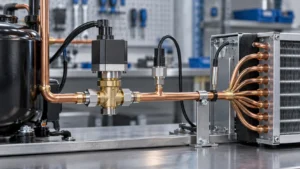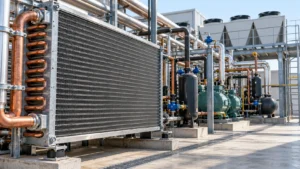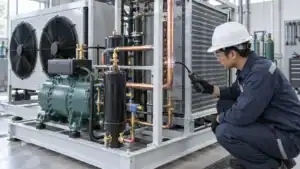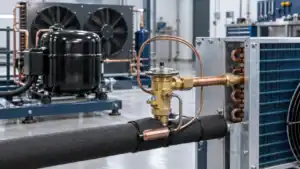

HVAC coil corrosion protection should be selected from the exposure environment, material combination, cleaning chemistry, drainage, service plan, and required test evidence; no single coating is suitable for every coil or site.
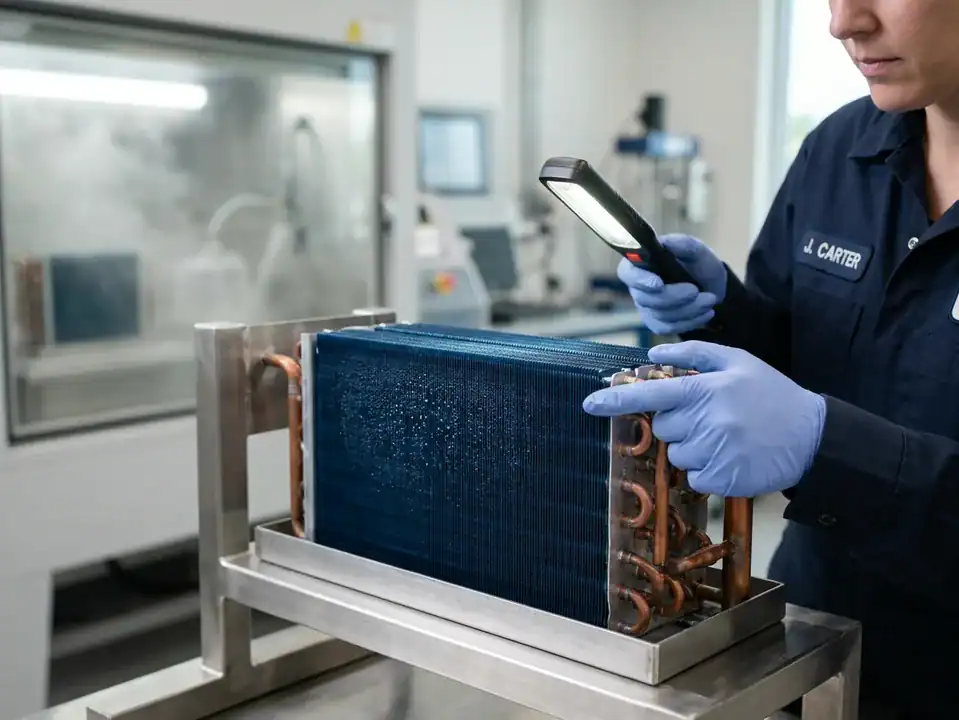
The search term HVAC coil coating can mean several different buying needs. A coastal building owner may want protection from salt-laden air. An industrial facility may be concerned about process chemicals. A maintenance team may want a coating that survives regular cleaning. An OEM may need a material, surface treatment, or drainage change that can be controlled across thousands of units. Those projects should not receive the same generic recommendation.
Corrosion protection begins with the environment and the complete coil assembly. The tube, fin, header, braze, bracket, fastener, drain pan, cabinet, coating, packaging, and cleaning method all contribute to field performance. A coating may help protect a surface, but it cannot correct standing water, incompatible metals, a damaged edge, an unsuitable cleaner, or an installation that traps salt.
This guide helps OEM buyers and engineers compare materials, coatings, and design actions. It does not promise a fixed lifetime or a universal salt-spray rating. The correct route is to define the exposure, specify the required evidence, test the actual construction when necessary, and keep the surface treatment under controlled production. For a broader design route, review Domi’s HVAC and heat pump heat exchanger solutions, then send the coil drawing and environment details for a project-specific review.
Why HVAC coils corrode
Corrosion requires a susceptible material, an electrolyte or reactive environment, and time. HVAC coils regularly encounter moisture, condensate, salt, dust, cleaning chemicals, temperature changes, and mixed metals. The exact mechanism can differ between a dry outdoor condenser, a wet indoor evaporator, a coastal heat pump, and an industrial air handler.
Coastal exposure
Salt-laden air can deposit chlorides on fins, tubes, headers, and cabinet interfaces. The risk depends on distance from the coast, wind, shelter, humidity, wash-down, installation orientation, and maintenance. “Near the sea” is not a complete exposure specification. Describe the location, airflow, salt or chemical source, expected wetness, and cleaning method.
Industrial and chemical exposure
Factories, wastewater facilities, food plants, swimming-pool buildings, and chemical sites can expose coils to gases, aerosols, cleaning agents, or process residues. The correct coating depends on the actual chemical, concentration, temperature, contact time, and method of exposure. A coastal coating recommendation cannot automatically be transferred to an industrial process.
Condensate and standing water
Wet coils can corrode at low points, edges, joints, brackets, drain pans, and areas where water remains after operation. Drainage, slope, pan design, and airflow may be as important as the coating. Inspect the complete assembly rather than only the center of the fin field.
Mixed-metal contact
Copper, aluminum, steel, stainless steel, brass, zinc-plated fasteners, solder, braze, and coatings can appear in one assembly. Moisture and electrical contact can create galvanic risk. The supplier should identify dissimilar-metal interfaces and explain how they are isolated or protected.
The Heresite HVAC coil protection overview illustrates how corrosion protection is discussed as an application-specific system. It is useful market context, but the actual product, substrate, application process, and test basis must be confirmed for the Domi part.
Common HVAC coil corrosion protection options
The best option may be a coating, a material change, a design change, a maintenance change, or a combination.
| Protection option | When it may be considered | Questions to ask |
|---|---|---|
| Bare material with controlled design | Mild exposure and a clear drainage/maintenance plan | Is the material suitable for the actual wet and chemical conditions? |
| Pretreatment or conversion layer | Improved surface preparation or adhesion objective | What substrate, process, and test evidence apply? |
| Organic or polymer coating | Barrier or environmental protection objective | What are the application, thickness, adhesion, repair, and cleaning limits? |
| Epoxy or specialized system | Aggressive exposure or specified protection need | Is thermal, airflow, and field-service impact verified? |
| Material combination change | The base material or mixed-metal interface is the primary issue | Does availability, forming, joining, and cost remain acceptable? |
| Geometry and drainage improvement | Water retention or contamination is the main cause | Does the finished assembly remove low points and support cleaning? |
| Maintenance and packaging controls | The site or delivery stage creates the exposure | Can the buyer implement the cleaning, storage, and inspection plan? |
The table is for project scoping. It does not select a product without exposure data. Ask the supplier to explain why the option fits the environment and which claims are supported by tests on the actual construction.
What a coating can and cannot do
A coating can create a barrier, improve a surface property, or protect a specified substrate under stated conditions. It may be damaged by forming, brazing, handling, impact, ultraviolet exposure, chemicals, or cleaning. It may also add thermal resistance or change the surface behavior of a wet coil. It cannot guarantee that every edge, hole, joint, fastener, and drain component remains protected forever.
The Nyalic cooling-coil coating page shows why buyers should identify the actual coating application rather than relying on a generic “coil coating” category. Ask for the product data, application process, substrate, preparation, curing, touch-up, and limitations.
How to match protection to the operating environment
Build an environment matrix
Before asking for “the best coating,” create a matrix that names the exposure and the consequence.
| Environment | Exposure questions | Design and protection questions |
|---|---|---|
| Coastal outdoor | Distance, salt, wind, rain, humidity, shelter, wash-down | Material isolation, coating, drainage, packaging, inspection |
| Urban outdoor | Dust, traffic residue, humidity, seasonal temperature | Cleaning, fin access, surface protection, maintenance |
| Industrial | Chemical identity, concentration, temperature, vapor/aerosol | Material compatibility, coating system, test exposure, service |
| Indoor wet coil | Condensate, cleaning, standing water, air quality | Fin spacing, pan/drain, surface treatment, cleaning compatibility |
| Food or wash-down | Detergent, sanitizer, frequency, temperature, hygiene | Approved materials, coating evidence, drainability, documentation |
| Storage and shipping | Humidity, salt air, packaging time, impact | Covers, separators, desiccant/ventilation plan, inspection |
This matrix turns a vague location into a technical requirement. If the buyer does not know the chemical or cleaning product, that should be an open item, not a hidden assumption.
Coastal does not mean one test condition
Salt exposure varies with wind, wet/dry cycles, orientation, shelter, distance, and cleaning. A laboratory salt-spray result can be useful for comparing defined samples, but it does not predict every site lifetime. State the method, panel or coil construction, scribe or edge condition, exposure, and acceptance criteria.
Cleaning chemistry is part of the coating specification
The maintenance team may use alkaline, acidic, solvent-based, foaming, or disinfecting products. Each can interact differently with aluminum, copper, coatings, and seals. Ask the supplier to list compatible and prohibited chemicals and to describe the recommended pressure, brush, spray, and rinse method.
Coating selection questions for aluminum and copper coils
Use the following questions in the technical review:
- What is the substrate and alloy or material grade?
- Is the coating applied to flat material, a formed fin, a completed coil, or several stages?
- How are edges, holes, headers, joints, and connection areas treated?
- What surface preparation and pretreatment are used?
- What coating system, thickness range, cure condition, and inspection method apply?
- Does the coating change thermal selection, airflow, pressure drop, or drainage assumptions?
- What adhesion, abrasion, chemical, humidity, or corrosion evidence is available?
- Which cleaning agents, temperatures, and pressures are permitted?
- How are damaged areas repaired or handled in the field?
- What lot traceability and change-control rules apply?
Do not ask only “How many years will it last?” A useful answer needs the exposure, test basis, surface preparation, damage condition, maintenance, and limitations. If the supplier cannot give a fixed lifetime, that is not necessarily a weakness; it may mean the environment is not defined well enough for one.
Designing the coil for drainage and maintainability
Remove water traps
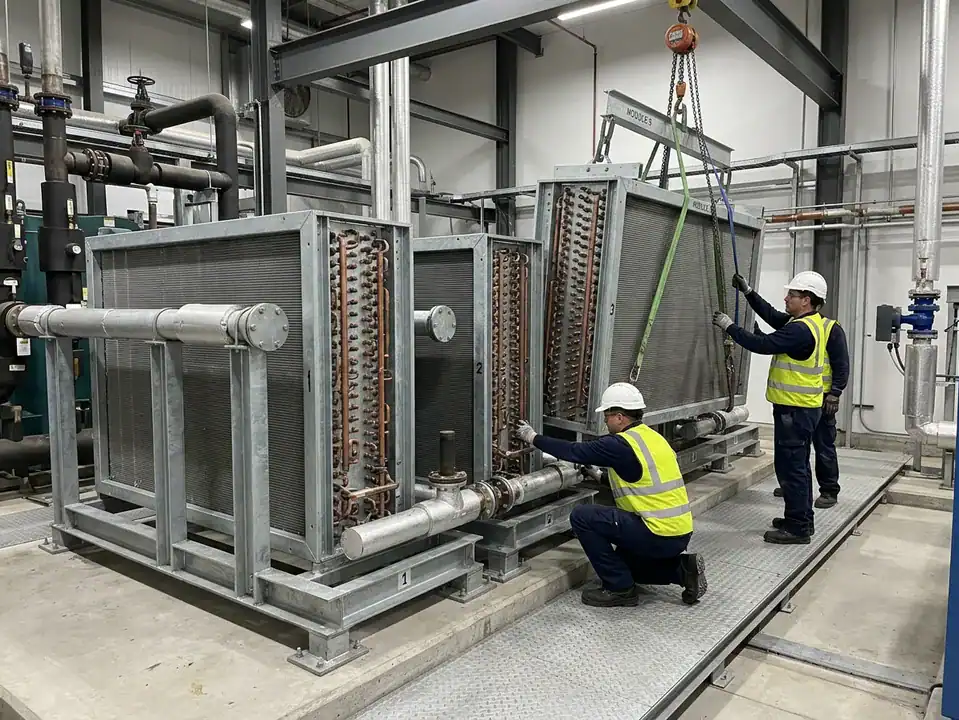
Review the bottom row, headers, end plates, brackets, pan, drain outlet, and installation slope. Water that remains after a wet cycle can create a more aggressive local environment than water that drains quickly. A coating can help, but the geometry should not deliberately retain water.
Provide cleaning access
A protected coil still needs inspection and cleaning. Define access to the face, back, headers, drain pan, and connections. If a filter or grille blocks part of the coil, include it in the service procedure. Make sure the approved cleaning method does not require excessive pressure or a chemical that damages the surface.
Protect during handling and installation
Fins can be crushed, coating can be scratched, and tube ends can be bent before the equipment is commissioned. Use separators, edge protection, lifting instructions, and packaging that suits the shipment. The ISO 9001 explanation is a useful reminder that documented information and process control belong to quality management; the buyer should specify the records and checks required for the coil program.
Consider the complete material stack
The coating may protect the fin but not the fastener, bracket, header, drain pan, or cabinet. Identify where water and dissimilar metals meet. If a copper tube passes through an aluminum fin, the interface and condensate should be considered alongside the exposed surfaces.
What corrosion test evidence should a supplier provide?
The evidence should identify the sample and test, not only provide a result number.
| Evidence field | What to record |
|---|---|
| Sample | Substrate, alloy/material, coating, thickness, formed or flat, complete or coupon |
| Preparation | Cleaning, pretreatment, cure, edge, scribe, joint, and repair condition |
| Exposure | Salt, humidity, chemical, immersion, UV, freeze/thaw, or site sample |
| Method | Standard or internal procedure, equipment, duration, temperature, concentration |
| Evaluation | Blistering, creepage, corrosion, adhesion, appearance, performance change |
| Acceptance | Pass/fail rule, comparison sample, and limitations |
| Relevance | How the sample represents the finished Domi coil and site environment |
| Traceability | Material lot, coating lot, sample date, operator, and report revision |
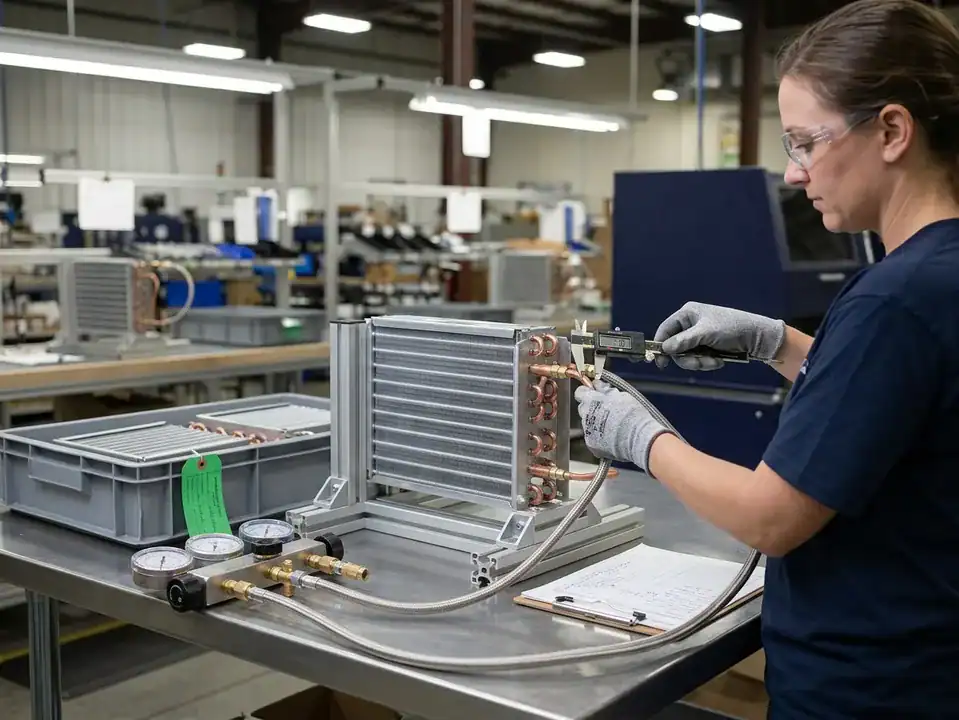
Testing is a tool for a decision, not a marketing decoration. A flat-panel test may screen materials; a finished-coil test may be needed when edges, joints, drain paths, and mixed metals control the risk. The buyer and supplier should agree which test is sufficient for the equipment risk.
Why fixed salt-spray hours need context
A salt-spray duration without the method, sample, scribe, substrate, coating, and acceptance rule is difficult to compare. It may also be irrelevant to an industrial chemical exposure or a wet indoor coil. Use a defined test to compare defined options, and do not convert it into a universal field lifetime.
Test after forming and assembly when the risk demands it
Forming, fin insertion, brazing, cleaning, and handling can expose or damage a surface. If the coating is a critical purchase requirement, ask whether the evidence covers the finished configuration. If not, mark a sample test as an open validation item.
HVAC coil coating RFQ checklist
Send a structured RFQ so the supplier can propose an environment-based solution:
| RFQ line | Buyer information |
|---|---|
| Equipment | Condenser, evaporator, heat pump, air handler, or other |
| Site | Coastal distance, industrial process, indoor humidity, wash-down, storage |
| Contaminants | Salt, dust, gases, chemicals, cleaners, sanitizer, oils |
| Operating conditions | Temperature, humidity, condensate, airflow, duty cycle |
| Coil construction | Tube, fin, header, materials, connections, brackets, pan |
| Surface requirement | Corrosion objective, hydrophilic/wetting objective, appearance |
| Maintenance | Inspection frequency, cleaning agent, pressure, brush/spray method |
| Tests | Standard, internal test, sample, exposure, acceptance, report |
| Production | Coating application, cure, inspection, repair, traceability |
| Program | Samples, pilot, volume, SKU mix, packaging, delivery |
Ask for at least one recommended option and one alternative when the environment is uncertain. The supplier should explain the trade-offs in material, cost, thermal effect, service, testing, and lead time.
Common mistakes in coil corrosion protection
Choosing the coating before defining the environment
The same product may be suitable for one exposure and unsuitable for another. Describe the chemicals, moisture, temperature, cleaning, and site rather than starting from a product name.
Treating “marine grade” as a complete specification
Marine, coastal, or anti-corrosion language can be useful shorthand, but it does not define the actual test or installation. Ask what the term means for the specific coil.
Ignoring cut edges and joints
Edges, holes, tube contacts, header joints, brackets, and fasteners can create local corrosion even when the fin face looks good. Inspect the complete assembly.
Assuming a thicker coating is always better
A thicker layer may affect heat transfer, fit, cure, edge coverage, flexibility, or repair. Use the coating system and test evidence rather than optimizing one thickness number.
Using an incompatible cleaner
The maintenance procedure can destroy a surface that performed well in the factory. Put cleaning chemicals and pressure limits into the service documentation.
Promising a fixed lifetime or permanent protection
Field life depends on exposure, installation, maintenance, damage, and the actual material system. Use conditional, evidence-based claims and identify limitations.
How Domi can support corrosion protection planning
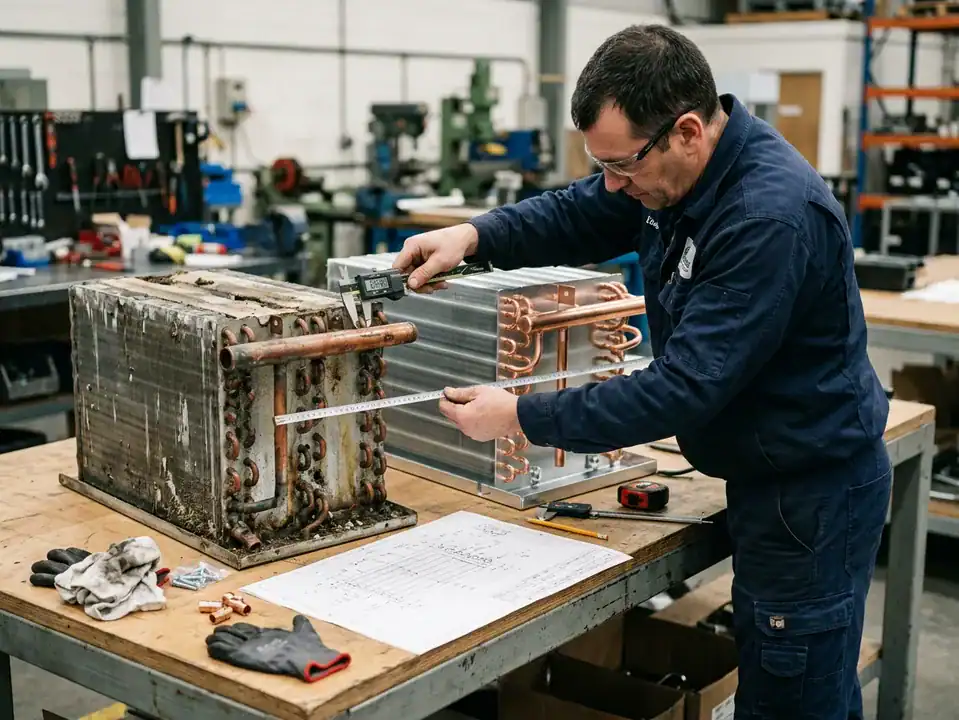
Send Domi the coil drawing, material requirements, site exposure, cleaning chemicals, duty, drainage details, sample quantity, and target production volume. The custom coil fabrication page is the appropriate route for a drawing-based quotation. Use engineering capabilities for design and material questions and testing lab support to discuss the evidence that the project actually needs.
For a replacement coil, include photographs of corrosion, the failed location, operating history, cleaning record, and the original material or coating if known. For a new OEM design, include the environment matrix before selecting a finish. Use the contact page to send the specification and ask for a technical review.
The final choice may be a coating, material change, drainage improvement, maintenance change, or a combined design. A supplier should be transparent about what it can verify and what still requires site or system testing.
Investigating a corrosion failure before changing the coating
When a coil has corroded, photograph and map the failure before cleaning or replacing it. Record the equipment location, age, operating mode, wetness, airflow, cleaning history, nearby chemicals, storage, packaging, and the exact places where damage started. A broad statement such as “the coil rusted” hides important differences between aluminum pitting, copper corrosion, coating blistering, galvanic attack, erosion, and dirt-related underfilm damage.
Look for a pattern
Is the damage concentrated at the leading edge, bottom row, tube-to-fin interface, header, braze joint, fastener, drain pan, or a side exposed to a chemical plume? Does it occur only on one face? Is the coating missing at bends or cut edges? The pattern can suggest whether the main control is material, surface preparation, water retention, airflow, installation, or cleaning.
Check the maintenance record
Identify the cleaner, concentration, temperature, pressure, dwell time, rinse, and frequency. Ask whether a different contractor or product was used before the failure. A coating that is compatible with one neutral cleaner may not survive an acidic or alkaline wash. The maintenance record is part of the corrosion evidence.
Separate cause from consequence
A damaged coating may be a consequence of a bent fin, impact, aggressive cleaning, or standing water rather than the original cause. Recoating the surface without correcting the drain, airflow, chemical, or handling problem can repeat the failure. The failure review should therefore include the coil, pan, cabinet, installation, service, and packaging.
Decide whether a sample is needed
If the failure mechanism is unclear, compare the existing construction, a proposed coating, and a material or drainage alternative on representative samples. Define the exposure and acceptance before testing. A small sample cannot reproduce every site condition, but it can eliminate an unsuitable option and reveal which question needs a field test.
Lifecycle and cost questions for corrosion protection
The lowest initial coating price is not necessarily the lowest program cost. Include the total effect on procurement, production, service, warranty, replacement, packaging, cleaning, and downtime.
| Lifecycle line | Questions to include in the business case |
|---|---|
| Material and coating | What is the unit cost, batch minimum, lead time, and approved alternative? |
| Manufacturing | Does the process add forming, masking, curing, inspection, or scrap? |
| Thermal selection | Does the surface change the selected rows, face area, pressure drop, or fan requirement? |
| Packaging | Does the surface need separators, covers, or humidity protection? |
| Installation | Are there special handling, touch-up, or storage instructions? |
| Maintenance | What cleaner, pressure, frequency, and inspection are allowed? |
| Warranty | What records are needed to evaluate a field failure? |
| Replacement | Is the coated part stocked, repairable, or made to order? |
| Testing | What sample, site, or periodic verification is required? |
This structure helps procurement compare a standard coil with a protected coil without hiding the downstream costs. It also prevents the project from accepting a coating that cannot be supplied at the planned volume or supported by the service network.
Plan a controlled alternative
If the selected coating becomes unavailable, define an approved alternative process before the crisis occurs. The alternative should be reviewed for substrate, thickness, adhesion, thermal impact, cleaning, corrosion evidence, packaging, and requalification. “Equivalent coating” is not a sufficient change description.
Keep a field feedback loop
Record the site, climate, coil revision, coating lot, cleaning, failure location, and service action for returns. Over time, the OEM can see whether failures correlate with a material, an installation, or a maintenance practice. The feedback should update the design and service instructions rather than only trigger one replacement.
Choosing between coating, material, and geometry changes
Use a short comparison when the team is deciding how to respond to a corrosion risk:
| Option | Strength | Limitation to check |
|---|---|---|
| Coating | Can protect a defined surface without redesigning the full core | Application, edges, damage, cleaning, cure, and evidence |
| Material change | May address a substrate or mixed-metal problem at the source | Cost, availability, forming, joining, and supply stability |
| Fin-spacing change | Can reduce blockage or improve cleaning access | May change capacity, pressure drop, face area, and package |
| Drainage change | Removes standing water and reduces local exposure | May require a new pan, cabinet, slope, or installation instruction |
| Maintenance change | Can reduce deposit and chemical exposure | Depends on site discipline, access, and service resources |
| Combined design | Addresses more than one mechanism | More validation, documentation, and change-control work |
The team should state which failure mechanism each option addresses. If a coating only protects the fin face but the failure starts at a bracket or drain pan, it is not a complete response. If a material change solves the substrate issue but creates a new cleaning or supply problem, the business case must show that trade-off.
Review the option with the thermal engineer
Surface treatments and material changes can affect the selection assumptions. Ask whether the proposed change alters fin contact, surface resistance, wetting, air-side pressure drop, frosting, drainage, or the selected face area. A corrosion decision should not be approved in isolation from the thermal and mechanical drawing.
Review the option with service and quality
Service should know how to clean, inspect, repair, and replace the protected part. Quality should know how to identify the material and surface-treatment lot and which production checks prove that the approved process was used. These records make a future field failure easier to investigate.
For procurement, the decision record should also name the approved supplier, process, drawing revision, and change-notification rule. That keeps an apparently minor material substitution from entering production without a new corrosion or thermal review.
That record can also state the field evidence required when the part returns: photographs, site exposure, cleaning history, lot number, and failure location. Without those details, the next coating decision will be based on a guess.
The same evidence should be used when comparing a new supplier or an alternate coating, so the program learns from field conditions rather than only from laboratory labels.
For a new site, make the environment record before the purchase order. Note whether the coil is inside or outside, how often it will be wet, what chemicals are nearby, how it will be cleaned, what materials touch one another, and where water can collect. A short site survey often reveals a drainage or maintenance change that is cheaper and more reliable than adding a coating after the cabinet has been designed.
The site record should travel with the approved coating or material choice. If the unit moves to another building, climate, cleaning contractor, or process area, the buyer can see which assumptions have changed. That does not mean every relocation requires a new coating, but it does give engineering a reason to review the exposure before the next order. It also helps service teams explain why a finish selected for an indoor wet coil is not automatically suitable for a salt-exposed outdoor condenser.
This is a useful place to record the limits of the recommendation. State the expected exposure, approved cleaners, storage conditions, inspection interval, and the evidence that supports the choice. A narrow recommendation is easier to maintain than a broad promise that the same coating will protect every HVAC coil in every climate.
That feedback keeps the specification tied to the equipment’s actual service environment.
The service manual can repeat the same boundaries without inventing a new claim.
For broader equipment and reference context, review the EPA refrigeration and air-conditioning program, the ASHRAE standards and guidelines library, and AHRI resources. These sources do not replace an environment-specific coating and test decision.
Frequently asked questions
What is the best coating for an HVAC coil?
There is no universal best coating. The choice depends on the substrate, coastal or industrial exposure, wet operation, cleaning chemicals, temperature, airflow, drainage, service plan, and required test evidence. Compare defined options against the actual environment.
Do all coastal HVAC coils need a coating?
Not necessarily, but coastal exposure should trigger an environment and material review. Some equipment may need a coating, some may need a different material or drainage design, and some may need a combined solution. The site and maintenance conditions decide the requirement.
Does coating a coil reduce heat transfer?
A surface treatment can affect thermal resistance or the selected geometry, but the effect depends on the coating system, thickness, substrate, and coil design. Ask for the selection basis and test data for the actual assembly rather than assuming a universal penalty or gain.
Can a coated HVAC coil be cleaned normally?
Only within the coating and equipment supplier’s instructions. The approved chemicals, concentration, temperature, pressure, and brushing method should be documented. A generic cleaner may damage the surface.
Does epoxy coating stop all coil corrosion?
No coating can guarantee protection against every environment, defect, edge, joint, cleaner, installation condition, or service error. The coating must be selected, applied, tested, maintained, and combined with appropriate materials and drainage.
What corrosion test should I request?
Request a test that represents the risk: a defined salt, humidity, chemical, immersion, freeze/thaw, or site exposure, with the sample, method, duration, evaluation, and acceptance rule recorded. A flat coupon may not represent a finished coil.
How do I specify a coated replacement coil?
Provide the equipment model, old coil drawing or sample, materials, corrosion location, site environment, cleaning method, dimensions, connections, duty, and quantity. Ask the supplier to confirm whether the proposed coating and construction match the failure mechanism.
Can Domi recommend a corrosion-protection option?
Send the environment matrix and coil details so Domi can confirm the feasible material or surface-treatment route. The recommendation should identify assumptions, test evidence, service limits, and any open validation item.
Related articles
- Microchannel vs Fin-Tube Coils for HVAC Systems
- How to Size a Custom HVAC Coil
- R32 vs R410A HVAC Coil Design
- Hydrophilic Aluminum Fins for HVAC Evaporator Coils
- Heat Pump Outdoor Coil Frosting and Defrost Design
- What Is a Heat Exchanger? Types, Uses and How It Works
Final takeaway
Effective HVAC coil corrosion protection starts with the environment, not a generic product label. Coatings, materials, drainage, mixed-metal interfaces, cleaning, packaging, and inspection all contribute to the result. Define the exposure, specify the evidence, validate the actual construction when necessary, and document the maintenance limits.
Send Domi the drawing, material and coating objective, site exposure, cleaning plan, drainage details, sample requirement, and production volume. That information allows the supplier to compare realistic options and avoid promising a coating that has never been tested for the way the coil will actually be used.