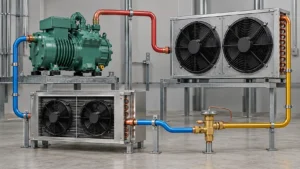

An R32 coil cannot be treated as an R410A coil with a different label; refrigerant properties, pressure and safety requirements, circuiting, connections, controls, documentation, and system approval must be reviewed for the specific equipment.
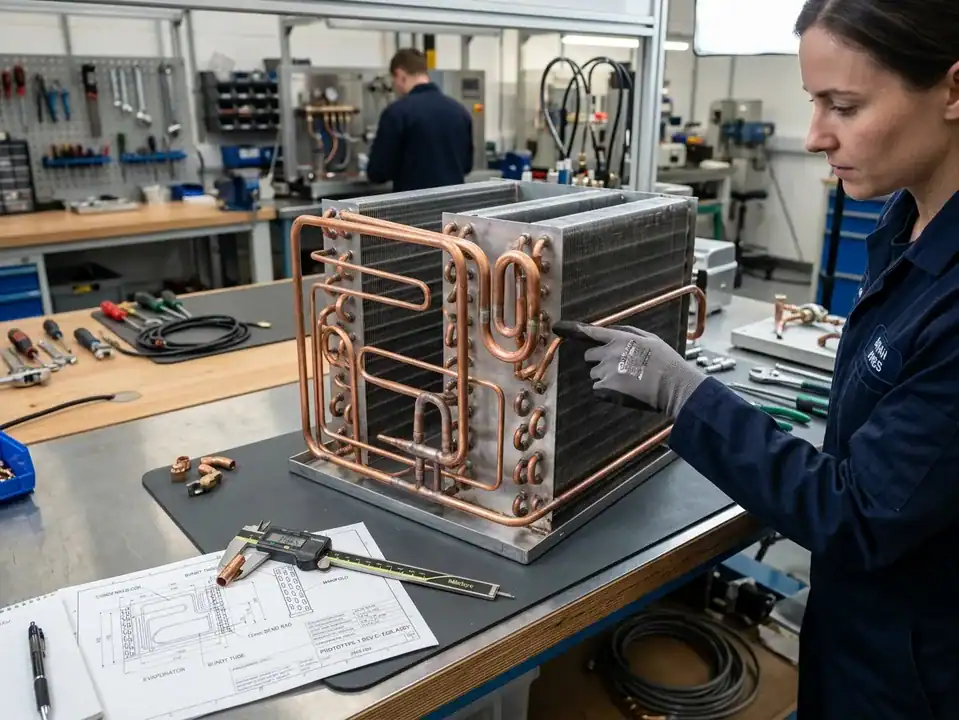
The phrase R32 vs R410A HVAC coil sounds like a simple product comparison, but an OEM project is really asking a compatibility question. Can an existing coil be reused? Does the new refrigerant require a different circuit arrangement? Do the pressure, safety classification, charge, control, service, and documentation requirements change? Those questions cannot be answered from the coil’s outside dimensions alone.
R32 and R410A have different properties and system requirements. The coil is one component in a circuit that also includes the compressor, expansion device, piping, valves, heat exchangers, controls, electrical protection, and cabinet. A project that changes refrigerant may therefore require a system redesign or formal approval, not just a replacement coil.
This guide is written for HVAC and heat pump OEM buyers, engineering teams, and procurement managers. It explains what to put in a refrigerant-specific RFQ and which assumptions must be confirmed by a qualified engineer. For the broader product route, see Domi’s HVAC and heat pump heat exchanger solutions; for a quotation, send the actual drawing and operating data rather than relying on a generic coil name.
Why the R32 vs R410A coil question is system-specific
A coil transfers heat, but the way it transfers heat depends on the refrigerant state, mass flow, temperature glide or phase behavior where applicable, pressure, oil and material compatibility, circuiting, and control strategy. The same face dimensions can contain different tubes, ports, circuits, headers, connections, and design limits.
The first distinction is between three project types:
- A new equipment design. The OEM can select the refrigerant, coil construction, compressor, controls, and cabinet as a system.
- A refrigerant conversion. An existing machine may need a broader engineering and compliance review before a new refrigerant is approved.
- A coil replacement. The replacement must match the actual equipment and refrigerant conditions. It is not automatically interchangeable because the old and new assemblies look similar.
The EPA information on substitutes for refrigeration and air conditioning is a useful starting point for understanding that refrigerant acceptability is tied to end use and regulatory context. The relevant listing, safety requirements, and market rules depend on the equipment category and jurisdiction. Use current official guidance and a qualified professional for the final decision.
What cannot be inferred from a part number
The following items should not be inferred merely from an R32 or R410A label:
- Design or working pressure.
- Required pressure test and leak-test conditions.
- Allowable refrigerant charge and system volume.
- Circuiting or header arrangement.
- Expansion-device selection and control range.
- Sensor, service, and electrical requirements.
- A2L or other safety handling procedures where applicable.
- Compatibility with an existing compressor, oil, valve, or controller.
- Compliance with a particular market or equipment standard.
Those items belong in the engineering review and should be recorded in the specification.
Design inputs that change between R32 and R410A projects
Refrigerant identity and safety classification
Identify the refrigerant, the equipment end use, the intended market, and the applicable safety documentation. R32 is commonly discussed in the context of lower-global-warming-potential transitions and A2L classification, but the exact installation and compliance requirements depend on the equipment and jurisdiction. R410A has its own pressure and handling requirements. Neither statement alone tells a supplier how to design a coil.
Use the ASHRAE refrigerant designations page and the applicable local codes or certification instructions as references, not as a substitute for an equipment-specific safety review. Never tell a buyer that a coil is “approved for all markets” unless the exact certification scope has been verified.
Design pressure and temperature range
The RFQ should state normal operating pressure, maximum working or design pressure, test pressure required by the project, and the temperature envelope. The supplier needs to know whether the value applies to the tube, header, complete coil, or system assembly. Define whether the pressure is gauge or absolute and identify the test medium and procedure.
Do not copy a pressure value from a different refrigerant project. A coil that passes a leak test at one condition may still need a different mechanical review for a new pressure envelope. The drawing, material, joining process, and test record should use the same defined basis.
Circuiting and refrigerant distribution
R32 vs R410A design may require a review of circuit length, port or tube diameter, number of circuits, header geometry, return bends, and connection location. The objective is not to select a larger or smaller tube from a rule of thumb. It is to create a refrigerant path that meets the duty and pressure-drop requirements across the expected operating range.
For an evaporator, consider inlet distribution, two-phase behavior, outlet superheat assumptions, and the response of the expansion device. For a condenser, consider desuperheating, condensation, and subcooling zones. For a heat pump outdoor coil, the same physical coil may operate in both roles and may be exposed to frosting and defrost.
Materials, oil, and joining
The buyer should state the required tube, fin, header, braze, coating, and connection materials, or ask the supplier to propose them. Compatibility includes more than the internal refrigerant contact. It can include oil, flux residue, elastomers, valves, insulation, coatings, and cleaning chemicals.
The AHRI 410 performance-rating scope can help identify questions about forced-circulation air coils, but it does not decide whether a particular refrigerant conversion is acceptable. Put the refrigerant, operating condition, construction, and acceptance method in the project specification.
Charge and internal volume
The coil’s internal volume and circuiting can affect the refrigerant charge and transient behavior of the system. It is not safe to promise a fixed charge reduction from a construction label. The result depends on tube or port geometry, circuit length, headers, system controls, operating envelope, and the rest of the circuit.
For a new design, ask the supplier to provide the internal volume basis and assumptions that can be shared with the system engineer. For a conversion, confirm whether the compressor, expansion device, receiver, accumulator, piping, and controls were designed for the new refrigerant. A new coil alone does not solve a system-level charge or safety question.
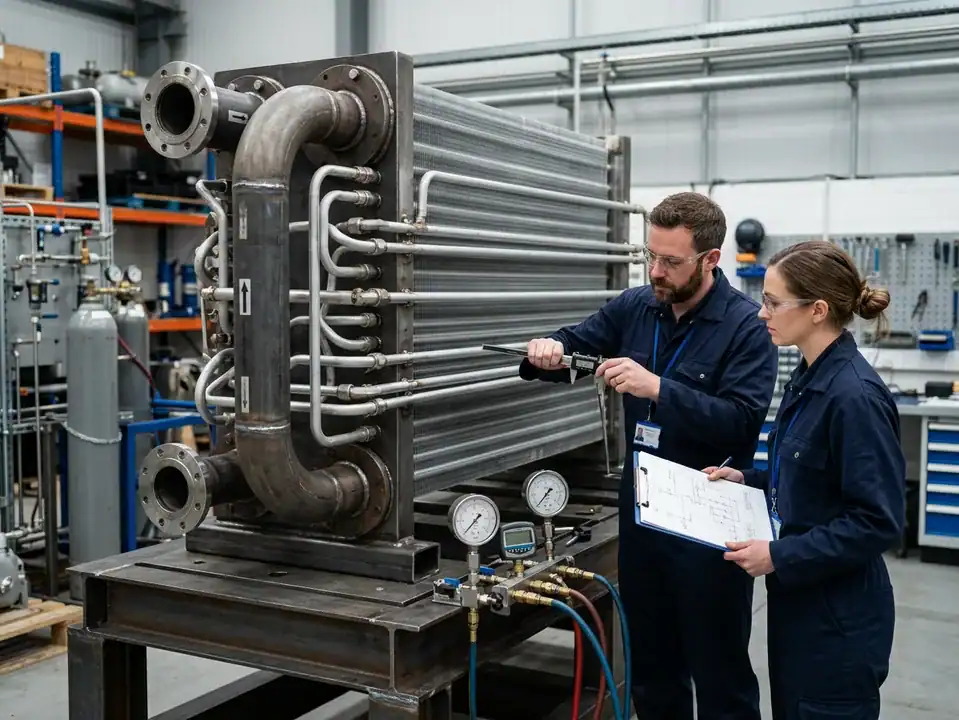
R32 vs R410A replacement: what is and is not interchangeable
The safest replacement decision is made with a compatibility matrix. Do not use a single “same size” statement.
| Compatibility layer | Questions to answer before replacement |
|---|---|
| Mechanical | Does the assembly fit the cabinet, fan, brackets, drain, insulation, and service opening? |
| Thermal | Is capacity confirmed at the new refrigerant’s operating conditions and airflow? |
| Refrigerant | Are tube, header, circuiting, volume, connections, and pressure limits suitable? |
| Controls | Are expansion devices, sensors, valves, compressor maps, and defrost controls compatible? |
| Safety | Are charge, ventilation, ignition-source, labeling, service, and local code requirements addressed? |
| Quality | Are leak, pressure, dimensional, performance, and traceability requirements defined? |
| Commercial | Are samples, tooling, SKU changes, packaging, and documentation planned? |
If any line is unknown, the replacement should be treated as an engineering project, not as a direct spare-part order. The buyer can still ask for a preliminary quotation, but the quote should list the open assumptions.
Why the old coil drawing is not enough
An old drawing may show the tube layout and connections but omit internal volume, design pressure, refrigerant, test method, coating, or the actual equipment rating point. It may also be at an older revision. Ask for the equipment model, nameplate, service history, refrigerant record, and any system changes made since the original part was released.
Photographs are useful for brackets, labels, and damage. They are not a substitute for a dimensioned drawing and operating data. If a sample is the only reference, record which dimensions are measured, which are estimated, and which must be confirmed during fit-up.
Why a “drop-in” claim needs boundaries
The phrase “drop-in replacement” should be limited to verified interfaces. A supplier may be able to match the mechanical envelope, but the buyer still needs to check the refrigerant, controls, pressure, performance, safety, and documentation. Use a more precise statement such as “mechanically compatible with the supplied drawing; system validation required.”
OEM RFQ checklist for a refrigerant-specific coil
Send the following information to the supplier:
| RFQ line | Required detail | Review question |
|---|---|---|
| Refrigerant | R32, R410A, or other; confirm market and equipment category | Is the design basis current and explicit? |
| Operating envelope | Evaporating/condensing temperatures, pressure range, ambient range | Does the coil cover normal and limit conditions? |
| Thermal duty | Cooling/heating capacity, rating point, part-load targets | Which test or selection method will be used? |
| Air side | Flow, entering temperature, humidity, pressure-drop limit | Is air distribution understood? |
| Coil geometry | Face, depth, rows, tube/port, fin, headers, connections | Which dimensions are fixed? |
| Materials | Tubes, fins, headers, braze, coating, insulation and fasteners | Are internal and external materials compatible? |
| Charge/system | Internal volume target, controls, compressor, expansion device | Is the coil being evaluated with the complete circuit? |
| Safety | Handling, service, labeling, ventilation, local requirements | Which party owns compliance confirmation? |
| Quality | Leak, pressure, dimensional, performance and traceability | What does the sample need to prove? |
| Program | Samples, pilot, annual volume, SKU mix, packaging | Can the design be repeated and supported? |
Mark every line as confirmed, estimated, or to be confirmed. If the buyer wants the supplier to propose a value, ask for the assumption in the quotation.
How to validate a new refrigerant coil before production release
Drawing and design review
Check the refrigerant, pressure, temperature, materials, connections, circuiting, headers, mounting, drain, coating, inspection points, and revision. Confirm that the drawing describes the finished assembly and that the test requirement uses the same pressure and temperature terminology.
Sample and leak/pressure checks
Define the test method, medium, duration, acceptance limit, equipment, and record. A leak test and a pressure test answer different questions. They should not be reported as the same result. The buyer should also confirm whether the coil is tested before coating, after coating, or as part of a larger assembly.
Thermal and system checks
Test the coil in the complete equipment or a fixture that represents the agreed airflow, refrigerant circuit, controls, and operating conditions. Record the test point and any deviations. For a heat pump, include the modes that matter to the product, including low ambient, frosting, and defrost when applicable.
Safety and documentation review
Confirm that the equipment manufacturer and local compliance team own the final approval. Provide the material, pressure, leak, drawing, label, service, and handling documentation requested by the project. Do not use a supplier’s generic certificate as proof of approval for a different equipment model or market.
Controlled production release
Use the approved revision, material batch rules, work instructions, inspection plan, packaging, and change-notification process. A refrigerant change can make a previously minor variation more important. Define which changes require requalification, such as tube or port geometry, header layout, coating, joining method, circuiting, or connection location.

Common mistakes in R32 and R410A coil projects
Treating refrigerant conversion as a part swap
A new coil can be required, but the system still needs a review of compressor, expansion device, piping, controls, charge, safety, and test plan. If the project is a conversion, list the whole system boundary.
Copying a pressure value from a generic chart
Pressure depends on the operating point, temperature, refrigerant, and design basis. Use the project’s controlled engineering data and current standards. Do not present a generalized internet value as the maximum working pressure of a custom coil.
Ignoring A2L or other safety implications
Safety classification affects more than the refrigerant name. It can affect charge, installation, ventilation, ignition sources, service tools, labeling, training, and local code. The equipment owner and qualified safety engineer must confirm the actual requirements.
Comparing efficiency without rating conditions
“More efficient” is incomplete without the system, capacity, airflow, temperature, controls, pressure drop, and test method. An article can explain design trade-offs, but it should not promise a fixed gain for a coil that has not been selected and tested.
Forgetting the service and documentation package
The field team needs to know the refrigerant, pressure limits, connections, service procedure, replacement part number, labels, and disposal/handling expectations. Add those requirements to the development plan, not after production starts.
How Domi can support the design conversation
The useful first step is a technical review, not a generic price request. Send the equipment model, refrigerant, operating range, duty, airflow, envelope, connection drawing, environment, sample quantity, and annual volume. If the project is a conversion, identify the existing coil and every system component that will change.
Domi’s custom coil fabrication route can be used for a drawing-based inquiry. The engineering capabilities page is the relevant path for questions about development and design review, while testing lab support should be discussed for the project’s actual test requirements. Use the contact page to submit the drawing and data securely through the normal inquiry route.
The supplier should explain what it can confirm, what requires system validation, and what information remains missing. That clarity is more valuable than a quick answer that a coil is “compatible” without a stated basis.
A practical decision tree for an R32 or R410A coil project
The following sequence helps the project team decide how much work is required.
Question 1: Is this a new system or a replacement?
For a new system, the OEM can design the compressor, expansion device, coil, controls, cabinet, and safety documentation as one product. The project still needs a defined refrigerant and market, but it has more freedom to optimize the circuit.
For a replacement, recover the existing system data first. Identify the refrigerant currently in the equipment, the nameplate, compressor and valve information, control board, coil connections, pressure history, and reason for replacement. If the buyer wants a different refrigerant, move the project into a conversion review rather than a spare-part workflow.
Question 2: Is the refrigerant and market basis confirmed?
Write the refrigerant, end use, country or market, charge approach, safety category, and documentation owner into the brief. Regulations and standards can change, and a component that is acceptable in one system or market may not be acceptable in another. The supplier can support the coil design, but the OEM remains responsible for confirming the complete equipment requirements.
Question 3: Are the pressure, temperature, and duty conditions controlled?
If the operating range is missing, the supplier can make a preliminary recommendation only. Identify whether the coil is an evaporator, condenser, or reversing outdoor coil, and define the normal, minimum, and maximum conditions. Include capacity, airflow, pressure-drop limits, and control assumptions. A pressure value without a temperature and design basis is not a complete specification.
Question 4: Is the mechanical envelope frozen?
If the cabinet, connections, brackets, drain, and fan are fixed, the supplier must fit the coil within those constraints. If the envelope is still flexible, ask for a comparison of construction and circuiting options before tooling is released. A small amount of package freedom can make the design easier to validate.
Question 5: What level of evidence does the project need?
Decide whether the first output is a concept, a quotation, a fit sample, a production-intent sample, a system test, or a released component. Define the tests for each stage. A drawing review may show that the connections fit; it does not prove system capacity or safety approval.
This decision tree helps procurement avoid asking for a price before engineering has defined what the price must include. It also lets Domi state which assumptions are open and which deliverables can be offered.
Documentation and approval package for refrigerant-specific coils
The document set should be proportionate to the equipment risk, but it commonly includes:
- Approved assembly drawing with revision and material notes.
- Refrigerant, operating range, and pressure/design basis.
- Circuiting or header information where required for selection and service.
- Material and surface-treatment records.
- Joining, cleaning, and inspection requirements.
- Leak and pressure-test procedure and acceptance criteria.
- Sample or system performance test plan.
- Safety, label, handling, and service information owned by the OEM.
- Change-control and requalification rules.
- Packaging and storage instructions.
Keep the component documentation connected to the equipment revision. A coil drawing can be correct for an R410A model and still be wrong for an R32 model that shares a cabinet. The part number, label, control settings, service instruction, and replacement record should make the distinction clear to the field team.
Document the boundary between supplier and OEM
The supplier can document the coil’s material, dimensions, joining, testing, and stated selection basis. The OEM or equipment designer must confirm the compressor, valves, piping, charge, electrical protection, enclosure, labels, installation, safety, and market compliance. Put this division in the quality or technical agreement.
This boundary prevents a supplier’s coil report from being misread as a complete equipment certification. It also gives the buyer a clear list of questions to send to the system engineer. If a requirement is not within the coil supplier’s control, identify the owner instead of leaving it unassigned.
Requalification triggers
Define the changes that trigger a review. Typical examples include:
| Change | Why it may trigger requalification |
|---|---|
| R32 to R410A or the reverse | New refrigerant, pressure, charge, safety, and system basis |
| Tube/port or header geometry | Changes volume, distribution, pressure loss, or joining |
| Circuiting | Changes phase distribution and thermal behavior |
| Fin material or coating | Changes corrosion, wetting, thermal, and cleaning assumptions |
| Connection location | Can affect piping, service, cabinet, and flow distribution |
| Compressor or expansion device | Changes mass flow and operating envelope |
| Control or defrost sequence | Changes coil temperatures and mode operation |
| Cabinet airflow | Changes face velocity, pressure drop, and frosting |
The point is not to make every minor change expensive. It is to identify which changes are technically meaningful before the product enters production.
Questions for the refrigerant design review meeting
Bring engineering, procurement, quality, service, and the equipment owner into the same review. Ask each group to answer the question that belongs to it:
- Engineering: Which refrigerant, duty, pressure, temperature, circuiting, materials, and controls are the approved design basis?
- Procurement: Which dimensions, materials, coatings, documents, samples, and quantities must be fixed in the quotation?
- Quality: Which leak, pressure, dimensional, performance, traceability, and change-control records are required?
- Service: Which labels, tools, connections, replacement parts, cleaning instructions, and safety steps must be provided?
- Compliance: Which market, safety, installation, charge, labeling, and certification requirements apply to the complete equipment?
End the meeting with an action table. Give every open item an owner, due date, evidence required, and affected drawing revision. This prevents the coil supplier from receiving a late request to “make it R32-ready” when the project has not decided what ready means.
A useful release statement
The release note can state: “This coil is approved for the identified equipment model, refrigerant, operating envelope, materials, connections, and test plan. Changes outside this basis require engineering review.” That language is more useful than a broad statement that the coil supports R32 or R410A in general.
The quotation should use the same boundary. It should identify the refrigerant, design conditions, material and pressure assumptions, sample scope, and the items that remain the OEM’s responsibility. That makes a later technical or commercial review much easier.
If the refrigerant is still under review, request a comparison quote with separate assumptions for each option. Do not ask the supplier to hide the difference inside one blended price or one generic drawing.
The result should leave a trace from refrigerant choice to coil drawing, test plan, service document, and equipment approval. That trace is the practical meaning of refrigerant-specific design.
It also gives purchasing a defensible basis for comparing suppliers: each offer can be checked against the same refrigerant and system assumptions.
The technical file should explain what the coil supplier selected and what the system engineer still has to verify. That separation makes a review faster. It prevents a component report from being read as a complete heat-pump certification and keeps the final safety decision with the equipment owner and qualified compliance team.
For procurement, this distinction matters when quotes look similar. One supplier may include only a mechanically compatible coil, while another includes a production-intent sample, pressure documentation, or a refrigerant-specific review. Ask each supplier to list included tests, excluded system responsibilities, sample assumptions, and documents. A lower line price is not comparable if it removes the evidence the product team needs for release.
The same comparison should appear in the purchase order or technical agreement. List the coil revision, refrigerant, pressure basis, sample quantity, required documents, and approval owner. If a test belongs to the complete unit rather than the coil, write that boundary down. Clear ownership reduces late arguments about whether the supplier was asked to validate a component or the whole heat-pump product.
Put the final approval signature on the same revision that the supplier uses for production.
When those assumptions change, the comparison should be refreshed rather than carried forward by habit.
For additional standards context, review the ASHRAE standards and guidelines library and the ASME engineering drawing standards resources. Use the current project and market requirements for the final approval.
Frequently asked questions
Can I use an R410A coil with R32?
Do not assume that it is safe or technically acceptable. The coil and complete system need a compatibility review covering pressure, temperature, materials, circuiting, internal volume, controls, charge, safety, and local requirements. A qualified engineer or equipment manufacturer must make the final determination.
Is R32 a direct replacement for R410A?
No universal direct-replacement answer applies. The equipment, refrigerant charge, safety classification, compressor, expansion device, controls, piping, coil, and compliance requirements may all matter. Treat the change as a system-specific engineering decision.
Does an R32 coil need a different tube or fin material?
The answer depends on the design pressure, internal fluid compatibility, joining process, external environment, and equipment specification. Material should be selected and documented for the complete design, not from the refrigerant name alone.
Does refrigerant choice change coil circuiting?
It can. Refrigerant properties, flow, pressure drop, phase distribution, and operating range may lead to a different circuiting or header review. The supplier needs the actual duty and system conditions to propose a circuit arrangement.
Does R32 always require a smaller charge?
Do not promise a fixed charge outcome. Charge depends on the complete system volume, circuiting, compressor, controls, operating range, and design. If charge is a project objective, state it as a controlled requirement with a measurement method.
What pressure information should appear on the coil drawing?
The drawing or specification should identify the relevant working/design pressure, test pressure and method, temperature basis, test medium when needed, and acceptance criteria. The exact values must come from the project’s qualified engineering basis.
Can an OEM use the same cabinet for R32 and R410A?
Possibly, but the cabinet envelope alone does not establish compatibility. Review ventilation, charge, ignition-source controls, labels, service access, coil, compressor, valves, and the applicable market requirements.
What should I send Domi for an R32 or R410A coil quote?
Send the refrigerant, application, thermal duty, operating range, airflow, pressure-drop limit, envelope, connections, materials, safety/documentation requirements, sample plan, and volume. Include the existing drawing or sample data if the project is a replacement.
Related articles
- Microchannel vs Fin-Tube Coils for HVAC Systems
- How to Size a Custom HVAC Coil
- Hydrophilic Aluminum Fins for HVAC Evaporator Coils
- Heat Pump Outdoor Coil Frosting and Defrost Design
- HVAC Coil Corrosion Protection Options
- What Is a Heat Exchanger? Types, Uses and How It Works
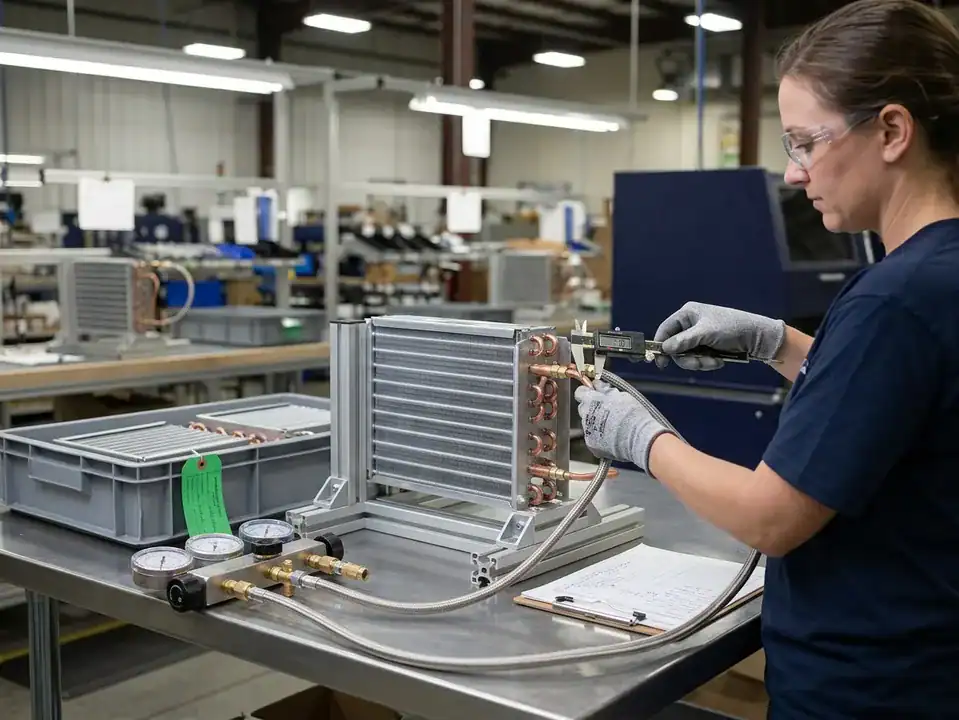
Final takeaway
The important difference in an R32 vs R410A HVAC coil project is not a label on the purchase order. It is the complete design basis: refrigerant, pressure, temperature, circuiting, materials, charge, controls, safety, documentation, and system validation. A coil that fits the same cabinet may still be the wrong component for a different refrigerant.
If you are planning a new heat pump or a refrigerant conversion, send Domi the controlled operating data and drawing. Ask for assumptions to be written down, keep the system boundary visible, and release the coil only after the required engineering and compliance checks are complete.