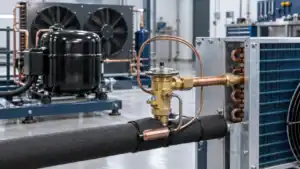

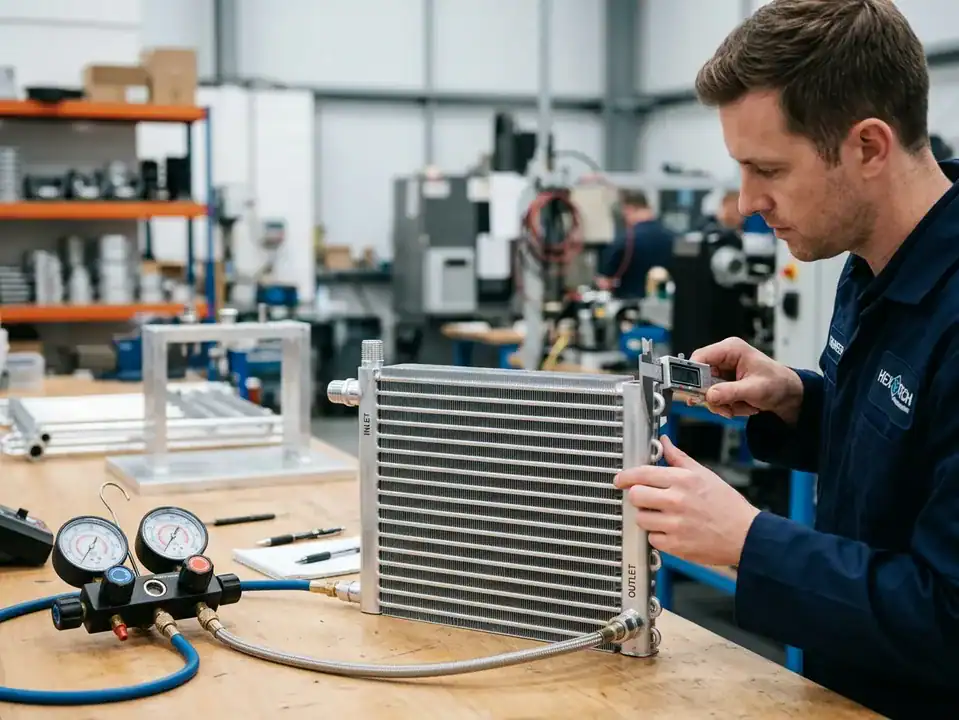
HVAC coils transfer heat between air and a working medium such as refrigerant, water, glycol, or steam. The right HVAC coils depend on the duty, entering and leaving conditions, airflow, pressure-drop limit, available space, materials, corrosion exposure, and service plan. A coil name by itself is not enough to select a commercial replacement or new design.
Buying HVAC coils for a commercial project is rarely a matter of choosing the largest core that fits the cabinet. The coil has to work with the fan, controls, refrigerant or fluid circuit, drain path, access panels, and the equipment’s operating schedule. A design that looks suitable on a drawing can still miss the required duty if the air condition, fluid temperature, circuiting, or pressure-drop limit changes.
This guide is written for OEM engineers, equipment integrators, procurement teams, contractors, and buyers who need a clear specification before requesting a quote. It covers common HVAC coils, but it does not replace a project rating, a licensed system design, or the final supplier approval. If the project involves a safety classification, refrigerant change, or code requirement, the responsible engineer must verify the applicable rules.
The word HVAC coils also covers several different component families. A direct-expansion evaporator, a chilled-water coil, a condenser, a steam coil, and a heat-pump outdoor coil may all be called HVAC coils, yet they operate under different conditions. Start with the heat-transfer role and the working medium. Then define the equipment limits.
What HVAC coils do in commercial equipment
HVAC coils provide the surface where heat moves from one stream to another. In an air-cooling application, air passes over tubes, fins, plates, or another heat-transfer surface while refrigerant, water, glycol, or another medium moves through the coil. The surface temperature and flow arrangement determine whether the coil cools, heats, condenses moisture, rejects heat, or supports a heat-pump cycle.
An evaporator coil absorbs heat from air or another process stream. In a direct-expansion system, the refrigerant changes state inside the coil. In a hydronic system, chilled water or glycol carries the cooling effect through the tubes. A condenser coil rejects heat from the refrigerant to ambient air or a secondary fluid. A heating coil transfers heat from hot water, steam, refrigerant, or electric elements into the air stream.
The coil is one part of a system. Fan selection controls how much air actually crosses the face. The cabinet controls bypass and recirculation. The expansion device affects refrigerant distribution. The pump affects water flow and fluid-side pressure drop. The drain pan and slope affect condensate removal. When an HVAC coil is replaced, these relationships must be checked again.
Evaporator and cooling coils
Evaporator HVAC coils are often used in air handlers, packaged equipment, cold rooms, display cases, process units, and heat pumps. Their specification may include cooling capacity, refrigerant, evaporating condition, superheat target, entering-air temperature, humidity, airflow, face velocity, frost or condensation risk, and drain requirements.
Chilled-water and glycol HVAC coils use a liquid circuit rather than a direct-expansion refrigerant circuit. The buyer normally needs to provide fluid type and concentration, entering and leaving temperatures, flow rate or available pressure drop, design pressure, connection size and position, and the air-side conditions. Glycol concentration changes heat transfer and pumping requirements, so the fluid name alone is not a complete input.
Condenser coils
Condenser HVAC coils reject heat to ambient air. Their selection depends on refrigerant and condensing conditions, outdoor design temperature, heat rejection duty, fan airflow, fin and tube materials, circuiting, subcooling expectations, noise limits, and fouling or corrosion exposure. A condenser with the same external dimensions as an evaporator is not an interchangeable component.
For a commercial refrigeration condenser, the fan and coil are closely linked. A change in fin spacing can alter heat transfer, air-side pressure drop, cleaning access, and dirt retention. A change in circuiting can alter refrigerant distribution and pressure drop. A quotation should show the rating condition and the assumptions behind the result.
Heating, steam, and heat-pump coils
Heating HVAC coils may use hot water, steam, refrigerant, or another source. Steam coils need attention to condensate drainage, control valves, freeze protection, and orientation. Hot-water coils need flow, temperature difference, pressure drop, and water quality inputs. Heat-pump coils can change role between heating and cooling, so the design review must cover both operating modes and the controls that switch them.
The phrase HVAC coils does not tell a supplier whether one coil has one duty or must operate in several modes. State the modes in the RFQ. If the equipment can run at more than one airflow or fluid condition, include the rating points rather than asking the supplier to assume a single condition.
| HVAC coil type | Typical working medium | Common commercial use | Main RFQ question |
|---|---|---|---|
| Direct-expansion evaporator | Refrigerant | Air handlers, packaged units, refrigeration equipment | What refrigerant, evaporating condition, superheat basis, and air condition apply? |
| Chilled-water or glycol coil | Water or glycol solution | Air handlers, process cooling, fan-coil equipment | What fluid concentration, flow, entering temperature, and leaving temperature are required? |
| Air-cooled condenser | Refrigerant and ambient air | Condensing units, refrigeration equipment, cooling packages | What heat-rejection duty, ambient design temperature, fan condition, and subcooling basis apply? |
| Hot-water coil | Heated water | Heating sections and air handlers | What flow, water temperatures, design pressure, and control arrangement apply? |
| Steam coil | Steam and condensate | Industrial or commercial air heating | How will condensate drain, and what freeze and control protection is required? |
| Heat-pump coil | Refrigerant, with mode changes | Reversible heating and cooling equipment | Which operating modes and control transitions must the coil support? |
Define the duty before choosing HVAC coils
The first useful document is not a product name. It is a duty statement. The duty should identify what the coil must do, under what conditions, and with what limits. A buyer who sends only a cabinet size may receive a fast answer, but that answer may be based on an assumption that later changes the price, performance, or fit.
State the working medium
List the refrigerant, water, glycol, steam, or other medium. For refrigerants, include the mixture or designation used by the system and state whether the project is a new design, a retrofit, or a replacement. Refrigerant compatibility includes more than tube material. It can affect operating pressure, circuiting, controls, oil return, safety review, and the final equipment approval.
For water and glycol HVAC coils, state concentration and water quality if known. Glycol is not a simple substitute for water. Its thermal properties and viscosity affect capacity, flow, pump duty, and pressure drop. If the concentration is not final, mark the value as a design assumption and ask the supplier to show how the rating changes when the concentration changes.
Provide entering and leaving conditions
Air-side conditions normally include entering dry-bulb temperature, entering wet-bulb temperature or relative humidity, leaving target, airflow, and operating schedule. Fluid-side conditions include entering temperature, leaving target, flow rate, and allowable pressure drop. Refrigerant-side conditions may include evaporating or condensing temperature, superheat, subcooling, pressure, and the expansion-device basis.
Humidity matters when an evaporator coil operates below the air dew point. Condensation adds drain load and can change the effective surface condition. A coil that is acceptable for dry cooling may need a different face area, fin spacing, drain arrangement, or casing when it must dehumidify.
Define airflow and pressure drop
Airflow is often stated in CFM, but the supplier also needs to know how that airflow is distributed across the face. A fan may not cover the full face evenly. A filter, grille, bend, or transition can create local high velocity. These details affect the rating and the actual performance of HVAC coils in the equipment.
Air-side pressure drop affects fan selection, sound, energy use, and control range. Fluid-side and refrigerant-side pressure drop affect pump or compressor operation and distribution. A quotation should identify whether a pressure-drop value is clean-coil, rated-coil, or field-condition information. If the project has a hard limit, state it clearly.
Define the installation envelope
The envelope should include face width, face height, depth, row limit, header or connection space, casing, frame, drain pan, mounting points, service clearance, and removal path. A replacement coil may fit the opening but fail to pass through the service door. A new coil may fit the cabinet but leave no room for brazing, insulation, valve access, drain routing, or cleaning.
Take measurements from the coil itself when possible. Record the direction of airflow, tube orientation, connection side, header position, mounting holes, casing flange, drain outlet, and any unusual bracket. Photographs are useful, but they should support a dimensioned sketch or drawing rather than replace it.
| Input group | What to provide | Why it changes the HVAC coil decision |
|---|---|---|
| Thermal duty | Cooling or heating load, rating points, operating modes | Sets the required heat-transfer surface and rating basis |
| Air side | Airflow, entering and leaving temperature, humidity, face area, filter or grille | Affects capacity, condensation, face velocity, fan duty, and pressure drop |
| Fluid or refrigerant side | Medium, flow or refrigerant condition, pressure limits, connections | Affects tube circuiting, material, control, distribution, and safety review |
| Mechanical envelope | Width, height, depth, rows, frame, mounting, service opening | Determines whether the coil can be installed and removed |
| Environment | Salt, moisture, chemicals, dust, wash-down, temperature | Changes material, coating, drainage, inspection, and maintenance needs |
| Commercial scope | Quantity, sample need, destination, packaging, drawing revision | Allows the supplier to define quotation, prototype, and production scope |
Compare construction and materials
HVAC coils are often described by the tube and fin combination, but construction includes the entire heat-transfer path. Tube diameter, wall thickness, fin material, fin spacing, tube pattern, number of rows, circuiting, headers, brazed joints, casing, frame, coating, and drain details all matter.
Fin-tube construction
Fin-tube HVAC coils use tubes with fins attached to increase air-side surface area. Copper tubes with aluminum fins are common, but the correct material depends on the working medium, environment, manufacturing process, service plan, and project requirements. Aluminum tubes, stainless components, coated fins, and other combinations may be considered for specific applications.
Fin spacing affects surface area, airflow resistance, dirt retention, cleaning access, and frost behavior. A tight fin pitch may provide more surface in a compact face, but it can be less forgiving in a dusty or frosting environment. A wider spacing may help cleaning or frost clearance, but it can require more face area or depth to meet the duty.
Microchannel construction
Microchannel HVAC coils use flat multi-port tubes and fins in a compact core. They can offer a different balance of size, material, refrigerant charge, airflow, repair practice, and corrosion exposure than a conventional fin-tube coil. The comparison must be project specific. A microchannel core should not be treated as a drop-in replacement simply because the outside dimensions are similar.
When choosing between microchannel and fin-tube HVAC coils, compare refrigerant distribution, tube and header configuration, pressure drop, service access, cleaning method, corrosion protection, and replacement availability. The AHRI 410 standard has a defined scope and exclusions. Do not describe every coil construction as if one rating method covers all of them.
Coatings and corrosion protection
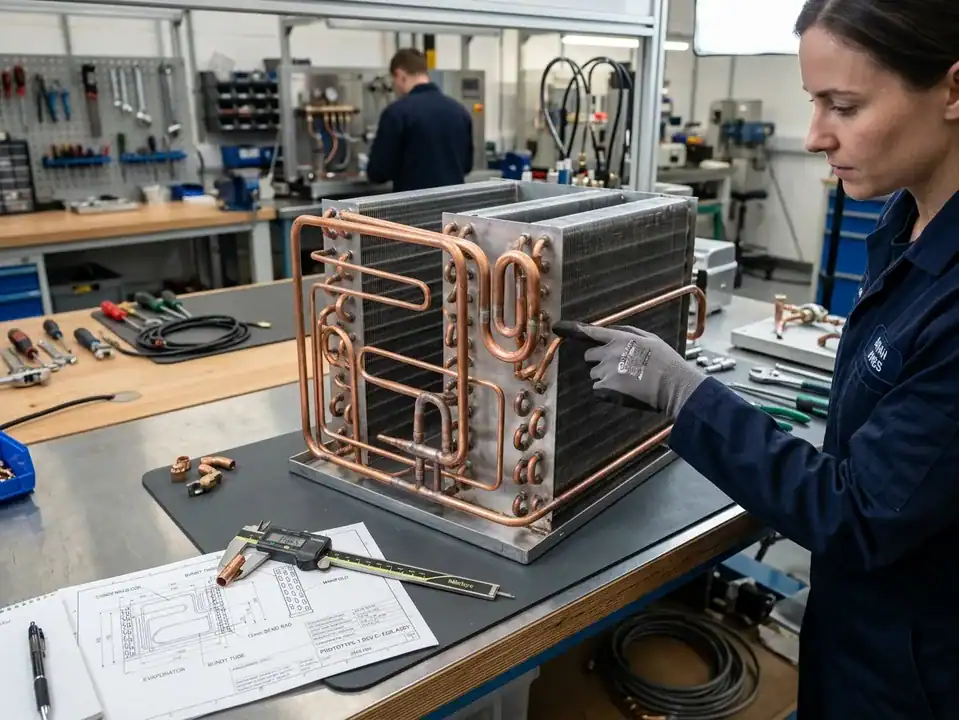
Coating may be appropriate for a particular environment, but it is not a universal answer. Salt, humidity, chemicals, wash-down agents, dissimilar metals, dirt, and drain water can create different failure conditions. Ask what surface is being coated, how edges and joints are handled, what preparation is used, and which test evidence applies to the actual construction.
Do not select a coating by name alone. Request the product data, application boundary, adhesion or corrosion test evidence, cleaning compatibility, repair method, and sample approval process. If the project needs a specific coating or certification and the business has not confirmed it, mark the request REQUIRES BUSINESS INPUT instead of promising it in the article or RFQ.
Headers, connections, and circuiting
The header and circuiting determine how the working medium enters, distributes, and leaves the coil. A change in connection side, header volume, circuit count, or circuit length may affect pressure drop, temperature distribution, oil return, or control stability. It can also make a replacement impossible to install without new piping.
Show connection size, orientation, location, braze or mechanical interface, and required service clearance. If the equipment has a distributor, expansion valve, receiver, pump, or control valve, show its relationship to the coil. A clean drawing is usually more useful than a long description with missing interface details.
HVAC coils for commercial systems versus residential service parts
Search results for HVAC coils often mix residential repair queries with commercial and industrial supplier pages. The basic heat-transfer principles are the same, but the buying decision is different. A homeowner may ask about a replacement price. A commercial buyer may need a repeatable coil family, a controlled drawing, a sample, a documented inspection plan, packaging, and support for several equipment variants.
Commercial HVAC coils also have different operating schedules and service constraints. A supermarket case, food-service cabinet, air handler, office terminal, and process unit may see different humidity, dust, cleaning, temperature, and corrosion conditions. The supplier needs the application, not only the keyword used in the search.
For a replacement, distinguish three goals:
- Fit replacement: the new coil must match the existing envelope and interfaces.
- Duty replacement: the new coil must meet a defined capacity under specified conditions.
- Design improvement: the project changes materials, circuiting, airflow, service access, or corrosion protection.
Those goals can overlap, but they should not be treated as the same quotation. A fit-only coil may preserve an old limitation. A design improvement may require cabinet, fan, control, or piping changes. Write the goal on the RFQ cover sheet.
How to review HVAC coils with a supplier
The most efficient review starts with a short, complete information packet. Include the equipment name, application, operating mode, drawing or measurements, medium, air conditions, flow or refrigerant conditions, pressure-drop limits, materials, environment, quantity, and requested deliverables. State what is known and what is still pending.
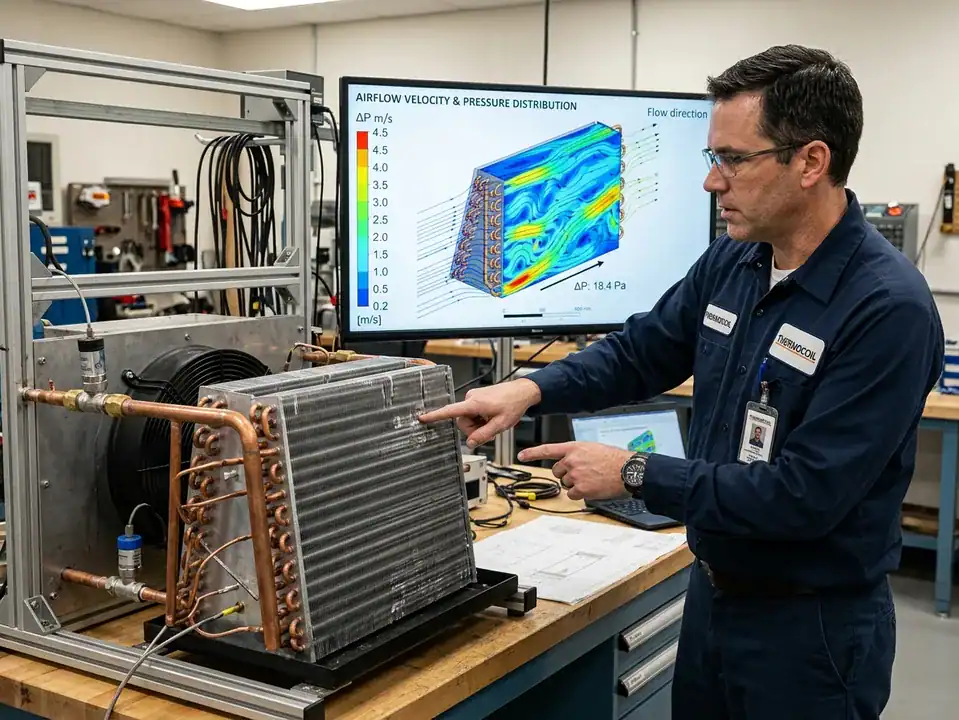
The supplier should return a response that is easy to compare. It should identify the proposed construction, rating basis, connection details, dimensions, assumptions, exclusions, and open questions. If the result is budgetary, label it as budgetary. If the result is based on a sample, identify the sample. If the result is final, link it to the approved drawing and test plan.
| Review stage | Supplier output to request | Buyer check before moving on |
|---|---|---|
| Application review | Open-point list and interpretation of the duty | The medium, operating modes, and missing conditions are correct |
| Preliminary design | Proposed geometry, materials, connections, and rating assumptions | The design fits the cabinet and respects pressure-drop limits |
| Drawing review | Controlled drawing with revision, interfaces, and inspection points | Dimensions, connection locations, mounting, and drain details match |
| Sample or prototype | Sample record, measured dimensions, and agreed tests | The sample represents the production design and approval basis |
| Production release | Final drawing, inspection plan, packaging, and change-control path | The purchase order references the right revision and scope |
Use standards with a defined scope
Standards can make test and rating language clearer, but the standard must match the component. The ASHRAE standards and guidelines resource is a starting point for locating HVAC references. The U.S. Department of Energy commercial buildings resource provides broader building-system context. Neither source replaces a project-specific rating or a supplier’s signed design record.
Refrigerant projects also need a safety and regulatory review. The U.S. EPA refrigerant management requirements describe obligations under Section 608 for certain refrigerants and service work. An article can point buyers to the source, but it should not state that a particular coil or project is compliant without the required design and documentation.
Validate the result before production
Validation may include dimension inspection, leak testing, pressure testing, thermal rating, airflow checks, pressure-drop checks, drain or condensate observation, coating or corrosion testing, and fit checks. The actual test list depends on the construction and equipment. Do not publish a fixed test package as if it applies to all HVAC coils.
If the project uses a prototype, record the sample number, drawing revision, test conditions, instruments, acceptance criteria, and open points. The Domi testing laboratory page describes the public testing context available for review. Specific test methods, instruments, and results still need project confirmation.
Common purchasing mistakes
The first mistake is using the old model number as the whole specification. Model numbers can identify an assembly, but they may not show the actual dimensions, circuiting, material, revision, or field modification. Measure the component and review the equipment duty.
The second mistake is comparing capacity numbers with different rating conditions. A number without entering-air temperature, airflow, medium, refrigerant condition, or pressure-drop basis is not a fair comparison.
The third mistake is treating the coil as independent from the fan and controls. A coil can have a suitable theoretical capacity but deliver a different result when the fan cannot maintain airflow, when the valve authority is poor, or when the drain arrangement allows water to carry over.
The fourth mistake is asking for a coating or material without describing the environment. Salt air, chemical wash-down, dust, and high humidity need different questions. The supplier cannot choose a defensible surface treatment from a generic phrase such as outdoor use.
The fifth mistake is changing the drawing after the quotation without updating the rating and inspection plan. A row count, fin pitch, connection position, or circuit change can affect both fit and performance. Use revision control, even for a small replacement.
A practical HVAC coil RFQ checklist
Before sending an RFQ, assemble the following information:
- Application and equipment type, including whether the coil is new, replacement, or redesign.
- Cooling, heating, condensing, or heat-pump duty and the operating modes.
- Working medium, refrigerant designation, fluid concentration, or steam condition.
- Airflow, entering and leaving air temperature, humidity, and operating schedule.
- Fluid flow or refrigerant-side design conditions and allowable pressure drops.
- Face width, face height, depth, rows, fin spacing, tube diameter, headers, and connections.
- Airflow direction, mounting points, casing, drain pan, drain outlet, and service access.
- Ambient exposure, salt, chemicals, cleaning method, dust, frost, condensation, and wash-down.
- Required drawing format, sample need, inspection records, packaging, quantity, and destination.
- Any applicable standard, certification, safety classification, or customer document. Use
REQUIRES BUSINESS INPUTwhere the requirement is not confirmed.
The custom coil fabrication page can be used as an internal starting point when the project needs a drawing-led discussion. The engineering capabilities page is another useful link for design questions. The actual scope, materials, testing, MOQ, lead time, and commercial terms must be confirmed for the specific project.
Separate an engineering answer from a purchasing answer
An engineering answer explains whether the proposed HVAC coils can meet the stated duty and interfaces. A purchasing answer explains what is included, which revision applies, how many parts are covered, and which documents will be delivered. The two answers should agree, but they serve different readers.
When the supplier sends a capacity number, record its conditions in the purchasing file. When the supplier sends a drawing, record its revision in the purchase order. When a material or coating is a customer requirement, connect it to the drawing and inspection plan. This prevents a sales description from becoming the only record of the technical scope.
The same discipline applies to changes after quotation. If the buyer changes the face size, airflow, medium, connection side, fin pitch, or quantity, ask which parts of the rating and quote must be updated. A small change may affect the coil, fan, cabinet, drain, packaging, or test. Keep the open questions visible until the responsible owner closes them.
It is also useful to separate three confidence levels. A screening discussion identifies whether a concept fits the application. A budgetary quotation uses stated assumptions to support planning. A final release uses approved conditions, drawings, and checks. These labels do not slow a project down. They tell each reader how much weight to put on the result.
How Domi can support a project discussion
Domi’s commercial cooling coils page groups commercial cooling components and application information for buyers. A buyer can use that page as the product starting point, then send the drawing, measurements, duty, medium, air or fluid conditions, quantity, and destination for review.
The best request gives the supplier enough information to identify the next question. It does not need to be perfect. If the load is not final, say so. If the old coil is damaged, show the connection side and failure area. If the equipment has several models, separate common dimensions from model-specific differences. A clear open-point list helps the engineering and purchasing teams avoid assumptions.
For a prototype, ask which documents will be issued before sample approval and which measurements will be recorded after production. For repeat orders, ask how drawing revisions, material substitutions, packaging changes, and nonconforming parts will be controlled. Those questions make the HVAC coils program easier to manage after the first shipment.
How to read a commercial coil rating sheet
A rating sheet is useful only when the reader can see the conditions behind the result. Start with the component identity. Check the drawing number, revision, coil type, medium, connection side, airflow direction, and whether the rating describes an evaporator, condenser, chilled-water coil, or another member of the HVAC coils family. If the sheet uses a short internal code, ask for the plain-language construction before comparing it with another quotation.
Next, check the air-side data. The entering and leaving temperatures should match the equipment design point. If the coil is expected to remove moisture, the sheet should show enough humidity information to make the latent result meaningful. Check airflow, face area, face velocity, air-side pressure drop, and whether the result is based on a clean surface or a fouled allowance. An airflow value that looks correct can still be wrong for the installed fan if the test point uses a different filter or transition.
Then review the working-medium data. For a water or glycol coil, compare fluid type, concentration, entering temperature, leaving temperature, flow, pressure drop, and design pressure. For a direct-expansion coil, compare refrigerant designation, evaporating or condensing condition, superheat or subcooling basis, circuiting, distributor, and connection details. Do not treat a refrigerant name as a complete rating condition.
The geometry section deserves its own check. Compare face width, face height, depth, rows, fin spacing, tube diameter, tube pattern, headers, casing, and connections with the drawing. A rating sheet can show a capacity that is technically sound while the proposed coil still fails the service opening or drain connection. Ask the supplier to identify any dimension that is provisional.
Finally, read the notes and exclusions. A note may limit the result to a certain airflow, state that performance is preliminary, exclude frost, require a specific fan, or assume a coating that has not been approved. Those notes are not minor details. They describe the boundary of the quote. Carry the open items into the purchase review and close them before a production release.
This reading method works for new and replacement HVAC coils. It also gives procurement a fair way to compare suppliers. If two ratings use different air conditions, mediums, pressure-drop limits, or geometry, place the results in separate rows and ask for a common basis. A lower price or higher capacity number is not meaningful until the conditions are comparable.
HVAC coils FAQ
What are HVAC coils?
HVAC coils are heat-transfer components that move heat between air and a working medium. The medium may be refrigerant, water, glycol, steam, or another fluid. Evaporator, condenser, chilled-water, hot-water, steam, and heat-pump coils are all common HVAC coil families, but each has different design inputs.
How do I choose the right HVAC coils?
Start with the duty, medium, air conditions, airflow, pressure-drop limit, physical envelope, connections, materials, environment, and service plan. Then compare the proposed rating and drawing against those inputs. Do not choose HVAC coils by outside size or product name alone.
Are evaporator and condenser HVAC coils interchangeable?
No. An evaporator absorbs heat and a condenser rejects heat. They can have different refrigerant conditions, circuiting, airflow, materials, connections, and pressure-drop requirements. A replacement must match the system role and approved duty.
What information does a supplier need for a commercial coil quote?
Provide the application, duty, medium, air and fluid conditions, airflow or flow rate, allowable pressure drops, dimensions, rows, fin spacing, connections, mounting, drain details, environment, quantity, and destination. Include a drawing or measured sketch when available.
Are microchannel HVAC coils better than fin-tube coils?
Neither construction is automatically better for every project. Compare size, refrigerant distribution, materials, pressure drop, corrosion exposure, cleaning, service, repair practice, and replacement needs under the actual conditions. The rating method must also match the construction.
Does a tighter fin pitch improve an HVAC coil?
A tighter fin pitch can add surface area within a given face, but it can also raise air-side pressure drop, retain more dirt, reduce cleaning access, or increase frost concerns. The correct pitch balances duty, airflow, environment, maintenance, and cabinet limits.
Can a supplier quote HVAC coils from photographs?
Photographs help identify the component and show damage, but they rarely define a complete replacement. Add dimensions, connection measurements, airflow direction, equipment information, medium, operating conditions, and the intended replacement goal. A supplier can then identify which points still need confirmation.
Can Domi review a custom HVAC coil drawing?
A drawing is a useful starting point for a project discussion. Domi may also need duty, medium, air or fluid conditions, pressure limits, materials, environment, quantity, and destination. The final scope and quotation should be confirmed against the specific drawing and application.