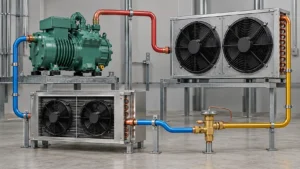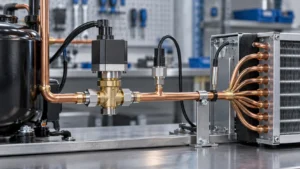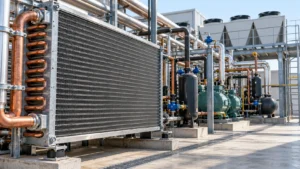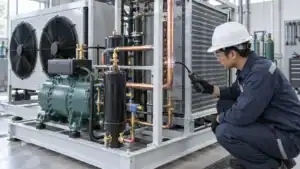

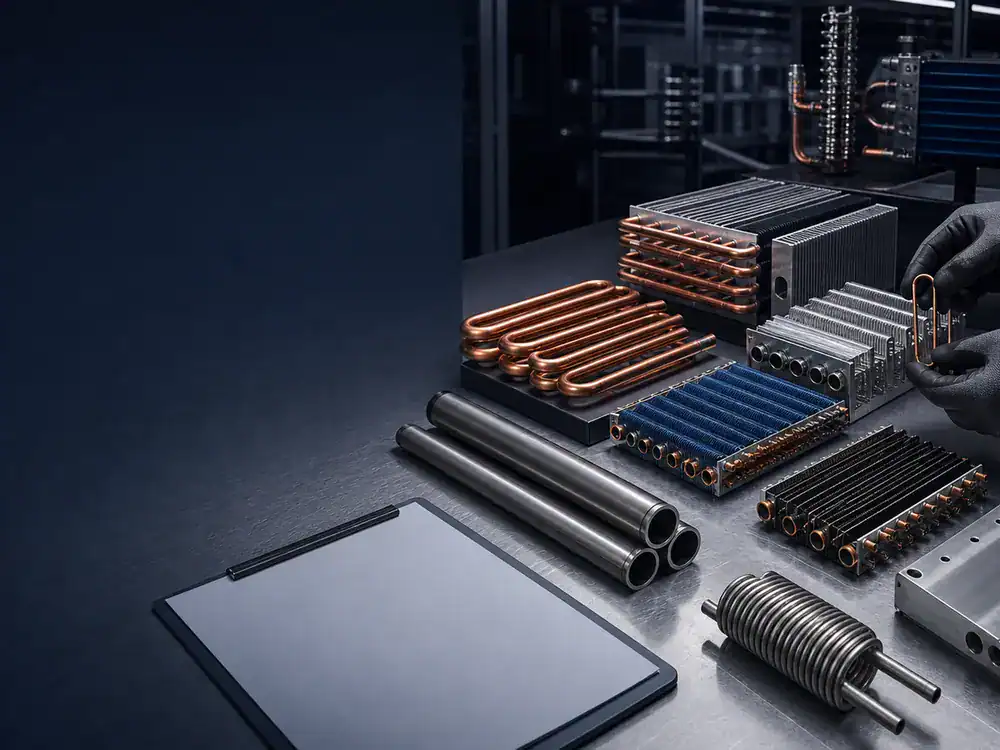
The evaporator coil absorbs heat from the cooled space or air stream. The condenser coil rejects heat to ambient air or another cooling medium. In a condenser vs evaporator coil comparison, the important differences are the heat-transfer role, refrigerant state, operating condition, airflow, circuiting, connections, drainage, materials, and installation environment. They are not interchangeable because they look similar.
The question condenser vs evaporator coil appears in many search results, but the answers are often written for residential air-conditioning users. Commercial buyers need the simple distinction plus the details that affect an OEM or replacement decision. Two coils can share copper tubes and aluminum fins while serving different parts of the refrigeration cycle and requiring different ratings.
This guide explains the roles in plain language and then moves into procurement. It is intended for OEM engineers, equipment integrators, refrigeration contractors, distributors, and buyers who need to identify a coil or review a replacement. It does not replace a system design, refrigerant safety assessment, or project-specific rating.
The short answer: condenser vs evaporator coil
An evaporator coil is the heat absorber. Refrigerant or another cooling medium moves through it while air, product, water, or process fluid gives up heat. The coil surface is often colder than the entering air, and moisture may condense or frost on the surface.
A condenser coil is the heat rejector. Hot refrigerant vapor from the compressor releases heat to outdoor air, room air, water, or another medium. The refrigerant moves toward a liquid state. The condenser operates on the high side of the system and may need to handle higher pressure and temperature than the evaporator.
That is the basic condenser vs evaporator coil difference. The final design is more specific. The two coils can have different tube circuits, headers, distributors, connections, fin spacing, frames, drains, materials, fans, and control interfaces.
| Comparison point | Evaporator coil | Condenser coil | Why the buyer should care |
|---|---|---|---|
| Heat-transfer role | Absorbs heat from air, product, water, or process fluid | Rejects heat to ambient air, water, or another medium | Sets the system location and rating basis |
| Refrigerant state | Often receives a two-phase mixture and leaves as vapor or superheated vapor | Receives hot vapor and leaves as liquid or subcooled liquid | Changes circuiting, pressure, controls, and connection requirements |
| Surface condition | May condense moisture or accumulate frost | Usually rejects heat to a warmer ambient stream | Affects drainage, defrost, cleaning, and fin spacing |
| Air-side issue | Low temperature, humidity, frost, carryover, and airflow | Ambient temperature, recirculation, fouling, fan airflow, and noise | Changes the actual operating point |
| Common location | Indoor unit, cabinet, display case, walk-in, air handler, or process section | Outdoor unit, remote condenser, condensing package, or equipment cabinet | Determines environment and service access |
The table is a starting point, not a replacement specification. An evaporator can be air cooled, water cooled, or process specific. A condenser can reject heat to air or water. State the medium before choosing a part.
How the coils fit into the refrigeration cycle
The refrigeration cycle moves heat rather than creating cold. The evaporator receives low-pressure refrigerant and absorbs heat from the cooled side. The compressor raises the refrigerant pressure and temperature. The condenser rejects the absorbed heat plus compressor work. The expansion device reduces pressure and prepares the refrigerant for the next evaporator pass.
The refrigerant cycle guide provides a related explanation of the four stages. For a commercial component, add the equipment conditions. The evaporator and condenser must be rated with the compressor, expansion device, fans, piping, controls, and operating modes that the system will use.
Evaporator inlet and outlet
An evaporator may receive refrigerant from an expansion valve, capillary, distributor, or another control device. The inlet condition, circuit length, header arrangement, and outlet superheat affect distribution and system control. The outlet connection should be reviewed with the suction line and oil return path.
The evaporator air side may be dry, wet, or frosting. A display case, walk-in cooler, ice machine, air handler, and process unit can have different humidity and drain requirements. Fin spacing, drain pan, defrost, insulation, and access should be stated in the RFQ.
Condenser inlet and outlet
A condenser receives hot refrigerant vapor from the compressor and sends liquid toward the receiver, liquid line, subcooler, or expansion device. The inlet and outlet locations, circuiting, header, and liquid storage arrangement should be clear. A condenser with a suitable capacity can still create a system problem if the liquid connection or pressure-drop assumption is wrong.
The condenser air side can see high ambient, dust, salt, grease, recirculated air, and wash-down. The fan and coil must be selected for the installed environment. Cleaning and service access should be designed before the cabinet is released.
Compare the design inputs
The condenser vs evaporator coil decision becomes clearer when the buyer writes the design inputs side by side. Capacity alone does not define the component. The input record should show the working medium, air or fluid condition, pressure limit, operating schedule, envelope, connection, environment, and control intent.
Refrigerant and pressure
State the refrigerant and the pressure or temperature condition used for rating. A refrigerant change can affect pressure, temperature, tube selection, control, material, circuiting, and safety. Do not assume that a coil is compatible because the coil shape is the same.
For a direct-expansion evaporator, include evaporating condition, superheat, distributor, expansion device, and circuiting. For a condenser, include condensing condition, subcooling basis, compressor discharge, receiver or liquid-line arrangement, and head-pressure control if applicable.
If the project uses a regulated refrigerant, the responsible engineer should verify the applicable requirements. The U.S. EPA refrigerant management requirements are a public reference for United States Section 608 obligations. The article does not certify a specific system.
Air and fluid conditions
For both coil roles, provide airflow and entering temperature. For an evaporator, humidity, dew point, frost, drain, and defrost can be critical. For a condenser, ambient, recirculation, fan, fouling, and sound can be critical. For a water or glycol coil, provide fluid flow, concentration, entering temperature, leaving temperature, and allowable pressure drop.
The same face area can produce different results at a different airflow. The same airflow can produce a different result when the filter, grille, duct, or fan changes. Put the system interface in the rating request.
Geometry and connection
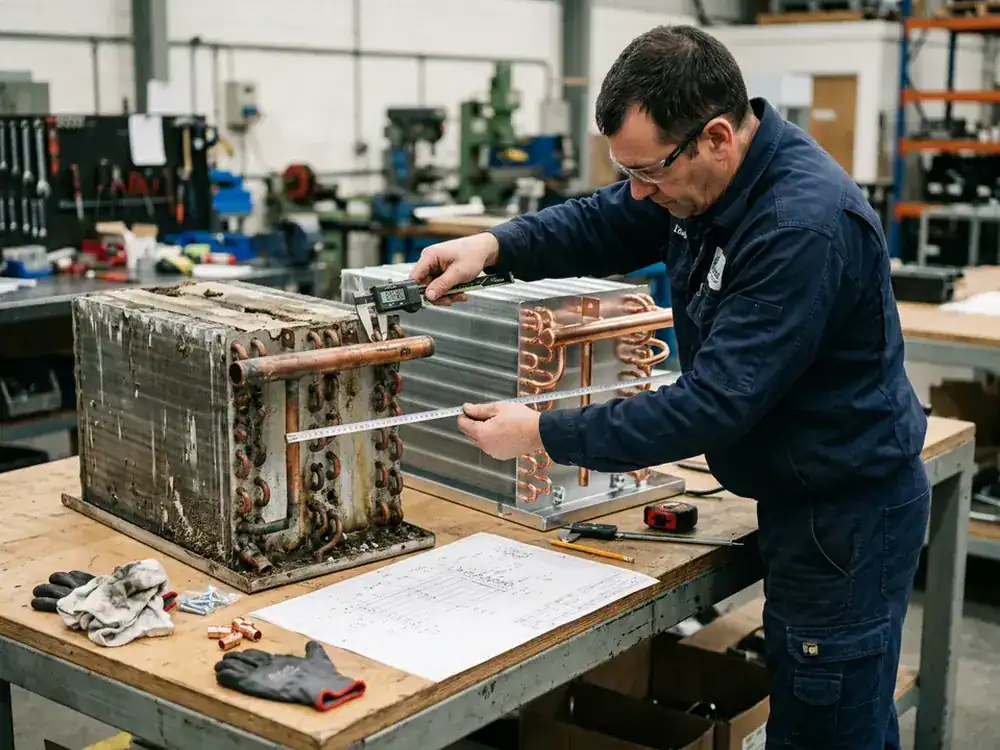
Measure face width, face height, depth, rows, fin spacing, tube diameter, tube pattern, headers, connections, mounting, casing, and drain. Show airflow direction and service side. For a replacement, show the removal path and field modifications.
Headers and circuits are not cosmetic. A changed circuit can alter pressure drop, distribution, oil return, temperature uniformity, and control. A changed connection can create a piping problem. Include a circuit or connection drawing when the application is custom or replacement.
| Design input | Evaporator question | Condenser question |
|---|---|---|
| Thermal duty | What heat must be absorbed, and at what air or product condition? | What heat must be rejected, and at what ambient condition? |
| Refrigerant side | What are evaporating condition, superheat, distributor, and outlet requirements? | What are condensing condition, subcooling, compressor discharge, and liquid outlet requirements? |
| Air side | Is the air dry, wet, frosting, filtered, or affected by carryover? | Is the air hot, dirty, salty, recirculated, restricted, or subject to a sound limit? |
| Geometry | What face, depth, rows, fins, circuits, drain, and service path are available? | What face, depth, rows, fins, fan, connections, and cleaning path are available? |
| Materials | What temperature, moisture, frost, cleaning, and corrosion conditions apply? | What ambient, salt, grease, wash-down, and recirculation conditions apply? |
This comparison makes the condenser vs evaporator coil choice concrete. It also gives procurement a way to detect when a supplier has rated the wrong component or used the wrong condition.
Materials, fins, and circuiting
Many commercial coils use copper tubes and aluminum fins, but the construction should follow the medium and environment. Aluminum tubes, coated fins, stainless components, and other material combinations may be considered. The tube, fin, header, frame, joints, fasteners, coating, and drain pan all contribute to the service result.
Evaporator fin spacing and drainage
Evaporator fin spacing affects moisture, dirt, frost, cleaning, and pressure drop. A freezer evaporator may need frost clearance and defrost planning. A wet air coil may need condensate control. A tighter fin pitch is not automatically a higher-performing choice because it may block sooner or make cleaning harder.
The drain pan should match the coil orientation and air velocity. Check slope, outlet, trap, insulation, access, and drain-line routing. Carryover can result from airflow, pan geometry, a blocked outlet, a damaged fin pack, or operation outside the rating. Put the drain review in the prototype or installation checklist.
Condenser fin spacing and air path
Condenser fin spacing affects surface area, fouling, pressure drop, and cleaning. The fan must provide the required airflow through the coil, guard, louver, and cabinet. Recirculated discharge air can raise the effective ambient temperature. Show inlet and outlet clearances on the equipment drawing.
The condenser may be exposed to salt, dust, grease, chemical vapors, or wash-down. Ask about surface preparation, coating, cleaning, and repair. Do not publish a universal coating or corrosion grade without project evidence. Use REQUIRES BUSINESS INPUT when the customer requirement is not confirmed.
Circuiting and headers
The number and length of circuits affect pressure drop and distribution. An evaporator needs refrigerant distribution and outlet behavior that match the expansion device and suction connection. A condenser needs vapor distribution at the inlet and liquid collection at the outlet. The header may also affect installation and service.
If the replacement changes circuiting, request a revised rating. If the equipment has multiple modes, ask for each mode. A condenser vs evaporator coil comparison should never end with the sentence that one can simply replace the other.
Replacement checks for commercial buyers
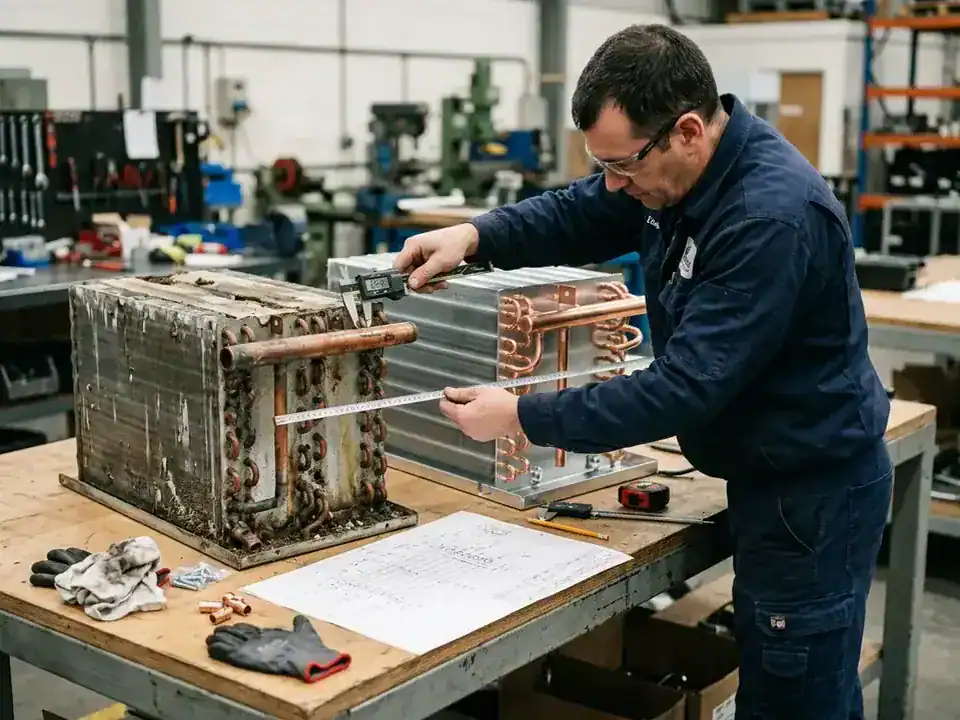
A replacement buyer should identify the existing coil and the intended goal. Is it a fit-only part, a duty match, a redesign, a new material, or a corrosion correction? Provide the old coil, drawing, measurements, nameplate, equipment model, fan, medium, operating conditions, failure area, quantity, and destination.
A model number can identify a family but may not reveal a field modification. Measure connections, mounting, frame, depth, drain, airflow direction, and removal path. Record the difference between the damaged coil and the original intended geometry.
For a condenser, include ambient, fan, heat rejection, recirculation, and cleaning. For an evaporator, include humidity, frost, defrost, drain, product temperature, and airflow. Those details are often more important than the phrase condenser vs evaporator coil used in a search.
Use standards and tests carefully
Standards can improve clarity, but their scope matters. The AHRI 410 performance rating resource applies to defined forced-circulation air-cooling and air-heating coil conditions and includes exclusions. It is not a blanket rating method for every frosting, microchannel, bare-tube, or direct-expansion coil.
The ASHRAE standards and guidelines page can help locate HVAC references. The applicable method for a commercial coil should be named in the rating or test record. If the result is a calculation, keep the assumptions. If the result is a sample test, keep the test condition, instruments, acceptance criteria, and sample revision.
Validation may include dimensions, fit, leak, pressure, airflow, pressure drop, thermal capacity, condensate, frost, defrost, corrosion, fan, sound, or system checks. The actual package depends on the component and project risk. The Domi testing laboratory page provides public context for the available testing discussion, but the project test plan still needs confirmation.
A commercial coil RFQ template
Write the request so a supplier can tell whether the part is a condenser, an evaporator, or another coil. Include the following:
- Component role, equipment, application, operating modes, and replacement or new-design status.
- Refrigerant or fluid, pressure and temperature conditions, superheat or subcooling, and safety requirements.
- Heat duty or capacity target, rating points, airflow, entering and leaving air, humidity, and operating schedule.
- Face width, height, depth, rows, fin spacing, tube pattern, headers, circuits, connections, frame, drain, and mounting.
- Fan, motor, speed, control, external static pressure, sound, vibration, and clearance.
- Salt, dust, chemicals, grease, wash-down, moisture, frost, defrost, cleaning method, and coating request.
- Quantity, sample, prototype, drawing, inspection, test, packaging, destination, and change-control needs.
- Missing capacity, certification, coating, MOQ, lead-time, or testing information marked
REQUIRES BUSINESS INPUT.
The custom coil fabrication page can be linked in a buyer’s internal RFQ workflow. If the design is part of a commercial cooling project, the commercial cooling coils page is the appropriate product hub.
| Approval step | Information to approve | Typical open question |
|---|---|---|
| Role and duty | Evaporator or condenser, medium, rating point, operating modes | Are we comparing the same system role and condition? |
| Mechanical design | Face, depth, rows, fins, circuits, connections, drain, mounting | Does the part fit and can it be serviced? |
| Performance | Capacity, airflow, pressure drop, refrigerant or fluid data | Is the rating based on the actual equipment conditions? |
| Environment | Materials, coating, cleaning, salt, dust, moisture, frost | Does the surface and maintenance plan fit the site? |
| Release | Drawing, sample, inspection, packaging, change process | Does the order reference the approved revision? |
How Domi can help clarify the component
Domi’s commercial cooling coils page gives buyers a starting point for commercial cooling components. The buyer should state whether the request is for a condenser, evaporator, chilled-water coil, fan, motor, or another component. Add the operating conditions and drawing details so the supply scope is clear.
The commercial refrigeration solutions page provides related application context. Existing guides on refrigeration condenser coils and ice-machine evaporator coils show how a specific component can be discussed with a defined buyer and application.
If a customer sends only the phrase condenser vs evaporator coil, the first response should ask what equipment and role they mean. If they send a drawing, include the dimensions, connections, medium, airflow, conditions, quantity, and destination. That information turns a general question into a project review without making an unsupported product promise.
How the difference appears in commercial equipment
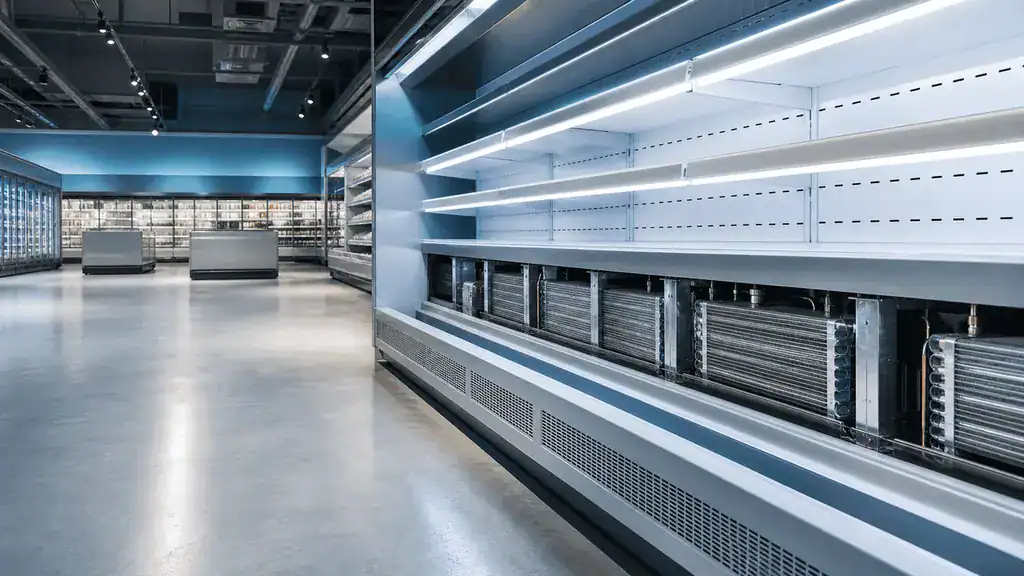
The condenser vs evaporator coil distinction changes with the application, even though the core principle stays the same. In a display case, the evaporator may be hidden in a refrigerated cabinet while the condenser sits in a machine compartment or remote location. In a walk-in cooler, the evaporator may need frost and defrost planning while the condenser needs outdoor airflow and cleaning access. In an ice machine, the evaporator surface may be part of the ice-forming process and need a different water and sanitation review.
In a food-service cabinet, the condenser may be exposed to grease, dust, warm kitchen air, or frequent cleaning. The evaporator may see moisture, product load, and repeated door openings. Those conditions affect fin spacing, coating, drainage, service, and controls. The phrase condenser vs evaporator coil is a useful way to identify the roles, but it does not replace the application record.
In an air handler or heat pump, a coil can change role with the mode. The coil that absorbs heat in cooling can reject heat in heating, depending on the system arrangement. The equipment schedule should show the mode, medium, airflow, defrost, drainage, and control conditions. A replacement decision that looks only at the cooling mode may miss a heating or low-ambient requirement.
Use symptoms to guide the replacement review
A service symptom does not automatically identify a failed coil. Low cooling can come from airflow, charge, compressor, expansion device, control, dirty surface, fan, or a leak. High head pressure can come from a condenser problem, fan control, ambient, charge, noncondensables, or restricted airflow. Frost on an evaporator can relate to humidity, airflow, defrost, charge, sensor, or drain.
Record the symptom, when it occurs, and what was measured. Include suction and discharge conditions when available, air temperatures, airflow, fan state, visible frost, oil residue, leak location, drain state, and the equipment mode. The supplier can then separate a component replacement from a system diagnosis.
When a coil has a visible failure, photograph the area before washing or disassembly. Mark pitting, tube wear, vibration marks, bent fins, blocked channels, oil traces, header damage, coating loss, or water stains. The pattern can influence material, support, circuit, coating, drain, or fan questions.
Distinguish role from location
People often call the evaporator the indoor coil and the condenser the outdoor coil. That description works for a common split air-conditioning system, but it is not universal. A commercial refrigeration system may have a remote evaporator, a remote condenser, or a coil inside an equipment cabinet. A heat pump can reverse the role of a coil. A water-cooled condenser rejects heat into water rather than outdoor air.
Use role, medium, and operating condition together. Write evaporator coil for a direct-expansion low-side component, condenser coil for a high-side heat-rejection component, chilled-water coil for an air-side water circuit, or another precise term. If the component is a fluid cooler or air-to-air core, name that architecture rather than forcing it into the condenser vs evaporator coil pair.
Compare procurement questions, not only definitions
For an evaporator, ask about heat absorption, refrigerant distribution, superheat, frost or condensation, drain, defrost, airflow, and service. For a condenser, ask about heat rejection, condensing condition, ambient, fan, recirculation, subcooling, cleaning, sound, and corrosion. For either one, ask about dimensions, connections, materials, circuiting, pressure, quantity, drawings, testing, and packaging.
The supplier should identify the rating basis and open points. A quotation should make it clear whether the component is a new design, an exact fit, a duty match, or a redesign. If the buyer wants the same external dimensions but a different construction, ask whether the fan, piping, drain, controls, or cabinet need review.
This makes the condenser vs evaporator coil comparison useful for procurement, engineering, and service. It gives each team a different question without changing the basic definition. The condenser vs evaporator coil decision should remain tied to the refrigeration role, not to a generic product photograph or a part number copied from an old invoice.
Check a replacement drawing step by step
Start with the title block and revision. It should identify the component role and the equipment model or project. Then compare the face and depth dimensions, rows, fin spacing, tube or header arrangement, connections, mounting, drain, airflow direction, and service opening.
For an evaporator, inspect the distributor, circuiting, inlet and outlet, drain pan, drain outlet, defrost arrangement, and sensor location. For a condenser, inspect the compressor discharge connection, liquid outlet, circuiting, fan opening, guard, mounting, clearances, and cleaning path.
Check the material list and surface treatment. Confirm tube, fin, header, frame, fastener, joint, coating, and drain materials. If the project needs a coating or certificate and the record does not confirm it, mark it REQUIRES BUSINESS INPUT. Do not infer it from a supplier logo or a general product image.
Finally, check the test and inspection references. A dimension report, leak check, pressure test, rating sheet, airflow test, or coating test should point to the same drawing revision as the part. A sample is not representative if the supplier later changes rows, fins, circuits, connections, fan, or materials without a new review.
Explain the difference to non-engineering buyers
Procurement teams often need a short answer. Use this wording: the evaporator picks up heat, and the condenser puts heat out. Then add the practical question: which role does the replacement part serve, what medium does it carry, and what conditions must it meet?
That explanation is more useful than saying one coil is cold and one is hot. The temperature depends on the system. A condenser can be cool in a mild ambient condition, and an evaporator can be warmer than expected during a fault. Role and flow path are safer ways to identify the part.
For a purchase request, attach a simple cycle sketch and mark the part. Add a photo from the service side, a dimensioned drawing, the equipment model, and the failure record. These details reduce the risk of ordering the wrong component even when the keyword and product names look similar.
Use a handoff record for the coil decision
Once the component role is clear, create a short handoff record that can be read by design, purchasing, quality, and service. Start with the equipment and application. State whether the part is an evaporator, condenser, chilled-water coil, heat-pump coil, fluid cooler, or another architecture. Then record the working medium, pressure or temperature limits, air conditions, fluid conditions, dimensions, connections, mounting, materials, and quantity.
The record should explain the reason for the selection. The evaporator may have been selected for a low-temperature room, a food display case, an air handler, or a process load. The condenser may be rejecting heat to outdoor air, a plant-room air path, or a restricted enclosure. A short reason helps a future buyer understand why the design cannot be substituted casually.
For a condenser vs evaporator coil review, separate facts from assumptions. A measured face dimension is a fact with a source. A target capacity from an old label is a reference that may need confirmation. A proposed fin spacing is a design choice. A predicted pressure drop is a calculated result. Keeping these categories separate makes the next review faster and makes it easier to decide which item needs testing.
The handoff should include the interfaces that could make a technically correct part unusable. For an evaporator, check distributor, expansion device, suction outlet, drain, defrost, sensors, airflow direction, and service clearance. For a condenser, check discharge inlet, liquid outlet, fan, guard, head-pressure controls, air recirculation, cleaning path, and service clearance. If the request is a replacement, compare the new drawing with the old part at each interface.
Do not approve the role based only on temperature. A condenser can operate at a lower temperature during mild conditions, and an evaporator can operate above freezing in a comfort application. The cycle position, heat-flow direction, medium, and design condition are stronger identifiers. The phrase condenser vs evaporator coil should lead to that engineering check rather than a rule based on hot and cold surfaces.
Before release, make sure the drawing, rating, material list, test plan, inspection form, and purchase description use the same component name and revision. If a fan, cabinet, valve, drain, or control is excluded, say so. If a certification, coating, performance value, MOQ, or lead time is not confirmed, mark it REQUIRES BUSINESS INPUT. This keeps the condenser vs evaporator coil decision traceable from the first RFQ to the delivered part.
For a final condenser vs evaporator coil review, ask the supplier to state the role in the quotation title and on the drawing. Repeat the condenser vs evaporator coil check when the equipment has a reversing cycle or several coil variants.
Condenser vs evaporator coil FAQ
What is the main difference between a condenser and an evaporator coil?
The evaporator absorbs heat from the cooled space or process. The condenser rejects heat to ambient air, water, or another medium. They operate at different points in the refrigeration cycle and can have different refrigerant conditions, circuits, connections, materials, airflow, and service requirements.
Can a condenser coil be used as an evaporator coil?
Not as a direct assumption. The coil role, refrigerant state, pressure, circuiting, distributor, airflow, temperature, drainage, and controls may all differ. A project-specific design and rating are needed before considering a change.
Which coil is colder, the condenser or the evaporator?
The evaporator surface is usually colder than the air or product it cools, while the condenser rejects heat to a warmer ambient stream. The actual temperature depends on the system and operating condition. A simple cold or hot label is not a replacement specification.
Do both coils use copper tubes and aluminum fins?
They often can, but material depends on medium, pressure, temperature, environment, joining, corrosion, cleaning, and manufacturing method. The same tube and fin combination does not make two coils interchangeable.
Why does an evaporator need a drain?
When the evaporator surface is below the air dew point, moisture can condense. In a freezer, frost can form and later melt during defrost. The pan, slope, outlet, trap, insulation, and drain line need to match the equipment orientation and operating sequence.
What information is needed to replace either coil?
Provide the equipment, coil role, medium, dimensions, connections, airflow direction, fan, duty, air and fluid conditions, refrigerant condition, pressure limits, environment, failure area, quantity, and destination. Include an old-part drawing or measured sketch.
Is more surface area always better for a condenser or evaporator?
No. More surface may increase capacity at one rating point, but it can also increase cost, weight, pressure drop, dirt retention, frost, cleaning difficulty, or cabinet size. The design must balance heat transfer with the full system and service limits.
Can Domi identify the right coil from a drawing?
A drawing is a useful starting point. Domi may also need the application, duty, medium, airflow, pressure limits, environment, quantity, and destination. The final component and quotation should be confirmed against the project requirements.
Related Articles
- Commercial Cooling Coils for Display Cases, Freezers and Food Service Equipment
- Refrigerant Cycle Explained: The 4 Stages and Coil Roles
- Condenser Coil: Types, Failure Signs, and Maintenance Guide
- Refrigeration Condenser Coils: Selection and Commercial RFQ Guide
- Ice Machine Evaporator Coil Guide
- Commercial Refrigeration Coil Sizing