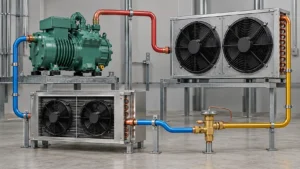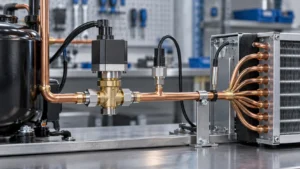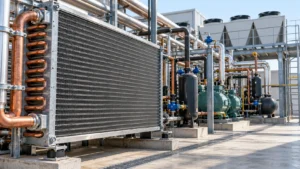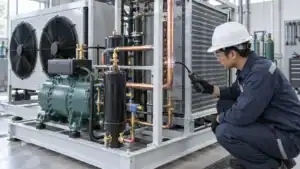

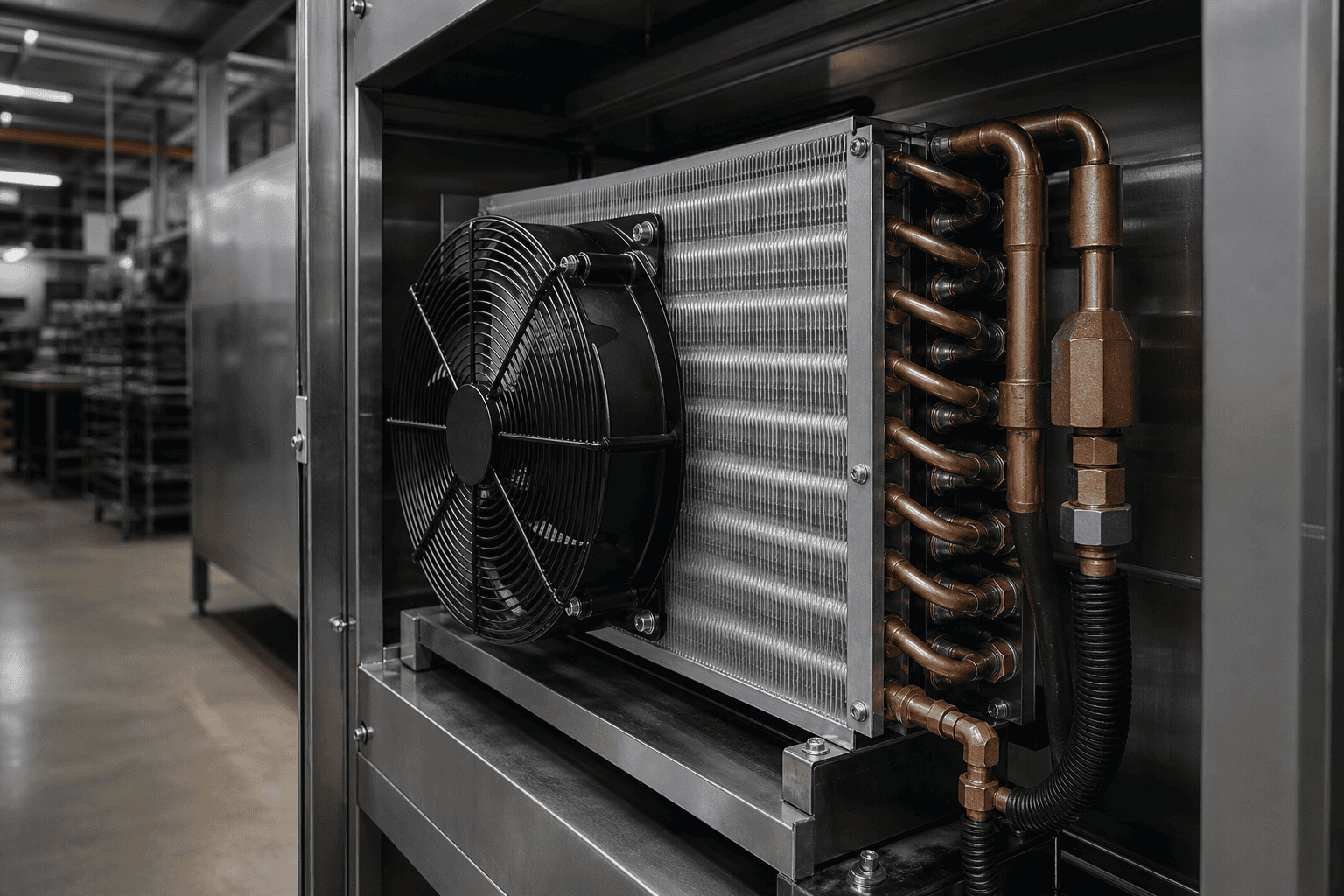
Refrigeration condenser coils reject the heat absorbed by the evaporator plus the compressor work. For commercial equipment, a useful condenser-coil specification includes heat rejection, entering-air conditions, airflow, refrigerant and pressure, fin and tube construction, corrosion exposure, sound limits, envelope, connections, service access, and inspection requirements.
Buyers often search for refrigeration condenser coils when they already know the component has failed or when a new cabinet needs a heat-rejection assembly. The search phrase is broad. It can describe a small condenser inside a beverage cooler, a wire-tube assembly in an appliance, a finned coil on a remote condensing unit, or a larger bank serving a commercial display or food-service system. These components cannot be compared by outside dimensions alone.
The existing condenser coil guide explains condenser types, failure signs, and maintenance. This article takes a different route. It is a commercial selection and quotation guide for engineering and procurement teams that need to translate a system requirement into a refrigeration condenser coils RFQ. It also shows which details should be confirmed before a supplier is asked to change the geometry, material, coating, circuiting, or connection position.
The design must remain tied to the complete refrigeration system. A condenser that looks larger on a drawing may have a different airflow resistance or refrigerant-side pressure drop. A replacement that fits the cabinet may not reject enough heat at the actual ambient condition. A coated surface may help in a corrosive environment but change the surface, cleaning, or heat-transfer discussion. The right question is not which condenser coil is best in general. It is which construction meets the defined duty and operating environment.
What are refrigeration condenser coils?
Refrigeration condenser coils are heat exchangers that move heat from a refrigerant to air, water, or another heat sink. In a common air-cooled system, hot high-pressure refrigerant enters the condenser, rejects heat through the tube wall and fins, condenses to liquid, and leaves toward the liquid-side controls. The coil may include a subcooling section, headers, receiver interface, fan shroud, brackets, guard, coating, or other assembly parts depending on the equipment.
The term condenser coil does not define the heat-rejection rating. The rating depends on refrigerant, condensing temperature, entering-air temperature, airflow, surface condition, circuiting, subcooling, and pressure drop. A compact self-contained cabinet and a remote outdoor condenser may both use refrigeration condenser coils, but their air path, environment, service access, and packaging can be very different.
Condenser duty is not evaporator duty
An evaporator absorbs heat from the refrigerated space or product. A condenser rejects that heat plus compressor input. Because the condenser duty is larger than the evaporator duty at the same operating point, the condenser should be evaluated with a stated heat-rejection basis. Do not simply reuse the evaporator capacity as the condenser size.
The relationship also changes with ambient temperature, compressor efficiency, suction condition, and operating mode. A display case operating at a high outdoor ambient may place a different load on the condenser than the same case in a controlled test room. If a replacement condenser has a different fan, fin spacing, or circuit design, the equipment controls may also see a different condensing pressure response.
Air-cooled, water-cooled and hybrid arrangements
Air-cooled refrigeration condenser coils use ambient or equipment air across fins. They are common where water is unavailable or where a self-contained package is preferred. Water-cooled condensers transfer heat to a water circuit and require water quality, flow, pressure, and maintenance information. Hybrid or remote arrangements combine a coil with a fan system, heat-recovery section, fluid circuit, or dedicated controls.
This article focuses on air-cooled coil selection because it is the most common meaning of refrigeration condenser coils in commercial equipment requests. If the project is water-cooled or uses a secondary loop, state that in the inquiry. The supplier needs the actual heat-transfer medium and not only the word condenser.
Application differences across commercial equipment
Commercial refrigeration equipment exposes its condenser to different conditions. A beverage cooler may have a compact, restricted air path. A restaurant cabinet may see grease, steam, cleaning chemicals, and frequent door openings. A supermarket system may operate with remote condensers, long pipe runs, variable ambient conditions, or low-GWP refrigerant requirements. A replacement distributor may need repeatable dimensions and a stable part number more than a new geometry.
The target application should be named before discussing refrigeration condenser coils. Include the equipment type, location of the condenser, airflow direction, fan arrangement, operating schedule, ambient range, and service access. If the condenser is part of a condensing unit, identify what is inside the assembly and what is supplied separately.
| Commercial application | Condenser review priority | Common RFQ attachment |
|---|---|---|
| Beverage cooler or reach-in cabinet | Compact airflow, cabinet fit, cleanability, noise | Cabinet drawing, fan data, old-coil photos |
| Restaurant or prep-table equipment | Grease, moisture, cleaning, compact envelope | Cleaning environment, coating requirement, connection sketch |
| Supermarket display system | Heat rejection, ambient range, remote piping, controls | System schedule, design ambient, refrigerant and operating map |
| Ice machine | Repeated cycling, compact surface, service access | Equipment model, cycle conditions, condenser location |
| Replacement or distribution program | Repeatability, dimensional control, packaging, SKU control | Part list, drawing revisions, forecast and sample requirements |
The application table is a starting point, not a performance standard. A supplier should identify which assumptions were used to develop the proposal and which inputs remain open.
Indoor and outdoor exposure
Indoor equipment may still face moisture, grease, dust, detergents, and high kitchen temperature. Outdoor equipment may face rain, salt, dust, sunlight, temperature cycling, and more difficult cleaning. A generic outdoor label does not state a corrosion rating, coating life, or test result. Describe the environment and ask what construction and inspection method are proposed.
Noise and customer-facing placement
Condenser fans and air pressure drop can affect sound. A tighter fin pitch or a restricted grille may increase fan effort. A larger surface may reduce the required air velocity, but the cabinet may not have space for it. If the condenser sits near customers or staff, send the available noise target, fan model, mounting details, and grille arrangement. A coil supplier can review the coil and air-side implications, but final sound performance depends on the whole assembly.
Heat rejection and rating conditions
The most important technical step is to define the rating condition. State required heat rejection, refrigerant, condensing temperature or condensing pressure, entering-air temperature, airflow, subcooling expectation, circuiting assumptions, and allowable pressure drops. If the system operates over a range, provide minimum, normal, and maximum points where practical.
Air temperature alone is not enough. An entering-air condition can vary with equipment location, store temperature, outdoor weather, recirculation, grille blockage, and fan control. A condenser quoted at one ambient may not maintain the same capacity at a higher ambient. The proposal should show the design point and any operating limits that the buyer must account for.
The EPA advanced refrigeration technologies page describes how commercial systems can use centralized, distributed, secondary-loop, cascade, transcritical carbon dioxide, or self-contained arrangements. Each arrangement affects refrigerant routing and heat rejection. The page is useful background, but the exact duty still belongs in the equipment specification.
Condensing temperature and approach
The temperature difference between refrigerant condensing temperature and entering air is part of the heat-transfer basis. A smaller approach can require more surface area or airflow, while a higher condensing temperature can change compressor power and system efficiency. Do not compare two refrigeration condenser coils if one proposal uses a different condensing condition without recording the deviation.
Subcooling section
Some condenser designs include a dedicated subcooling region or rely on downstream components for subcooling. The quote should identify whether subcooling is part of the requested performance, where the section is located, and how it affects circuiting and pressure drop. A larger coil may not provide the intended result if the liquid path, receiver, ambient airflow, or control arrangement is different.
Pressure drop and controls
Refrigerant-side pressure drop can influence the available pressure difference, liquid condition, control stability, and system performance. Air-side pressure drop affects fan selection and noise. Both should be reported with the rating condition. A coil drawing should show circuiting, headers, connections, and flow direction so an engineer can check whether the proposed construction is compatible with the system.
| Rating input | Why it changes refrigeration condenser coils | What to request in a proposal |
|---|---|---|
| Heat rejection | Defines the required thermal duty at the stated operating point | Capacity and rating basis with units |
| Entering-air condition | Changes the temperature difference and condensing response | Air temperature range and measurement basis |
| Airflow and fan | Controls air-side heat transfer, noise and pressure drop | Air volume, fan curve or fan scope |
| Refrigerant and pressure | Changes saturation, material and design-pressure requirements | Refrigerant, design pressure and test pressure |
| Subcooling | Changes circuiting, liquid condition and required surface | Subcooling target and section responsibility |
| Ambient and schedule | Determines normal and peak operating conditions | Design ambient, operating hours and control modes |
When the rating is not final
Early-stage projects often have an unconfirmed refrigerant or compressor. Mark the rating as provisional and list the candidates. A supplier can review a range or explain which data would cause a redesign. The buyer should not allow a provisional rating to be copied into a final drawing without an approval step.
Fin, tube and circuiting choices
The construction of refrigeration condenser coils controls the balance between heat transfer, pressure drop, corrosion, cleanability, weight, cost, and serviceability. Tube diameter, tube spacing, row count, fin pitch, fin thickness, circuiting, header style, and joint method all matter. The correct choice depends on the application and rating, not on a single generic preference.
Fin spacing and fouling
Close fin spacing can fit more surface into a given face area. It may also restrict airflow when dust, lint, grease, or corrosion products accumulate. Wider fin spacing can improve cleanability and air passage, but it may require more face area or a different circuit layout. Ask the supplier to relate fin spacing to the stated environment and cleaning method.
Condenser fins should also remain supported during shipping, installation, and service. Fin damage reduces effective surface and can create local airflow changes. Protective packaging should be defined for the destination and handling method. Packaging is part of the performance-preservation plan, not merely a logistics detail.
Tube material and joints
Copper, aluminum, stainless, and other material combinations may be used in condenser construction. Compatibility with the refrigerant, oil, joining method, pressure, coating, and operating environment must be checked. A supplier should identify the proposed materials and any treatment or coating rather than using a phrase such as premium metal.
Joint quality and leak testing should be linked to the project requirement. A visual check is not the same as a pressure test. The buyer should ask which test medium, pressure, hold time, inspection record, and acceptance criteria apply. Exact values depend on the system and applicable standards, so they should be confirmed by the responsible engineer.
Circuiting and header layout
Circuiting distributes refrigerant across the coil. It affects velocity, pressure drop, superheat or subcooling behavior, and how the surface is used. Header position and connection orientation affect installation, service access, and the possibility of trapped liquid or oil. A replacement condenser that copies the face dimensions but changes the circuiting may need a different control or piping review.
Microchannel and fin-tube options
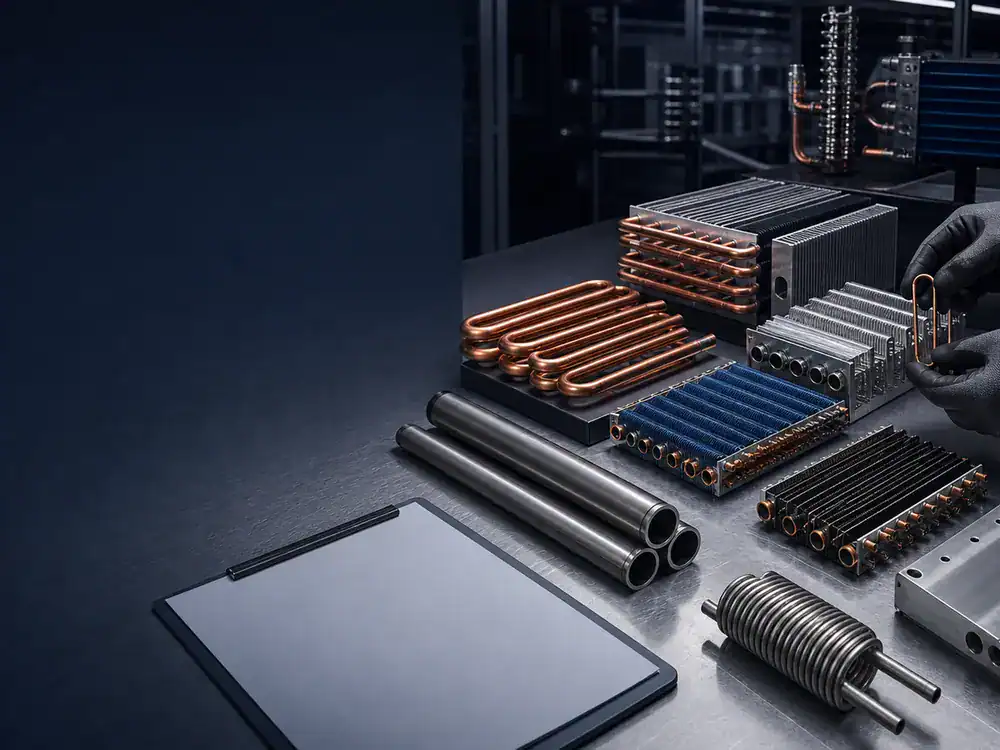
Some commercial systems use flat multiport or microchannel construction for compactness and reduced internal volume. Other systems use conventional fin-tube construction for flexible geometry, established repair practice, or a particular cabinet envelope. The choice should consider refrigerant distribution, corrosion exposure, cleaning, repair route, headers, joining, pressure, and end-of-life handling.
Do not treat microchannel as a universal replacement for a fin-tube condenser. A change in construction can alter connections, mounting, cleaning practice, test method, and field-service expectations. If a buyer is considering a different construction, request a side-by-side review under the same heat-rejection and airflow conditions.
Corrosion, coating and cleaning environment
Commercial condenser coils can face humidity, salt, grease, detergents, acidic residues, dust, and wet-dry cycling. Corrosion may attack fins, tubes, joints, brackets, or a coating system. The correct response may involve material selection, geometry, drainage, protective packaging, cleaning instructions, coating, or a change in where the condenser is installed.
The phrase anti-corrosion condenser coil is not a complete technical requirement. Identify the exposure, expected cleaning method, frequency, water quality, chemical list if available, and whether the coil is indoors or outdoors. Ask how coating affects heat transfer, fin thickness, connections, masking, inspection, and repair. Coating should be evaluated as part of the system, not added as a decorative option after the drawing is complete.
The EPA GreenChill program provides broader context on commercial refrigeration emissions and equipment practices. It does not certify a specific coil coating or determine a commercial product’s corrosion performance. Keep regulatory, environmental, material, and performance claims separate in the purchase specification.
Cleaning access and service tools
A coil that cannot be reached will not be cleaned consistently. Confirm the space for a brush, low-pressure wash, vacuum, fin comb, inspection light, or other approved tool. Provide the grille and fan arrangement when asking for a replacement. If a new coil depth blocks the access path, the apparent thermal improvement may create a maintenance problem.
Cleaning should follow equipment and chemical guidance. A buyer should not ask a supplier to guarantee life under an unspecified chemical regime. Record the operating exposure and request compatibility information or a recommendation that can be reviewed by the equipment owner.
Replacement refrigeration condenser coils
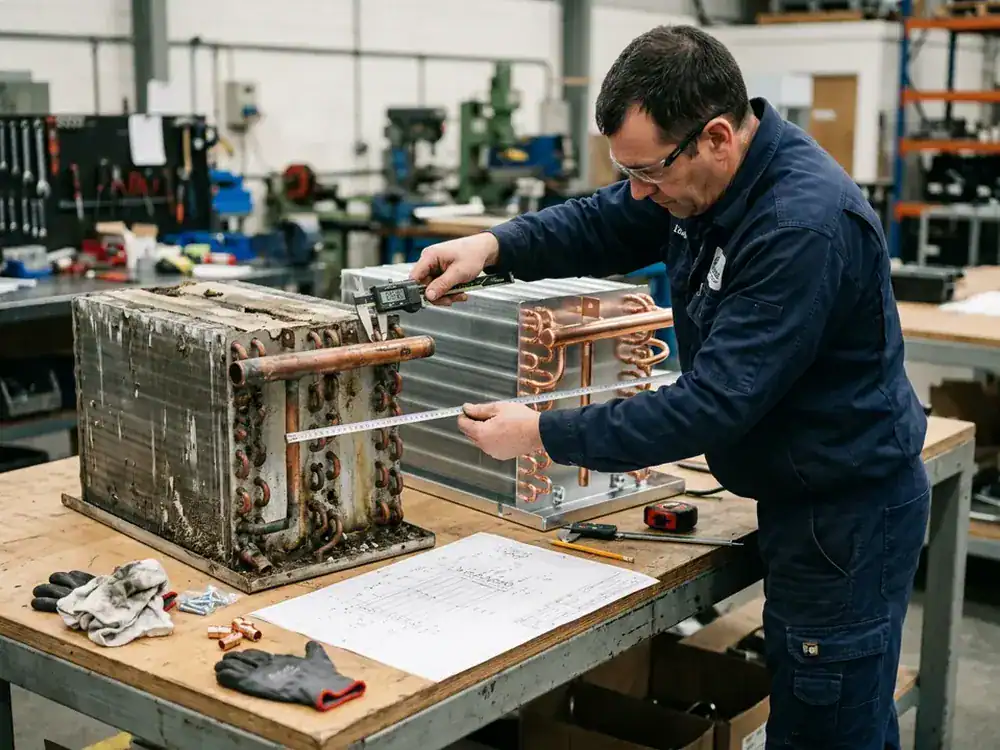
Replacement work is often urgent, but a fast quote still needs the correct data. The old condenser may have a label, but the label may identify only the equipment model and not the coil geometry. Photograph the coil from multiple sides, mark the airflow direction, measure the face, depth, header positions, connection centerlines, bracket locations, fan clearance, grille, drain, and nearby obstructions.
Record how the old part failed. Look for fin collapse, corrosion, leaks, vibration, blocked airflow, oil marks, fan contact, loose brackets, and evidence of poor drainage. If the coil was pressure-washed or chemically cleaned, record that as part of the history. A replacement should address the actual failure environment where practical.
| Replacement item | Measurement or document | Why it matters |
|---|---|---|
| Overall envelope | Height, width, depth and clearance | Determines cabinet and fan fit |
| Connections | Diameter, centerline, orientation and connection type | Prevents piping and brazing rework |
| Mounting | Brackets, holes, supports, pads and vibration points | Controls installation and service stability |
| Air side | Fan, grille, shroud, airflow direction and bypass openings | Controls rating and noise assumptions |
| Refrigerant side | Refrigerant, pressure, circuiting, inlet and outlet | Controls compatibility and pressure review |
| Environment | Moisture, grease, salt, chemical cleaning and dust | Guides material and coating discussion |
| Documents | Old drawing, part number, photos, inspection record | Creates traceability for the replacement decision |
When a replacement should not be dimension-for-dimension
A dimension-for-dimension replacement may be unsuitable if the old design suffered from corrosion, blocked airflow, poor drainage, vibration, or inadequate heat rejection. A supplier can propose a revised fin pitch, material, coating, bracket, or circuit arrangement, but each change should be recorded and approved. Preserve the old design as a reference rather than silently changing the part.
Distribution and repeat supply
Distributors may need the same condenser across multiple equipment variants. Confirm whether the part is a single SKU or part of a family. List drawing revisions, packaging, labels, protective caps, quantities, and replacement identification. A repeat program benefits from a controlled master drawing and a clear change-notification process.
How to write an RFQ for refrigeration condenser coils
Start with the equipment and system. State whether the request is for a new design, replacement, alternate source, capacity upgrade, or cost-down review. Then list the rating basis, mechanical envelope, materials, coating, connections, inspection, packaging, quantity, and destination. If a field is unknown, use an open question instead of an invented value.
The ASHRAE standards and guidelines resource can help an engineering team identify the standards relevant to its system, but it should not be used as a substitute for the final project specification. Coil ratings and design-pressure decisions must be reviewed by the responsible engineer and equipment manufacturer.
Request the supplier’s assumptions
Ask the supplier to return a data sheet showing the assumed refrigerant, heat rejection, entering air, airflow, pressure drops, dimensions, fin spacing, tube material, coating, connections, and scope. Require deviations to be listed. This makes two proposals comparable even when they use different construction families.
Define what is included
State whether the quote should include fan, shroud, guard, bracket, drain pan, coating, pressure testing, leak testing, drawing, inspection report, packaging, label, or installation hardware. A coil-only quote may be correct for one buyer and incomplete for another. The scope should not be inferred from a product photograph.
Ask what still needs confirmation
The supplier should identify unresolved items such as final refrigerant, exact ambient, fan selection, coating compatibility, test standard, or connection change. A responsible open item is better than a confident but unsupported promise. Use the follow-up list to decide whether the project is ready for sample, prototype, or production review.
Comparing refrigeration condenser coils proposals
Compare performance first, then fit, then risk. Performance includes heat rejection, condensing condition, air temperature, airflow, pressure drops, subcooling, and sound assumptions. Fit includes dimensions, headers, connections, brackets, fan, grille, access, and packaging. Risk includes materials, coating, inspection, leak test, drawing control, change process, and service route.
Avoid treating lower cost as a like-for-like result until the scope is normalized. A quote may exclude coating, a fan, a bracket, documentation, or a required test. Another may use a higher material cost because the exposure is more severe. The buyer should record the comparison in a decision sheet with the accepted deviations.
Quality and validation questions
The quality plan should match the risk of the component and the equipment. Typical discussion areas include material certificates when required, dimensional inspection, brazing or joining records, pressure or leak testing, coating coverage, fin integrity, connection protection, and packaging inspection. Do not claim that a specific test is included until the supplier confirms it for the project.
Validation should distinguish mechanical fit from thermal performance. A sample can fit the cabinet while its rating basis is unresolved. A laboratory performance result can be acceptable while the part still needs a bracket or drain change. Link the sample, drawing revision, test condition, inspection record, and approval owner.
Drawing revision control
Every change to fin pitch, rows, circuiting, header, connection, coating, material, bracket, or overall envelope can affect the equipment. Use a revision number and change description. Update the quotation, inspection plan, packaging, and replacement identification when the design changes. This protects distributors and service teams from receiving an old part against a new cabinet revision.
Operating changes that justify a condenser review
A condenser may need a fresh review even when the part has not visibly failed. The equipment may move to a warmer location, a smaller grille, a different fan control, a new refrigerant, a different compressor, or a higher product load. A store layout change can reduce the free air around a remote condenser. A new cleaning program can increase water and chemical exposure. These changes alter the real duty or the risk around the coil.
Start the review by separating the observed problem from the proposed solution. High discharge pressure can come from a dirty surface, a failed fan, a blocked grille, excessive refrigerant, non-condensables, high ambient, or an undersized condenser. A leak can come from corrosion, vibration, joint quality, impact, or a pressure event. A noisy fan can be a bearing or mounting problem rather than a fin-area problem. The request should describe symptoms, measurements, operating conditions, and maintenance history.
For a redesign, ask the equipment owner to identify the change that triggered the review. The coil supplier can then compare the old and new duty. If the compressor capacity increases, the condenser heat rejection usually needs a new rating. If the refrigerant changes, pressure, flow, saturation, oil compatibility, and controls may also change. If the cabinet becomes more compact, a smaller envelope may force higher air velocity or a different fan. Each change should have an owner and an approval record.
Keep field data with the design record
Useful field data includes entering air temperature, discharge pressure, liquid temperature, fan voltage, fan speed, airflow condition, surface cleanliness, fin damage, and the time of day. Note the measurement location and instrument condition. One temperature near the grille does not describe a remote condenser’s full air path. Photos should show the coil face, fan, grille, brackets, header, connections, and nearby obstructions.
Field data should not be used to create a false precision. If the ambient was estimated or the pressure was read from a control display, label it as an estimate. The supplier can use it for a feasibility screen and identify what needs confirmation. This makes the next test more useful than ordering a new part from an incomplete diagnosis.
Service and ownership questions
The purchaser, equipment OEM, installer, service contractor, and coil manufacturer may own different parts of the result. Define who selects the fan, who validates the rating, who approves the drawing, who sets the controls, who confirms the refrigerant, and who accepts the replacement. A clear responsibility map prevents the coil from being expected to guarantee cabinet performance that depends on other components.
A practical request path for Domi review
The commercial refrigeration solutions page shows the wider application and component context for display cases, food-service equipment, coolers, freezers, beverage equipment, and related commercial projects. When contacting Domi, attach the equipment model or drawing, heat-rejection requirement, refrigerant, ambient, airflow, dimensions, connections, material or coating requirement, quantity, and destination.
For a commercial product or replacement program, the commercial cooling coils page can help organize the application path. For a failure investigation, review the existing condenser coil article and record the actual environment rather than asking for a generic replacement. Use the contact page for a controlled inquiry and identify which data is final, provisional, or missing.
Refrigeration condenser coils FAQ
What do refrigeration condenser coils do?
Refrigeration condenser coils reject heat from the refrigerant to air, water, or another heat sink. In an air-cooled commercial system, fans move air over finned tubes while the refrigerant condenses and may be subcooled. The required size depends on heat rejection, ambient, airflow, refrigerant, pressure, and construction.
How do I size refrigeration condenser coils?
Start with heat rejection and the rating basis, then provide refrigerant, condensing condition, entering-air temperature, airflow, pressure drops, subcooling, envelope, and sound limits. A supplier can review the coil geometry, but the final selection belongs to the complete refrigeration system and its controls.
Are all condenser coils interchangeable?
No. Refrigeration condenser coils may differ in material, circuiting, pressure, connection positions, fin spacing, airflow, heat rejection, and service requirements. A part that fits the cabinet may still be unsuitable for the operating condition or control system.
What causes a commercial condenser coil to fail?
Common contributors include corrosion, blocked airflow, damaged fins, vibration, leaks at joints, fan contact, poor drainage, chemical cleaning, high ambient operation, and incorrect system conditions. Confirm the failure cause before approving a replacement so the same exposure is not repeated.
Does coating improve a condenser coil?
A suitable coating may help address a defined corrosion exposure, but it is not a universal performance guarantee. Review surface, coverage, heat-transfer effect, cleaning compatibility, connections, inspection, and the actual environment. Final coating selection should be confirmed per project.
How important is fin spacing?
Fin spacing changes surface area, air pressure drop, fouling tolerance, cleanability, weight, and cabinet fit. Close spacing is not automatically better. State the dust, grease, moisture, salt, and cleaning environment and ask the supplier to explain the proposed tradeoff.
What should I send for a replacement condenser coil?
Send the equipment model, old coil photos, height, width, depth, connections, header positions, brackets, fan and grille data, refrigerant, ambient, failure pattern, coating exposure, quantity, and destination. A dimensioned drawing or marked-up photo is more reliable than a part name alone.
Can Domi quote refrigeration condenser coils from photos?
Photos can support an initial feasibility review, especially when they include a scale, labels, connections, brackets, fan, grille, and surrounding clearances. A final quotation may still require dimensions, operating conditions, refrigerant, heat rejection, materials, quantity, and drawing confirmation.