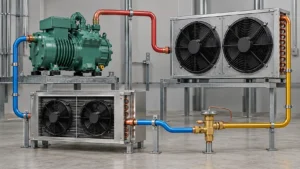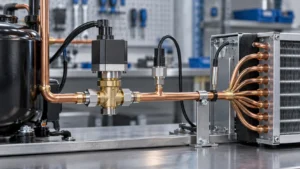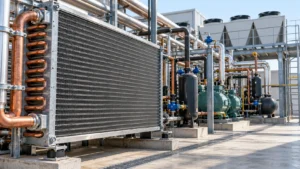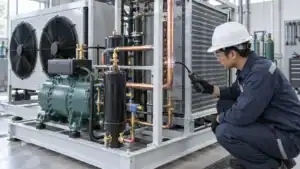

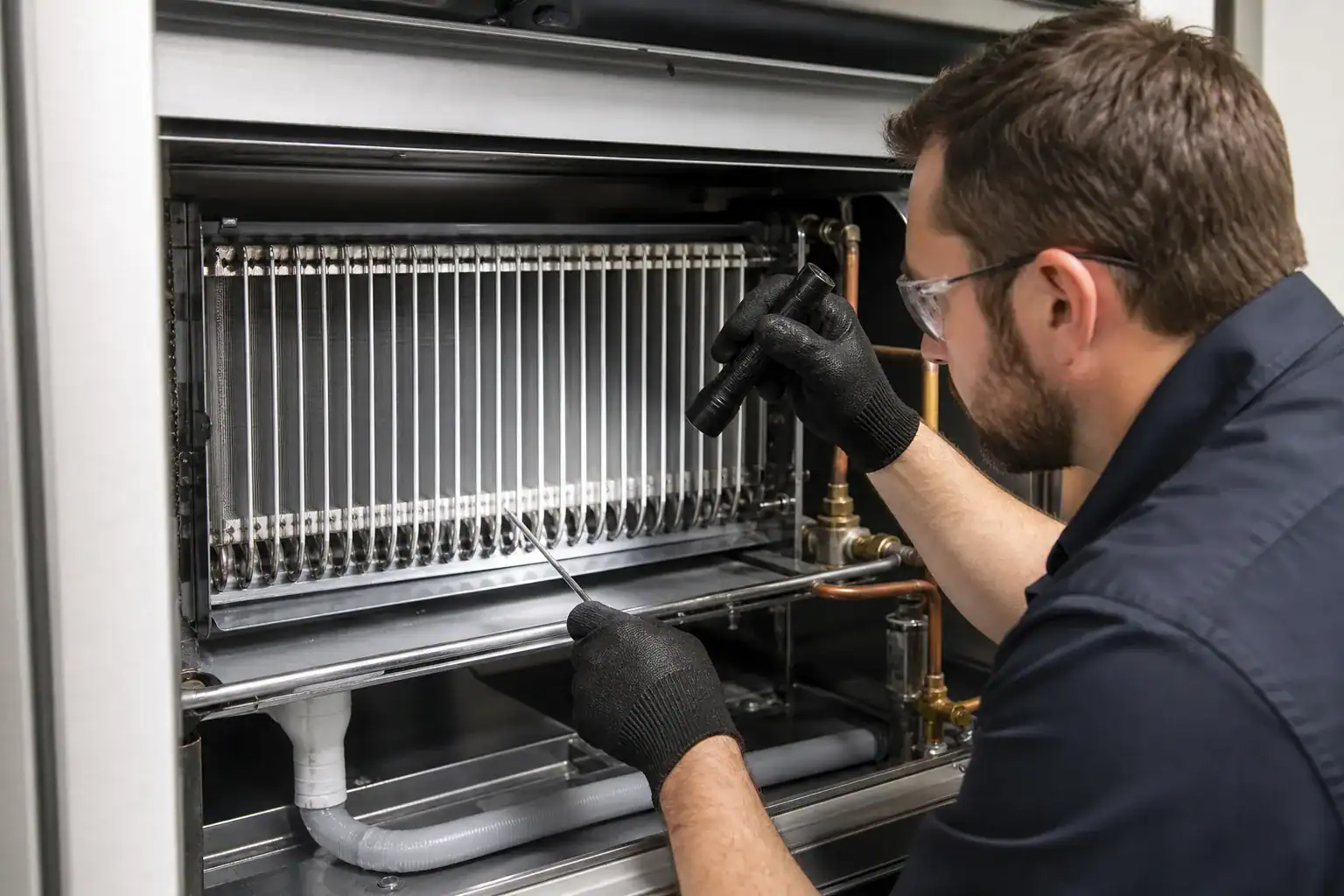
An ice machine evaporator is the cold heat-transfer surface where refrigerant absorbs heat from water or an ice-forming surface during the freeze cycle. A supplier-ready request must define the ice-making method, freeze and harvest conditions, water path, refrigerant, geometry, materials, hygiene boundary, mounting, connections, inspection, and expected production cycle.
The phrase evaporator ice machine is used by engineers, service teams, distributors, and people looking for a replacement part. Those audiences may mean different components. One project needs a plate or grid evaporator that forms cubes. Another uses a tube or surface arrangement for flake or nugget ice. A third needs a replacement evaporator in a compact undercounter unit. The equipment label may be incomplete, and the visible part may not show the internal circuit or the water distribution path.
The ice machine evaporator cannot be selected by height and width alone. The surface temperature, refrigerant, water flow, ice thickness, harvest method, cycle time, water chemistry, sanitation routine, and thermal contact all affect the result. A component can fit a cabinet and still produce the wrong ice form, harvest poorly, create excessive scale, or stress a joint during repeated cycles.
This guide focuses on commercial and OEM component review. It does not certify a machine for food production, approve a sanitation program, or promise a fixed output. Food equipment must follow the requirements that apply to its market. The FDA Food Code 2022 is an important reference for food safety controls, but the equipment manufacturer remains responsible for the complete design and validation.
What is an ice machine evaporator?
An ice machine evaporator is a refrigeration heat exchanger that becomes cold enough to remove heat from water and support ice formation. Refrigerant changes phase inside the refrigerant-side passages while the water side, mold surface, grid, cylinder, or other forming surface releases heat. The evaporator is part of a cycle that includes a compressor, condenser, metering or expansion device, controls, water pump or valve, harvest method, and sensors.
An ice machine evaporator is exposed to repeated changes. During freeze, the surface must remove heat steadily without creating an uncontrolled ice pattern or starving a region of the forming surface. During harvest, the ice needs to release, drop, slide, or separate using the machine’s approved method. The component may see hot gas, warm water, mechanical movement, or a controlled pressure change, depending on the equipment. The freeze and harvest sequence should therefore be part of the RFQ.
Evaporator and condenser serve different functions
The evaporator absorbs heat from the ice-making side. The condenser rejects heat to air or water. In a commercial ice machine both components may be compact, but they are not interchangeable. The condenser sizing affects condensing pressure and the evaporator’s available operating condition. The water system affects the heat load and the ice surface. A request for an evaporator ice machine should identify which side of the system is being sourced.
The target page’s commercial refrigeration solutions section includes ice-machine applications and related components. This article expands the evaporator side of that application. It should not be used as a replacement for the page’s ice-machine condenser path or as a general condenser-coil article.
Common commercial ice-making formats
Ice form and machine architecture influence the evaporator design. Cube machines may use a grid, plate, mold, or a related surface that lets water freeze in defined cavities. Flake and nugget systems can use a cylindrical evaporator with an auger or scraping mechanism. Tube ice and specialty systems may use a different forming surface and harvest sequence. The phrase ice machine evaporator should be paired with the ice form and equipment format.
| Ice-making format | Evaporator interface | Questions for the supplier |
|---|---|---|
| Cube or modular cube | Mold, grid, plate or cavity surface | Cube geometry, water path, harvest method, surface finish |
| Flake ice | Cold cylindrical or curved surface with scraping action | Cylinder dimensions, scraper clearance, water film, drive interface |
| Nugget or chewable ice | Evaporator and compression or extrusion path | Ice density, auger interface, freeze zone, product path |
| Tube ice | Tube or mold surface with controlled water movement | Tube count, water distribution, harvest method, connection layout |
| Undercounter or compact unit | Integrated evaporator inside a limited cabinet | Envelope, controls, service access, water and drain locations |
These categories are useful for scoping only. The supplier needs the actual drawings, water path, cycle, refrigerant, and mounting information before final design decisions.
Freeze-cycle requirements for an evaporator ice machine
The freeze cycle is the period in which the evaporator removes heat from water and the ice grows or forms. The required surface temperature and refrigerant condition depend on water temperature, flow, ice geometry, cycle time, and the point at which the machine stops freezing. A small change in surface condition can affect ice thickness, transparency, density, or harvest behavior.
The RFQ should state the water inlet temperature range, flow rate or distribution method, water chemistry assumptions, target ice shape, ice thickness or mass per cycle, freeze time, and desired production schedule. If those values are not final, label them as design targets. A supplier can then identify whether the request is suitable for a drawing review, sample, or more detailed thermal analysis.
Water film and distribution
Some machines circulate water over a cold surface, while others fill molds or use a controlled flow. Uneven distribution can create uneven ice, warm areas, scaling, or a cycle that ends before the surface has been used efficiently. The evaporator geometry should be evaluated with the pump, tray, spray bar, distributor, or valve that supplies the water.
Provide the water path as a sketch if a detailed drawing is not available. Mark the inlet, overflow, drain, pump, spray direction, forming surface, sensors, and areas that must remain accessible for cleaning. The supplier can review the evaporator, but a water-distribution issue may need a change to the tray, manifold, valve, or control sequence.
Freeze temperature and refrigerant condition
Refrigerant selection affects pressure, saturation, oil, mass flow, material compatibility, and controls. Commercial refrigeration systems use different refrigerant paths, including self-contained and remote arrangements. The EPA advanced refrigeration technology overview provides useful system context, but it does not determine the correct refrigerant or ice-machine evaporator rating.
State the refrigerant, evaporating temperature range, suction condition, design pressure, test pressure requirement, control method, and oil compatibility if known. If the refrigerant is changing, identify the old and candidate new refrigerants. A replacement evaporator may need a new circuiting, joint, or pressure review even if its external dimensions remain the same.
Harvest-cycle requirements
Harvest is the transition from formed ice to released product. A cube may release from a mold, fall from a grid, or separate after a controlled temperature or pressure change. Flake or nugget machines may use a scraper, auger, or other mechanical interface. The evaporator surface, wall thickness, finish, geometry, mounting, and thermal expansion all influence the harvest sequence.
The design team should describe how the existing machine harvests. State whether the evaporator sees hot gas, warm water, ambient air, mechanical force, pressure equalization, or a combination. Note the harvest duration, sensor locations, ice release point, and any evidence of sticking, cracking, or excessive force. A supplier should not infer harvest details from the word evaporator alone.
Repeated thermal cycling
Every cycle can create expansion and contraction in tubes, plates, headers, joints, brackets, seals, and the forming surface. The actual temperature range, ramp rate, water condition, and mounting stiffness matter. A design that performs in one continuous freeze test may behave differently after many cycles or when the water chemistry changes.
Ask what the project needs to validate. It may be a fit-up sample, a leak test, a cycle test, a production rate test, an ice-release test, or a combination. Record the test setup and acceptance criteria. Avoid claiming a service life or cycle count without a verified test basis.
Ice release and surface finish
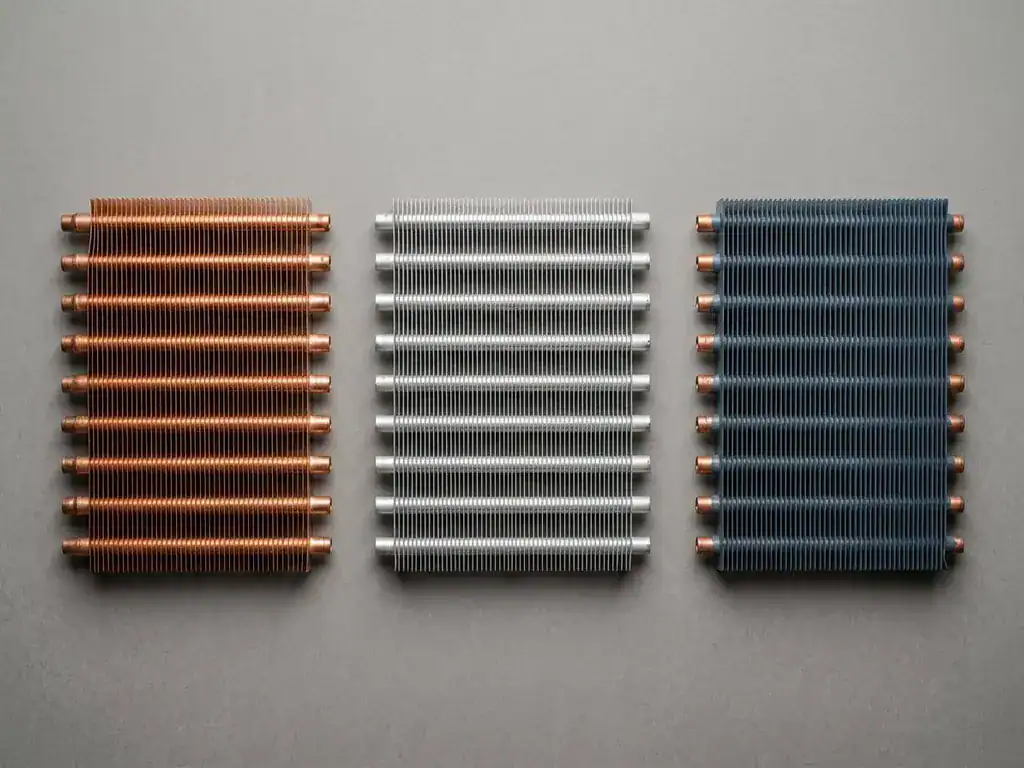
Surface finish can influence ice adhesion, cleaning, water wetting, and release. The correct finish depends on the forming surface, materials, cleaning chemicals, and applicable food-equipment requirements. A smooth appearance is not proof of food-contact compliance or reliable harvest. State the required finish and the responsible approval standard.
If a coating or treatment is proposed, check whether it contacts water or ice, how it is applied, where it is masked, how it is inspected, and how it behaves during repeated thermal cycling. Keep coating claims separate from general corrosion claims. The equipment designer and compliance team should confirm whether the material and process are suitable for the intended food path.
Materials, water quality and sanitation boundaries
Water quality can influence scale, mineral deposits, corrosion, microbial growth, and cleaning frequency. A commercial ice machine evaporator may be exposed to treated water, hard water, chlorine, acid cleaners, sanitizers, and repeated rinsing. The supplier needs the known water chemistry and cleaning practice to discuss material and surface options.
The phrase food-grade material is not a complete specification. Identify the exact surface that contacts water or ice, the material standard or approval needed, and the cleaning chemicals. If the coil itself is separated from the food path by a plate or sealed surface, document that boundary. If refrigerant-side metal can be exposed due to a leak or joint failure, the equipment risk review should cover it.
The FDA Food Code page can help a team locate food-equipment requirements and updates. It should be read with the local code, machine standard, water treatment plan, and company quality procedure. Do not state that a component is certified just because a material is commonly used in food equipment.
Scale and mineral deposits
Scale adds resistance to heat transfer and can change the water path. It may also make ice release less consistent or create locations that are difficult to clean. Record the water hardness, filtration, treatment, cleaning interval, and observed deposits during a replacement investigation. The answer may involve water treatment or cleaning as well as a different evaporator surface.
Corrosion and joint protection
Corrosion risk can affect the forming surface, tubes, headers, brackets, fasteners, and joints. Moisture and cleaning chemicals may reach areas that are dry during the freeze cycle. Protective measures should be compatible with water, ice, cleaning, thermal cycling, and required inspection. A general request for corrosion resistance should be converted into an exposure description.
Geometry and mechanical fit-up
A commercial ice machine evaporator is usually constrained by the cabinet, water system, drive, ice chute, drain, fan or airflow path, controls, and service access. Provide the overall envelope, mounting points, connection centerlines, water interface, forming surface, scraper or auger clearance, sensor locations, insulation, and access panels.
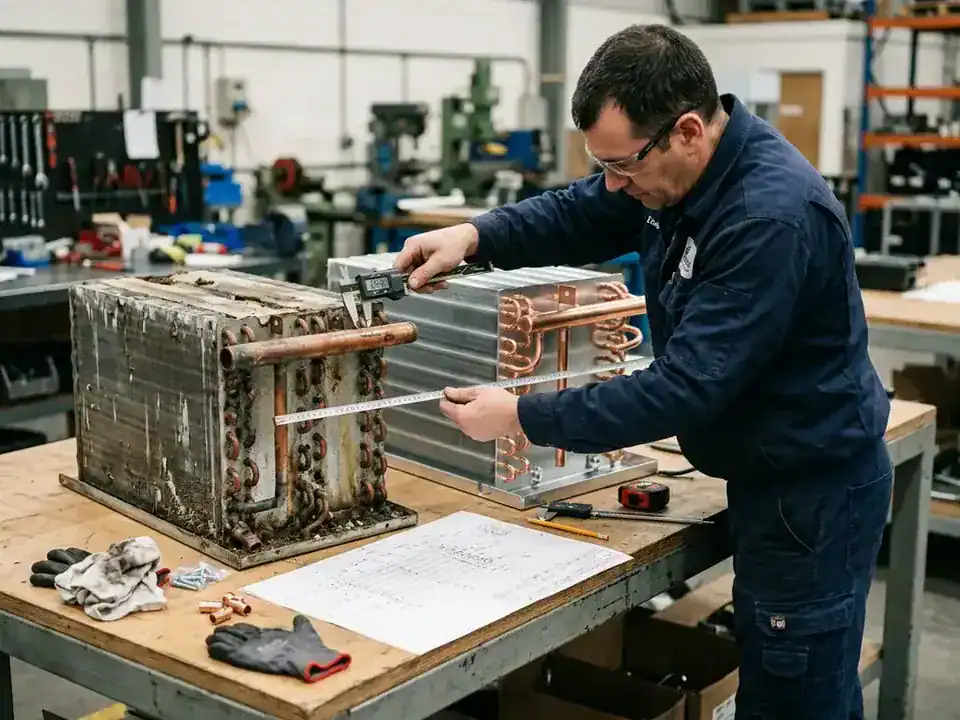
For a replacement, make a record before removing the part if possible. Photograph the evaporator from the water side and refrigerant side. Mark the top, bottom, inlet, outlet, flow direction, brackets, clips, fasteners, and nearby components. Use a scale in each image. If the old component has a label, capture it separately and do not rely on a low-resolution photograph of the whole cabinet.
Connections and refrigerant routing
Connection size and location affect the piping route and service access. The supplier should know whether the inlet and outlet are at the top, bottom, side, or rear; whether a suction accumulator or distributor connects near the evaporator; and whether the system requires a particular orientation. Circuiting changes may require a change in connection orientation or refrigerant control.
Water and drain routing
Water inlet, overflow, drain, pump suction, harvest water, and cleaning access should be dimensioned together with the evaporator. A new evaporator can fit the refrigerant lines and still block a drain or alter the water level. Include the water tray, manifold, valve, pump, and drain in the marked-up assembly drawing.
| Mechanical input | What to show | Typical risk when missing |
|---|---|---|
| Forming surface | Shape, cavities, plate, cylinder or grid | Ice form or harvest does not match |
| Refrigerant circuit | Inlet, outlet, headers and circuit direction | Pressure drop, oil return or control mismatch |
| Water path | Inlet, spray, overflow, drain and cleaning access | Uneven ice, scale or standing water |
| Mounting | Brackets, supports, drive interface and expansion clearance | Vibration, stress or cabinet interference |
| Service envelope | Removal path, panels, tools and inspection view | Component cannot be cleaned or replaced |
Thermal expansion and support
Different materials expand by different amounts during freeze and harvest. Rigid supports, tight clearances, or a bracket that touches the forming surface may create stress. Ask the supplier to review support, mounting, thermal movement, and service removal. For a replacement, retain the old mounting hardware until fit-up is confirmed.
Inspection and validation for an ice machine evaporator
Inspection should match the risks of the part. Dimensional inspection checks the envelope, connections, forming surface, brackets, and mounting. Leak or pressure testing checks the refrigerant circuit. Surface inspection checks finish, damage, coating or treatment. Functional testing may check freeze behavior, harvest, water distribution, ice form, and cycle repeatability.
The buyer should state which records are required. A standard drawing, material record, pressure test report, dimensional report, sample photos, or cycle data may be appropriate depending on the program. Do not assume that a supplier’s standard quality file contains every document needed by the equipment owner.
Separate component validation from machine validation
An evaporator can pass a pressure test and still not produce the intended ice if water distribution, controls, condenser performance, compressor capacity, or harvest timing is wrong. Conversely, a machine may produce ice during a test while the component has a fit-up or service issue. Use a staged approval: component inspection, cabinet fit-up, water and refrigerant connection review, operating cycle, and final equipment validation.
Change control for production
Changes to material, surface, tube path, header, plate, coating, connection, bracket, or finish should carry a revision number and description. The equipment owner should decide whether a change needs a new sample, a new cycle test, or only a drawing update. Keep the approved component, machine drawing, inspection record, and purchase description aligned.
Diagnosing an ice machine evaporator replacement
An ice machine evaporator replacement should begin with a failure and fit-up record, not with a generic part search. Write down the machine model, ice form, production symptom, cycle timing, water condition, refrigerant, and visible condition. A replacement may be needed because of a leak, corrosion, scale, a damaged forming surface, repeated harvest trouble, or a cabinet change. Each cause points to a different review.
The ice machine evaporator may be the source of the problem, but it may also be showing the effect of another fault. Low water flow can create uneven ice and leave dry areas. A dirty condenser can raise condensing pressure and change the freeze cycle. A control or sensor can end the cycle at the wrong time. A blocked drain can create standing water. A pump, valve, distributor, or auger can change the load seen by the evaporator.
For that reason, an ice machine evaporator quote should include the old part and the operating history where possible. Photograph the refrigerant connections, water surface, forming cavities, supports, insulation, and nearby controls. Mark the leak location or damaged area. If the failure was found during service, record the pressure test method and the conditions under which the symptom appeared. This evidence helps separate a true design replacement from a repeated maintenance problem.
Match the replacement decision to the machine objective
An ice machine evaporator for a new OEM platform may be optimized with the cabinet, water path, controls, and service access from the beginning. A replacement evaporator usually needs to preserve the equipment’s approved interface. The two projects should not use the same decision rule. A new platform can reconsider surface area, connection location, bracket stiffness, and harvest timing. A replacement needs a controlled change record if any of those features move.
The ice machine evaporator should also be compared at the actual product objective. The owner may need faster production, a different ice shape, lower water waste, a shorter harvest, or a more serviceable component. Increasing surface area alone may not achieve that goal. Confirm the compressor, condenser, water system, controls, and cabinet limits before changing the component.
Build a staged sample plan
An ice machine evaporator sample can be reviewed in stages. Start with drawing and dimensional checks. Confirm the refrigerant-side connections and water-side interface. Install the sample without changing unrelated controls, then record freeze time, water distribution, ice form, harvest time, surface condition, and leak status. If the sample is approved, document whether approval covers fit, thermal performance, harvest, or only a limited test.
The ice machine evaporator sample should carry a clear identification and drawing revision. Keep the test setup with the result so a later supplier or factory team does not compare two samples under different water temperatures, refrigerant conditions, or cycle settings. If a result is not conclusive, record the open question rather than marking the part approved.
Service documentation and spare parts
An ice machine evaporator program benefits from a spare-part description that includes the machine model, component drawing, connection positions, mounting, surface or finish, and approved substitute rules. Distributors should know whether a field replacement can use the same part across multiple machine revisions. If it cannot, show the differences in the parts list and packaging label.
The ice machine evaporator request should also identify whether the part will be installed by the OEM, an authorized service company, or a general replacement channel. That changes the documentation and fit-up risk. A part that requires a new control setting or a special bracket should not be presented as a direct drop-in replacement without that qualification.
Before handoff, keep one simple record of the water path, refrigerant path, mounting points, cleaning boundary, and approved drawing revision. This record helps procurement, production, service, and quality teams use the same description. It also makes later troubleshooting more reliable because the team can compare the installed part with the approved interface instead of guessing from a product photograph.
What to send in an ice machine evaporator RFQ
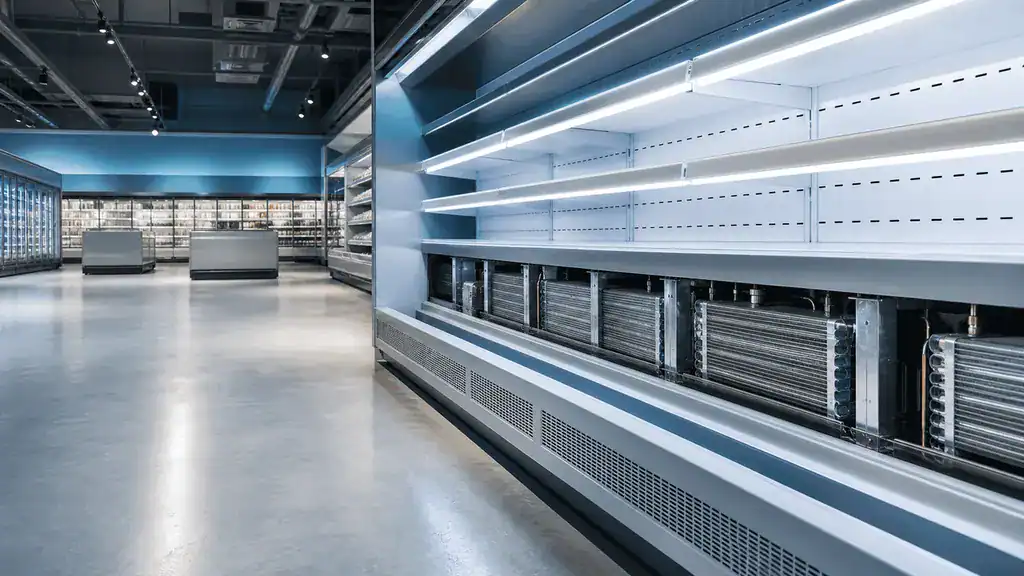
An RFQ should describe the machine, ice form, cycle, water, refrigerant, geometry, quality, and commercial requirements. The ASHRAE standards and guidelines resource helps engineers identify relevant references, but the final document should name the standards, codes, and acceptance criteria that actually apply to the project.
Start with the platform and purpose: new design, alternate source, replacement, cost-down, output upgrade, or refrigerant conversion. Then state which values are measured, estimated, targeted, or not available. This is faster than sending a vague inquiry and exchanging several rounds of guesses.
| RFQ group | Details to include | Useful attachment |
|---|---|---|
| Machine and ice | Ice form, output target, cycle length, freeze and harvest sequence | Machine drawing, model, video or cycle description |
| Refrigeration | Refrigerant, evaporating range, suction condition, pressure and controls | System schematic, compressor and metering data |
| Water and hygiene | Water temperature, flow, chemistry, cleaning, surface boundary | Water path sketch, sanitation procedure, material requirement |
| Mechanical | Envelope, forming surface, connections, supports, sensors, drain | Three-view drawing, old part, marked photos |
| Quality and supply | Sample, inspection, test records, quantity, packaging, destination | Quality plan, forecast, drawing revision list |
Describe the desired decision
Tell the supplier what the next decision is. It may be feasibility, a budgetary design, a sample, a replacement confirmation, or a production quote. A buyer asking for a sample should explain what will be measured and who approves the result. A buyer asking for a replacement should identify whether the old machine must remain unchanged.
Keep unknowns visible
If the ice form is still under discussion, list the candidate forms. If the water quality is unknown, request the supplier’s minimum information. If the refrigerant is changing, provide both existing and proposed conditions. Do not let an incomplete RFQ become an unrecorded assumption in the purchase order.
Comparing ice machine evaporator proposals
Compare the freeze and harvest basis first. Check whether the proposals use the same water temperature, flow, refrigerant, evaporating condition, cycle time, ice form, surface, and test load. Then compare fit-up, water path, connections, mounting, service access, material, finish, inspection, and packaging. Finally compare commercial scope, quantity, documents, and change control.
The lowest unit cost may omit water components, a forming surface, a bracket, treatment, pressure testing, or a drawing. The most complex proposal may include features the equipment does not need. A clear comparison sheet lets the buyer ask targeted questions without converting every difference into a price argument.
Replacement versus new design
Replacement buyers often need the machine back in operation quickly, but the old part may not contain enough information. New-design buyers can influence the cabinet, water path, and service access before tooling or production. Identify which path applies. A replacement request should protect fit-up and parts interchangeability. A new design should optimize the complete cycle and service route.
Hygiene and maintenance questions
Ask how the forming surface is cleaned, how water is drained, which parts can be removed, and where scale is expected. A component that is difficult to inspect can create a quality burden even if it performs thermally. The equipment owner’s sanitation procedure should be checked with the material and surface supplier.
A practical Domi project review path
Use Domi’s commercial refrigeration solutions page as the starting point for a commercial application inquiry. Attach the ice machine format, ice type, freeze and harvest cycle, water path, refrigerant, dimensions, connections, materials, surface or coating requirement, quantity, and destination. Photos can start the review, but measured drawings and operating data support a final quotation.
The commercial cooling coils page provides related application context for ice machines, display cases, food-service equipment, and compact commercial coils. The heat exchanger guide explains how construction families differ, but an ice machine evaporator still needs its own water, ice, harvest, and hygiene review. Use the contact page for the controlled RFQ.
The expected outcome should be specific: missing-input list, feasibility note, drawing review, sample proposal, replacement confirmation, or production quotation. Final material, finish, performance, testing, timing, and commercial terms should be confirmed against the approved project documents.
Ice machine evaporator FAQ
What does an evaporator do in an ice machine?
The evaporator absorbs heat from water or an ice-forming surface during the freeze cycle. Refrigerant changes phase inside the circuit while the surface becomes cold enough for ice to form. The design also has to support the harvest cycle, water distribution, cleaning, mounting, and service access.
Is an ice machine evaporator the same as a condenser?
No. The evaporator removes heat from the water or forming surface, while the condenser rejects heat to air or water. Their pressures, temperatures, circuit roles, materials, and controls can differ even when both components are compact.
What information is needed for an evaporator ice machine quote?
Provide the ice form, machine type, cycle time, water temperature and flow, refrigerant, evaporating range, design pressure, forming surface, connections, dimensions, supports, sensors, drain, cleaning, water chemistry, quantity, and required documents. A drawing, sample, and clear photos are useful for replacement work.
Why can ice form unevenly on an evaporator?
Uneven ice can come from water distribution, surface temperature, refrigerant circuiting, airflow or heat leakage, scale, control timing, or a mechanical issue. The evaporator should be reviewed with the pump, tray, distributor, valve, sensors, and refrigeration system rather than replaced from dimensions alone.
How does harvest affect evaporator design?
Harvest may use warm water, hot gas, pressure change, mechanical movement, or another method. The surface, mounting, joints, thermal expansion, and ice-release condition need to support that transition. A design that freezes well but releases poorly may need a surface, cycle, or support review.
Is coating suitable for an ice machine evaporator?
It depends on where the coating is located, whether it contacts water or ice, the cleaning chemicals, thermal cycling, surface finish, inspection, and applicable approvals. Do not select coating from a generic corrosion claim. Confirm material and food-equipment requirements for the complete machine.
Can a replacement evaporator use the same dimensions as the original?
It can be a starting point, but the old design may have had a scale, corrosion, harvest, drainage, or water-distribution problem. Confirm the forming surface, circuiting, connections, supports, sensors, water path, and operating conditions before approving a replacement.
Can Domi review an ice machine evaporator from a sample photo?
Yes, a photo can support an initial review when it shows the full part, scale, connections, brackets, water path, forming surface, and surrounding clearances. A final design or quotation may require measured dimensions, refrigerant and cycle data, water conditions, materials, quantity, and drawing confirmation.
Related Articles
- Commercial Refrigeration Solutions
- Commercial Cooling Coils: HVAC Applications, Specs and Selection Guide
- What Is a Heat Exchanger? How It Works, Types and Uses
- Refrigeration Condenser Coils: Selection and Commercial RFQ Guide
- Commercial Refrigeration Coil Coating Guide
- Commercial Blast Chiller Coil Guide