

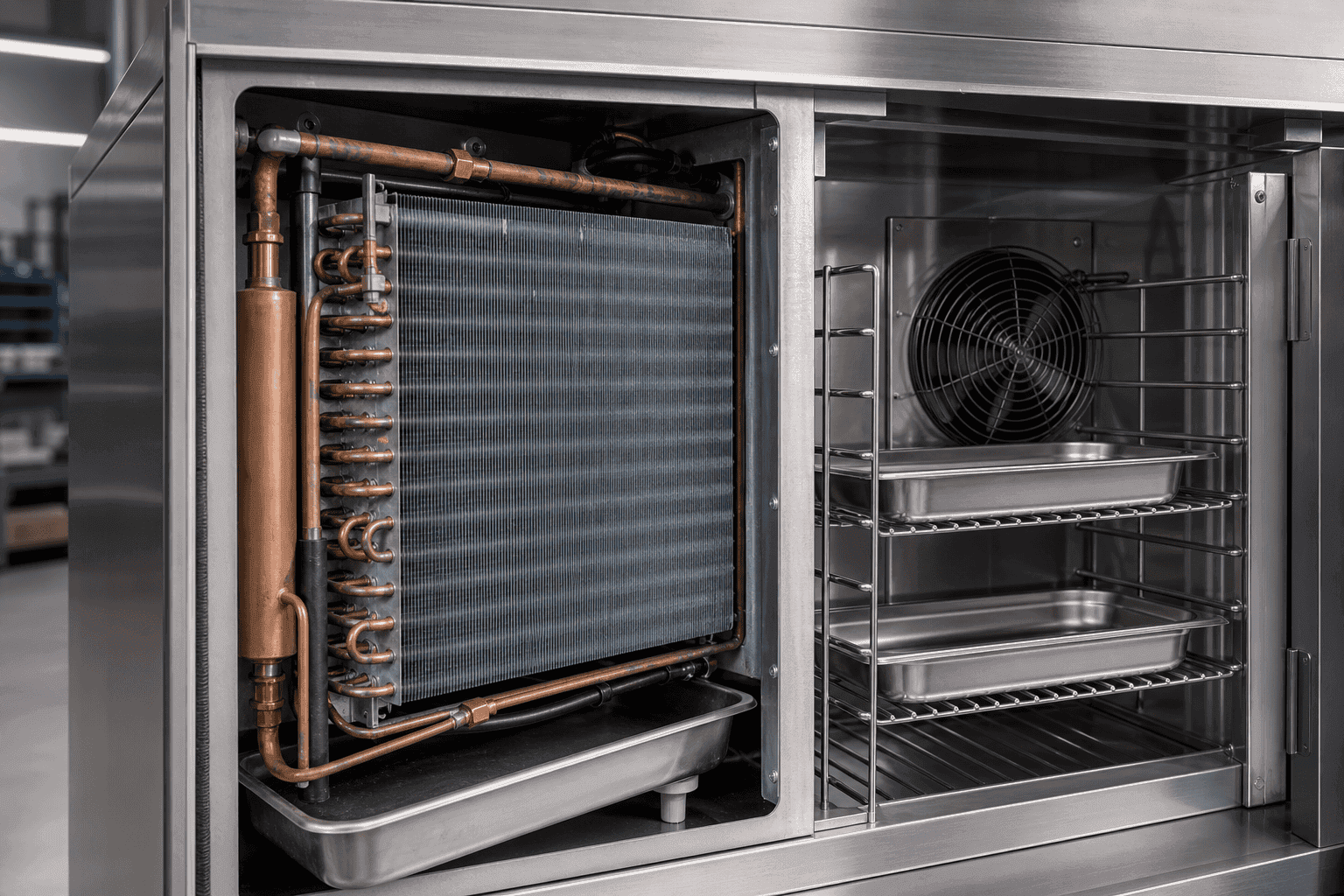
A commercial blast chiller coil is the evaporating heat-exchange surface that removes heat from food, trays, racks, or a chamber air stream at a controlled rate. A useful specification must describe the product load, air conditions, refrigerant, airflow, frost and defrost conditions, cabinet envelope, and cleaning environment.
The phrase commercial blast chiller covers more than one equipment format. A countertop unit, reach-in cabinet, roll-in cabinet, and production-room system may all be described with the same keyword while using different evaporator arrangements. The coil may sit above a rack, behind a fan wall, inside a ducted plenum, or in a compact compartment with very limited service access. That is why a capacity number or cabinet volume is not enough to select a suitable coil.
The coil has to move heat from the food load into the refrigerant circuit while the equipment maintains the intended air movement and temperature profile. If the evaporator is too small, the system may take too long to cool the load. If it is too large for the available airflow or control range, the design may create poor distribution, unnecessary frost, difficult defrost, or a cabinet that cannot be cleaned and serviced properly. A commercial blast chiller coil guide is therefore useful to engineers and procurement teams before they send an RFQ.
This article focuses on the coil and the equipment interface. It is not a food-safety approval, a cooking procedure, a fixed product recommendation, or a promise of a standard Domi configuration. Food operators must follow the rules that apply to their location and product. The FDA Food Code 2022 is a useful reference for cooling and cold-holding requirements, while the actual equipment design still needs a project-specific review.
What does a commercial blast chiller coil do?
A commercial blast chiller coil transfers heat from a moving air stream into an evaporating refrigerant. Fans move cabinet air across the finned surface. The air then returns to the food zone at a lower temperature, and repeated circulation removes sensible heat from the load. Depending on the product, surface condition, and operating temperature, moisture may condense or freeze on the coil. That moisture changes airflow resistance and can affect the timing and method of defrost.
The coil is only one part of the thermal path. Product thickness, tray material, loading pattern, door openings, chamber insulation, fan performance, refrigerant control, suction conditions, drain design, sensors, and defrost logic all influence the result. A supplier can review the coil geometry, but the rating basis should be agreed with the equipment designer. The same coil cannot be compared fairly under one proposal’s warm entering-air condition and another proposal’s colder condition.
The term blast chiller also describes a process goal rather than one universal rating class. One buyer may need fast reduction of a cooked food load to a regulated holding temperature. Another may need a compact cabinet for pastry, prepared meals, or catering trays. A third may need a blast-chilling and freezing cabinet with a wider operating range. These cases may call for different fin spacing, circuiting, fan arrangement, drain treatment, and defrost assumptions.
How the evaporator fits into the refrigeration cycle
The refrigerant enters the evaporator at a low pressure and temperature. As it absorbs heat from the air, it changes phase and leaves toward the suction side of the system. The condenser then rejects the absorbed heat plus compressor work. The relationship between the evaporator, metering device, compressor, condenser, and controls is described in the EPA overview of advanced refrigeration technologies, although a particular blast chiller may use a self-contained or remote system.
For an OEM project, the question is not simply whether a coil can evaporate refrigerant. The question is whether the circuiting, surface, headers, connections, and airflow match the operating envelope. A coil that works for a holding cabinet may not work for a fast pull-down cycle. A coil used in a dry, controlled cabinet may need different protection from one exposed to condensation, washdown, food residues, or frequent door openings.
Why the food load matters to coil selection
Heat removal begins with the product and its container. A shallow tray of small portions behaves differently from a deep pan, a tall container, a rack of dense packaged food, or a mixed load. Product moisture, initial temperature, target temperature, loading density, tray spacing, and the amount of product introduced per cycle all affect the air-side duty.
The equipment designer should provide a rating basis that distinguishes product load from cabinet pull-down. The initial air temperature, product temperature, and wall heat load may be different at the start of a cycle. Fan heat, infiltration, door openings, and defrost recovery also belong in the review. A commercial blast chiller coil manufacturer can respond more accurately when the inquiry separates these loads instead of using one rounded tonnage value.
Commercial blast chiller versus blast freezer coil requirements
Blast chilling and blast freezing can use similar cabinet hardware, but the coil and control requirements may not be identical. Blast chilling usually focuses on a controlled reduction to a cold holding range. Blast freezing adds a lower product endpoint, more severe frost exposure, and potentially longer periods at low evaporating temperature. A dual-purpose cabinet must define which mode governs the coil design and which modes are seasonal or optional.
The word commercial in the keyword does not identify a single set of temperature conditions. The RFQ should identify the highest priority operating mode, the expected cycle time, the product load, and whether the equipment must operate in both chiller and freezer ranges. It should also state whether the coil is being designed for a new cabinet, a replacement, a line extension, or a change in refrigerant and controls.
| Equipment case | Coil review emphasis | Information that should be confirmed |
|---|---|---|
| Reach-in blast chiller | Compact surface, airflow balance, service access | Cabinet size, rack layout, fan curve, product load, cycle target |
| Roll-in blast chiller | Larger face area and distribution across racks | Cart dimensions, tray spacing, air path, door seals, defrost method |
| Blast chiller and freezer | Wider low-temperature envelope and frost management | Chiller and freezer modes, lowest evaporating condition, defrost recovery |
| Production-room system | Capacity, modularity, and field installation | Room volume, rack quantity, loading schedule, remote piping, controls |
| Replacement evaporator | Fit-up, connections, and documentation control | Old coil drawings, photos, dimensions, refrigerant, failure environment |
These are review categories, not interchangeable performance specifications. A quote should state the assumptions for each mode. When a proposal uses a different air temperature, airflow, or refrigerant condition, the difference should be visible so procurement can compare the offers on the same basis.
Product temperature and air temperature are different inputs
Food does not cool instantly when the air reaches a certain temperature. The center of a product can remain warm while the surface becomes cold. Container geometry and loading density influence the resistance to heat transfer. The coil therefore needs to be evaluated as part of the air system, not as an isolated surface.
The design review should identify entering air temperature, leaving air temperature, target product temperature, and the intended measurement locations. If the system is controlled by chamber air alone, the buyer should say how the product endpoint will be checked. This does not turn the coil supplier into a food-safety assessor. It gives the supplier the information needed to evaluate air-side duty and avoid a misleading coil rating.
The FDA’s cooling guidance describes a two-step cooling process for certain time and temperature control for safety foods. A project should use the applicable regulatory and operating requirements as the design boundary, then confirm that the equipment control and validation plan can meet them. The coil selection should support that plan, but the coil alone cannot guarantee the outcome.
Airflow design for a commercial blast chiller coil
Airflow is the connection between the coil and the product. A high-capacity coil with poor air distribution may create cold spots near the surface and warm zones behind a loaded rack. A low-airflow coil may not remove enough heat even if its fin area looks large. A high-airflow design may improve heat transfer but increase noise, fan power, surface frosting, or product dehydration depending on the application.
The RFQ should describe fan quantity, fan type, fan curve, rotation, air direction, available static pressure, and the physical distance between the coil and the product. For a replacement, photographs of the fan wall and ducting are often as important as the old coil label. The supplier should know whether the coil is draw-through or blow-through, whether air reverses during defrost, and whether the fan assembly is included in the scope.
Face velocity and fin spacing
Face velocity is the average air speed across the coil face. It is a useful comparison input, but it is not a complete performance number. The same average can hide uneven fan coverage, bypass gaps, blocked sections, or local recirculation. Fin spacing also changes the balance between heat-transfer surface, air pressure drop, frost tolerance, and cleanability.
Close fin spacing can provide more surface area in a compact envelope, but it may become restrictive as frost or food residue accumulates. Wider spacing can help drainage and frost tolerance, but the coil may require more face area or different circuiting for the same duty. A commercial blast chiller coil should be selected with the expected moisture and defrost conditions in mind, not solely from a catalog face dimension.
Air distribution around racks and trays
The coil can be thermally adequate while the cabinet still performs poorly if air leaves the fan wall unevenly. Racks, tray edges, baffles, gaskets, door openings, and product packaging all change the path. Ask for a section drawing or a simple airflow sketch. Mark the coil, fan, product zone, return path, drain, and any bypass opening.
For a new unit, a supplier review can compare coil height, width, depth, header position, fan location, and return-air clearance. For a replacement, the original airflow arrangement should be preserved unless the equipment designer approves a change. Moving the header or increasing the coil depth may create a fit-up conflict even when the new coil offers a better nominal capacity.
Frost, condensation, drainage and defrost
Moist air reaches a cold evaporator surface and may condense. If the surface is below freezing, the condensate can become frost. Frost acts as an insulating layer and blocks airflow. Its rate depends on humidity, door openings, product moisture, surface temperature, airflow, and the time between defrost cycles. A coil design that ignores frost may look correct in a dry rating test and fail in actual food-service operation.
The inquiry should state whether the coil operates wet, dry, or frosting, and whether the cabinet uses electric, hot-gas, off-cycle, or another defrost approach. AHRI 410 is useful for certain forced-circulation air-cooling and air-heating coil ratings, but its listed scope excludes several frosting and direct-expansion configurations. Read the AHRI 410 standard scope before treating it as the rating basis for a blast chiller evaporator.
Drain pan and outlet position
Defrost water needs a practical path out of the cabinet. The coil, pan, outlet, drain line, insulation, and service access have to work together. A deeper coil may move the drain outlet, while a new header or support can block a pan slope. A replacement quote should therefore list the drain connection location and any pan or bracket included in the scope.
Food-service equipment may also experience frequent cleaning and sanitation. Materials and seals should be evaluated against the cleaning chemicals, water temperature, splash, and drying practice used by the customer. A coating or finish should not be selected from a generic label alone. Confirm the intended surface, coverage, cleaning compatibility, and inspection method for the project.
Defrost recovery is part of the cycle
Defrost is not only a maintenance event. It affects product recovery, air temperature, water management, fan operation, control logic, and available production time. A design that needs a long recovery period may reduce throughput. A design that defrosts too often may waste energy and expose the product to temperature variation.
The equipment team should define whether the coil needs to return to a stable operating condition before the next load is introduced. Provide the expected cycle schedule, door openings, and defrost windows. The coil supplier can then review surface area, circuiting, drainability, and connection locations with the rest of the equipment design.
Materials and construction inputs
Tube material, fin material, header construction, joints, brackets, coatings, and protective packaging should be stated in the quote request. Copper tube with aluminum fins is common in many air-cooling applications, but the correct construction depends on refrigerant, pressure, corrosion exposure, joining method, cleaning, and customer standards. Aluminum, stainless, coated, or special constructions may be appropriate in other cases.
Material selection should not be separated from the operating environment. A restaurant kitchen may expose a condenser or evaporator to grease, steam, detergents, and repeated washdown. A clean production area may have different risks. An outdoor remote condenser may face rain, salt, dust, and temperature cycling. The word corrosion-resistant is not a complete specification. State the exposure and ask for the proposed construction and validation basis.
Refrigerant and pressure conditions
The coil needs to match the refrigerant and its operating pressure. Commercial refrigeration equipment is moving through different refrigerant options, and regulations can affect new equipment and installation decisions. The EPA commercial refrigeration transition page is a useful starting point for regulatory context, but it does not select a refrigerant or coil for a particular machine.
The RFQ should include refrigerant designation, evaporating temperature range, suction condition, design pressure, test pressure requirement, control method, and any oil or compatibility requirement known to the equipment designer. If the refrigerant is not final, say so. A supplier may be able to compare options, but the quote must not silently assume a pressure or temperature condition that is different from the final system.
Coil depth, connections and mounting
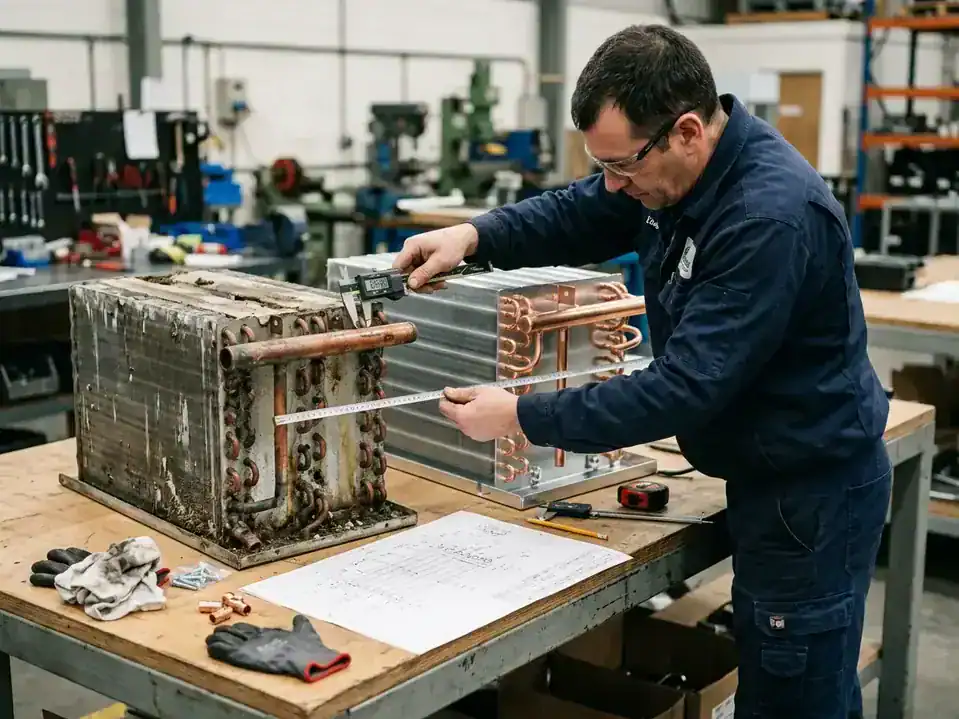
The available envelope controls more than the face dimensions. Provide overall height, width, depth, tube direction, header clearance, fan clearance, pan clearance, bracket locations, connection diameter, connection orientation, and service access. A simple three-view drawing with a datum and connection centerlines is better than a photograph alone. For a replacement, measure the old coil after removal if safe and practical, then keep the old part available for comparison.

Commercial blast chiller coil quotation checklist
A strong RFQ reduces clarification cycles without forcing the buyer to guess technical data. Send what is known, label what is provisional, and ask the supplier to confirm the missing items. The AHRI forced-circulation coil program resources show why capacity, air pressure drop, and fluid-side pressure drop are usually tied to a specific rating basis.
| RFQ group | Useful information | If the value is unknown |
|---|---|---|
| Equipment | Cabinet type, rack size, product load, cycle target, new or replacement | Send photos, cabinet drawing, or equipment model for a feasibility review |
| Thermal duty | Product start and target conditions, air entering/leaving conditions, heat load assumptions | Separate known measurements from design targets and request supplier assumptions |
| Refrigeration | Refrigerant, evaporating range, suction condition, design and test pressure | State the candidate refrigerants and the final approval owner |
| Air side | Fan curve, airflow, direction, static pressure, face area, clearance | Send fan model, motor data, or a cabinet airflow sketch |
| Frost and defrost | Moisture exposure, expected frost, defrost type, drain path, recovery time | Describe the operating cycle and cleaning schedule |
| Mechanical | Height, width, depth, connection positions, brackets, pan, service clearance | Attach the old coil or dimensioned photos with a clear scale |
| Commercial | Sample quantity, production quantity, packaging, destination, requested documents | State the decision schedule without promising a supplier lead time |
Separate the design basis from the requested result
Write the requested result in measurable terms. Instead of asking for a high-performance blast chiller coil, state the target product load, time window, air conditions, airflow, and cabinet limits. Instead of asking for a replacement coil that fits, give the connection centerlines, support points, pan arrangement, and old part photos. This lets the supplier explain what is confirmed and what needs engineering review.
Ask for deviations in the quotation
A quotation should identify differences from the RFQ. Examples include a different fin spacing, a different refrigerant assumption, a new header location, a smaller drain outlet, no pan, no fan assembly, or a rating based on dry non-frosting air. These changes may be acceptable, but they should not be hidden inside a similar part number.
Protect the food-contact boundary
An evaporator coil is not automatically a food-contact component. The cabinet designer should identify where food, water, condensate, and cleaning fluids can reach the coil or pan. Material, coating, seal, brazing, and surface-finish requirements should follow the actual equipment design and applicable rules. Keep food-contact claims separate from general corrosion or cleanability statements.
How to compare blast chiller coil proposals
Compare proposals in four passes. First compare the rating basis, including air state, airflow, refrigerant, evaporating condition, and whether the coil is frosting. Second compare the mechanical envelope, connections, brackets, pan, drain, fan clearance, and access. Third compare materials, coatings, joints, inspection, pressure testing, and documents. Fourth compare commercial assumptions such as sample quantity, production quantity, packaging, and delivery terms.
Do not compare only face area or tube diameter. A larger surface can have a different fin pitch, circuiting, pressure drop, or air distribution. A lower quoted cost can omit a pan, bracket set, coating, fan, inspection report, or export packaging. The supplier should state the scope so the buyer can request a like-for-like comparison.
The table below is a practical review sequence. It helps a procurement manager turn an engineering quote into a decision record without pretending that one specification works for every commercial blast chiller.
| Comparison step | Questions to ask | Evidence to retain |
|---|---|---|
| Rating basis | Are airflow, temperatures, refrigerant and frosting condition the same? | Rating sheet, assumptions and deviation list |
| Fit-up | Do headers, connections, pan, brackets and service clearances match? | Approved drawing and marked-up old-part photos |
| Operation | How do fans, controls, defrost and drain recovery interact with the coil? | Equipment sequence and responsibility matrix |
| Quality | What inspections, pressure tests and dimensional checks are included? | Inspection plan and sample records |
| Supply | Are sample, production, packaging and document requirements clear? | Purchase specification and revision-controlled quotation |
Prototype and sample review
A sample should be checked against the approved drawing before it is used for a production decision. Verify overall dimensions, connection positions, bracket locations, fin damage, surface condition, header orientation, drain relationship, and the fit inside the cabinet. If thermal testing is performed, record the fan, refrigerant, air conditions, load arrangement, sensors, cycle, and data reduction method.
The phrase sample approved should identify what was approved. A buyer may approve fit-up but not thermal performance. Another team may approve a laboratory rating but not production packaging. Keep drawing revision, sample number, test record, and change description together. That discipline is especially important if the blast chiller uses multiple cabinet sizes or variants.
Replacement projects and failure review
When a commercial blast chiller coil fails, the old part contains information about the actual operating environment. Record the failure location, corrosion pattern, leak points, frost pattern, bent fins, vibration marks, blocked airflow, and cleaning damage. Photograph the coil before cleaning if it is safe. A replacement that copies the dimensions but ignores the failure cause may repeat the problem.
Ask whether the failure came from corrosion, pressure, vibration, freezing water, poor drainage, impact, brazing, or a control problem. The coil may be only the visible symptom. A replacement supplier can review materials, coating, supports, circuiting, drainability, and service access, but the equipment owner should also correct the upstream or operating condition.
Commercial blast chiller coil maintenance considerations
Maintenance instructions belong to the complete equipment design. Keep the coil surface, fan guards, drain path, sensors, and access areas in a condition that matches the supplier’s recommendations. Avoid bending fins with uncontrolled tools, blocking the air path with product or packaging, or using a cleaning chemical that is incompatible with the material or coating.
Cleaning frequency depends on the environment. Food residues, grease, dust, and moisture can change air pressure drop and corrosion exposure. A coil that is clean in a factory acceptance test may operate in a very different environment after installation. Record cleaning method, chemical, concentration, rinse method, and drying practice when investigating performance decline.
Signs that call for an engineering review
Repeated long cycles, uneven product temperatures, rapid frost buildup, water carryover, high discharge temperature, nuisance high-pressure trips, fan noise, or recurring leaks are reasons to review the system. These symptoms do not prove that the coil is undersized or defective. Check airflow, refrigerant charge, controls, sensors, door seals, load pattern, defrost, drain, and condenser condition before changing the coil.
If a replacement is needed, keep the old design record and the new request in the same project file. An approved change should identify the reason, the new assumptions, the affected documents, and the person who accepted the risk. This is more useful than simply increasing the coil size and hoping that the operating issue disappears.
A practical request path for Domi review
Domi’s commercial refrigeration solutions page provides the broader component and application context. For a blast chiller project, send the equipment type, application, product load, operating conditions, refrigerant, airflow sketch, coil envelope, connections, defrost, materials, coating exposure, quantity, and destination. If a drawing is not available, send clear photos with a scale and mark the critical dimensions.
The commercial cooling coils page is useful when the request includes display cases, food-service equipment, compact evaporators, or other commercial air-cooling applications. The coil cooler guide explains why load, airflow, fluid, frost, pressure drop, and construction data should be reviewed together. Use the contact page for the project inquiry rather than placing sensitive equipment drawings in a public comment.
The review should end with a clear next step. That may be an initial feasibility response, a dimensioned drawing review, a sample quotation, a replacement comparison, or a request for missing operating data. A good commercial blast chiller coil inquiry makes the unknowns visible so that the supplier and buyer can resolve them without changing the project intent.
Commercial blast chiller coil FAQ
What is a commercial blast chiller coil?
A commercial blast chiller coil is usually an evaporator that cools the air circulating through a food-service or production cabinet. The coil absorbs heat into the refrigerant while fans move air across its fins. The actual design depends on the product load, air conditions, refrigerant, airflow, frost, defrost, cabinet dimensions, and cleaning environment.
Is a blast chiller coil the same as a blast freezer coil?
They may look similar, but the operating envelope can be different. A blast freezer may require lower evaporating conditions, more frost tolerance, and a different defrost and recovery plan. A dual-purpose cabinet should identify both modes and the mode that governs the coil design.
What information should I send for a blast chiller coil quote?
Send equipment type, product load, start and target conditions, cycle target, refrigerant, evaporating range, airflow, fan data, coil dimensions, connections, brackets, drain, defrost, materials, coating exposure, quantity, and destination. For a replacement, include the old coil, model information, photos, and measured centerlines.
How does frost affect a blast chiller evaporator?
Frost adds thermal resistance and restricts airflow. Its rate depends on humidity, door openings, product moisture, surface temperature, air velocity, and operating schedule. The design should identify whether the rating is dry, wet, or frosting and should include a practical defrost and drain plan.
Can a larger coil make a blast chiller faster?
Not automatically. A larger coil may increase surface area, but fan capacity, air distribution, circuiting, refrigerant control, cabinet layout, and product loading still control the result. A change in coil size should be reviewed with the complete air and refrigeration system.
What fin spacing is right for a commercial blast chiller?
There is no single correct fin spacing. The choice balances surface area, airflow resistance, frost tolerance, drainage, cleanability, and available cabinet space. Provide the moisture and defrost conditions and ask the supplier to state the design basis rather than choosing spacing from a generic catalog.
Should a replacement blast chiller coil copy the old coil exactly?
It should match the approved fit-up and operating requirements, but an exact copy may repeat a corrosion, drainage, vibration, or airflow problem. Review the old failure pattern, operating conditions, materials, supports, connections, and service access before approving a replacement.
Does Domi provide a standard commercial blast chiller coil?
Commercial blast chiller requirements vary by equipment and project. Domi can review a drawing, sample photo, dimensions, operating data, refrigerant, airflow, coating exposure, and quantity to determine what can be discussed for the specific inquiry. Final materials, performance, documents, timing, and commercial terms should be confirmed per project.
Related Articles
- Commercial Refrigeration Solutions
- Commercial Cooling Coils: HVAC Applications, Specs and Selection Guide
- Coil Cooler: Applications, Specifications and Selection Guide
- Condenser Coil: Types, Failure Signs, and Maintenance Guide
- What Is a Heat Exchanger? How It Works, Types and Uses
- Refrigerant Cycle Explained: The 4 Stages and Coil Roles