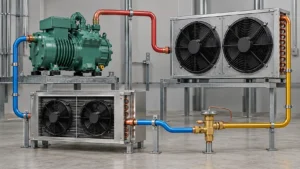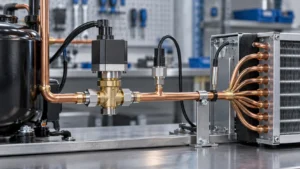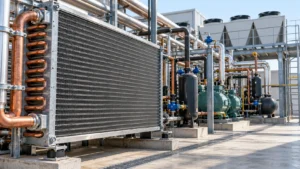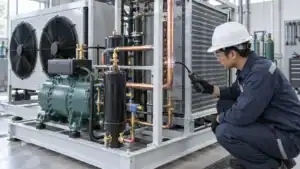

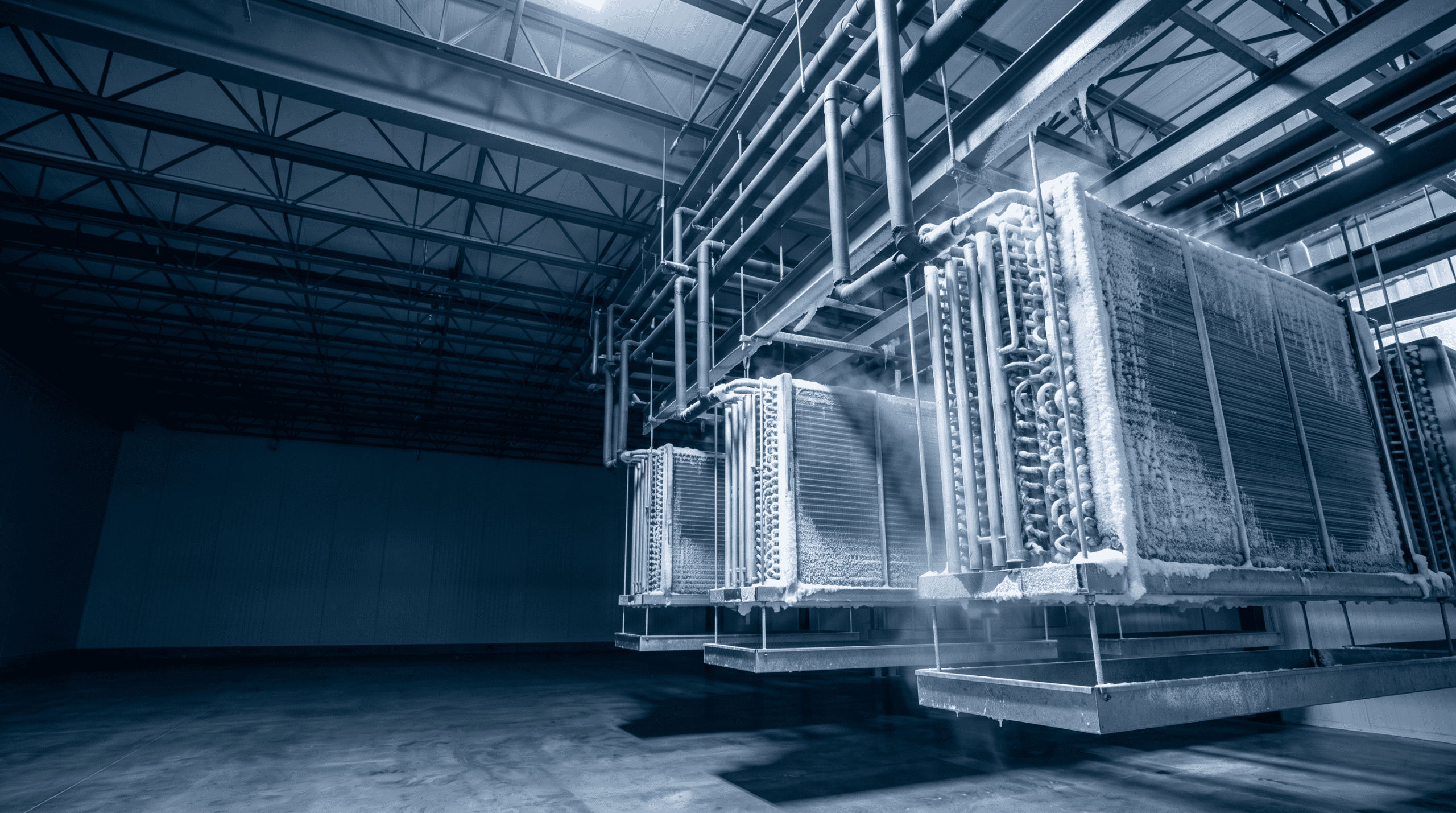
Industrial refrigeration evaporators sit at the point where the system removes heat from the application. In a cold room, that may mean cooling air around stored product. In a process system, it may mean cooling a secondary fluid or maintaining a defined product temperature. The coil geometry, refrigerant condition, airflow and drainage all have to work together.
This guide is for engineering and procurement teams comparing evaporator coils, unit coolers, or custom heat-exchanger assemblies. It focuses on the information a supplier needs to review a drawing or application instead of treating every evaporator as a standard catalogue part.
What an industrial refrigeration evaporator does
Inside a direct-expansion evaporator, refrigerant changes state while absorbing heat from air or another medium. In an indirect system, a secondary fluid such as glycol may pass through the coil while the refrigerant is handled elsewhere. Both are heat exchangers, but the pressure, circuiting, control and material requirements are different.
The application determines the design question:
| Application | Main selection question | Additional review point |
|---|---|---|
| Cold storage | Can the coil maintain the room condition at the required load? | Humidity, frost, defrost, drainage and product protection |
| Blast freezing | Can the air system remove field heat quickly enough? | Air distribution, fan duty, product airflow resistance and operating schedule |
| Process cooling | Can the outlet condition remain stable during the duty cycle? | Fluid flow, fouling, control range and cleaning method |
| Food or hygienic area | Can the assembly be cleaned and inspected? | Surface finish, access, drainage and material compatibility |
The final rating should be confirmed at the actual entering condition, target condition, refrigerant or fluid, and allowable pressure drop.
Evaporator choices for industrial applications
Finned air evaporators and unit coolers
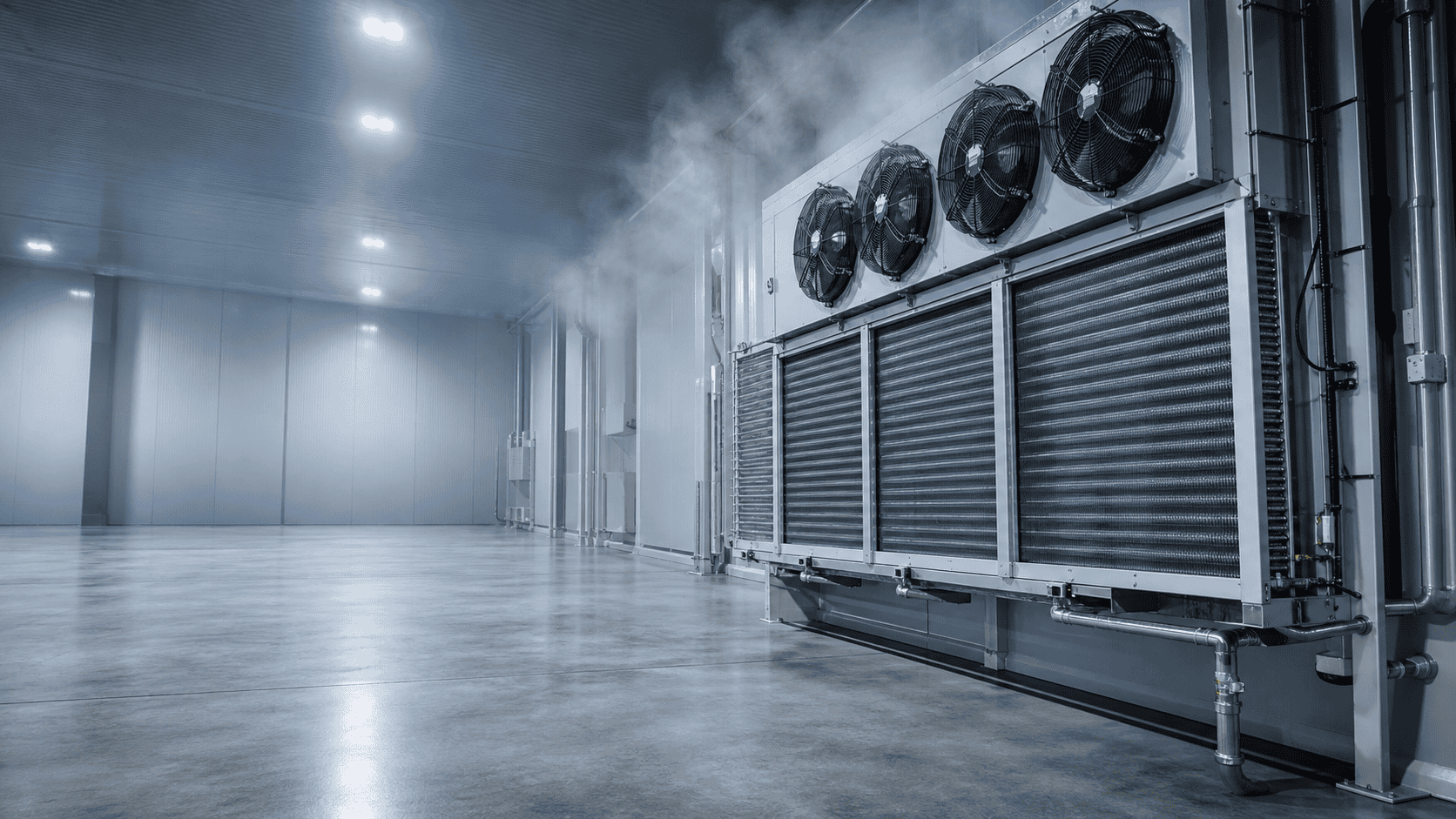
Finned coils are common where air is the heat-transfer medium. A packaged unit cooler may add fans, casing, drain pan, defrost components and guards. A bare coil may be integrated into a larger air-handling assembly.
The buyer should state whether the quotation covers only the coil or the complete air-side assembly. Fan selection, fan motor, casing and controls can change the project scope substantially.
Secondary-fluid evaporators
Glycol or chilled-fluid systems use a liquid coil rather than evaporating refrigerant inside the air coil. The supplier needs fluid type, concentration, flow rate, entering temperature, leaving target, allowable pressure drop and freeze-protection requirements. A coil that looks similar may need different circuiting and wall thickness when the medium changes.
Ammonia and CO2 applications
Ammonia and CO2 systems require application-specific pressure, material and safety review. Do not transfer an appliance-coil assumption to an industrial R717 or R744 project. Provide the refrigerant, design pressure, operating envelope, connection standard and applicable site requirements before a supplier confirms feasibility.
The sizing inputs a supplier needs
The phrase “refrigeration evaporator” is not enough to create a reliable quotation. Send a rating schedule with the following information:
- Required total and, where relevant, sensible capacity.
- Entering air or fluid condition and target leaving condition.
- Evaporating temperature, suction condition or secondary-fluid temperatures.
- Airflow, fluid flow and allowable air-side or fluid-side pressure drop.
- Room volume, product load, pull-down profile and operating schedule.
- Relative humidity, dew point, frost exposure and defrost method.
- Maximum envelope, mounting points, connections and service clearance.
- Refrigerant, material preference, coating, corrosion exposure and test requirements.
If one of these inputs is unknown, mark it as an assumption. A supplier can propose a preliminary geometry, but the proposal should not be mistaken for a final rating.
Tube, fin and circuiting decisions
Tube and fin construction
Tube material, diameter, wall thickness, fin material and fin spacing affect thermal performance, pressure capability, corrosion resistance, cleanability and cost. The correct choice depends on the refrigerant, fluid, temperature, pressure and environment.
Closer fins may provide more surface area but can increase air resistance and become more sensitive to dirt or frost. Wider spacing may help low-temperature service and cleaning but may require a larger face or deeper coil. Ask the supplier to show the capacity and pressure-drop impact of any geometry change.
Circuiting and distribution
Circuiting controls refrigerant or fluid distribution, pressure drop, return condition and the risk of uneven surface temperature. Headers and distributors should be reviewed with the coil position, piping arrangement and control strategy.
For a replacement evaporator, do not assume that copying the outside dimensions will reproduce the original performance. The tube pattern, circuiting, connections and airflow can be more important than the overall envelope.
Drainage and defrost
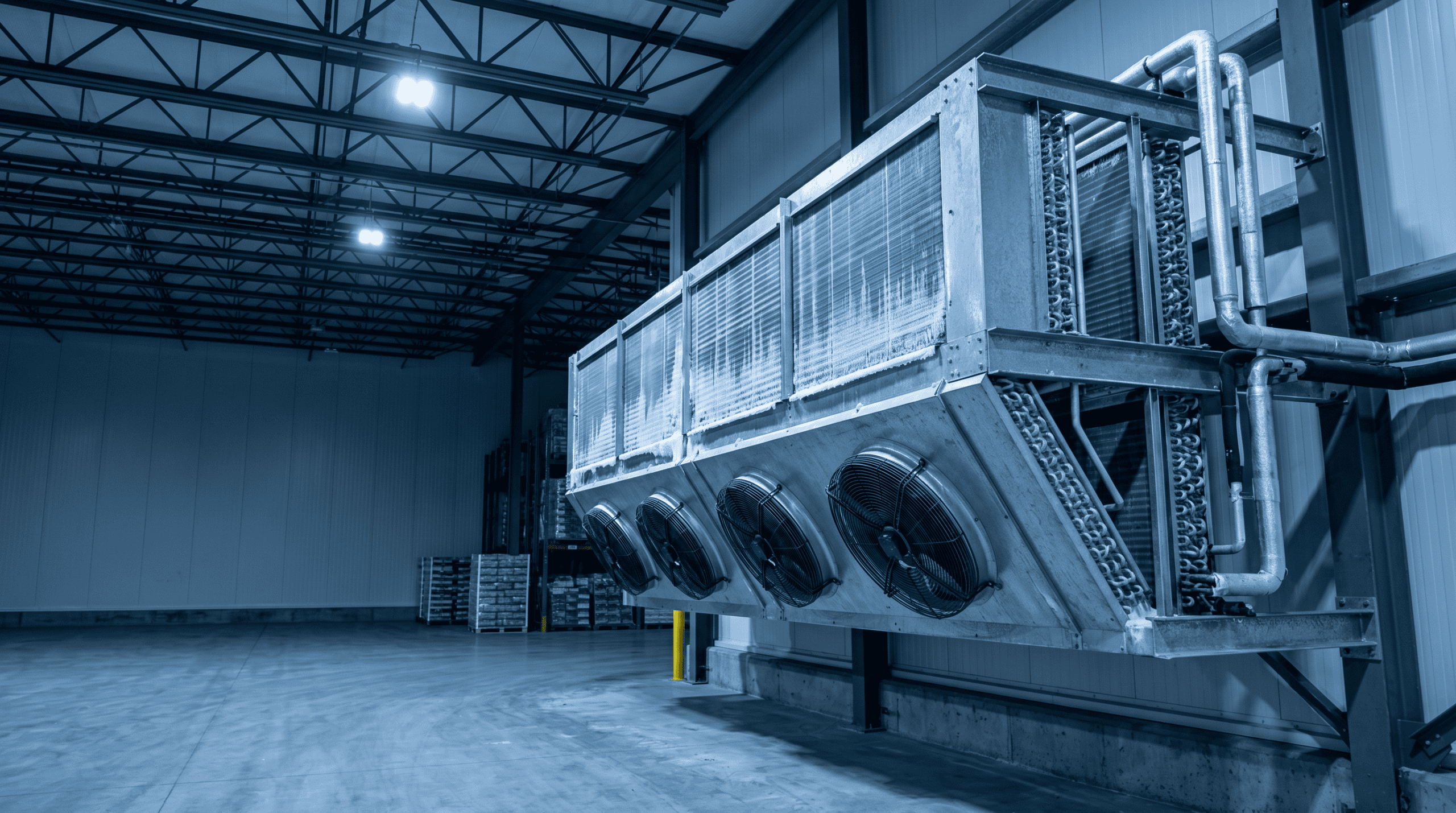
Low-temperature evaporators must manage frost and condensate. Confirm drain-pan slope, outlet location, heater or hot-gas defrost scope, access for cleaning and the time allowed for defrost. In a food or hygienic application, drainage and cleanability should be part of the drawing review, not an afterthought.
How to prepare an evaporator RFQ
Send the current drawing, photographs, nameplate, sample dimensions and application data as one package. A useful RFQ includes:
| RFQ section | Information to provide |
|---|---|
| Duty | Capacity, entering and leaving conditions, operating schedule |
| Refrigerant or fluid | Type, concentration where relevant, operating and design pressure |
| Geometry | Face, depth, rows, fin spacing, circuiting, connections and mounting |
| Environment | Humidity, corrosion, cleaning, frost and defrost |
| Quality | Leak or pressure test, dimensional report, material documents and sample approval |
| Commercial | Sample quantity, annual volume, SKU mix, packaging and destination |
If the existing unit has failed, include failure photos and the suspected cause. Corrosion, vibration, blocked airflow, poor drainage and incorrect defrost can require different replacement recommendations.
Internal links for the next project step
For product-level comparison, review Domi’s fin-type evaporator product page. For an OEM appliance quotation, see the evaporator coil quotation information guide. The main industrial refrigeration solutions page connects evaporator selection with condensers, heat exchangers, refrigerants and factory review.
FAQ: industrial refrigeration evaporators
Is an evaporator the same as a cooling coil?
An evaporator is a cooling coil in which refrigerant evaporates, while a cooling coil can also contain chilled water or glycol. Confirm the heat-transfer medium before comparing quotations.
What information is needed to size a refrigeration evaporator?
Provide capacity, entering and leaving conditions, refrigerant or fluid, flow rate, pressure-drop limit, dimensions, humidity, frost and defrost requirements. Nominal tons alone are not enough.
How do fins affect an industrial evaporator?
Fin material and spacing affect surface area, airflow resistance, frost sensitivity, cleanability and corrosion exposure. They should be reviewed with the actual air condition and maintenance method.
Can one evaporator design serve ammonia and CO2?
Not automatically. Refrigerant pressure, material compatibility, circuiting, connections and safety requirements must be reviewed for the specific system.
What should I send for a replacement evaporator?
Send the drawing revision, nameplate, photographs, measured dimensions, connections, refrigerant, duty and failure information. A sample can help confirm geometry but does not replace the rating data.
Can Domi review a custom evaporator drawing?
Yes. Send the drawing, application, refrigerant or fluid, capacity, quantity and inspection requirements for a project-specific review.
Related Articles
- Industrial refrigeration condenser-coil selection guide
- Industrial heat exchanger replacement guide
- Tube bundle heat exchanger engineering guide
- Shell-and-tube heat exchanger selection guide
- Forced-air cooler selection for cold storage
- Custom coil fabrication and engineering review
Request an evaporator review
Send your drawing, operating condition, refrigerant or secondary fluid, target capacity, quantity and delivery requirements. A technical review can then separate confirmed inputs, open assumptions and the next test or sample needed.