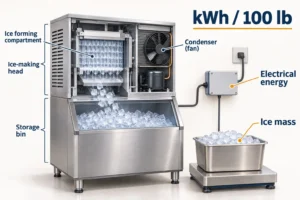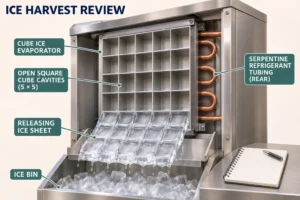

Beverage cooler energy efficiency must be evaluated at the complete appliance boundary under the applicable test procedure. A condenser capacity rating, low-power fan or efficient compressor does not establish cabinet compliance. First classify the equipment, confirm the DOE test route and any ENERGY STAR target, then compare installed condenser performance against a whole-appliance energy budget. AWEF is a walk-in refrigeration metric, not the ordinary energy rating for a beverage display cabinet.
For an OEM, the costly surprise is a cooler that holds temperature but consumes too much electricity during the prescribed test. A supplier may have delivered the requested coil dimensions and nominal heat rejection while leaving the installed airflow, operating conditions and power assumptions unresolved. The component can match its drawing while the appliance misses its target.
This guide connects the compliance engineer’s energy target with the data a condenser supplier can actually provide. It focuses on commercial beverage equipment intended for the United States. Residential beverage coolers, refrigerated vending machines and walk-in systems require their own classification review.
All illustrations are original AI-generated explanatory concepts. They are not Domi product photographs, test results, certification evidence or released engineering drawings.
Jump to a section: DOE route 路 ENERGY STAR 路 Energy budget 路 Supplier performance data 路 Failure diagnosis 路 FAQs.
Separate the cabinet, component and walk-in test boundaries
The first design review should identify what is being rated. A bare condenser rejects heat. A condensing unit includes additional refrigeration components. A beverage cabinet adds the enclosure, door, evaporator, lights, controls and other electrical loads. These boundaries cannot share an efficiency claim without supporting system data.

Item under review
Useful evidence
What that evidence cannot establish
Item under review: Bare condenser coil
Useful evidence: Heat rejection and pressure drop at stated conditions
What that evidence cannot establish: Complete cabinet daily electricity consumption
Item under review: Installed condenser and fan deck
Useful evidence: Thermal performance, airflow and fan input with defined restrictions
What that evidence cannot establish: Performance of the door, evaporator or appliance controls
Item under review: Commercial beverage cabinet
Useful evidence: Applicable whole-appliance energy and temperature results
What that evidence cannot establish: Eligibility under every other refrigeration product category
Item under review: Walk-in refrigeration system
Useful evidence: Applicable AWEF or successor rating under its own procedure
What that evidence cannot establish: A beverage merchandiser’s kWh/day rating
The walk-in provisions in 10 CFR Part 431, Subpart R belong to a separate equipment family. An AWEF number on a walk-in condensing-unit document is therefore not an answer to a beverage-cabinet daily-energy question. Ask the supplier which assembly and test method the number describes before putting it into a compliance file.
Which DOE route applies to your beverage cooler?
Start with the product’s intended use, geometry, doors, operating temperature and refrigeration arrangement. The marketing name “beverage cooler” is insufficient. A glass-door commercial merchandiser and a domestic drinks cooler can look similar while falling under different definitions. A refrigerated vending appliance should not be classified by appearance alone either.

For covered commercial refrigeration, DOE identifies the current standards in 10 CFR 431.66 and the test procedure in 431.64. The current standards text distinguishes equipment classes and applicable dates; daily-energy limits are expressed in kWh/day. Select the applicable row only after confirming the actual classification and the measurement basis for volume or display area.
Record the following on the project cover sheet:
- Intended commercial application and destination market.
- Door construction and orientation, temperature function and self-contained or remote arrangement.
- Applicable equipment class, test-method revision and manufacturing-date basis.
- Measured volume or display area where required, with the measurement record.
- Responsible party for the final rating, reporting and model-family decisions.
Check that the cited rule remains in force. DOE’s commercial refrigeration equipment page states that the amended standards rule published on January 21, 2025 was withdrawn on May 20, 2025. Its former January 22, 2029 compliance date should not be carried into an RFQ as a binding upcoming requirement. The source review for this guide was completed on October 15, 2026; verify the applicable text again before freezing a certification plan.
How is ENERGY STAR different from DOE compliance?
Treat ENERGY STAR as a separate voluntary certification objective for eligible products. Under the commercial refrigerator/freezer Version 5.0 specification reviewed here, eligible classes include certain self-contained closed-door equipment; remote-condensing equipment and walk-ins are excluded. The specification uses the commercial refrigeration Appendix B test method for energy, volume and display area, and requires the applicable certification process. Check the final specification and its effective-date provisions for the actual model.
A condenser supplier can support the OEM’s engineering review with component data. That does not make the coil, its supplier or the completed appliance ENERGY STAR certified. Keep the supplier’s thermal report and the final appliance certification evidence as separate records.
If the program is required by a customer tender, name it explicitly in the design brief. Otherwise, one team may optimize toward the mandatory limit while another assumes a stricter voluntary target. Resolve that difference before choosing the fan, coil envelope and control strategy.
Build a daily-energy budget before changing the condenser
The useful engineering question is how much electricity the assembled appliance can consume while meeting its temperature requirement. For early planning, add each load’s average input multiplied by its operating time. Variable-speed loads require integration or a representative time history rather than a nameplate power multiplied by 24 hours.
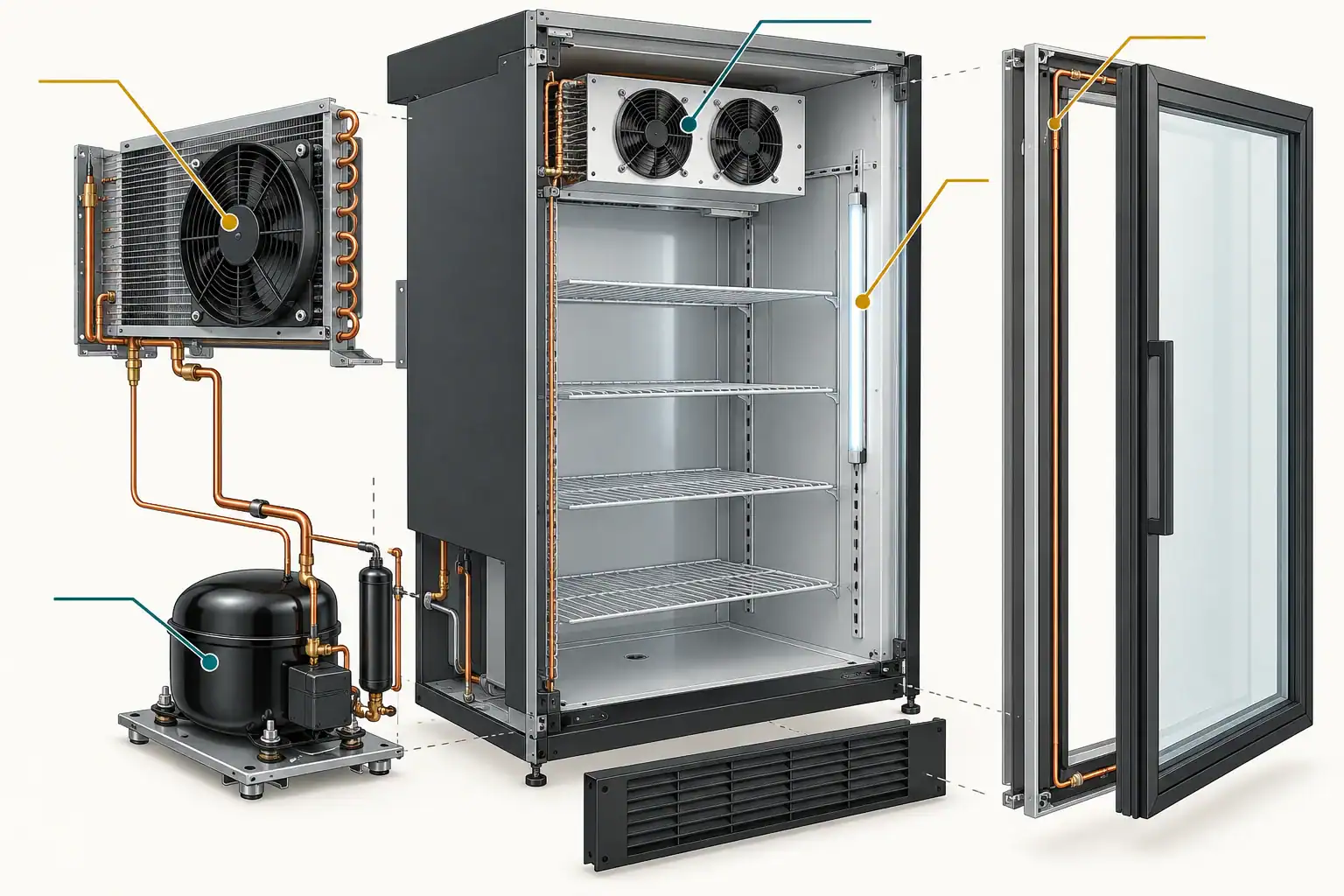
Consider a hypothetical development cabinet. Assume an internally selected energy ceiling of 2.50 kWh/day and an engineering target 15% below it, or 2.125 kWh/day. These are invented planning inputs for the arithmetic, not DOE limits, certified data or Domi performance claims.
Assumed load
Average input while operating
Operating time
Calculated daily energy
Assumed load: Compressor
Average input while operating: 110 W
Operating time: 12 h
Calculated daily energy: 1.320 kWh
Assumed load: Condenser fan
Average input while operating: 8 W
Operating time: 24 h
Calculated daily energy: 0.192 kWh
Assumed load: Evaporator fan
Average input while operating: 6 W
Operating time: 24 h
Calculated daily energy: 0.144 kWh
Assumed load: Lighting
Average input while operating: 12 W
Operating time: 16 h
Calculated daily energy: 0.192 kWh
Assumed load: Door-frame heater
Average input while operating: 20 W
Operating time: 8 h
Calculated daily energy: 0.160 kWh
Assumed load: Controls
Average input while operating: 3 W
Operating time: 24 h
Calculated daily energy: 0.072 kWh
Assumed load: Total
Average input while operating: All assumed loads
Operating time: One day
Calculated daily energy: 2.080 kWh
The calculated total sits 16.8% below the assumed ceiling, but only 0.045 kWh/day below the internal target. A small unmodeled load or longer compressor operation can erase that development allowance. Replace these assumptions with measured power traces before using the budget to approve hardware.
Now increase the condenser fan from 8 W to 12 W, still running continuously. Suppose this reduces compressor operation from 12 to 11.5 hours at the same assumed 110 W. Compressor energy falls by 0.055 kWh/day, while fan energy rises by 0.096 kWh/day. The net change is an increase of 0.041 kWh/day. The new total is 2.121 kWh/day.
This example is deliberately narrow: it holds compressor input constant and changes only two assumptions. A real coil or fan change may also alter compressor input, cycling and cabinet temperature. Measure those effects together. Lower condensing temperature is useful information, but it is not a complete daily-energy result.
Request condenser performance at the installed operating points
A supplier’s single nominal capacity is a weak basis for an energy decision. Ask for heat rejection, refrigerant conditions, airflow and input-power boundaries at the points your appliance designer needs. Distinguish the normal energy-test condition from additional development checks such as warm-product recovery or high ambient.

The condenser entering-air temperature matters more than the room temperature written on the laboratory wall. Warm exhaust, the compressor compartment and adjacent equipment can change what reaches the coil. A coil rated in unrestricted air may perform differently behind the production grille.
Request a returned-data sheet with:
- Refrigerant, evaporating and condensing conditions, and stated superheat/subcooling assumptions.
- Required heat rejection and its calculation boundary, including compressor input where applicable.
- Airflow through the coil, entering-air condition and clean airside pressure drop.
- Refrigerant pressure drop, connection arrangement and relevant operating limits.
- Fan model, speed command, electrical input and restrictions included in the test.
- Measurement method, instrument information, repeatability and uncertainty where available.
Ask the supplier to identify whether each value is measured, simulated or extrapolated. A model-based estimate can help screen a design, provided its validation range is stated. It should not be silently presented as a measured cabinet result. Use the existing beverage cooler condenser selection guide for the broader mechanical and thermal RFQ inputs.
Compare the fan and coil as an installed package
Free-air fan flow does not tell you the flow through the finished compartment. The coil, grille, guard, shroud and dust screen add resistance. Gaps can let air bypass the fins. Compare proposed fans with the same installed restriction set, rather than accepting two catalog airflow figures as equivalent.
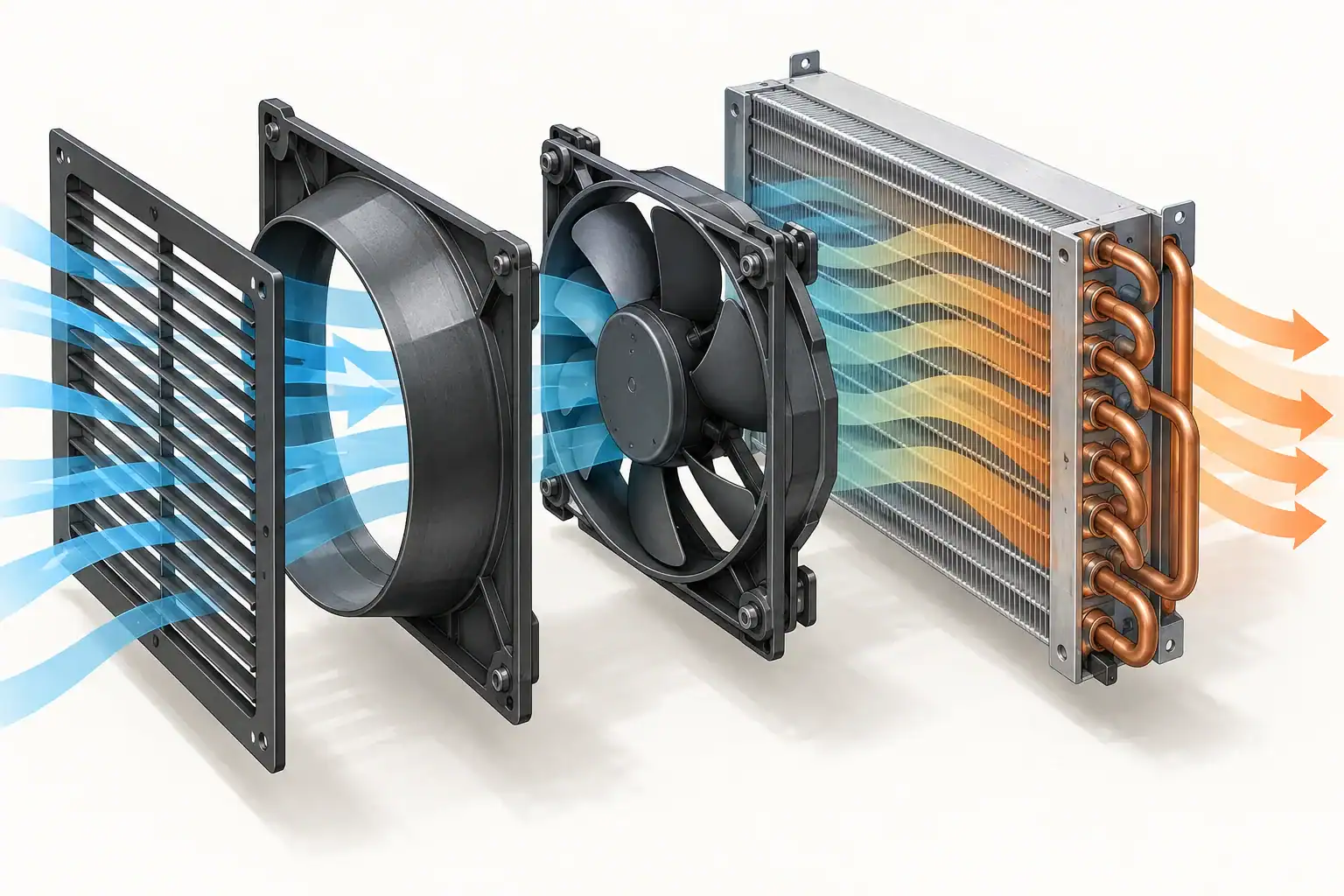
For a variable-speed fan, log the command and actual speed with power and temperatures. A firmware change can shift the energy result even when the mechanical bill of materials is unchanged. For an on/off fan, record the switching rule and operating time. Check how the fan behaves during compressor-off periods and recovery.
Choose the package with the lowest verified total appliance energy that also meets the temperature, recovery and sound requirements. A lower-wattage motor is attractive only if the resulting airflow remains adequate. The condenser fan selection guide provides additional inputs for comparing motors and controls.
Avoid trading lower condensing temperature for hidden penalties
Increasing surface area can reduce the temperature difference needed to reject heat at a given condition. But the way that area is added matters. Extra rows and dense fins can increase air resistance. A larger envelope may restrict the grille or service access. Different circuiting can change refrigerant pressure drop and inventory.
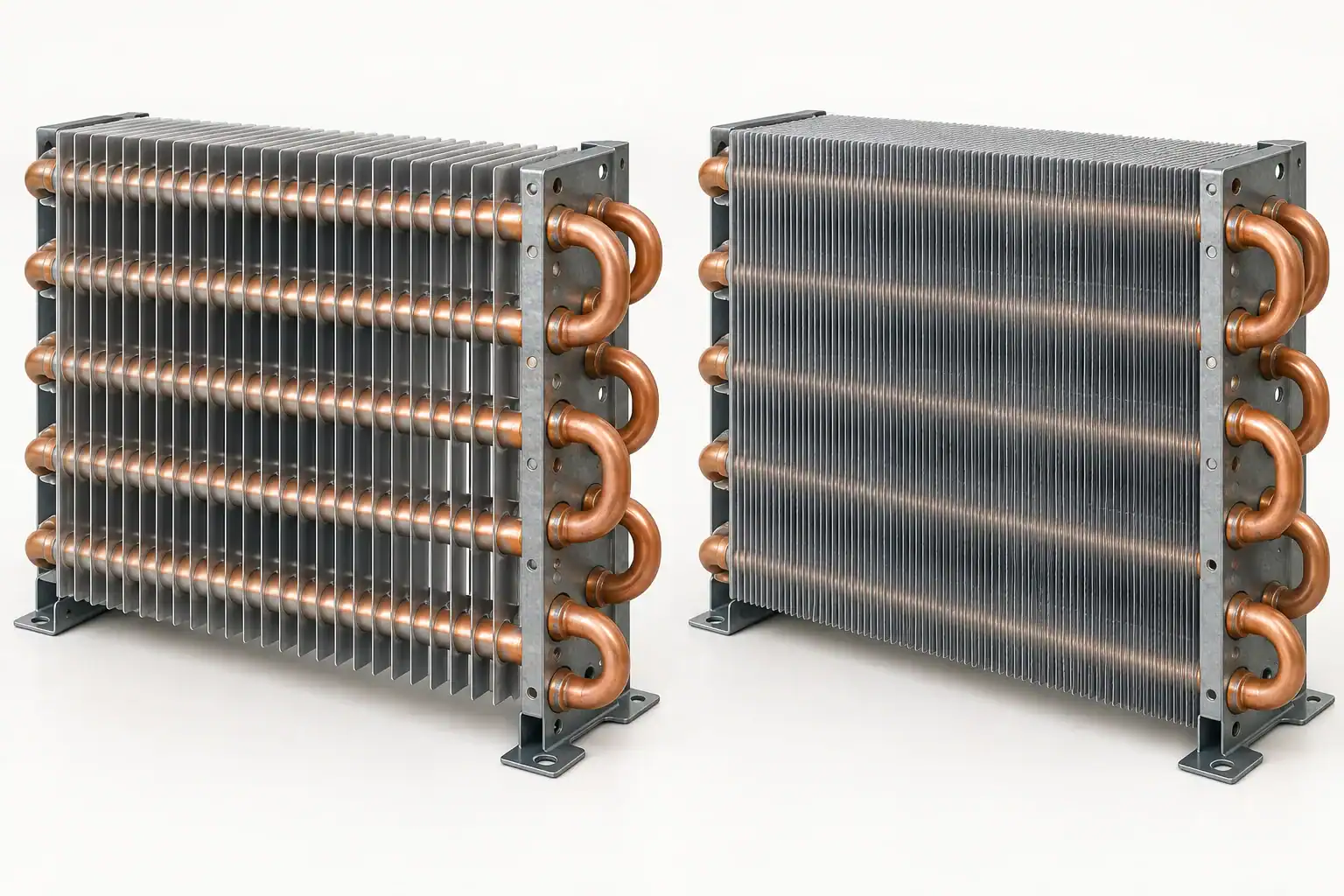
Ask each proposal to show the assumed fan operating point, rather than comparing heat rejection alone. Then check the same proposal against charge, noise, production and cleaning constraints. If the refrigerant is R290, carry the geometry change back into the whole-loop charge and safety review; the R290 beverage cooler design article covers that separate task.
A practical screening rule is to reject any claimed energy improvement that lacks an unchanged test boundary, a traceable hardware revision and a complete appliance measurement. The revised coil can remain a development candidate while those records are being assembled.
Instrument the prototype so an energy failure is explainable
A single power total reveals the size of the problem but rarely its cause. During development, synchronize the appliance power trace with the control states and temperatures. Document where each sensor sits and how it is attached. Probe placement changes can look like a hardware improvement if the measurement record is missing.
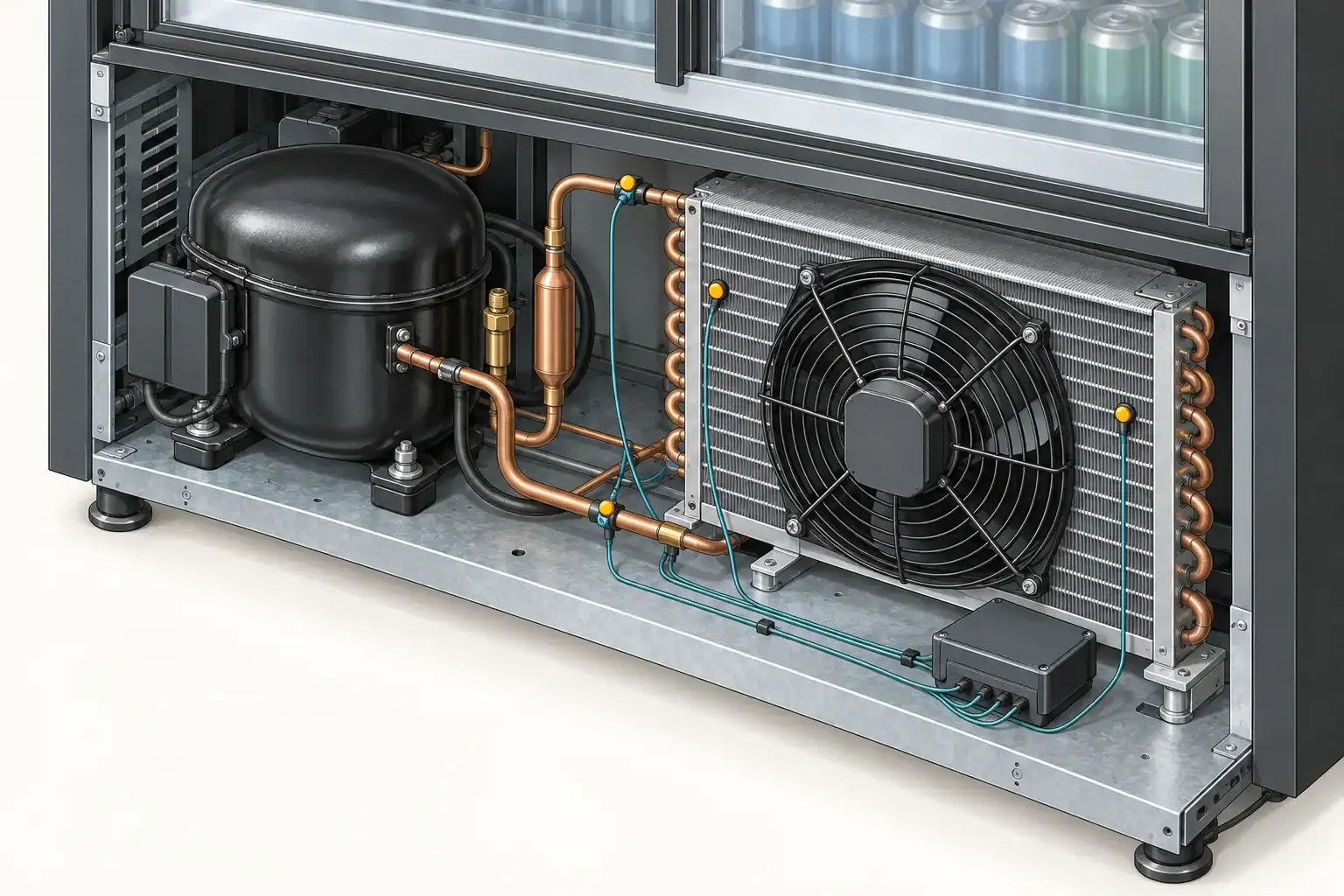
Useful development channels include cabinet temperatures, condenser entering and leaving air, compressor operating state, fan command, total appliance power and relevant refrigerant-side conditions. Pressure measurements and refrigerant work belong with qualified personnel using the equipment’s approved procedures.
Keep the official test configuration distinct from additional diagnostic instrumentation. Confirm with the responsible laboratory which probes, leads or measurement changes can affect airflow, sealing or the prescribed method. A convenient development setup must not quietly replace the required certification setup.
Use a test sequence that separates compliance from development
First stabilize a reference configuration and capture its complete record. Photograph panel positions, grille clearances, sensor locations and the hardware revision. Save the controller settings and firmware version. Run the prescribed energy test according to the applicable method, then retain the full trace rather than only a rounded daily total.
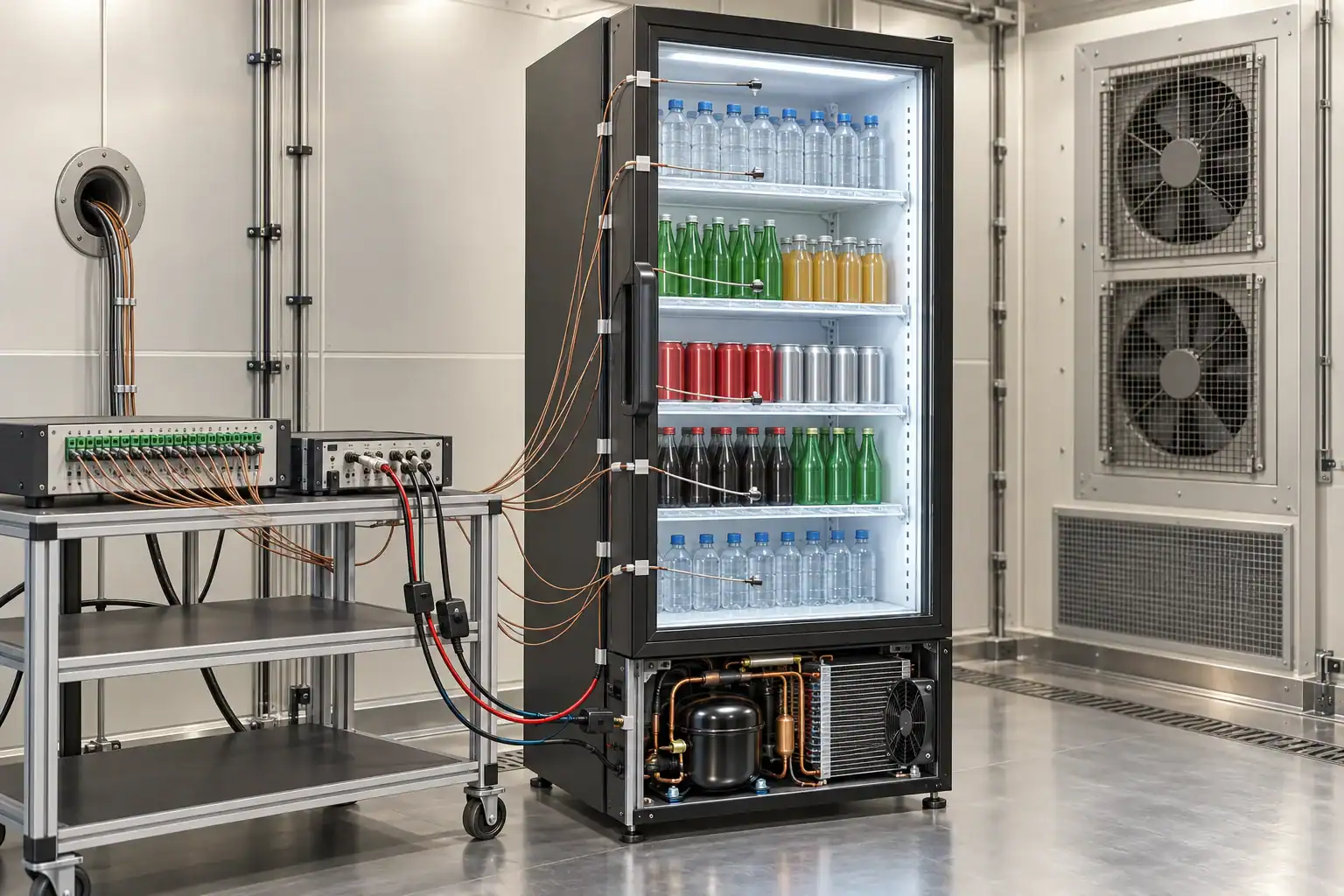
Use separate development runs for recovery, restricted airflow, ambient excursions or service scenarios where relevant. These checks help explain robustness; they do not substitute for the official energy procedure. Changing several components between runs may produce a better cabinet, but it makes the improvement hard to attribute. Screen one major variable at a time when practical, then confirm the final combined configuration.
For the final rating and reporting obligations, consult DOE’s certification and enforcement guidance. A successful development sample is an engineering milestone. The responsible manufacturer still needs the applicable model, sampling and reporting records before making the regulated representation.
Why does a cooler hold temperature but miss its energy target?
Start by checking whether the test was performed and interpreted correctly. Confirm the equipment class, stabilization, configuration, temperature result and energy calculation. Once the test record is sound, divide the electrical trace into compressor, fans and other loads where the instrumentation supports it.
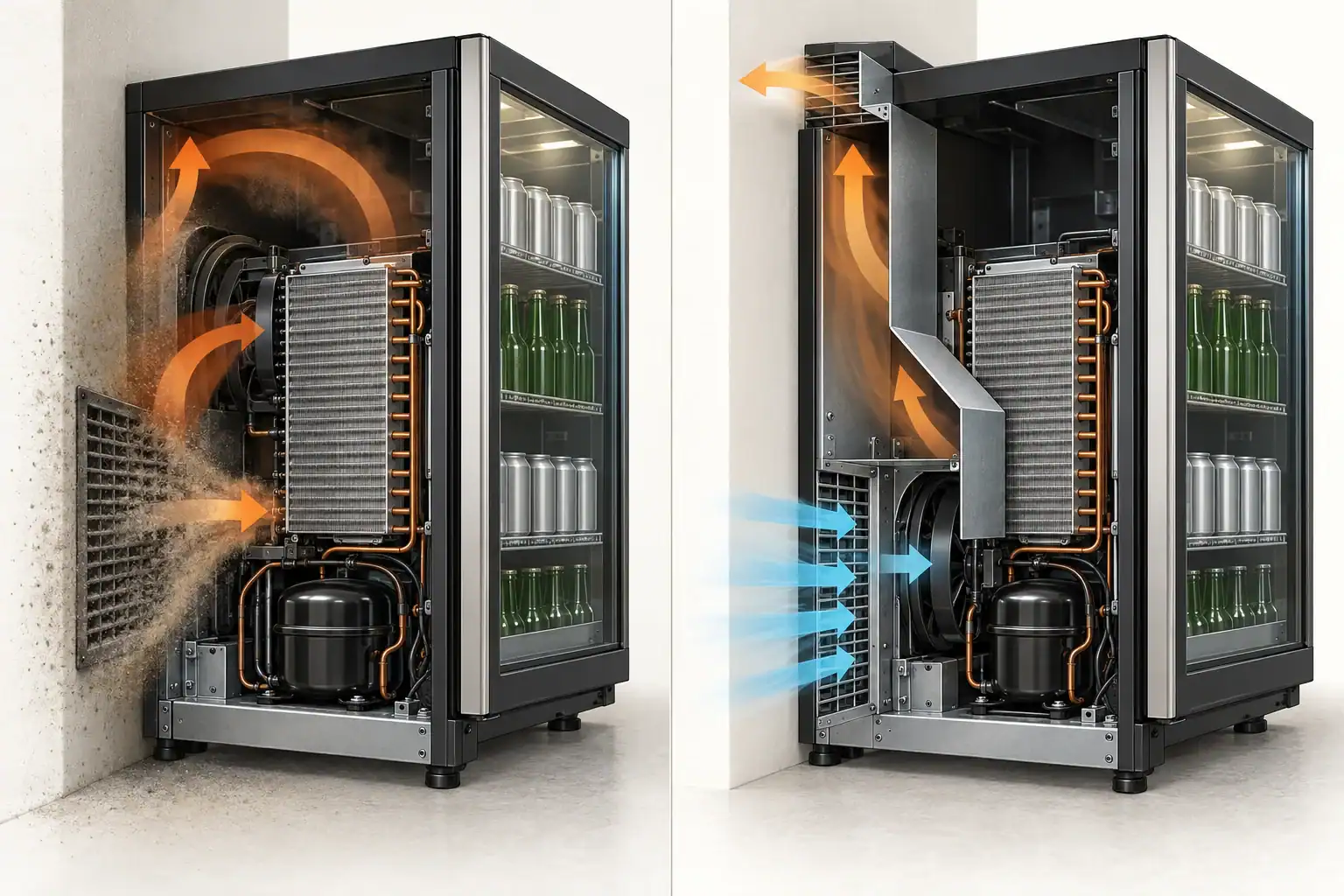
Observed development symptom
First comparison to make
Next decision
Observed development symptom: Long compressor operation and warm condenser entering air
First comparison to make: Room air versus coil inlet and exhaust path
Next decision: Investigate recirculation and compartment restrictions before resizing the coil
Observed development symptom: Higher fan energy with little compressor benefit
First comparison to make: Fan command, installed flow and total energy trace
Next decision: Reconsider speed, shroud and coil resistance together
Observed development symptom: Excess energy during compressor-off periods
First comparison to make: Heater, lighting, fan and controls states
Next decision: Review the auxiliary-load schedule under the applicable procedure
Observed development symptom: Good bench result but poor installed result
First comparison to make: Identical coil with production grille and panels fitted
Next decision: Correct the installed test boundary and repeat the comparison
Observed development symptom: Different results between nominally identical cabinets
First comparison to make: Hardware revisions, seals, fan speed and setup records
Next decision: Resolve variation before declaring the design stable
These observations are diagnostic leads, not unique fault signatures. Long runtime can arise from several causes outside the condenser. Check door sealing, load, evaporator behavior and controls before committing to a new coil. A condenser change should follow evidence that its installed thermal or airside performance is part of the problem.
Preserve the result through production changes
The tested assembly must be reproducible. Retain coil circuit drawings, tube and fin specifications, fan identification, grille geometry, seals and control settings. Record which revision was tested and which revision procurement has released. An apparently minor supplier substitution can alter airflow, electrical input or cycling.
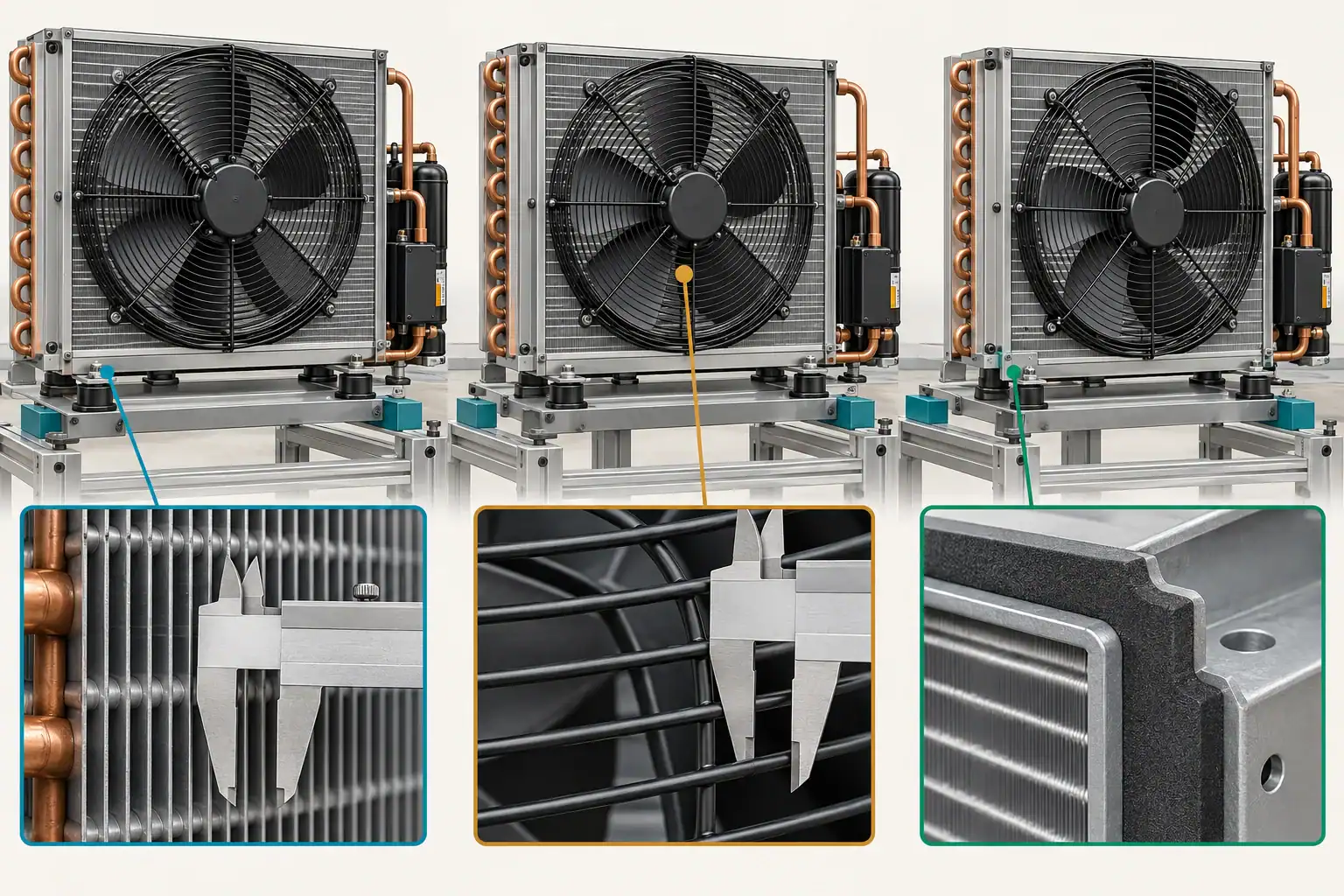
Define an engineering review trigger for changes to the coil, fan, controller, lighting, heater or enclosure. The responsible compliance team should determine whether a change affects the existing model rating or requires further testing. Do not assume that matching outside dimensions preserves energy performance.
If the final design has little measured margin, investigate the sources of variation before increasing order quantity. A larger development allowance may be appropriate, but it should come from the program’s measured variation and risk assessment. The 15% planning target in the earlier example is not a universal recommendation.
What should a condenser supplier return with a proposal?
A comparable proposal includes both a drawing and a performance basis. Ask for a traceable component identifier, revision, materials, connection details, rating conditions and an explanation of which assembly was tested. If the report concerns a coil alone, say so. If it includes the fan and shroud, identify them.

The useful supplier response separates confirmed values, assumptions and unresolved tests. Ask which data will be available before sample approval and which require a paid prototype program. Discuss lead time, MOQ, packaging and inspection documents directly; these commercial terms should not be inferred from an energy-performance illustration.
For a drawing-based inquiry, Domi’s custom coil fabrication page is the relevant starting point. The testing information page can help frame questions about available component checks and records. Confirm the scope for the actual project; this article does not claim that Domi provides whole-appliance DOE or ENERGY STAR certification.
Frequently asked questions
Does AWEF apply to an ordinary beverage display cooler?
Do not use a walk-in system’s AWEF rating to represent the daily energy consumption of a beverage display cabinet. Establish the cabinet’s own product class and applicable test route first.
Can a condenser be guaranteed to make the cabinet pass?
A condenser can be specified against defined thermal and mechanical conditions. The cabinet result also depends on the compressor, enclosure, evaporator, electrical loads and controls. A passing claim needs the complete appliance evidence.
Does a lower condensing temperature always mean lower daily energy?
No. Achieving it may require additional fan energy or change the control sequence. Compare the whole-appliance energy trace while preserving the required temperature performance and test conditions.
Can a supplier simulation replace the final energy test?
A supplier simulation can support component selection within its stated validation range. Do not treat it as an authorized replacement for the appliance’s required test or reporting route without confirmation from the responsible compliance team.
How much energy-test margin should an OEM reserve?
Base the allowance on measured repeatability, production variation, uncertainty and program risk. The hypothetical 15% target used in this guide demonstrates arithmetic; it is not a prescribed compliance allowance.
What should be checked before buying a larger condenser?
Compare coil entering-air temperature, installed airflow, recirculation, bypass and auxiliary loads. Establish whether the condenser is responsible for the energy excess before changing the envelope or circuiting.
Is a cabinet that holds temperature ready for certification?
Temperature performance is only one part of the evidence. Confirm energy consumption, classification, model configuration and the applicable test and reporting requirements with the responsible team.
What files should accompany an OEM condenser inquiry?
Send the cabinet and deck drawings, refrigerant and compressor data, target operating points, fan and grille details, energy-test objective, current prototype results and requested production quantities. Identify assumptions that still need engineering review.
Send the energy target with the condenser drawing

An RFQ is easier to assess when the supplier can see the installed package and the buyer’s test objective. Send the current baseline, the energy target, the design conditions and the required returned-data format together. Keep component acceptance separate from final cabinet certification, and require every proposed improvement to survive a documented whole-appliance comparison.