
Refrigerator condensation forms when moisture in the air meets a surface cold enough for water to condense. Start by locating it: inside the compartment, on the outside, around the door frame, or between glass panes. Check door closure, room humidity, blocked air passages and the drainage route before replacing parts. On commercial glass-door coolers, compare the affected surface temperature with the surrounding air’s dew point; coil changes alone may not solve door sweating.
A few droplets after opening a fridge and a frame that drips all day are different problems. This guide starts with checks for a working refrigerator, then covers the measurements and design choices that matter to display-cooler OEMs. The illustrations are original AI-generated concepts, not photographs of Domi products, customer installations or measured tests. Numerical examples are hypothetical.
Jump to the part you need:
Where is the refrigerator condensation forming?
Dry a small accessible area and watch where moisture returns during normal operation. Record whether it follows a door opening, restocking, a defrost event or a change in room conditions. A photograph taken before wiping is useful when the problem disappears before a service visit.
Location or pattern
First check
What the observation does not prove
Location or pattern: Rear wall or food containers
First check: Recent door openings, uncovered moisture sources, temperature and airflow
What the observation does not prove: A refrigerant leak or failed compressor
Location or pattern: Outside cabinet or glass
First check: Local room humidity and affected surface temperature
What the observation does not prove: Excess water inside the sealed refrigeration circuit
Location or pattern: One frame edge or corner
First check: Gasket contact, alignment, thermal bridge and heater operation
What the observation does not prove: That every door needs more heater power
Location or pattern: Fog that cannot be wiped from either accessible glass face
First check: Insulated-glass assembly and edge seal
What the observation does not prove: That a colder thermostat setting will clear it
Location or pattern: Water collecting beneath drawers or on the floor
First check: Drainage, spills, pan and any water-supply connection
What the observation does not prove: That all of the water is condensation
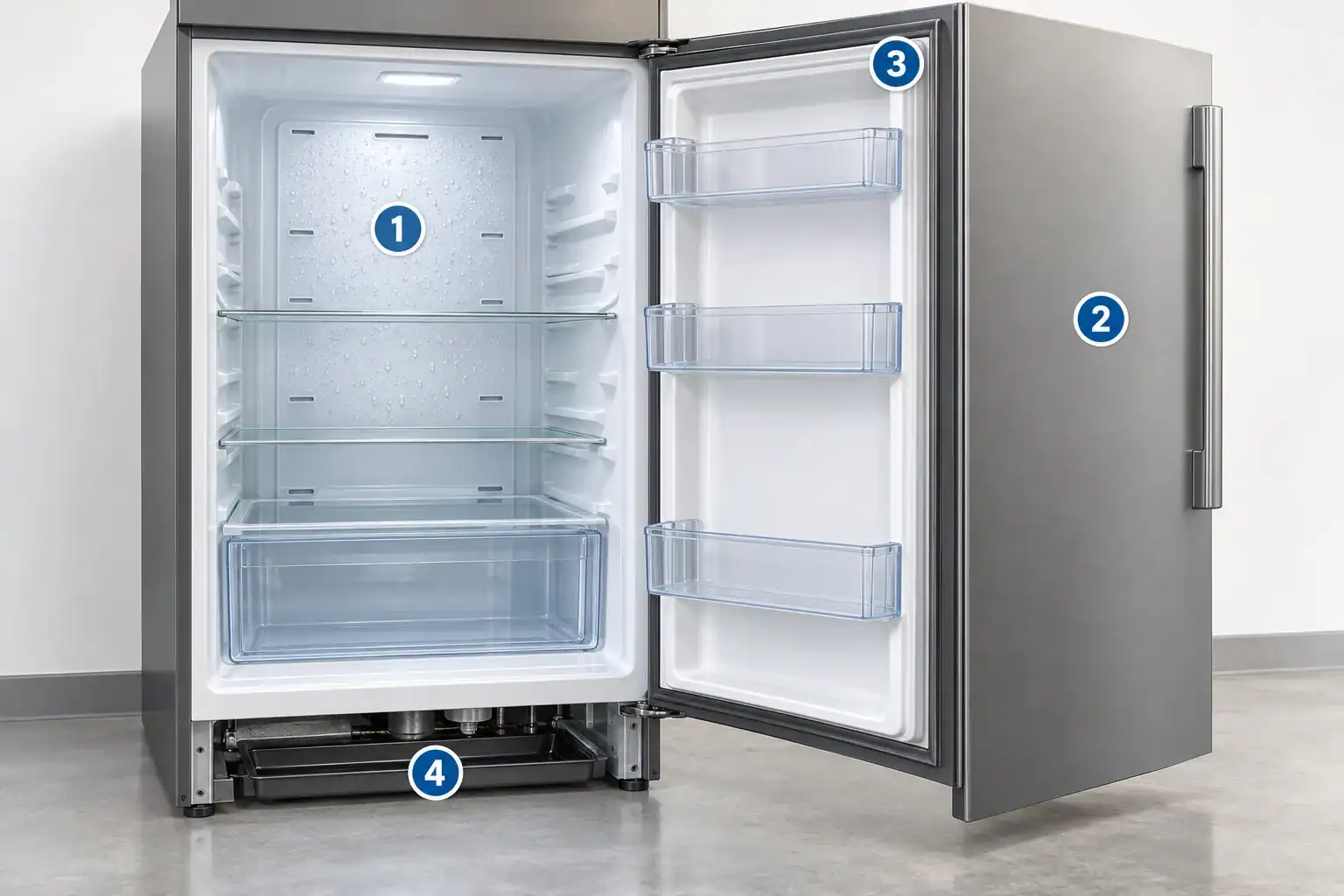
The numbered concept shows the inside rear wall, exterior door face, door perimeter and lower collection area. Actual drain and equipment locations vary by model. Persistent pooling, worsening frost or temperature alarms deserve investigation even if the cabinet still feels cold.
When is condensation inside a fridge normal?
Small, temporary droplets can appear as humid air enters and cools. On some designs, moisture on the rear cooling surface also changes through the operating cycle. Check whether the moisture drains or evaporates as intended and whether temperatures remain stable. A single droplet tells you little. Blomberg’s rear-wall moisture guidance discusses normal moisture alongside drainage, seal and airflow faults.
Watch when the droplets appear. If droplets occur immediately after a long door opening, shorten openings and repeat the observation. If the same area stays wet overnight with the door closed, investigate a continuing moisture source, leakage at the seal, or a drainage problem. These patterns narrow the search; neither pattern identifies a failed component by itself.
Cover stored liquids and use suitable closed containers. Keep the recommended storage temperature and verify it with an appropriate thermometer. Do not warm the compartment merely to make a surface look dry, or turn the thermostat progressively colder without checking actual temperature. Different products and appliances have different storage requirements.
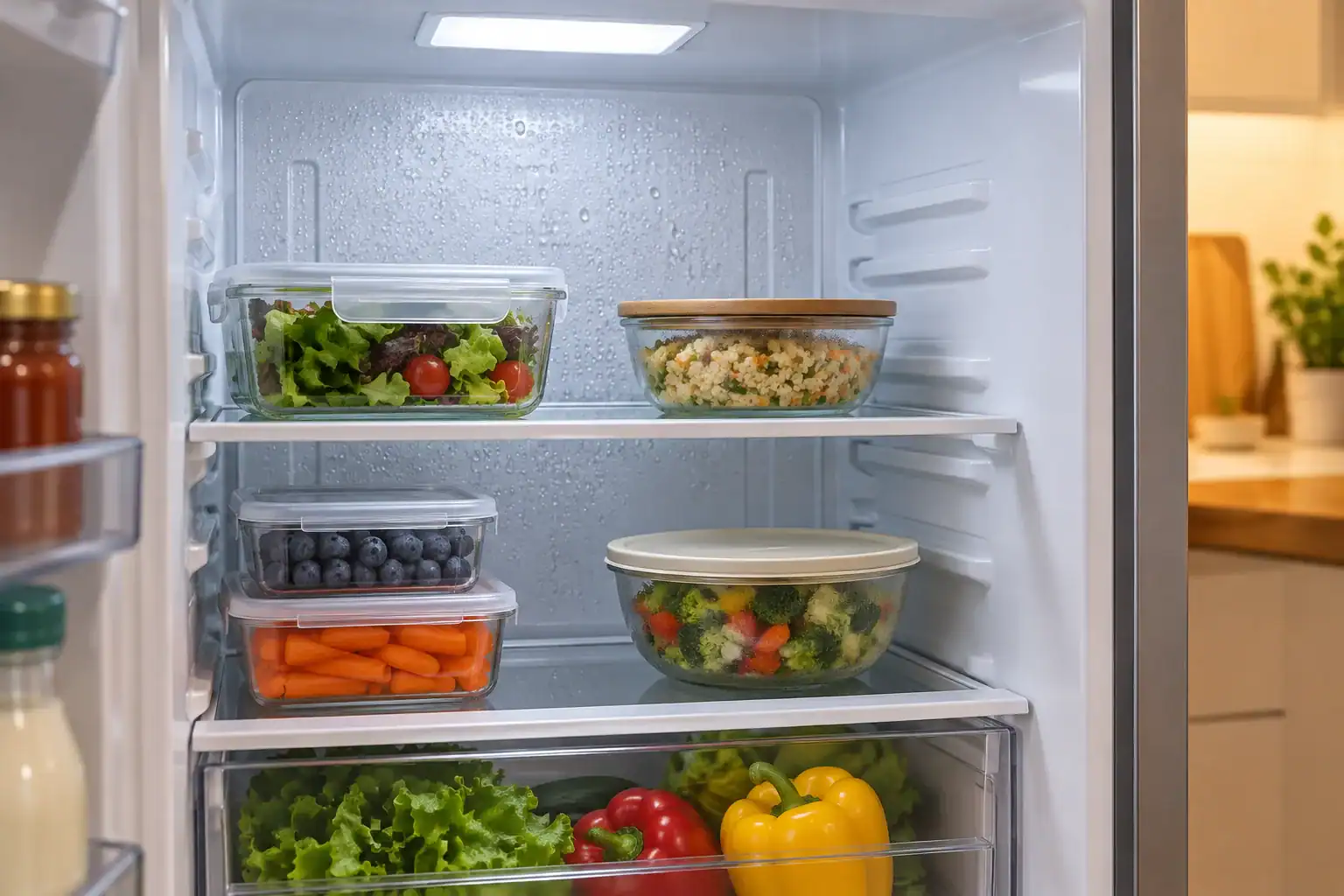
Check the door seal before changing settings
Look for a package, shelf or drawer preventing complete closure. Inspect the gasket for dirt, folds, tears and sections that no longer touch the cabinet. Clean it using the appliance manufacturer’s method. Observe closure at the top and bottom rather than assuming the latch side tells the whole story.
Whirlpool identifies frequent openings, incomplete sealing and blocked vents among the causes of moisture in the refrigerator compartment. Apply those checks to the actual model: hinge adjustment, leveling and gasket replacement procedures are not interchangeable across refrigerators.
For a commercial cabinet, record which door was affected and whether the problem follows loading periods. One wet door beside two dry doors under similar conditions points toward a local difference worth measuring. It does not eliminate a room-humidity problem; the affected door may simply have the coldest edge or poorest seal.

Keep the intended air paths open
Find the supply and return grilles in the manual. Move packages clear of them and keep the cabinet within its marked loading limits. An empty gap in front of a fan is insufficient if the return path is blocked farther down the compartment.
For troubleshooting, change the loading arrangement without changing the thermostat, then compare temperatures and moisture under a similar door-opening pattern. Changing both at once makes the result difficult to interpret. Note any fan noise, intermittent operation or unusual frost for the service technician; do not reach through guards or run the appliance with safety covers removed.
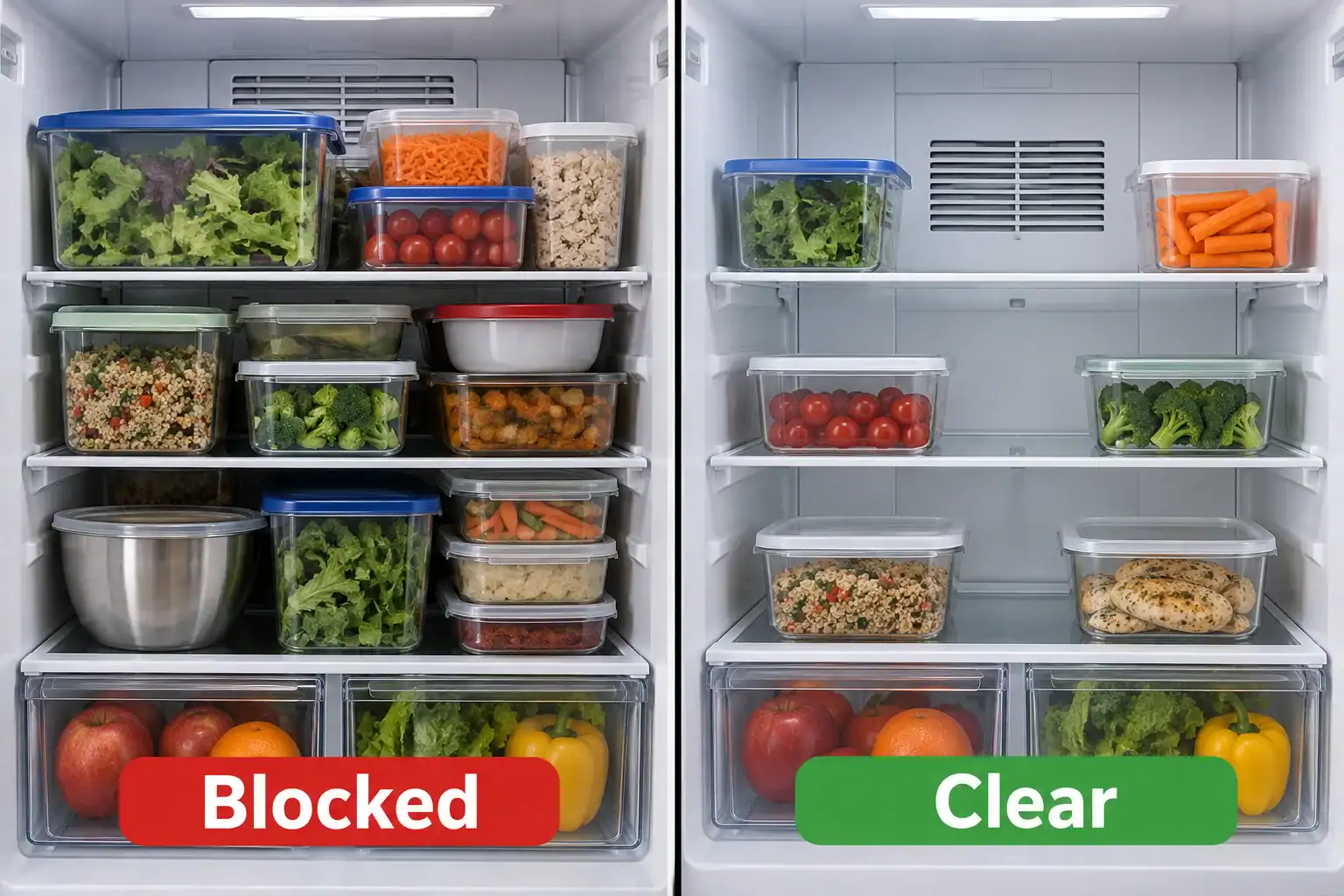
In a display cabinet, include shelf position, price strips and product overhang in the check. A prototype tested with empty shelves may circulate air differently after merchandising. Check temperatures across the loaded cabinet to see whether its air path works.
Is it condensation, a blocked drain or a water leak?
Water that began as moisture on a cold surface still needs a route out. A blocked or displaced drain can turn ordinary condensate into a puddle. Conversely, a spill or leaking water connection can look like a condensation problem from a distance.
Trace accessible wet areas back toward their source. Check the model’s drain and pan arrangement, and follow its cleaning instructions. Avoid sharp tools, improvised heaters or forcing a blockage into an inaccessible tube. Work requiring panels, electrical checks or refrigerant access belongs with an appropriately qualified technician.

The illustration separates collection, transport and final drainage or evaporation. It is a conceptual route, not an installation drawing. A useful service record identifies where water first appears, where it should go, and where it stops. If the pan fills only after defrost, observe that event before replacing a continuously operating component.
Why is the outside of the refrigerator sweating?
Compare the exposed surface temperature with the dew point of the air touching it. The National Weather Service explanation of dew point describes this saturation threshold. Relative humidity alone is incomplete because the corresponding dew point also depends on air temperature.
Use this screening quantity: surface margin = surface temperature minus local air dew point. A negative margin indicates that condensation is thermodynamically possible on that surface. A small positive margin is not a robust design pass when sensor uncertainty, uneven temperatures and changing humidity are considered.
In a hypothetical room at 26°C and 65% relative humidity, the dew point is approximately 18.9°C. An outer glass surface at 17°C has a margin of about -1.9°C. If the room remains at 26°C but is dehumidified to 50% RH, its dew point is about 14.8°C; assuming the glass stays at 17°C, the margin becomes about +2.2°C. The example isolates humidity. In a real cabinet, surface temperatures can also change.

Reducing room dry-bulb temperature alone, without removing moisture, does not automatically reduce dew point. Measure both temperature and humidity near the cabinet. Keep the sensor out of direct supply-air jets and condenser exhaust unless those local conditions are specifically being investigated. The psychrometric chart guide explains the broader air-property relationships.
Glass-door fogging: outside, inside or between panes?
Check which accessible face can be wiped clear. Exterior condensation is evaluated against room air. Moisture on the inner face after opening involves the humid air that has entered or contacted the cold surface. A haze trapped within an insulated-glass assembly needs a glass or door specialist’s assessment, including the edge seal; wiping either face cannot remove moisture in the sealed gap.
Do not judge the whole door by its center. The spacer, perimeter and frame can have different thermal paths and surface temperatures. Record separate readings at the central pane and affected edge. Where an infrared instrument is used, account for glass reflectivity and the instrument’s limitations; a suitable contact measurement is often more informative for this comparison.
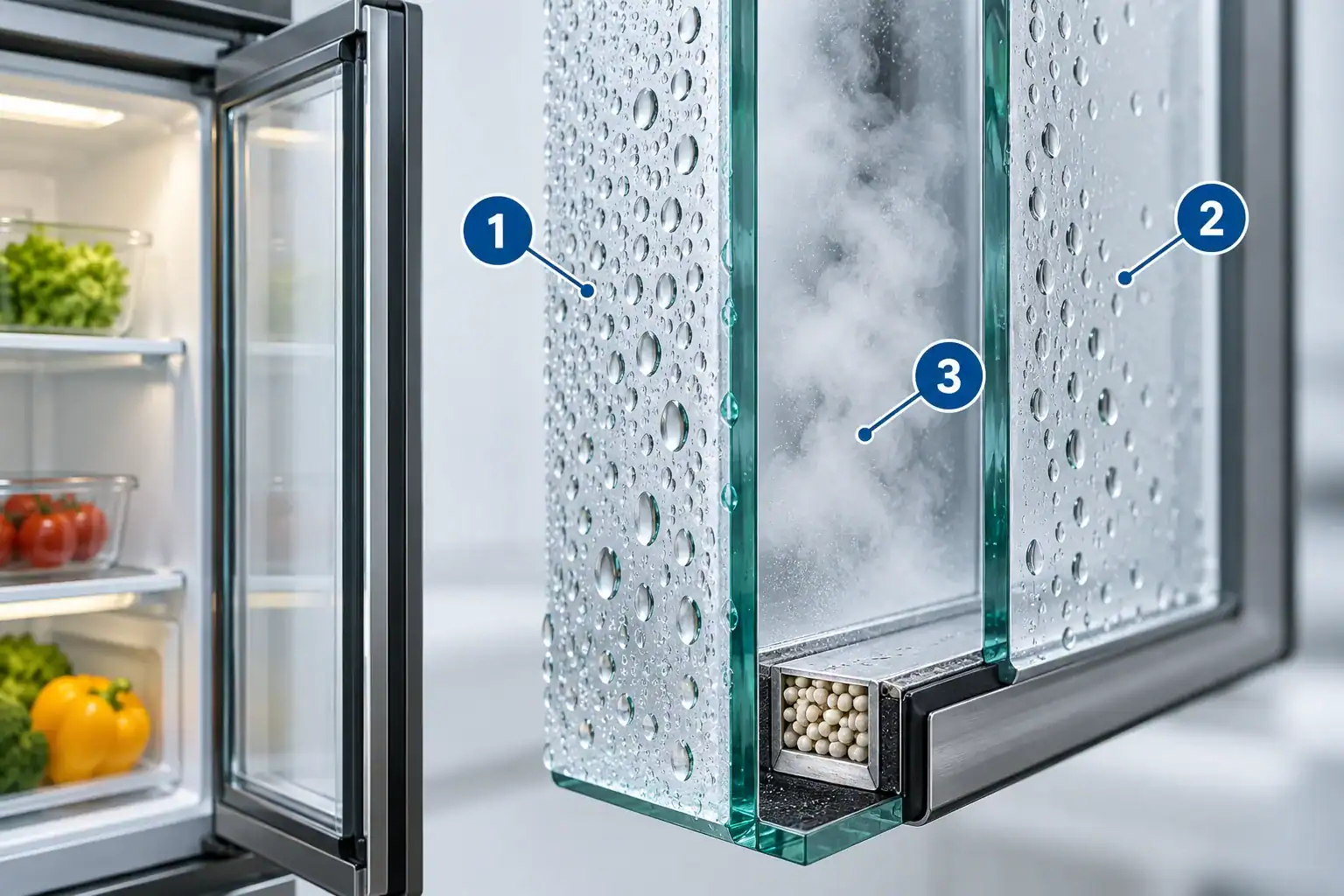
This conceptual cutaway distinguishes surface moisture from moisture in the glazing space. It is not a specified glass construction. Changing pane count, coatings, spacers or frame insulation requires assembly-level validation, including visibility, durability, cleaning compatibility and the intended ambient conditions.
Why can the door frame sweat while the glass stays clear?
A metal edge may conduct heat differently from the insulated pane. A gasket gap, cold-air impingement, an interrupted thermal break or an incorrectly operating heater can produce a local cold spot. Compare the wet location with an equivalent dry location before deciding which explanation fits.
Some appliances have a manufacturer-provided control for exterior moisture prevention. Whirlpool’s exterior cabinet moisture guidance describes such model-dependent heating arrangements. Use the correct manual and control setting; do not add or bypass heater wiring as a general condensation fix.
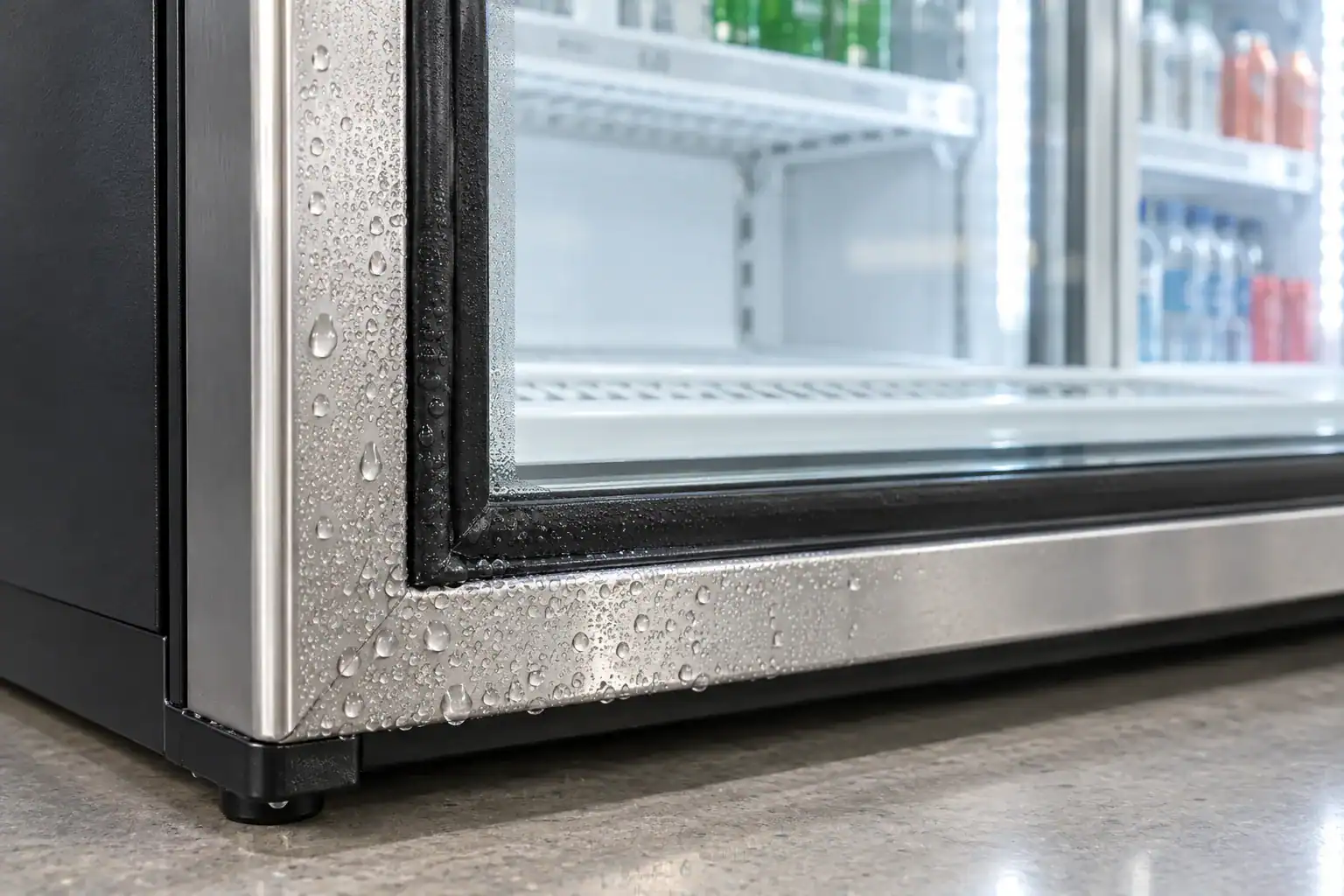
For an OEM investigation, map the wet perimeter and heater zones together. A dry center with a wet lower corner is a reason to inspect that corner’s construction and operating condition. Increasing power across the entire door may conceal the local defect while adding unnecessary heat elsewhere.
How does coil design affect glass-door condensation?
The evaporator affects cabinet-air temperature, moisture removal and the distribution of cooling. Its geometry, refrigerant circuiting, operating temperature and interaction with the fan therefore matter. However, the outside of a closed door is exposed to room air. Drying cabinet air does not directly dry the room-side boundary layer, and a different evaporator cannot repair a failed insulated-glass seal.
Treat the following as engineering checks, not universal upgrade rules:
Proposed change
What to verify
Potential trade-off
Proposed change: More coil face area
What to verify: Required duty at the available airflow and operating temperatures
Potential trade-off: Package size and air-path changes
Proposed change: Different fin spacing or depth
What to verify: Wet and frosted pressure loss with the installed fan
Potential trade-off: Surface area versus restricted flow and drainage
Proposed change: Lower evaporating temperature
What to verify: Moisture removal, frost, compressor operation and controls
Potential trade-off: Colder local surfaces and more defrost burden
Proposed change: Higher fan speed or new baffles
What to verify: Loaded-cabinet temperature distribution and glass-edge temperatures
Potential trade-off: Fan energy, noise and local overcooling
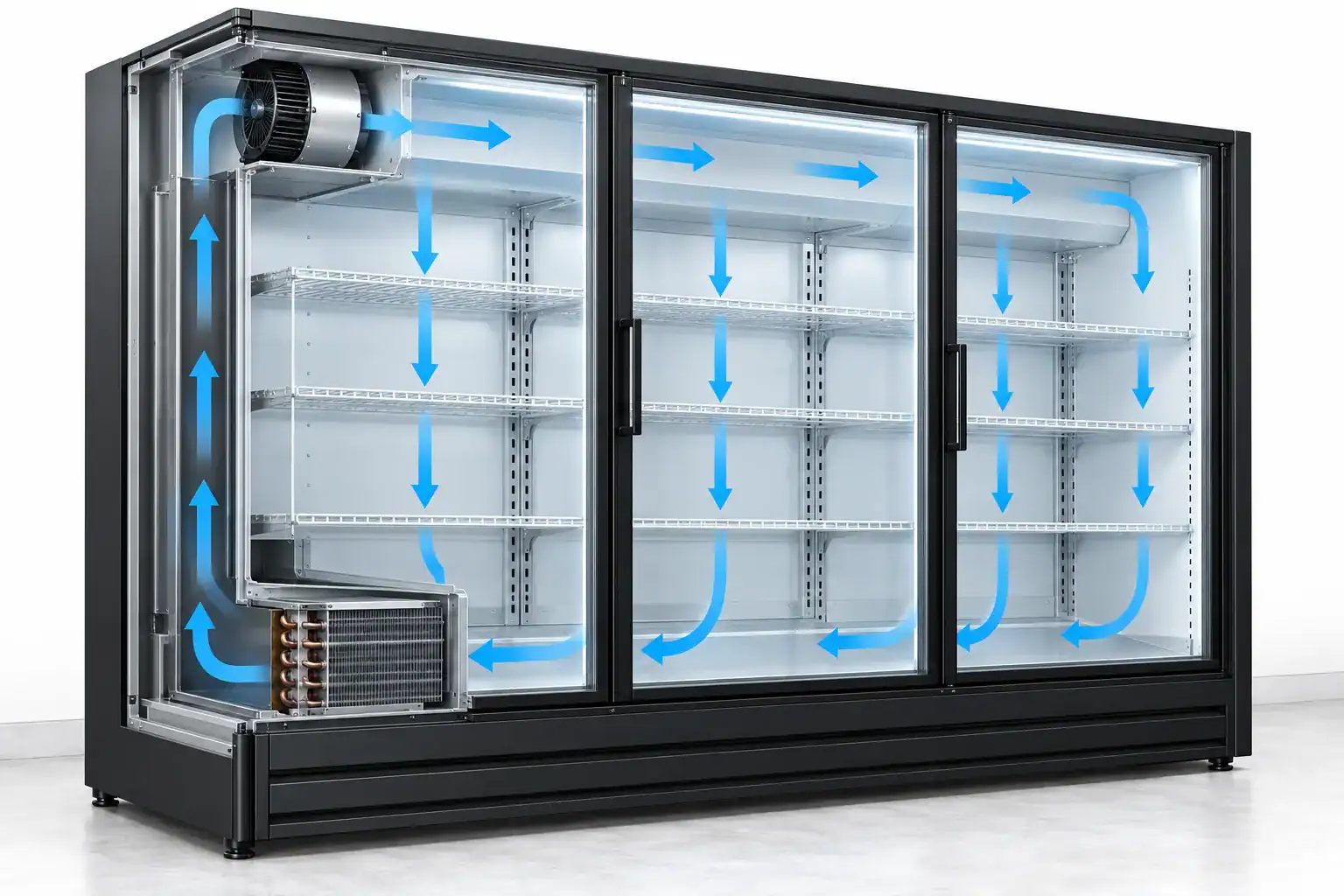
An evaporator can remove moisture when its surface is below the air’s dew point, but the resulting water must drain and the operating cycle must be considered. A colder coil is not automatically the best solution: it can change frost accumulation, runtime and the temperature of air reaching the door. Review total performance at the required product-storage conditions.
Use commercial refrigeration coil sizing inputs to establish the rating boundary. When assessing the condenser, keep its role separate. It rejects system heat; it is not the component that directly dehumidifies cabinet air. A dirty or poorly ventilated condenser can affect operation, but exterior door droplets alone do not prove a condenser fault. The beverage-cooler condenser selection guide covers that heat-rejection review.
Wet fins and frost need different checks
A wet coil with open air passages differs from fins bridged by frost or ice. During a test, record the time since defrost and the load history before comparing airflow or temperatures. Otherwise, two measurements can describe different coil states rather than different designs.
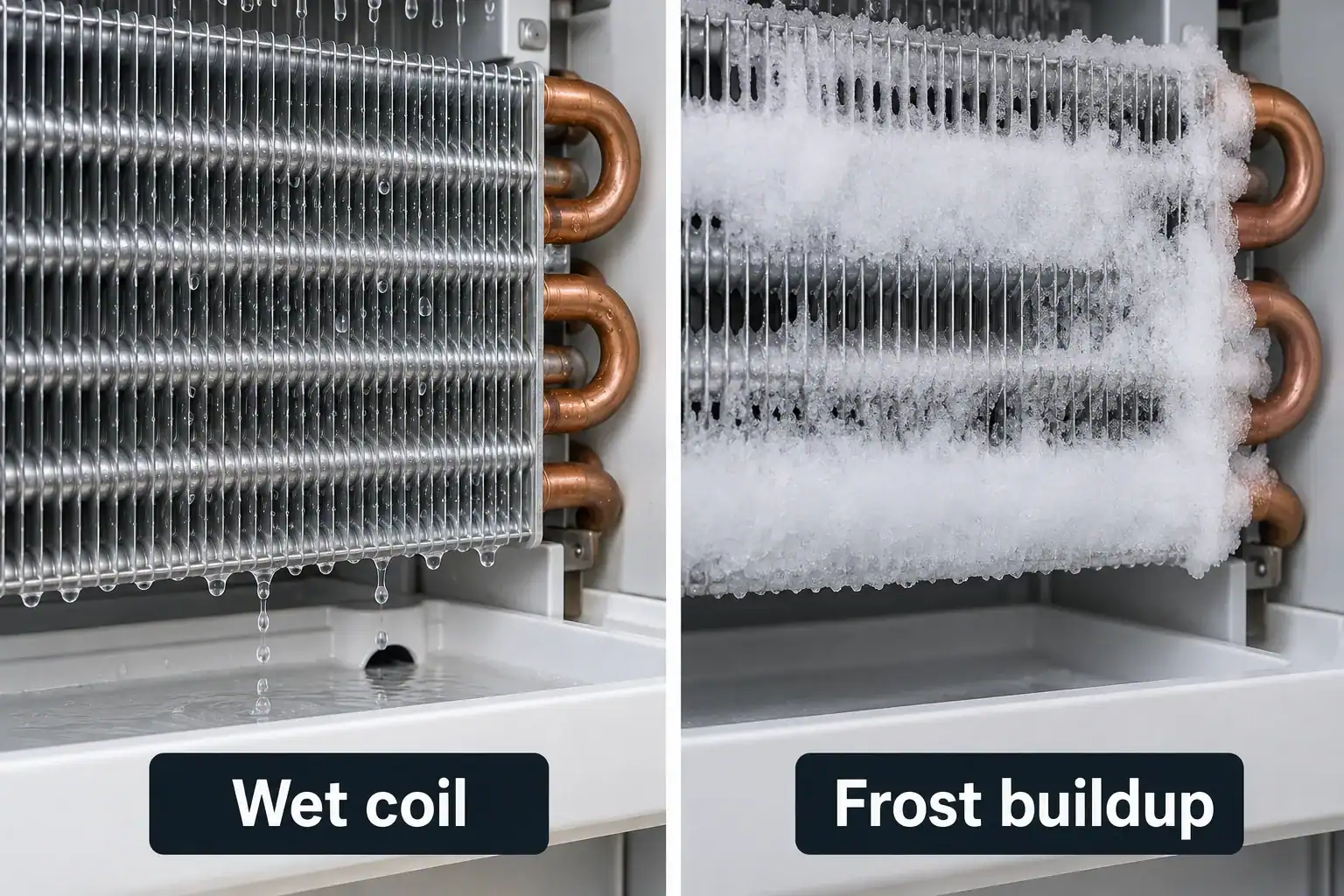
For a replacement, record fin pitch, coil depth, drain-pan fit and defrost arrangement alongside the external dimensions. Ask whether the fan operating point remains suitable as the coil becomes wet or frosted. After defrost, observe whether meltwater leaves the intended route and whether fan restart redistributes retained droplets. Validate the sequence for the actual appliance instead of applying one delay or temperature setting to every cabinet.
Can anti-sweat heaters use less energy?
Anti-sweat heaters raise the temperature of vulnerable glass or frame areas. Demand-based control can reduce unnecessary operation when conditions permit, but the acceptable setting depends on the door assembly and ambient moisture. A 2022 study of dew-point-based anti-sweat control evaluated glass and frame heaters on frozen-food display cases. Its results support testing this control approach; they are not a savings guarantee for a beverage cooler or another installation.

Consider a hypothetical 60 W heater per door across four doors. Continuous operation uses 60 × 4 × 24 ÷ 1,000 = 5.76 kWh/day. At an average 40% duty cycle, direct heater use would be 2.304 kWh/day, a calculated difference of 3.456 kWh/day. These are electrical arithmetic assumptions, not measured savings. They exclude control power and any change in refrigeration energy.
Test whether the lower duty still prevents unacceptable fogging and dripping through humid periods, door openings and defrost. Include sensor failure behavior and the coldest frame location. Record whole-cabinet consumption as well as heater consumption; a clear door at one dry-room condition is insufficient evidence for a production setting. Our beverage-cooler energy-efficiency guide discusses complete-equipment energy evaluation.
What should an OEM measure before changing the coil?
Record enough detail for another engineer to repeat the baseline test. Identify the cabinet and door revision, loading pattern, setpoint, room conditions, fan control, defrost sequence and heater settings. Log measurements on a common timeline so an apparent surface-temperature problem can be compared with door openings and operating events.
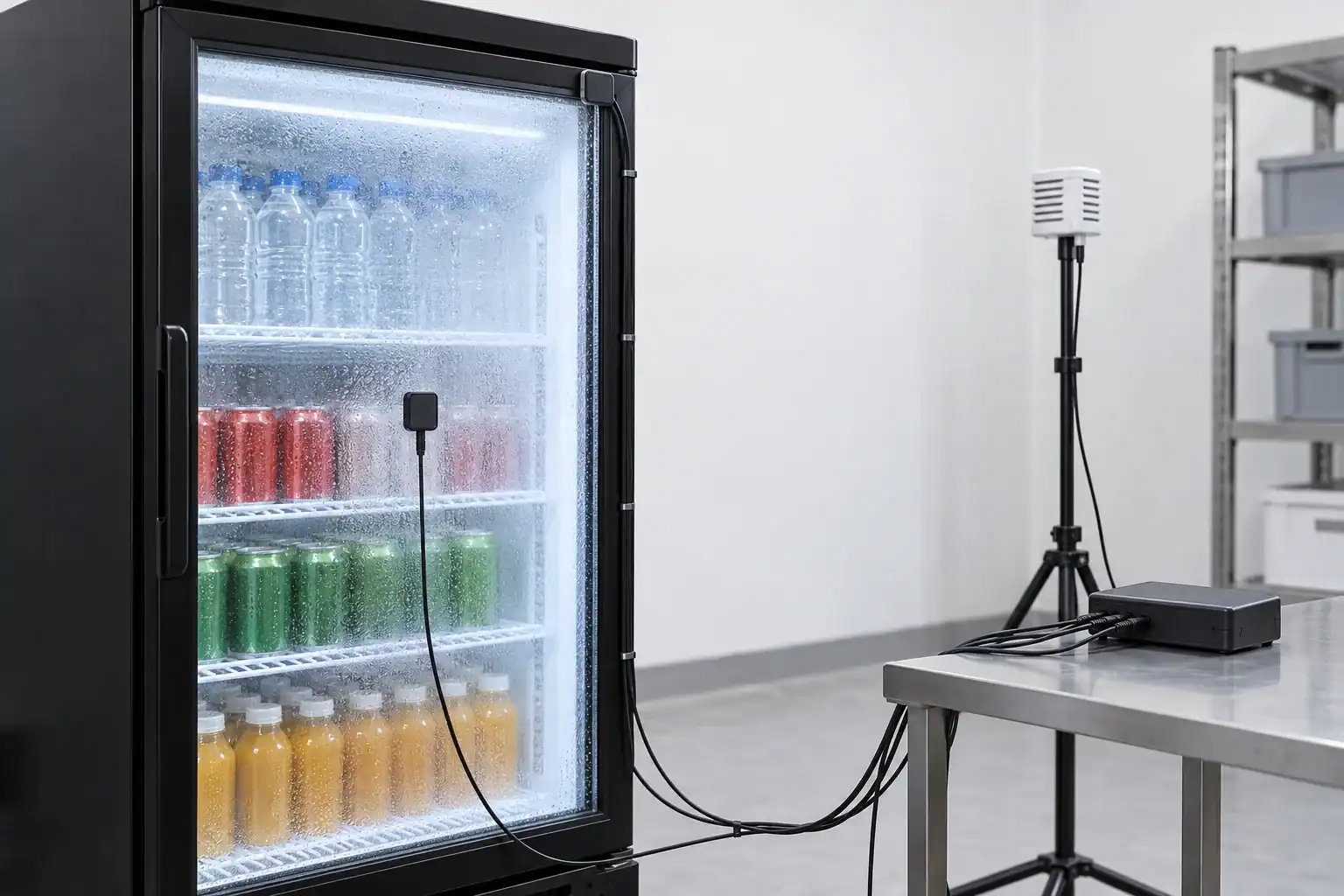
Include these measurements in the record:
- Ambient boundary: room temperature, RH, calculated dew point and sensor location.
- Cold surfaces: central glass, worst wet edge, frame corner and a dry comparison location.
- Cabinet outcome: representative air and product temperatures, recovery after a defined opening or restocking event.
- Equipment state: fan operation, coil frost condition, defrost and heater status, drainage observations.
- Acceptance evidence: timestamped photographs, duration of visible fog, dripping observations and whole-cabinet energy over the agreed test period.
Specify pass conditions before testing. These might include temperature limits, an agreed recovery window, no persistent dripping, an allowable visibility interruption and an energy target. The numerical limits must come from the product, customer specification and applicable test requirements. This article does not substitute a universal threshold.
Change one design variable where practical and repeat the baseline conditions. If several components change together, report a system result rather than crediting the coil alone. Retain unsuccessful runs: they often explain which operating condition the proposed fix cannot cover.
Frequently asked questions
Does refrigerator condensation mean the compressor is failing?
No. Moisture alone does not identify a compressor fault. Check its location, door closure, humidity, drainage and actual temperatures. Persistent temperature problems or abnormal operation require a broader service diagnosis.
Should I turn the fridge colder to stop condensation?
Do not use a colder setting as a general moisture remedy. It can lower exposed surface temperatures or increase frost. Keep the setting required for the appliance and stored products, then diagnose the moisture source.
Why does condensation return after I wipe it away?
Wiping removes liquid but does not change the conditions that formed it. Identify whether humid air continues to enter, a surface remains below dew point, or water is arriving from a drain, spill or supply leak.
Can cleaning the condenser stop glass-door sweating?
Cleaning according to the manual can restore a restricted heat-rejection path, but it does not directly resolve every wet door. Compare glass and frame temperatures with room dew point and check the door assembly before assigning the cause.
Will a bigger evaporator prevent condensation?
Not by size alone. The result depends on operating temperature, airflow, controls, moisture load and drainage. Outside-glass condensation also depends on door insulation and ambient dew point. Validate the complete cabinet.
Can an anti-fog coating replace a heater?
Do not assume they are interchangeable. A coating can alter how droplets spread and affect visibility without keeping a surface above dew point. Verify durability, cleaning compatibility, dripping and visibility requirements for the particular door system.
Why is only one corner of the frame wet?
That corner may be colder because of a thermal bridge, seal gap, local airflow or heater coverage. Measure it against a dry comparison point and inspect the construction. The visible pattern is a diagnostic clue, not a component-failure verdict.
What should I send for a commercial coil review?
Send the cabinet and coil drawings, refrigerant, required duty, operating temperatures, installed fan information, wet-location photos, ambient humidity record, defrost and drainage details, and the acceptance target. Include the current configuration so proposed changes can be compared fairly.
Fix the measured cause and repeat the same check
For an operating refrigerator, begin with the moisture location and accessible closure, loading and drainage checks. For a glass-door design, add surface temperatures and local dew point before choosing new glazing, heater controls or coil geometry. Confirm that the repair or design change reduces the original symptom while maintaining required storage temperatures under comparable conditions.
Review the cabinet air cooler with the door conditions included
Domi’s commercial refrigeration cabinet air cooler evaporator combines a coil and fan arrangement for cabinet applications, with project review of geometry, mounting and connections. For a condensation-related OEM inquiry, include the door construction, ambient humidity, wet locations, airflow path and drainage arrangement with the cooling requirement. These inputs help define the component review and the cabinet tests still needed. Coil selection does not certify the complete door assembly against sweating.