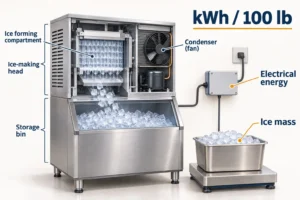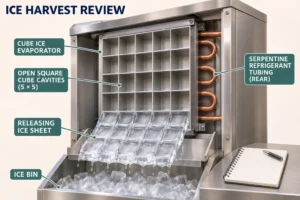

Sensible heat ratio (SHR) is sensible cooling divided by total cooling: SHR = Qs / (Qs + Ql). It describes the share of cooling used for temperature reduction. The remaining share, 1 − SHR, is latent cooling on the same accounting basis. For coil selection, check the required sensible and latent capacities separately; a high total kW rating can still leave a moisture-removal shortfall.
A room can reach its temperature setpoint while remaining too humid. Before ordering a larger coil, inspect its capacity split, entering air conditions and control sequence. The catalog’s total capacity alone does not explain what the equipment will do with the actual sensible and latent loads.
This guide is for engineers and technical buyers reviewing cooling coil selections. It distinguishes the load ratio from the equipment ratio and uses hypothetical calculations to show how a quotation can pass one requirement and fail another. The illustrations are original design concepts, not photographs of Domi performance tests. Their arrangements do not replace a project-specific coil selection or test plan.
What does sensible heat ratio mean?
Sensible cooling lowers air temperature. Latent cooling removes energy associated with moisture condensation during a wet-coil cooling process. Total cooling includes both components within the stated boundary. The Lennox explanation of sensible and latent heat provides a manufacturer introduction to that temperature-versus-moisture distinction.
Use these relationships when sensible and latent cooling are both nonnegative and total cooling is positive:
Qt = Qs + Ql
SHR = Qs / Qt
Ql = Qt × (1 − SHR)
The ratio has no unit. A value of 0.70 means 70% sensible cooling and 30% latent cooling on that basis. The following graphic illustrates that particular split; it is not a recommended ratio for every application. Use the same power unit for all capacity terms, whether kW, W or Btu/h.

SHR is not COP, an efficiency rating or the percentage of water removed from the air. Two coils can have the same SHR and very different total capacities. The ratio also does not directly specify leaving relative humidity, which depends on the leaving air temperature and moisture content.
Calculate SHR from a 20 kW example
Assume an illustrative coil provides 20 kW of total cooling, including 14 kW sensible cooling at a stated operating point. These are hypothetical teaching values, not a Domi product rating.
The sensible heat ratio is 14 / 20 = 0.70. Latent capacity is 20 − 14 = 6 kW, which also equals 20 × (1 − 0.70). The capacity balance closes: 14 + 6 = 20 kW.
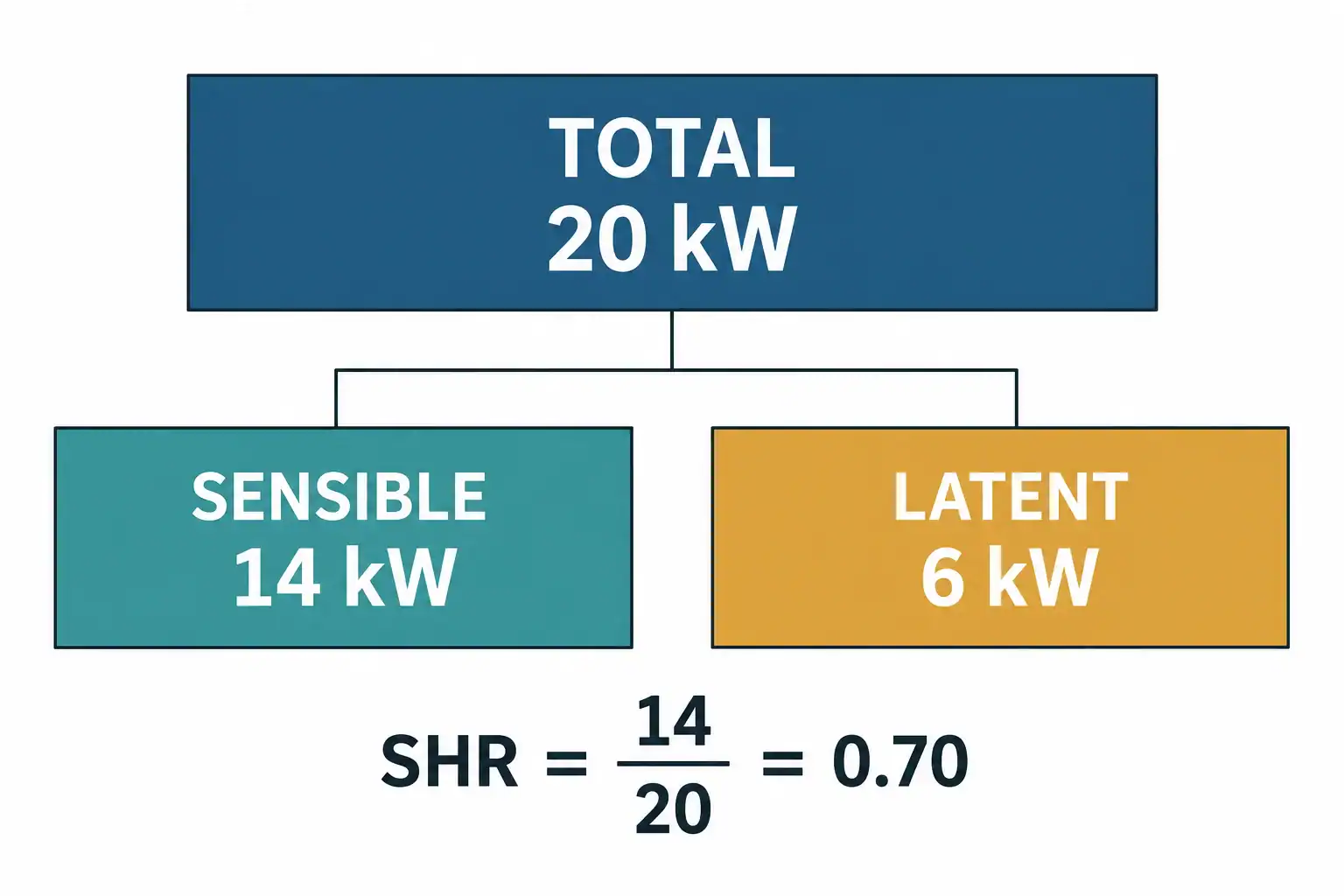
If a supplier gives only total capacity and SHR, calculate both components before comparing offers. If the supplier gives total and sensible capacity, calculate the latent remainder and confirm the common rating basis. A subtraction across different test points or gross/net definitions produces a number with little engineering value.
Converting between kW and Btu/h does not change SHR when every term is converted consistently. Also check whether a spreadsheet stores 70% as 0.70 or as 70. A percentage-format error can turn a correct input into an impossible result. At zero total cooling, the division is undefined; do not force an SHR calculation for an off condition with zero output.
Distinguish the load ratio from the coil ratio
The load SHR describes the sensible fraction of a room, process or other defined cooling requirement. The coil SHR describes the sensible fraction of the coil’s output at its stated conditions. These are related design inputs, not interchangeable labels.
A room calculation may exclude outdoor-air treatment, duct heat or fan heat that a selected coil must handle. Conversely, a terminal may serve only the sensible portion while another system handles ventilation and moisture. Write the boundary beside the ratio so the purchasing team can see what is included.

For example, a 16 kW sensible requirement plus a 4 kW latent requirement has a load SHR of 16 / 20 = 0.80. Before comparing that value with a catalog SHR, confirm that the 20 kW represents the load at the same coil boundary. Add or assign other loads explicitly rather than hiding them in a general oversizing allowance.
The existing psychrometric chart guide explains the broader air-state relationships. Here, the decision is narrower: which sensible and latent duties must this particular cooling component satisfy?
Test sensible and latent capacity as separate requirements
Consider two hypothetical coil offers returned at the same entering air state, airflow, fluid or refrigerant conditions and gross capacity boundary. The required coil duties are 16 kW sensible and 4 kW latent. The offers below are calculation inputs, not measured supplier performance.
Case
Total kW
SHR
Sensible kW
Latent kW
Case: Required duty
Total kW: 20.00
SHR: 0.80
Sensible kW: 16.00
Latent kW: 4.00
Case: Offer A
Total kW: 25.00
SHR: 0.85
Sensible kW: 21.25
Latent kW: 3.75
Case: Offer B
Total kW: 22.00
SHR: 0.75
Sensible kW: 16.50
Latent kW: 5.50
Offer A exceeds the sensible requirement but misses the latent requirement by 0.25 kW. Its larger total capacity does not fix that shortfall at the stated point. Offer B meets both stated duties at that point: 16.50 ≥ 16.00 and 5.50 ≥ 4.00.

Screen each offer against two requirements: available sensible capacity ≥ required sensible load, together with available latent capacity ≥ required latent load. Total capacity and a ratio alone should not replace those two checks. These inequalities do not establish season-long humidity control, acceptable sound, pressure drop, energy use or control stability.
Offer B remains a candidate, not an automatic purchase decision. Ask how the system modulates as the sensible load falls, whether the air and fluid operating limits are satisfied, and which part-load conditions need verification. A steady-state capacity match cannot by itself predict a thermostat-driven operating cycle.
Read the operating point behind the quoted SHR
An SHR without its conditions is an incomplete rating. Record the entering air dry-bulb temperature and a second independent humidity property, airflow or air mass flow, pressure where relevant, and the water or refrigerant conditions that determine the coil state. Record the leaving air conditions when available.
The rated point may be useful for a catalog comparison while differing from the OEM’s actual process. Ask for a selection at the intended entering air and flow conditions. Do not apply a catalog ratio to a different ambient or moisture condition simply because the model number remains the same.
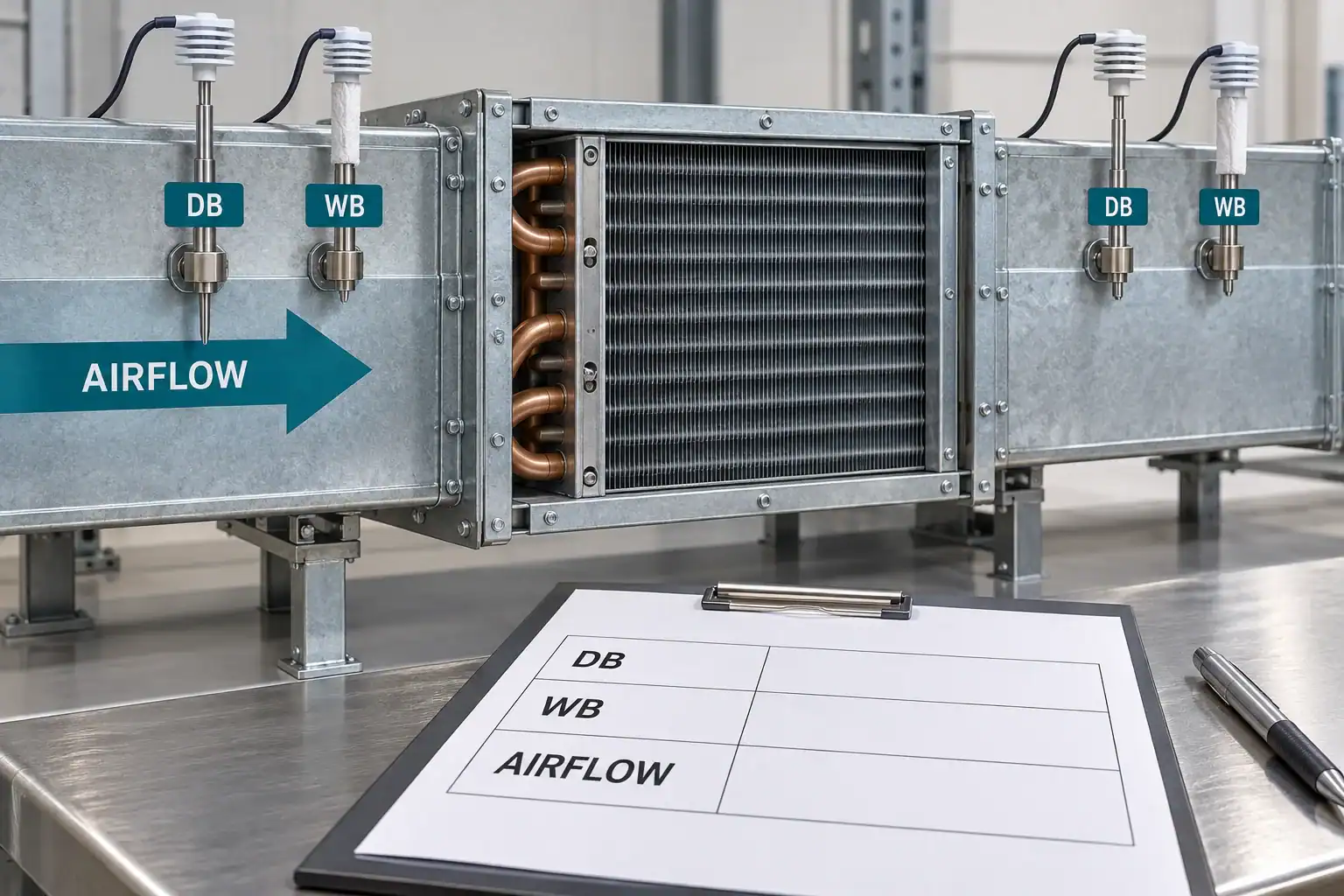
The EnergyPlus 26.1 coil engineering reference distinguishes rated SHR inputs from calculations at current operating conditions. Its documented models are a useful reminder to state the operating point. They are not proof that a particular commercial coil will reproduce a software result without suitable input data and validation.
Keep the returned data linked to the proposed geometry. A change in rows, fin spacing, circuiting or flow may require a revised selection. The commercial refrigeration coil sizing guide covers the associated geometry and pressure-drop questions.
Review airflow changes with a revised selection
Changing airflow changes the coil operating point. It can change leaving temperature, wetness, pressure drop and the sensible/latent split. The result depends on coil geometry, entering air, coolant or refrigerant conditions and system controls. A general claim that one airflow adjustment always produces the required SHR is insufficient for an OEM release.

Request a small operating map using the project’s intended flow range. At each point, compare total, sensible and latent output, leaving air state and pressure drop. Ask the supplier to identify prohibited operating conditions and which results are calculated versus tested.
The fan must also operate against the installed resistance, including filters, grilles, coil and duct features. A nominal fan airflow is not necessarily the flow through the assembled coil. Changing a fan setting to pursue moisture removal should stay within the equipment’s approved operating range and needs a system-level check, including any freeze or carryover limits.
Understand what a dry coil changes
A coil that cools air without condensing moisture has no condensation-related latent cooling under that operating condition. On the usual positive cooling basis, its sensible cooling equals its total cooling and SHR is 1. That can be appropriate for a deliberately sensible-only application.
For condensation to occur, relevant coil surfaces must be cold enough relative to the air’s dew point. A wet coil can then have sensible and latent components. The actual moisture removal still depends on the air state, surface-temperature distribution and operating conditions. A photograph of droplets cannot quantify latent capacity.

Do not assume that SHR = 1 means a failed coil. First identify whether the equipment is intended to remove moisture at the current point. Equally, a dry operating state is not acceptable evidence for a latent duty that the project requires. Check which condition the selection represents before changing the hardware.
This distinction also matters when comparing chilled water coil selections. A dry sensible-cooling duty and a wet dehumidification duty need different acceptance records, even when the frames look similar.
Check humidity behavior during part-load operation
The peak sensible load and the critical moisture-control condition may occur at different times. A cabinet or air-handling system may satisfy its temperature control while still receiving moisture from ventilation, infiltration or a process. The equipment’s time-dependent behavior then matters alongside the steady-state ratio.
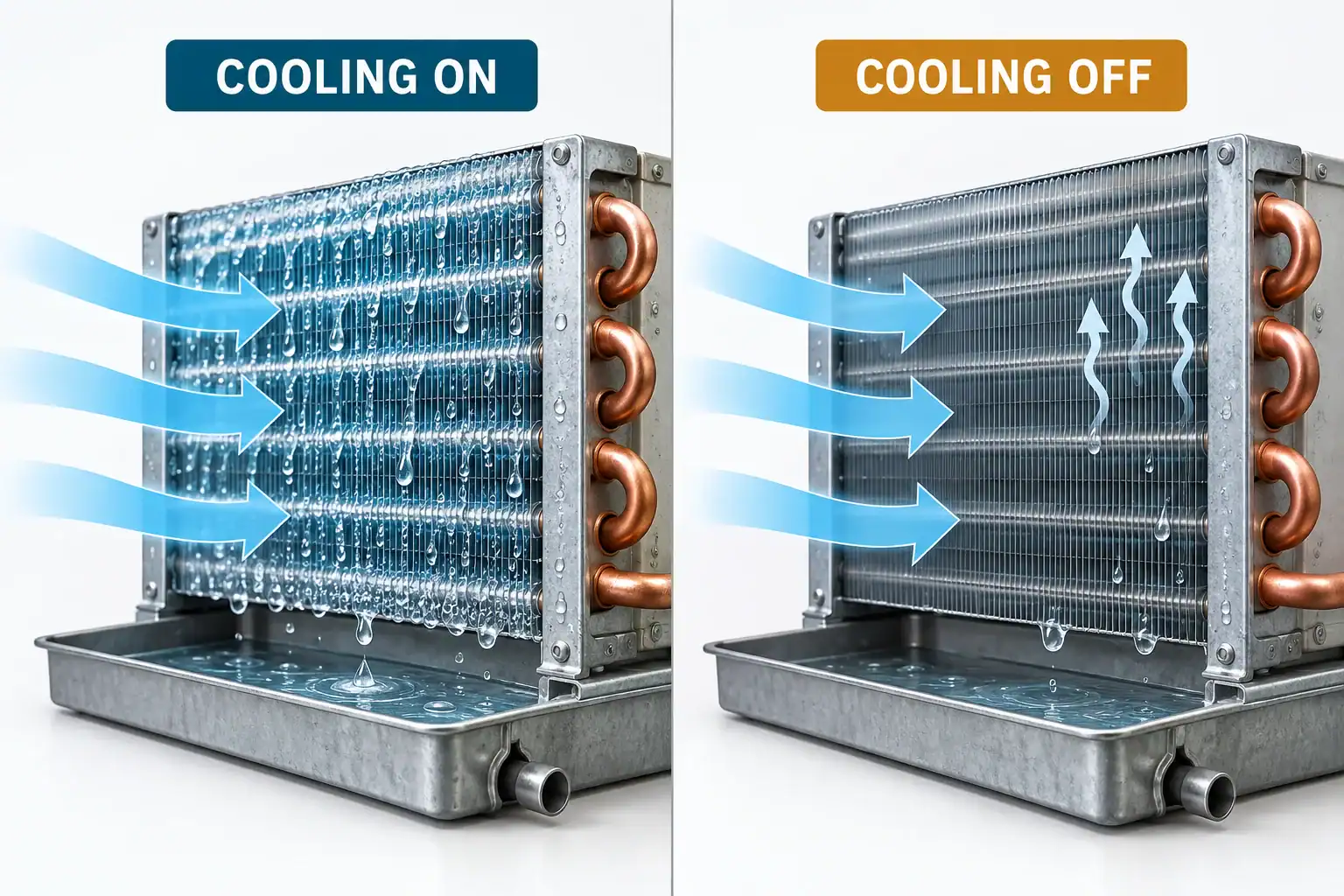
Where a wet coil retains water, some operating sequences can allow moisture to evaporate back into the airstream after cooling stops. EnergyPlus documents latent-degradation models that account for cycling and related coil behavior. That establishes a modeling consideration, not a universal moisture-loss percentage or a direct prediction for an untested appliance.
Request the control sequence with the rating: compressor or valve modulation, fan operation when cooling is off, condensate drainage and relevant humidity control. Trane’s 2019 engineering newsletter on indoor agriculture HVAC provides a manufacturer example of treating sensible and latent loads as separate design concerns. Its application context should not be treated as a generic coil specification.
Measure paired air states instead of temperature alone
A dry-bulb temperature difference alone does not measure total wet-coil cooling or SHR. An airside capacity review needs airflow or mass flow and the entering and leaving air states. Humidity measurements must be representative, not merely taken at a convenient damp corner of the duct.
For a declared dry-air mass-flow basis, a common total-capacity relationship is Qt = mda × (hin − hout). Using kg of dry air per second and kJ per kg of dry air gives kW. Sensible capacity requires a consistent psychrometric method or a suitably qualified heat-capacity approximation, with its assumptions stated. Latent capacity is then the total minus sensible output on that same basis.

Define sensor locations, mixing, calibration, steady-state criteria and the fan/duct boundary in the test plan. A drain collection measurement may help investigate moisture removal, but transient water storage and drainage delay mean it is not automatically interchangeable with an instantaneous airside latent result.
Treat a small latent remainder cautiously when it is obtained by subtracting two larger measured quantities. A reported difference should be assessed against measurement uncertainty before declaring a coil has passed or failed. Keep the raw measurements with the calculated capacities so another engineer can reproduce the result.
Keep fan heat out of a mixed capacity comparison
Gross coil capacity and net delivered cooling may account for fan heat differently. State where the fan is and where the capacity boundary is drawn. Do not subtract a net sensible value from a gross total value to create an apparent latent capacity.
Assume the earlier 20 kW gross cooling example has 14 kW sensible and 6 kW latent capacity. Now assume a downstream fan adds 0.6 kW of heat to the delivered air, with no moisture change, and neglect other gains. This is a separate hypothetical accounting example, not a fan-efficiency or product-performance claim.
Capacity basis
Sensible and latent kW
SHR
Capacity basis: Gross coil
Sensible and latent kW: 14.0 sensible + 6.0 latent = 20.0 total
SHR: 0.700
Capacity basis: Net delivered air
Sensible and latent kW: 13.4 sensible + 6.0 latent = 19.4 total
SHR: 13.4 / 19.4 ≈ 0.691

The coil did not become a different moisture-removal device. The accounting boundary changed because the delivered air received sensible heat after the coil. The fan-heat value in this example is the heat actually entering the airstream, not an assumption that every motor’s electrical input follows the same path. Ask the supplier to identify the basis used in each quoted field.
Match the application instead of targeting a universal SHR
A lower SHR indicates a larger latent fraction at the stated positive cooling point. It does not make a coil universally better. A system with mainly sensible loads and separately managed moisture may need a different arrangement from an air handler treating humid outside air.

Price Industries’ chilled-beam application discussion illustrates a sensible-terminal approach in which the wider system must address moisture. That application does not set a universal SHR cutoff for cooling coils. Set the moisture boundary and condensation constraints for the actual application.
For refrigeration equipment operating below freezing, extend the review to frost accumulation, defrost and the relevant time interval. A comfort-cooling wet-coil ratio does not describe every phase-change and storage effect in a frosted evaporator. Likewise, a condenser’s heat-rejection duty should not be confused with the air-cooling sensible/latent split discussed here. Use the ratio only inside a clearly defined process.
Put the capacity split in the coil RFQ
Give the supplier enough information to return separate sensible and latent outputs at a common point. A request for a low SHR without the load, airflow and entering air state leaves the design target incomplete.
Review field
Buyer input
Supplier response
Review field: Duty boundary
Buyer input: Required sensible and latent loads; gross or net basis
Supplier response: Capacity balance and stated inclusions
Review field: Air state
Buyer input: Entering dry-bulb plus humidity property; pressure if relevant
Supplier response: Leaving state and selection assumptions
Review field: Air and fluid flow
Buyer input: Installed airflow and water or refrigerant conditions
Supplier response: Capacity split and pressure drops at those conditions
Review field: Operating range
Buyer input: Critical humidity, sensible peak and part-load cases
Supplier response: Rated map, limitations and control assumptions
Review field: Construction
Buyer input: Envelope, materials, rows, connections and drain arrangement
Supplier response: Proposed geometry and drawing revision
Review field: Validation
Buyer input: Required evidence, sample scope and acceptance method
Supplier response: Calculated/tested status and open validation items

Review competing offers at the same air and fluid conditions before comparing prices. If a field is missing, record it as an unresolved assumption. Confirm which revision the sample represents and what needs to be rerated after a change. Keep the rating and sample inspection tied to the same drawing revision.
Frequently asked questions
What is the formula for sensible heat ratio?
SHR equals sensible cooling divided by total cooling: Qs / (Qs + Ql). All capacity terms must use the same unit, operating point and accounting boundary. The ratio is dimensionless and requires positive total cooling.
What does an SHR of 0.70 mean?
It means 70% of total cooling is sensible and 30% is latent on the stated basis. For a hypothetical 20 kW total output, those components are 14 kW and 6 kW. It does not mean 30% of the air’s moisture is removed.
Is a lower sensible heat ratio always better?
No. It indicates a larger latent fraction at that point, but the selected equipment must meet both the sensible and latent duties of the intended application. Evaluate capacity, conditions, controls and system limits together.
Can a coil meet total capacity but fail the humidity requirement?
Yes. A hypothetical 25 kW coil at SHR 0.85 provides only 3.75 kW latent cooling at that point. It misses a 4 kW latent requirement even though its total capacity exceeds a 20 kW combined load.
Why is the room SHR different from the coil SHR?
They describe different boundaries. The coil may also handle ventilation, fan or duct gains, or moisture may be treated by another component. Reconcile those loads before comparing the room ratio with a coil rating.
Does SHR change with airflow or humidity?
It can. Entering air conditions, airflow, fluid or refrigerant conditions, coil geometry and controls affect the operating point. Request rerated results for the intended range rather than treating the catalog value as constant.
Is SHR the same as COP or efficiency?
No. SHR describes the sensible fraction of cooling output. COP compares cooling output with energy input. A capacity split alone does not establish the equipment’s efficiency or operating cost.
What should I send for a coil selection involving humidity control?
Provide separate sensible and latent duties, entering air temperature and humidity, installed airflow, fluid or refrigerant conditions, gross/net boundary, geometry and critical operating cases. Include the evidence and sample validation you require.
Approve both capacity components on one basis
Use SHR to expose the cooling split, then return to the actual sensible and latent kW requirements. Compare offers at matching conditions, keep fan heat and other boundary changes explicit, and test the control cases that matter for moisture removal. A ratio is useful when its inputs and limits remain visible in the approval record.
Send the sensible and latent duties with your coil drawing
Domi’s custom coil fabrication service provides a route for reviewing a drawing, sample or parameter sheet. For a cooling and dehumidification application, send separate sensible and latent duties together with entering air temperature, humidity, installed airflow and the water or refrigerant conditions. Include the cabinet or air-handler envelope, materials, connections and condensate arrangement.
Ask for a returned selection that states total output, the capacity split and the rating boundary. The testing laboratory page is a starting point for discussing the validation scope the project needs; it is not evidence that a particular SHR or humidity result has already been certified. Identify which part-load cases, sample checks and acceptance records remain to be agreed before production.