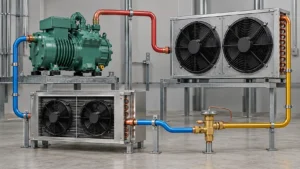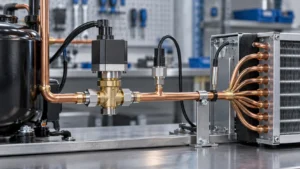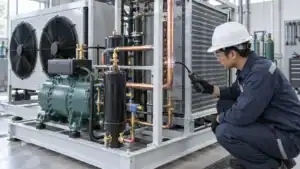

Evaporator coil quotation information should cover platform, refrigerant, duty, airflow, geometry, defrost, drainage, testing, quantity, and packaging.
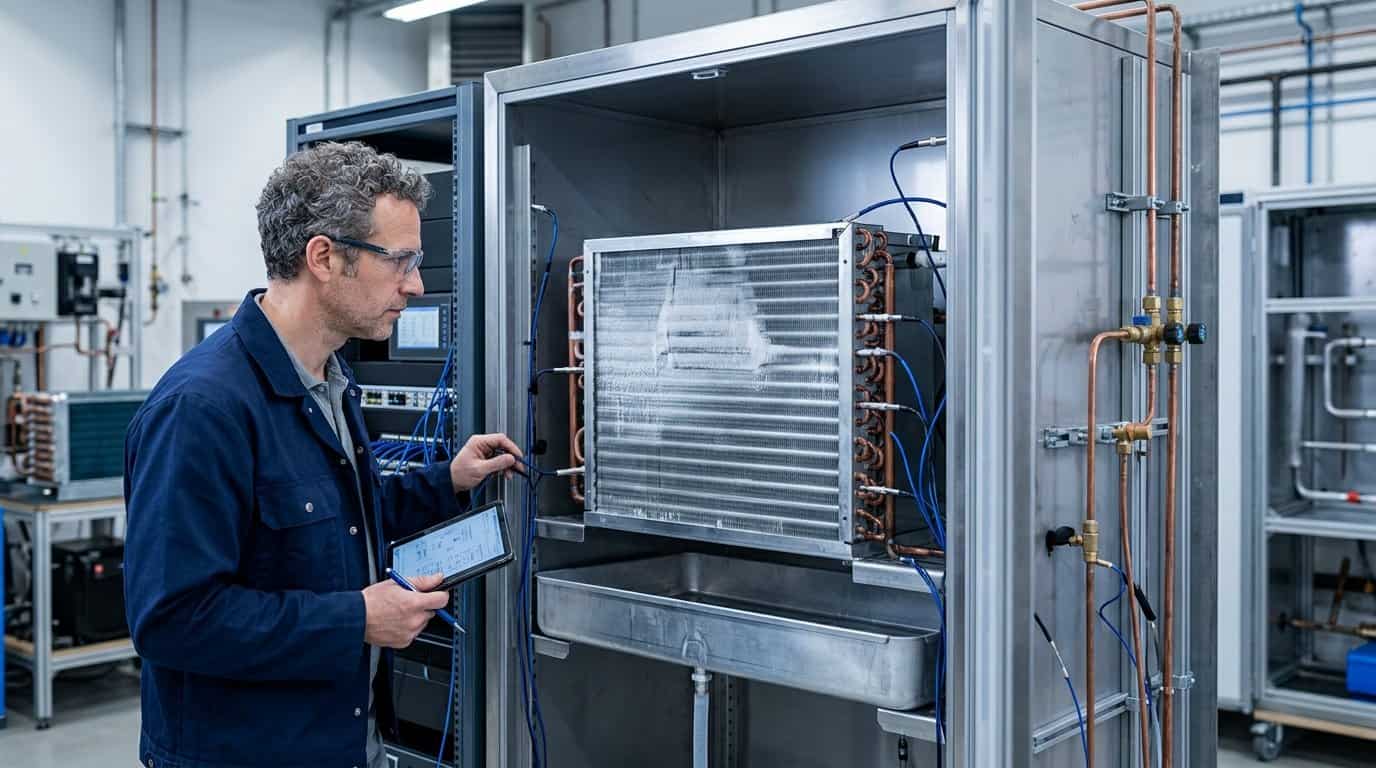
An evaporator coil quotation cannot be prepared reliably from an outside dimension and a target capacity alone. The supplier needs to understand the air side, refrigerant side, frosting behavior, defrost method, drain path, cabinet envelope, connection layout, validation plan, and expected volume. Without those inputs, a quote may describe a coil that fits on paper but does not perform in the appliance.
This guide organizes the evaporator coil quotation information an OEM engineer, sourcing manager, or product developer should send. It covers refrigerator, freezer, display, and other low-temperature applications where frost, water, airflow, and defrost can be as important as nominal heat-transfer capacity.
The article keeps technical requirements separate from commercial assumptions so a supplier can identify what is fixed and what can be proposed. If you are defining the wider program, review Domi’s OEM refrigerator and freezer coil solutions before sending the request.
What evaporator coil quotation information must answer
A useful quotation package answers four practical questions:
- What appliance and system will use the evaporator?
- What thermal and refrigerant conditions define the requested duty?
- What physical, defrost, drainage, and quality constraints define the part?
- What sample, pilot, production, packaging, and delivery conditions define the commercial request?
The fourth question is often left until the end. That creates a mismatch between the technical offer and the purchasing decision. A supplier may recommend one design for a single sample and another for a recurring multi-SKU program. State the project stage and quantity ladder at the start.
Separate fixed requirements from open design choices
Mark each item as required, critical, preferred, or supplier proposal.
| Label | Meaning | Evaporator example |
|---|---|---|
| Required | Must be met for the part to be considered | Cabinet envelope and connection side |
| Critical | Change requires engineering approval | Drain location, fin clearance, mounting datum |
| Preferred | Buyer preference that may have an equivalent | Material finish or standard cap |
| Supplier proposal | Open item for design review | Circuiting, fin pitch, or bracket method |
This classification keeps a supplier from pricing an open item as if it were fixed and helps the buyer see where a technical option may lower cost or lead time.
Appliance and system information
The first section of the evaporator coil quotation information should describe where the coil works.
Identify the platform and coil role
State whether the coil belongs to an upright refrigerator, freezer, chest unit, undercounter product, display case, ice machine, reach-in cabinet, or another system. Include model family, cabinet size, product generation, and whether the design is new, revised, replacement, or service-related.
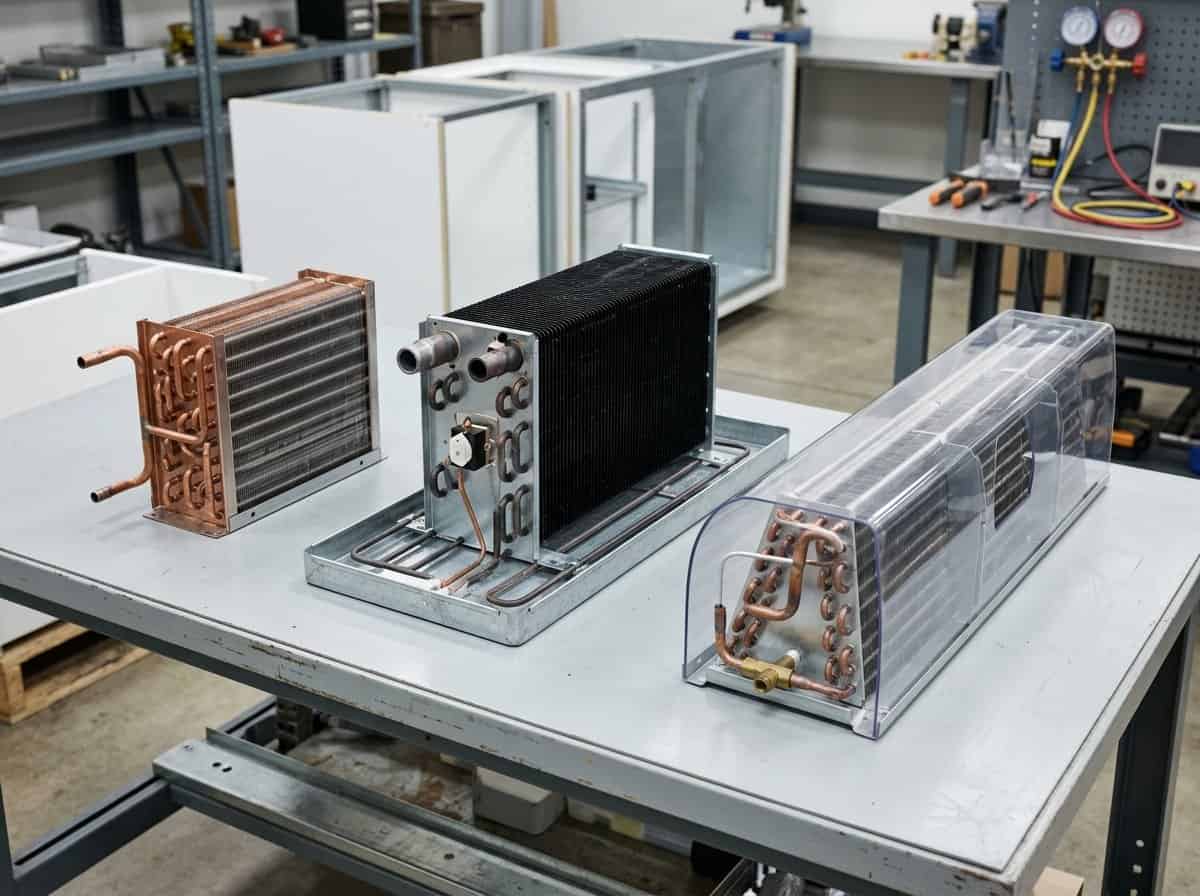
Explain the coil position and air path. Is it a forced-air fin-and-tube evaporator, a wraparound coil, tube-on-sheet, roll-bond plate, bare tube, or another construction? Is the coil upstream or downstream of a fan? Does air pass through insulation, a filter, a baffle, or a drain pan before reaching the coil?
The phrase “evaporator coil” describes a role, not a complete part definition. A freezer coil may operate with heavy frost and repeated defrost. A refrigerator coil may have a different humidity and drainage burden. The supplier needs the application context to make a reasonable quotation.
Provide the cabinet envelope
Include a controlled drawing or 3D envelope that shows:
- Overall width, height, depth, and maximum installed envelope.
- Mounting points, brackets, clips, and insulation interfaces.
- Fan, shroud, baffle, drain pan, heater, sensor, and service clearances.
- Connection side, tube routing, and brazing tool access.
- Drain outlet location, slope, and water collection area.
- Areas where fins, tubes, or coatings may not contact other parts.
Add photos or a simple section view when the installation is difficult to interpret from a flat drawing. A quotation that ignores the service tool path can lead to a coil that performs well but cannot be assembled efficiently.
Include the product duty and use pattern
State whether the coil supports pull-down, steady-state storage, recovery after door opening, high-ambient operation, or a service replacement. Include expected duty cycle and any control behavior that affects the coil, such as fan cycling, compressor cycling, hot-gas defrost, electric defrost, off-cycle defrost, or demand defrost.
Refrigerant-side and air-side conditions
Capacity only has meaning when the test point is defined. Provide the input conditions used by the calculation or simulation and label each one as measured, calculated, estimated, or still open.
Refrigerant information
List refrigerant designation, blend information if relevant, expected evaporating temperature or pressure, superheat, mass flow if known, and pressure range. State whether the circuit is direct expansion, flooded, capillary controlled, electronic expansion valve controlled, or another arrangement.
The ASHRAE refrigeration resources page explains that Standard 34 provides refrigerant designation and safety classification while Standard 15 addresses safe design, construction, installation, and operation of refrigeration systems. Use that reference to keep the system safety assumptions visible, then add the project-specific operating data a supplier needs.
The EPA refrigerant safety guidance notes that refrigerants can involve toxicity, flammability, asphyxiation, and physical hazards. The quotation package should therefore identify the refrigerant and the safe test or handling requirements instead of leaving the pressure boundary and test fluid unclear.
If a value is not final, label the range and the decision date rather than hiding the uncertainty in a note.
Air-side information
Provide air inlet temperature, target outlet temperature, airflow, face velocity, humidity or dew-point condition, air direction, fan curve, and any pressure-drop limit. If the fan is not final, state the expected range and ask the supplier to identify the sensitivity.
For a low-temperature coil, include the expected frost condition. If the system uses a fan, explain whether the coil operates during frost growth, whether the fan stops at a control point, and how performance is measured as the surface condition changes.
Capacity and pressure-drop target
Give the requested capacity, tolerance, rating point, and whether the value is total, sensible, or another defined quantity. Include the allowable air-side and refrigerant-side pressure drop when those values affect the fan or compressor selection.
The AHRI 410 performance rating page is useful when the coil falls within its defined forced-circulation scope, but the page also lists exclusions for frosting conditions, microchannel coils, bare-tube coils, and several refrigerant configurations. If the evaporator falls outside that scope, define the project test method rather than assuming the standard applies.
State the test stabilization rule
A quotation should say how the test reaches steady state or how a transient result is captured. Include warm-up or pull-down time, sample conditioning, frost state, defrost state, measuring interval, and pass criteria. A supplier cannot compare two designs if one is quoted at the beginning of pull-down and the other after stabilization.
Geometry, circuiting, and material
The physical portion of the evaporator coil quotation information should make the part buildable and inspectable.
Core geometry
Include tube size, wall thickness if fixed, row count, fin material, fin thickness or pitch, tube spacing, circuiting, header or manifold, and connection details. If the supplier may propose an alternative, state the boundary. For example, the supplier may propose fin pitch while the cabinet depth and airflow pressure drop remain fixed.
Circuiting and distribution
Circuiting affects refrigerant distribution, pressure drop, heat-transfer balance, charge, header work, and defrost behavior. Ask the supplier to state whether the circuiting is copied from the drawing, optimized by calculation, or proposed from a similar family.
If a circuiting change is proposed, request the expected impact on evaporating condition, outlet superheat, capacity, pressure drop, and sample test. Do not accept a design change because the part still fits the same rectangle.
Material and finish
List tube, fin, header, bracket, drain, coating, and cap materials. State corrosion exposure, cleaning chemicals, humidity, salt, galvanic contact, and storage conditions. If a coating is required, describe coverage, masking, cure, joint cleanliness, and the test or visual standard.
The material decision can affect the whole quotation. A coating may add process time and inspection. A mixed-metal joint may require a different joining route. A fin material may change handling and drainage. Ask the supplier to identify these interactions rather than writing only a material name.
Connection and cleanliness requirements
State inlet and outlet size, orientation, end treatment, fittings, braze or solder requirement, internal cleanliness, capped ends, and pressure-test condition. Confirm whether the supplier ships a bare coil or a pressure-tested assembly.
Frost, defrost, and drainage information
This is the section that separates a serious evaporator quotation from a generic coil price.
Frost condition
State air humidity, inlet dew point, operating temperature, fan behavior, frost growth time, and the performance measure used as frost develops. If the product has a maximum acceptable airflow restriction or temperature rise, include it.
Frost distribution can depend on circuiting, air velocity, surface temperature, fin pitch, and cabinet airflow. A design that works in a dry test may behave differently in a humid appliance. If the frost condition is unknown, ask the supplier to propose a test and identify what data is needed.
Defrost method
Describe electric, hot-gas, off-cycle, water, or another defrost method. Include heater position and power when relevant, start and stop conditions, maximum temperature, duration, sensor placement, and allowed recovery time.
Defrost requirements can change material, drain pan, bracket, coating, insulation, and validation. A coil quotation that does not mention defrost is incomplete for many freezer applications.
Drainage and water management
Show the drain outlet, slope, pan, heater, tube route, and discharge location. State whether the drain must remain open during storage, transport, and defrost. Include any restriction on water reaching cabinet surfaces, electronics, insulation, or food zones.
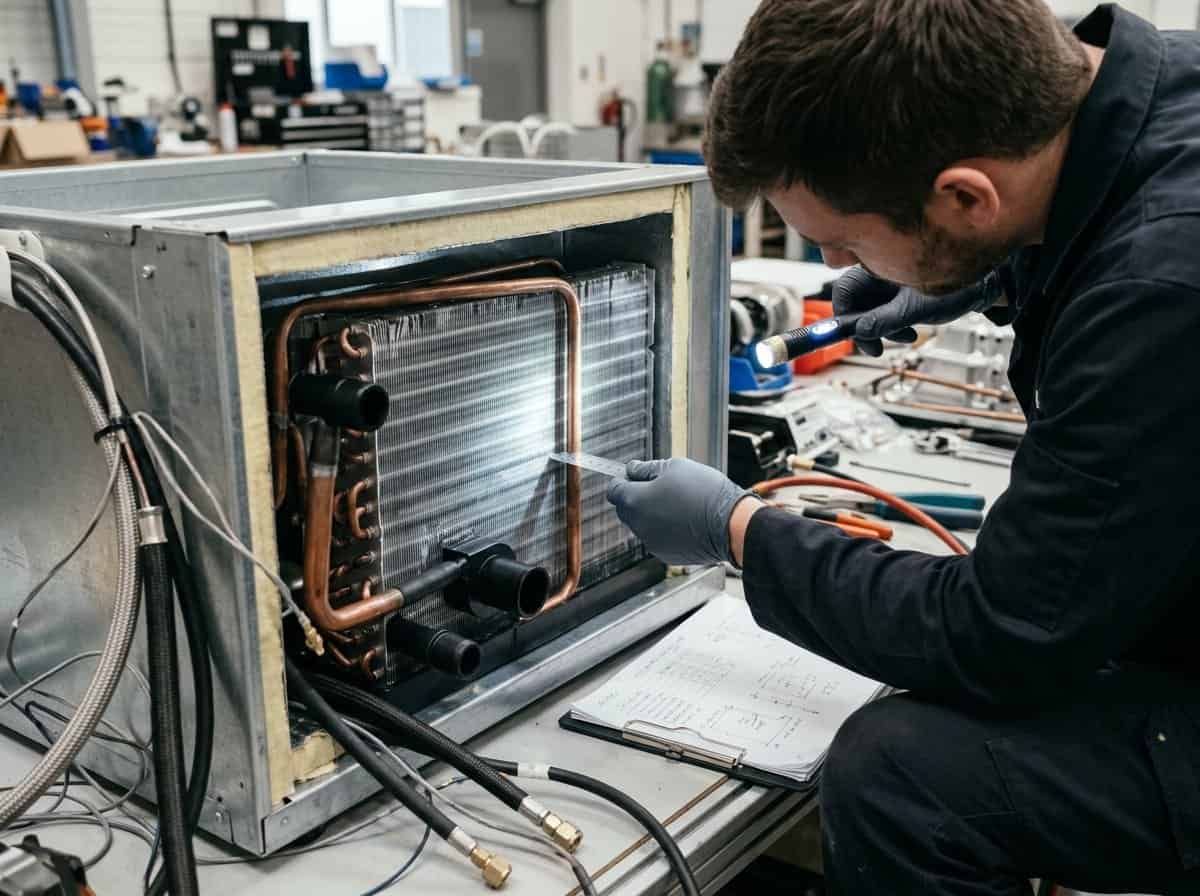
Ask for a drainage check in the sample plan. The check may include a controlled defrost and a visual inspection, not only a measurement of coil capacity.
Service and cleaning
Include access for cleaning, sensor replacement, heater service, fan replacement, and brazing or tubing work. The coil may meet the design envelope but be impossible to clean if the fin face is hidden behind a non-removable panel.
Validation, quality, and documentation
Quality requirements should be tied to the decisions the sample and production parts must support.
Define the inspection plan
List dimensions, mounting points, connection orientation, drain, fin damage, material, coating, joint appearance, and cleanliness. State sample size and report format. A first article may need more records than repeat production.
Define pressure and leak tests
State test fluid, test pressure, duration, temperature, method, acceptance limit, and responsibility. Confirm whether the test occurs before or after coating, capping, assembly, and shipment.
Define performance evidence
The performance record should identify sample revision, air condition, airflow, refrigerant condition, measured capacity, pressure drop, frost state, defrost state, equipment, and uncertainty or tolerance. The supplier should be able to explain a result without relying on a separate conversation.
The ISO 9001 explanation from ISO describes documented information, process control, measurement, and performance evaluation. For a coil program, that principle means the buyer should state which records are required and how they release the part.
Control drawing and sample revision
Put part number and revision on the drawing, CAD model, quotation, purchase request, sample label, test report, and inspection record. The ASME Y14.35 revision guidance is a useful reference for identifying and recording changes to engineering drawings and associated documents.
Quantity, MOQ, price, and schedule
Commercial assumptions belong in the evaporator coil quotation information because they affect the supplier’s recommended design and production route.
Give a quantity ladder
Separate engineering samples, pilot quantity, monthly demand, annual forecast, SKU mix, and service demand. Ask whether MOQ applies per SKU, family, material batch, or shipment. The condenser coil MOQ planning guide explains why these minimums should not be treated as one number; the same principle applies to evaporator programs.
Request a layered quotation
Ask for sample price, pilot price, recurring unit price, tooling, engineering work, testing, packaging, freight, and quote validity separately. If the design is still open, request a base option and one or two supplier proposals.
Show the delivery milestones
Include technical review, drawing release, prototype build, inspection, cabinet test, performance validation, revision approval, pilot production, and repeat production. If the product launch has a fixed date, state the test window and any long-lead material risk.
A supplier response matrix
Use a matrix that makes the quotation comparable.
| Requirement | Buyer input | Supplier response |
|---|---|---|
| Application and coil role | Platform, cabinet, evaporator location | Confirm understanding or ask a question |
| Refrigerant and duty | Refrigerant, pressure, temperature, capacity | Confirm rating basis |
| Air and frost condition | Airflow, humidity, frost, defrost | Confirm test or propose method |
| Geometry | Envelope, circuiting, connections, drain | Confirm drawing or list exception |
| Material | Tube, fin, header, coating, brackets | Confirm availability or alternative |
| Quality | Inspection, leak, pressure, performance records | List included evidence |
| Quantity | Samples, pilot, monthly, annual, SKU mix | State MOQ and price basis |
| Packaging | Caps, protection, cartons, pallets | Confirm standard and program options |
Ask the supplier to mark each row confirmed, exception, or proposal. That response becomes part of the quotation record and prevents the buyer from accepting an unstated assumption.
Review the quotation before selecting a supplier
The quote review should be a technical comparison, not only a price meeting. Put the supplier responses into a common worksheet and ask the same people who defined the RFQ to review the differences.
Confirm the rating basis first
Start with refrigerant, evaporating condition, airflow, air inlet condition, humidity, frost state, defrost state, stabilization, capacity tolerance, and pressure drop. If one supplier quotes a dry condition and another quotes a frosted condition, the numbers cannot be compared. If one quote assumes a different fan, write the assumption beside the price.
Ask each supplier to state what is included in the rating. The requested capacity may include sensible cooling, latent load, or a system value that depends on the cabinet. If the quote uses a calculated result rather than a measured result, ask what will be tested on the prototype.
Confirm the drawing basis
Check part number, revision, envelope, connection orientation, drain, mounting points, row count, fin pitch, material, coating, and joint process. Ask the supplier to list every exception. A supplier may propose a different bracket or circuiting that is technically sensible, but the buyer should see the change before a sample is ordered.
Confirm frost and defrost assumptions
For a freezer or humid application, ask how the supplier expects the coil to behave as frost grows and how the defrost cycle is represented. Confirm heater position, drain pan, sensor, water route, recovery time, and cabinet surfaces at risk. This is often the largest gap between a generic coil quote and a useful OEM proposal.
Confirm the validation plan
Ask who will perform fit, leak, pressure, performance, frost, defrost, drainage, and joint checks. Define the sample quantity and which records will be supplied. If the supplier’s test bench cannot reproduce the appliance airflow or frost condition, identify what the supplier can prove and what the OEM must test in the appliance.
Confirm the commercial basis
Separate sample, pilot, and production pricing. Record tooling, engineering, material, test, packaging, freight, MOQ, lead time, payment, price validity, and change charges. The custom coil cost factors guide can help the team keep those layers visible.
Use a decision scorecard
| Decision area | Evidence to review | Decision question |
|---|---|---|
| Technical fit | Drawing, envelope, connection, drain | Does the part fit without forced assembly? |
| Thermal duty | Rating inputs and calculated or measured result | Is the result based on the appliance condition? |
| Frost and defrost | Test method and observation plan | Can the coil control water and airflow through the cycle? |
| Manufacturing | Process route, tooling, material, inspection | Can the supplier repeat the part? |
| Commercial | Price layers, MOQ, lead time, packaging | Can the program buy and receive the part? |
| Change control | Revision and exception process | Can a future change be traced? |
Do not create a score that hides a failed requirement. A supplier with a lower price should not pass the technical gate because a commercial score is high. Use pass, open, and exception status for critical requirements, then discuss the trade-offs explicitly.
Request a written open-item list
Before selecting a supplier, ask for the remaining open items and the proposed close date. Some items may close during prototype review. Others may require an updated drawing or appliance test. Carry them into the purchase and project schedule so they do not disappear after the quotation is accepted.
Keep the quotation tied to the revision
The quotation should repeat the part number, drawing revision, date, quantity, and test basis. If the buyer changes the drawing after the quote, ask for a written impact review. This is part of the evaporator coil quotation information, not an administrative detail, because the revision can change material, tooling, test, price, and lead time.
Ask what the supplier needs next
End the review by asking which missing input blocks a firm quote, which missing input affects only validation, and which open item the supplier can propose. This question produces a useful handoff. The supplier may need the cabinet section for a fit review, the humidity range for frost analysis, or the release pattern for a recurring price. A list of next inputs is more useful than a general request for “more information” and keeps the quotation process moving without changing the scope silently.
Make the sample request match the quote
If the quotation is for a production-intent sample, say so. Request the material, joint process, connection ends, coating, caps, inspection, and test records that the sample must include. If the first part is only a geometry mock-up, label it that way and do not use its price or performance as proof of the recurring design. The sample request should also name the drawing revision and the cabinet or fixture used for fit approval. This closes the gap between evaporator coil quotation information and the part that actually arrives.
Include the intended review date and the person who will approve fit, performance, and deviations. A sample without an approval owner can sit in a receiving area while the project continues on an unverified assumption.
Also state what will happen if the first sample does not meet the agreed conditions. The quote can identify the rework route, retest responsibility, and approval evidence required before a pilot order. This makes the commercial offer more useful than a single unit price because it shows how technical uncertainty will be managed after the purchase order.
Common gaps in evaporator quotes
Capacity without humidity or frost
The quote uses a dry rating that does not represent the appliance. Add humidity, frost, and the performance measurement rule.
Drain shown as an afterthought
The coil fits but water has no controlled path during defrost. Add drain geometry, heater, slope, and discharge location.
Connection orientation not controlled
The supplier builds a mirrored part or a part that cannot be brazed in the cabinet. Show orientation from a defined viewing direction and repeat it in the sample label.
Material listed without environment
The supplier cannot judge coating or corrosion risk. Describe humidity, salt, cleaning, storage, and mixed-metal contact.
Test method missing
Two capacity values cannot be compared if they use different air, refrigerant, frost, or stabilization conditions. Write the method or ask for a supplier proposal.
Volume and SKU mix hidden
The first quote looks low until a family of brackets, coatings, and service parts appears. Send the volume ladder and family matrix.
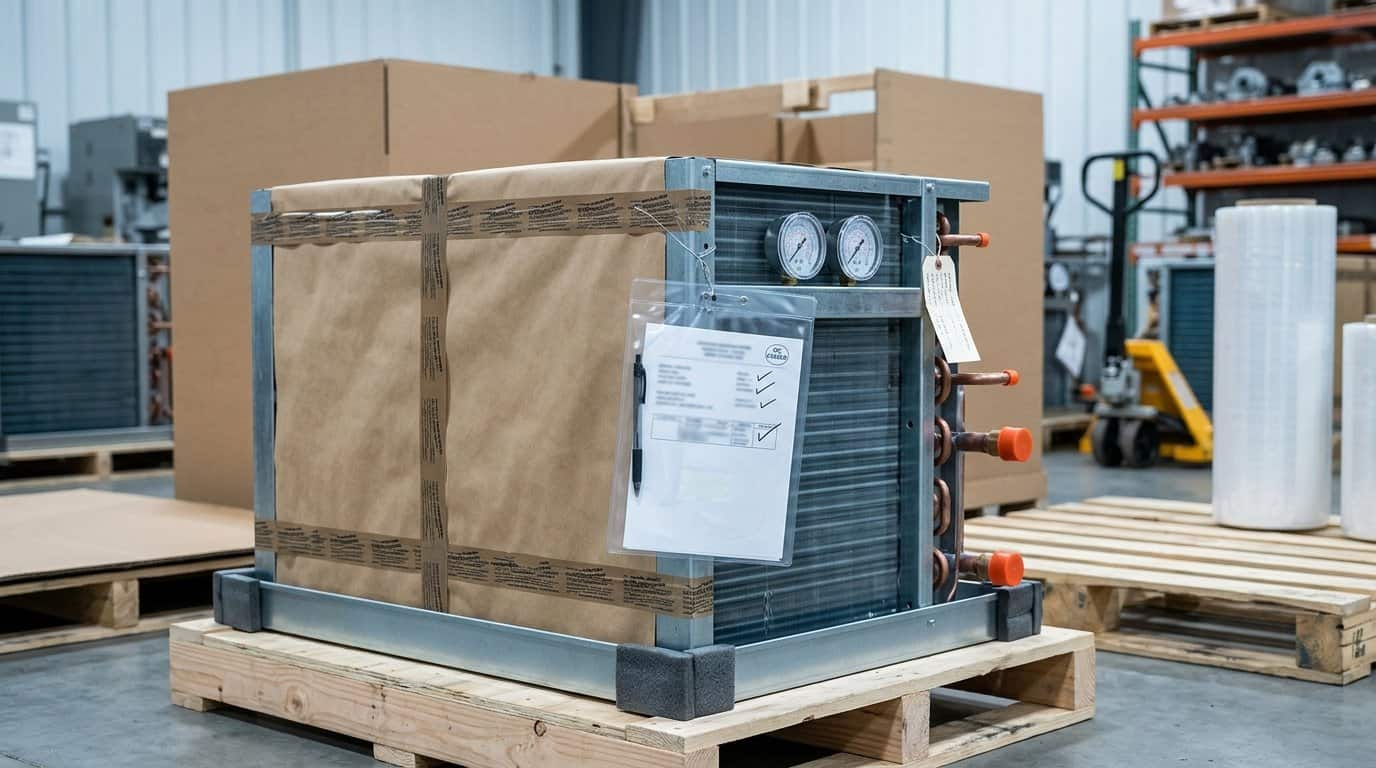
The same check applies to storage and transport. Ask how the coil will be capped, protected from fin damage, labeled, palletized, and stored before it reaches the appliance line. A quote that ignores those steps is not a complete delivered-part quotation.
Record who owns any open packaging decision and when the standard will become part of the production release.
This gives procurement a complete basis for the delivered part, not only the metal core.
It also gives engineering a clear record of what the supplier was asked to validate.
That clarity makes the next sample easier to approve.
FAQ: evaporator coil quotation information
What is the most important evaporator coil quotation information?
The most important inputs are appliance role, refrigerant, evaporating condition, air condition, capacity, airflow, frost and defrost behavior, cabinet envelope, connections, drain, quantity, and test method. Bottom line: provide the system duty and the physical interfaces together.
Can an evaporator coil be quoted from a drawing only?
A drawing can support a preliminary fabrication estimate, but it may not support a performance or production quotation without refrigerant, airflow, frost, defrost, quantity, and test information. Bottom line: use the drawing as the part definition and add the operating package.
What refrigerant data should be included?
Include designation, operating pressure or evaporating temperature, superheat, mass flow if known, control method, and safety assumptions. Bottom line: identify the refrigerant and operating condition before asking the supplier to confirm material and pressure tests.
Why does frost matter in an evaporator quotation?
Frost changes airflow, heat transfer, pressure drop, defrost behavior, and drainage. A dry rating may not represent the appliance condition. Bottom line: describe humidity, frost state, and the test point used for acceptance.
What defrost information does a supplier need?
Provide method, heater or hot-gas condition, duration, start and stop rules, maximum temperature, drain path, sensor placement, and recovery requirement. Bottom line: defrost is part of the coil application, not an accessory note.
What should the first sample prove?
The sample should prove the decision that matters most, such as fit, connection access, pressure integrity, capacity, frost response, drainage, or defrost. Bottom line: define sample purpose before selecting sample quantity.
How should I compare evaporator coil quotes?
Compare the same drawing revision, refrigerant, duty, airflow, frost state, material, test method, quantity, tooling, packaging, and delivery basis. Bottom line: normalize assumptions before comparing unit price.
What if some operating conditions are not final?
List the best current estimate, the expected range, and the decision still open. Ask the supplier for a base quote plus sensitivity or alternate options. Bottom line: an honest range is more useful than false precision.
Send a quotation package that supports the next test
Complete evaporator coil quotation information gives the supplier enough context to review the design and gives the OEM a clearer basis for comparing the response. Keep refrigerant, airflow, frost, defrost, drainage, geometry, validation, quantity, and revision status in the same controlled package.
For a project-specific review, connect the RFQ to Domi’s rapid prototyping support, heat exchanger testing laboratory, and manufacturing process. Send the current drawing, cabinet envelope, operating point, defrost method, quantity ladder, and the question that the quotation must answer.
What a buyer should do after receiving the quote
Evaporator coil quotation information becomes useful only when the buyer turns the response into a controlled technical and commercial decision. The next step is not always to choose the lowest unit price. It is to confirm which requirements were understood, which items remain open, and what evidence is included in the sample or pilot plan.
Compare the response with the original input package
Check the quoted coil against the cabinet platform, refrigerant, temperature range, capacity, airflow, circuiting, connection orientation, drain arrangement, defrost method, and packaging assumption. Mark every difference. A supplier may have proposed a different fin pitch, tube size, header, or connection because of manufacturing constraints. That may be a good proposal, but it should be visible and priced with its validation impact. Do not approve a quotation that answers a different duty point from the one the appliance team intended.
Turn open questions into sample acceptance items
The quote should state what the first sample will prove. Fit and clearance may be checked at the cabinet, while capacity, pressure drop, frost behavior, defrost recovery, drainage, and leak performance may need a controlled test. Name the condition, instrument, responsibility, and result required for approval. If a value is provisional, state how it will be confirmed. This keeps a sample that looks correct from being mistaken for a fully validated production part.
Confirm the commercial release path
Ask the supplier to identify sample quantity, pilot quantity, repeat-production quantity, tooling treatment, lead-time basis, packaging, delivery split, and quotation validity. Connect those answers to the drawing revision and the approval owner. If the buyer expects several evaporator variants, state whether they share a family order or need separate validation. A clean release path helps procurement schedule the purchase while giving engineering enough time to close the technical questions before the production order is issued.