
EPA does not require every commercial ice machine to use R-290 in 2026. Its January 1, 2026 manufacture/import restriction covers self-contained batch machines at 1,000 lb/24 h or less and self-contained continuous machines at 1,200 lb/24 h or less, with a GWP cutoff of 150. Other categories have different restrictions. R-290 is one option with end-use and safety conditions. See the EPA sector restrictions.
An OEM product manager needs to know which rule applies to the machine and what evidence supports a design change. A refrigerant name on a quotation cannot answer either question. Establish the machine architecture, ice-making method, daily harvest category and intended market first.
This guide covers U.S. commercial ice-machine programs. It separates regulatory requirements from suggested engineering review steps. Equipment illustrations explain concepts; they are not photographs of a certified product or records of Domi testing.
Which ice machines fall under the 2026 EPA limits?
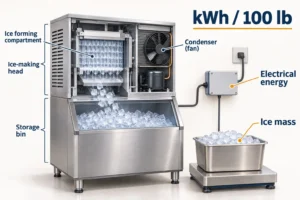
Start with how the equipment becomes a working refrigerating appliance. A factory-complete self-contained machine is different from equipment assembled or refrigerant-charged in the field. EPA explains this distinction in its product-versus-system questions. A remote installation should not inherit the self-contained category merely because its ice production is below a familiar threshold.

Architecture illustration: establish the factory and field assembly boundaries before assigning a regulatory category.
The following is a short classification aid. For prohibited-substance categories, check the complete refrigerant list rather than applying the smaller-machine GWP limit.
Equipment category
Daily ice harvest
Restriction basis
Compliance event and date
Equipment category: Self-contained, batch
Daily ice harvest: Up to 1,000 lb/24 h
Restriction basis: GWP limit 150
Compliance event and date: Manufacture/import: Jan. 1, 2026
Equipment category: Self-contained, continuous
Daily ice harvest: Up to 1,200 lb/24 h
Restriction basis: GWP limit 150
Compliance event and date: Manufacture/import: Jan. 1, 2026
Equipment category: Self-contained, batch
Daily ice harvest: Above 1,000 lb/24 h
Restriction basis: Named refrigerants prohibited
Compliance event and date: Manufacture/import: Jan. 1, 2027
Equipment category: Self-contained, continuous
Daily ice harvest: Above 1,200 lb/24 h
Restriction basis: Named refrigerants prohibited
Compliance event and date: Manufacture/import: Jan. 1, 2027
Equipment category: Remote commercial ice-machine system
Daily ice harvest: All harvest rates
Restriction basis: Separate prohibited-refrigerant list
Compliance event and date: Installation: Jan. 1, 2027
These categories and their different restriction formats are also explained in the 2023 Technology Transitions final rule. Use the current EPA sector page when checking for subsequent changes.
For the smaller self-contained categories, the prohibition covers regulated HFCs and blends containing them at GWP 150 or above. The 150 cutoff is not permission to use a covered blend with GWP exactly 150. See 40 CFR 84.54.
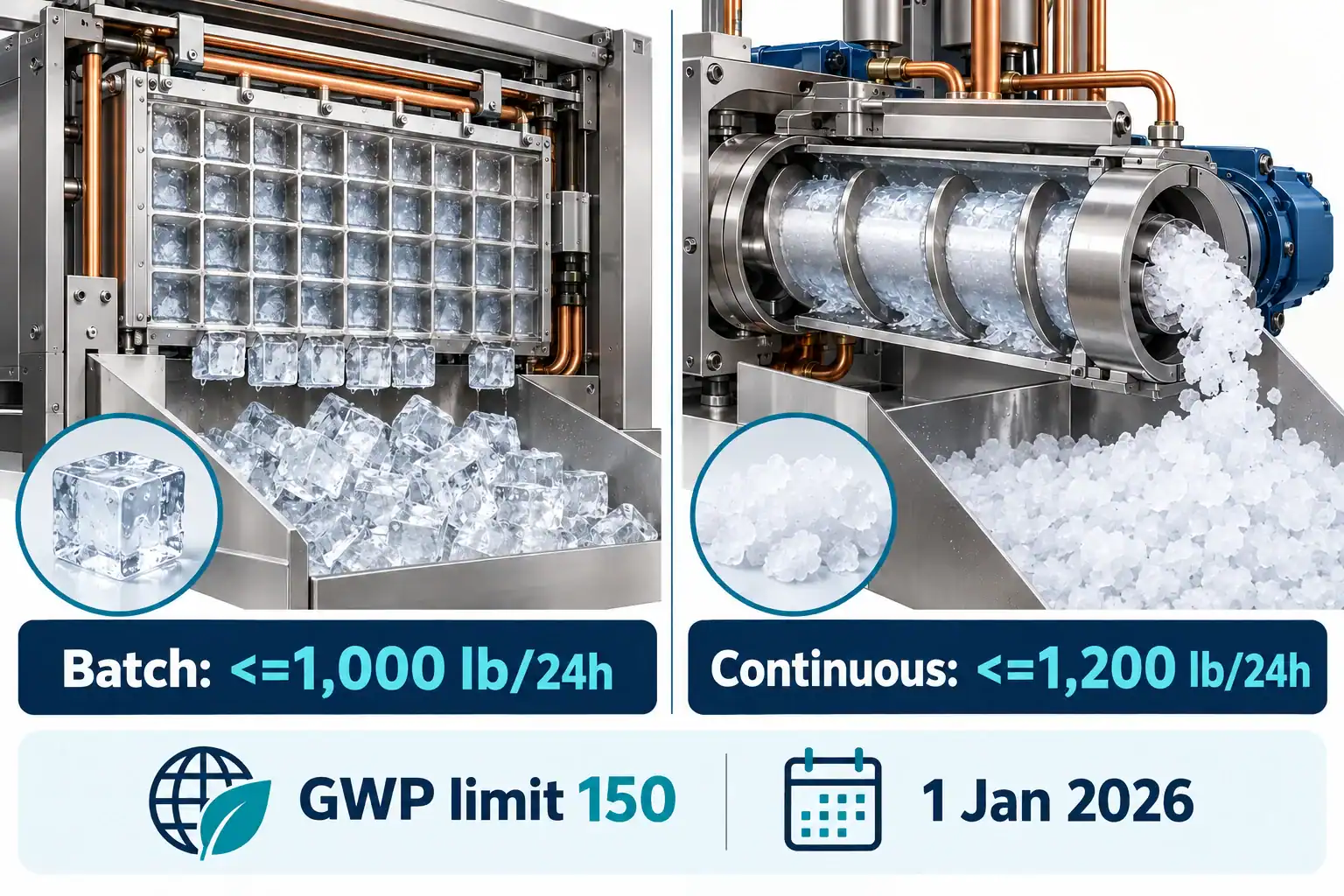
Production-category illustration: batch and continuous machines have different harvest thresholds.
Consider three hypothetical programs. A factory-complete batch machine rated at 900 lb/day belongs in the smaller batch review. A self-contained continuous machine at 1,100 lb/day still belongs in the smaller continuous review, despite exceeding 1,000 lb/day. A field-assembled remote system at 900 lb/day needs the system classification. These examples explain the classification logic; they are not model approvals.
Is R-290 mandatory for every ice machine?
No. A limit on refrigerant GWP does not prescribe one refrigerant for every design. EPA’s commercial ice-machine SNAP list identifies R-290, or propane, for new self-contained equipment subject to use conditions and lists its safety group as A3. Flammability belongs in the equipment review. The end-use listing must be read alongside the applicable Technology Transitions restriction; a SNAP entry alone does not settle every regulatory requirement.
Market examples show why the distinction matters. In its Manitowoc ice-machine development case, Secop describes a purpose-designed R-290 compressor, an expansion-valve change and a microchannel condenser. This is evidence of one development route. It does not establish that every ice machine must adopt that refrigerant or copy that component arrangement.
An OEM comparing proposals should therefore request the refrigerant selection basis and the corresponding equipment conditions. A supplier offering an R-290-compatible coil still needs the machine’s operating envelope and interface specification before it can make a useful proposal.
Which approvals belong in an OEM review?
Keep four records separate: the applicable refrigerant restriction, the end-use listing and conditions, the equipment safety evaluation, and the OEM’s design release. Each record answers a different question. An entry in the first file should not be used as a substitute for the other three.

Review illustration: the four documents support different decisions and may involve different responsible parties.
For example, a satisfactory thermal sample does not establish ignition-source acceptability. UL Solutions describes electrical-control evaluations for flammable refrigerants, including potential arcs and hot surfaces under normal and abnormal conditions. That work reaches beyond the dimensions of a condenser coil.
Assign an owner to each decision. The refrigeration engineer defines the operating basis, the equipment manufacturer coordinates the complete design, the relevant certification organization determines its evaluation scope, and procurement orders the released revision. Put those responsibilities in the project record so the scope of a component quotation is clear.
What changes for existing machines and spare coils?
A new-equipment compliance date is not an instruction to drain every machine already operating. EPA’s HFC phasedown questions distinguish continued equipment use from restrictions on new products and systems. A refrigerant transition also does not by itself authorize converting existing equipment to propane.

Date illustration: the two milestones describe different equipment categories and compliance events, not a universal replacement deadline.
For a spare-coil order, first record whether the work repairs a particular existing machine or supports a new equipment program. Include the original model, refrigerant, drawing revision, connection details and service purpose. If the work changes the refrigerant or substantially changes the equipment, ask the equipment manufacturer and relevant reviewer to define the project before buying parts.
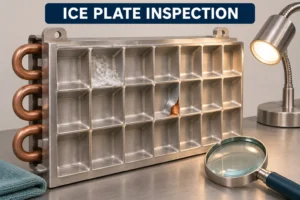
A coil that physically fits the cabinet may still have different circuiting, refrigerant-side volume or pressure characteristics. Match the replacement to the documented equipment requirements. Use the ice-machine evaporator guide for the component information that belongs in a replacement review.
What should change in the coil brief?
Treat the proposed refrigerant as an engineering input, not an instruction to reuse the old drawing with a new label. Freeze the intended compressor and oil, evaporating and condensing conditions, allowable operating pressures, air or water boundary, control strategy and installation envelope. Identify which values are specified, calculated or still awaiting validation.
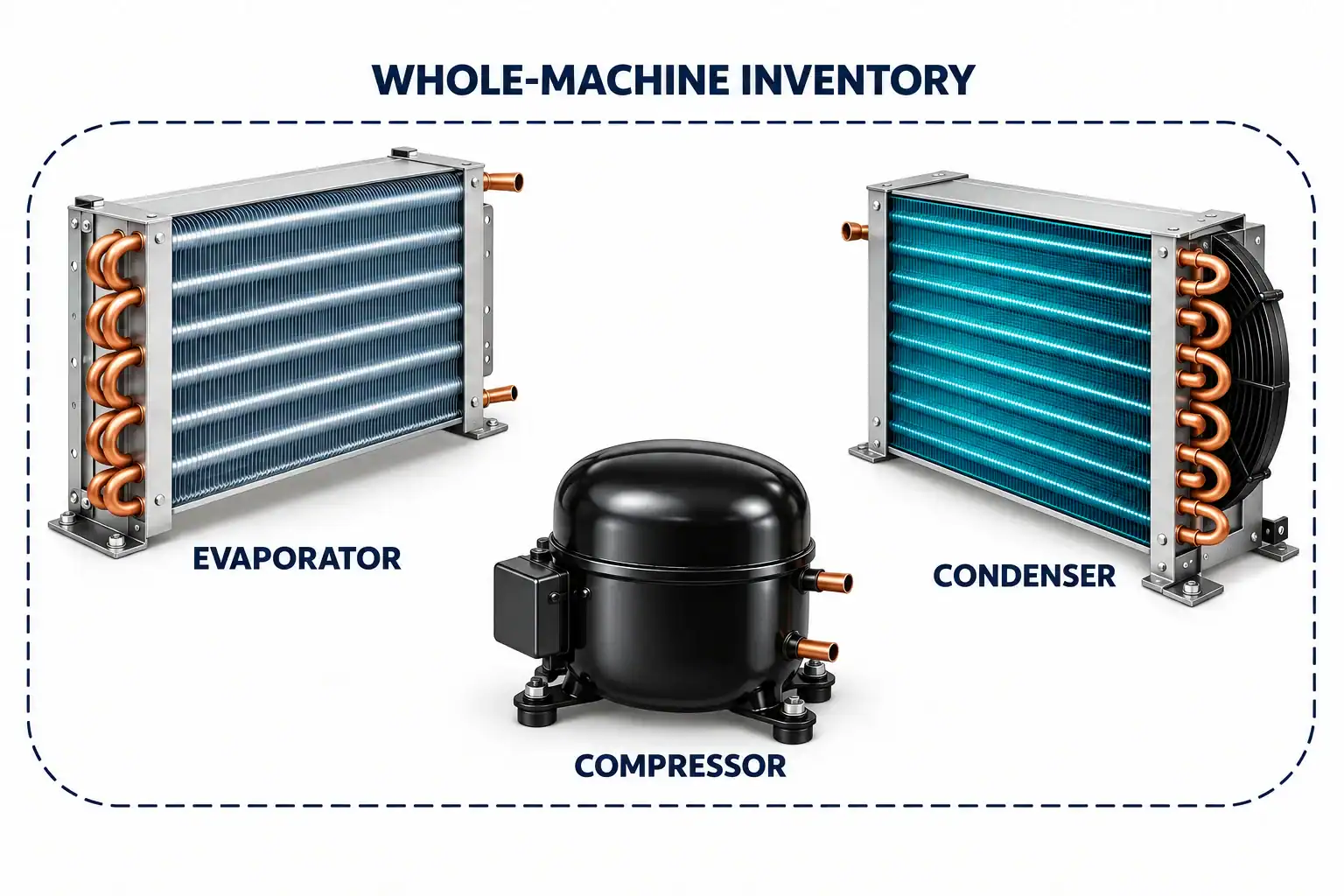
Component inventory illustration: a coil is one part of the complete-machine assessment. This is not a refrigerant piping schematic.
Request refrigerant-side internal volume as a separate drawing field. Headers, return bends and connected components matter as well as straight tube length. A smaller condenser volume may be useful to the project, but the supplier should explain the thermal and pressure-drop consequences of the proposed geometry.
State the condenser’s freeze-cycle heat-rejection duty and any other condition that controls selection. Define the evaporator’s ice-forming surface, water distribution and release requirements. Use the ice-machine condenser selection guide for the detailed component-selection inputs alongside this regulatory review.
A tube-volume example: geometry is not a charge allowance
Consider a hypothetical geometry check. Two straight circular tubes each contain 4 m of internal passage. One has a 6.0 mm inside diameter; the other has a 4.5 mm inside diameter. The example excludes bends, headers and manufacturing variation. It does not select a coil or calculate refrigerant charge.
For a circular passage, internal volume is V = π × ID² × L / 4. With diameter and length expressed in metres:
- The 6.0 mm passage contains about 0.0001131 m³, or 113.1 mL.
- The 4.5 mm passage contains about 0.00006362 m³, or 63.6 mL.
- The smaller bore reduces this assumed passage volume by 43.75%.
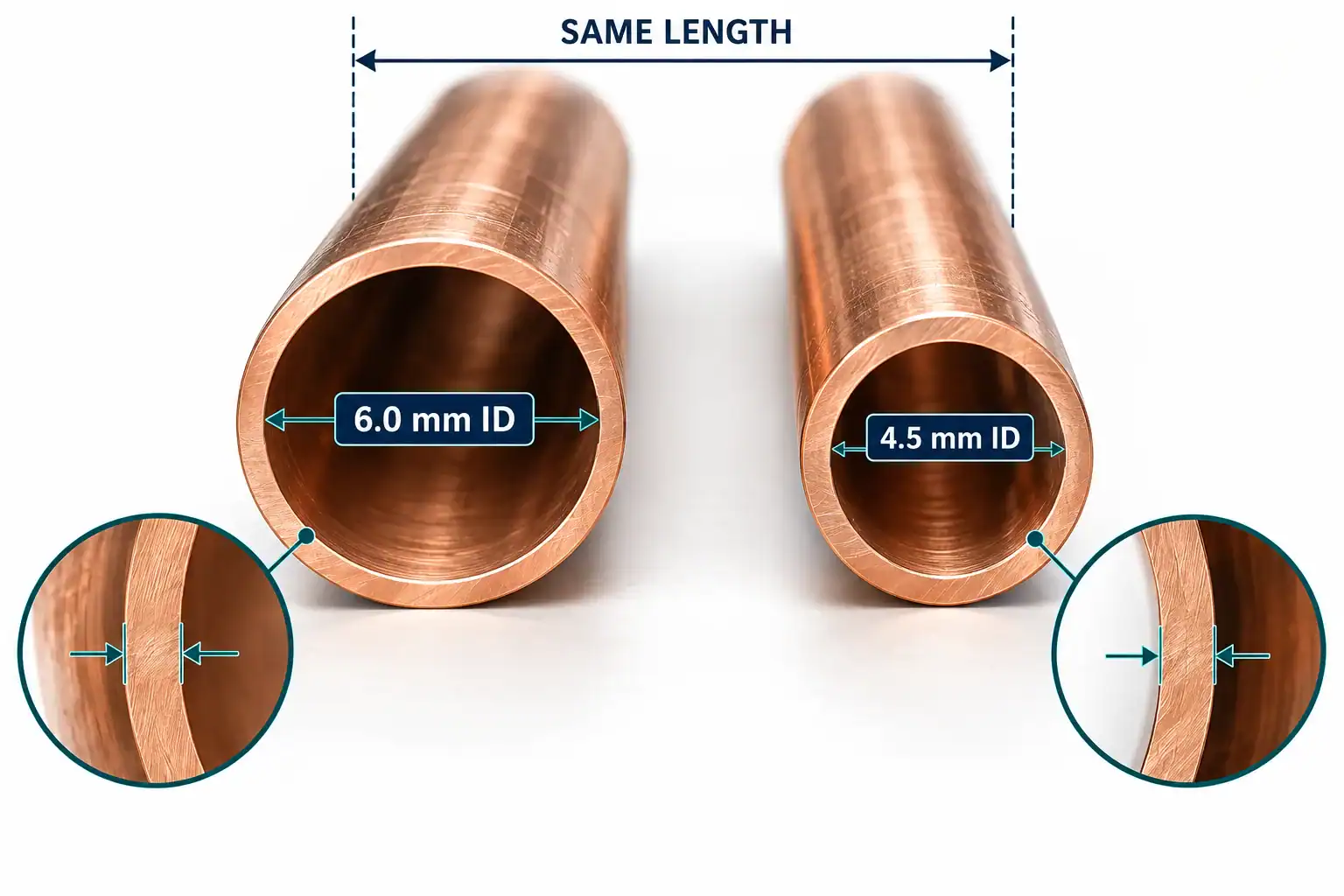
Geometry illustration: equal passage length isolates the effect of inside diameter.
That percentage does not establish a matching reduction in system charge. Refrigerant state, distribution and the rest of the circuit are absent from the calculation. It also says nothing about acceptable pressure drop or heat transfer. Use the example to request a volume breakdown, then evaluate the actual circuit with the responsible engineer.
Freeze and harvest need separate acceptance limits
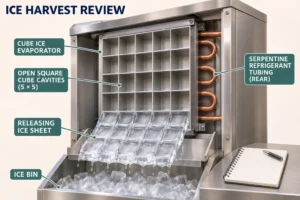
A batch machine must form ice and release it reliably. A coil proposal that looks satisfactory at a steady operating point can still leave an unresolved transition between those states. The sample plan should describe both, using the machine manufacturer’s control sequence and operating limits.
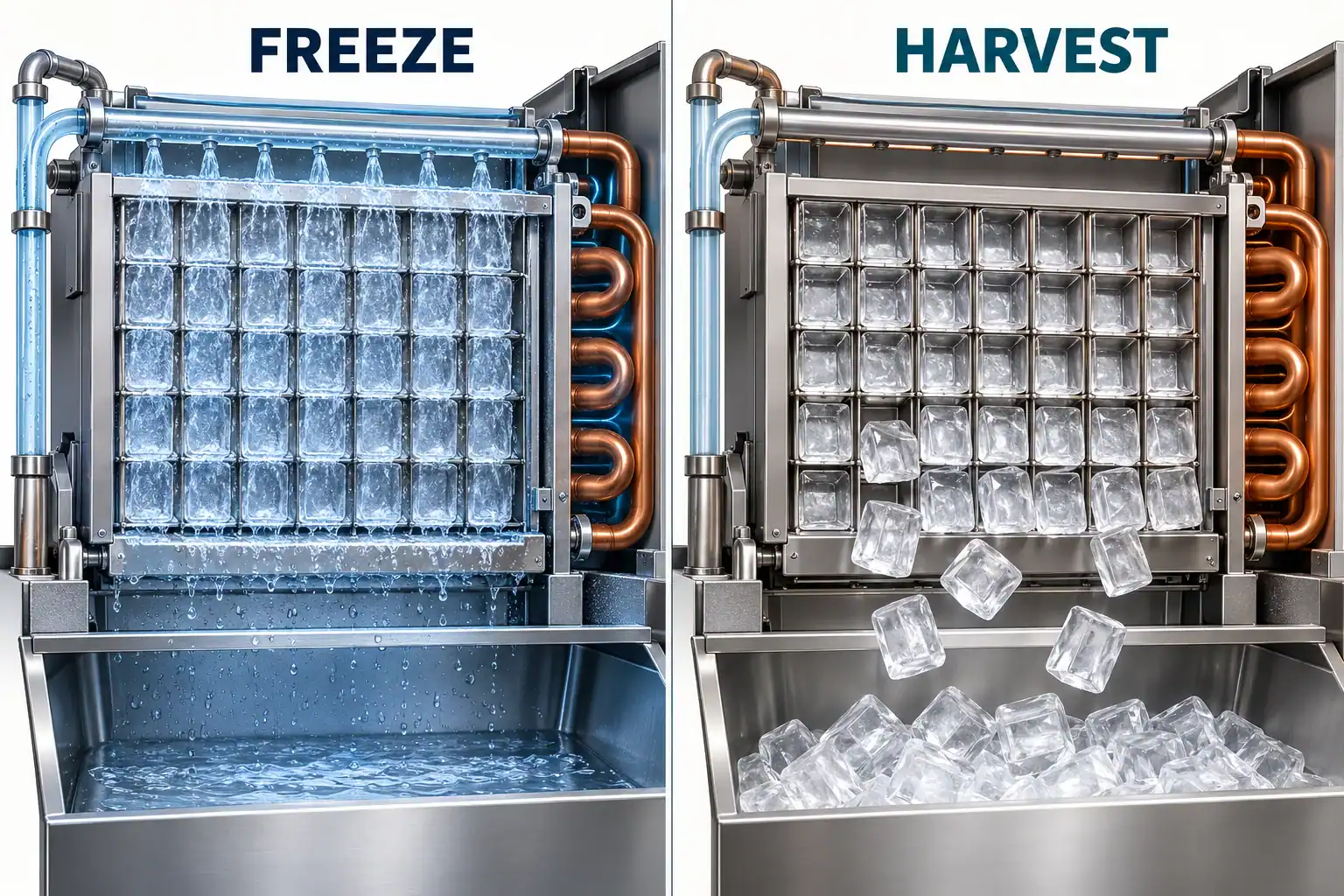
Operating-state illustration: the same ice-forming surface has different duties during freezing and release.
As a proposed OEM review method, record the test conditions before comparing samples: ambient and inlet-water conditions, water distribution, intended ice form, starting condition and control revision. Define acceptance for production rate, cycle behaviour and release quality. Continuous machines need their own operating-state plan rather than a batch harvest sequence copied into the specification.
If two suppliers test at different conditions, ask for a common test basis before comparing their results. Keep measured results separate from predictions. A quotation may contain a useful design estimate while still requiring complete-machine verification before production release.
Does every coil need recertification?
A calendar date alone does not tell an OEM to recertify every coil or production line. The 2024 SNAP final rule includes specific treatment of previously certified R-290 designs that remain unchanged apart from cosmetic changes. The provision has a defined scope; an engineering change still needs its own review.
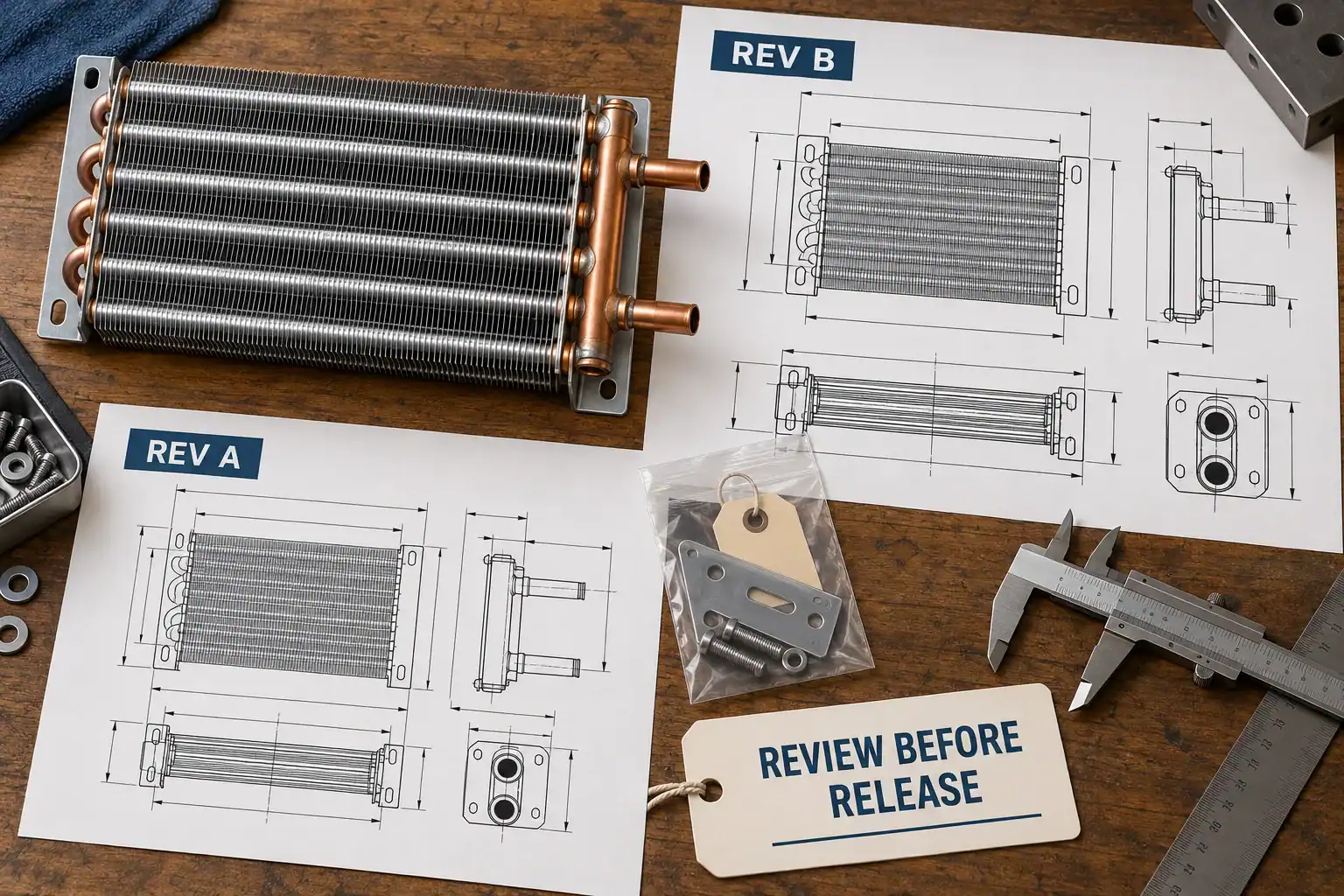
Revision illustration: the review needs the actual difference between the approved and proposed designs.
For an actual project, prepare a change list against the existing construction record. Identify refrigerant, compressor, metering device, coil circuiting, material, joints, internal volume, controls, enclosure and installation changes. Ask the relevant certification organization which changes require evaluation or testing and obtain the scope in writing.
UL Solutions lists low-GWP equipment and component evaluation services, including standards covering commercial refrigeration and ice makers. The relevant standard edition, listing conditions and proposed construction determine the review. A component test report should identify exactly what it covers; it should not be presented as approval of the entire machine.
Use four release gates before approving the change
The following is a proposed procurement workflow, not an EPA-prescribed certification sequence. It gives the OEM a way to keep an unresolved question from disappearing between engineering, purchasing and production.
Release gate
Record required
Decision before proceeding
Release gate: Equipment classification
Record required: Architecture, ice-making method, harvest category and target market
Decision before proceeding: The team has identified the applicable restriction and compliance event
Release gate: Design basis
Record required: Refrigerant selection, operating envelope and proposed drawing revision
Decision before proceeding: The supplier is quoting a defined technical requirement
Release gate: Sample acceptance
Record required: Agreed inspection plan, relevant component evidence and machine validation results
Decision before proceeding: The responsible reviewers accept the tested configuration
Release gate: Production release
Record required: Approved drawing, bill of materials, change log and order reference
Decision before proceeding: Purchasing and production are using the same released revision
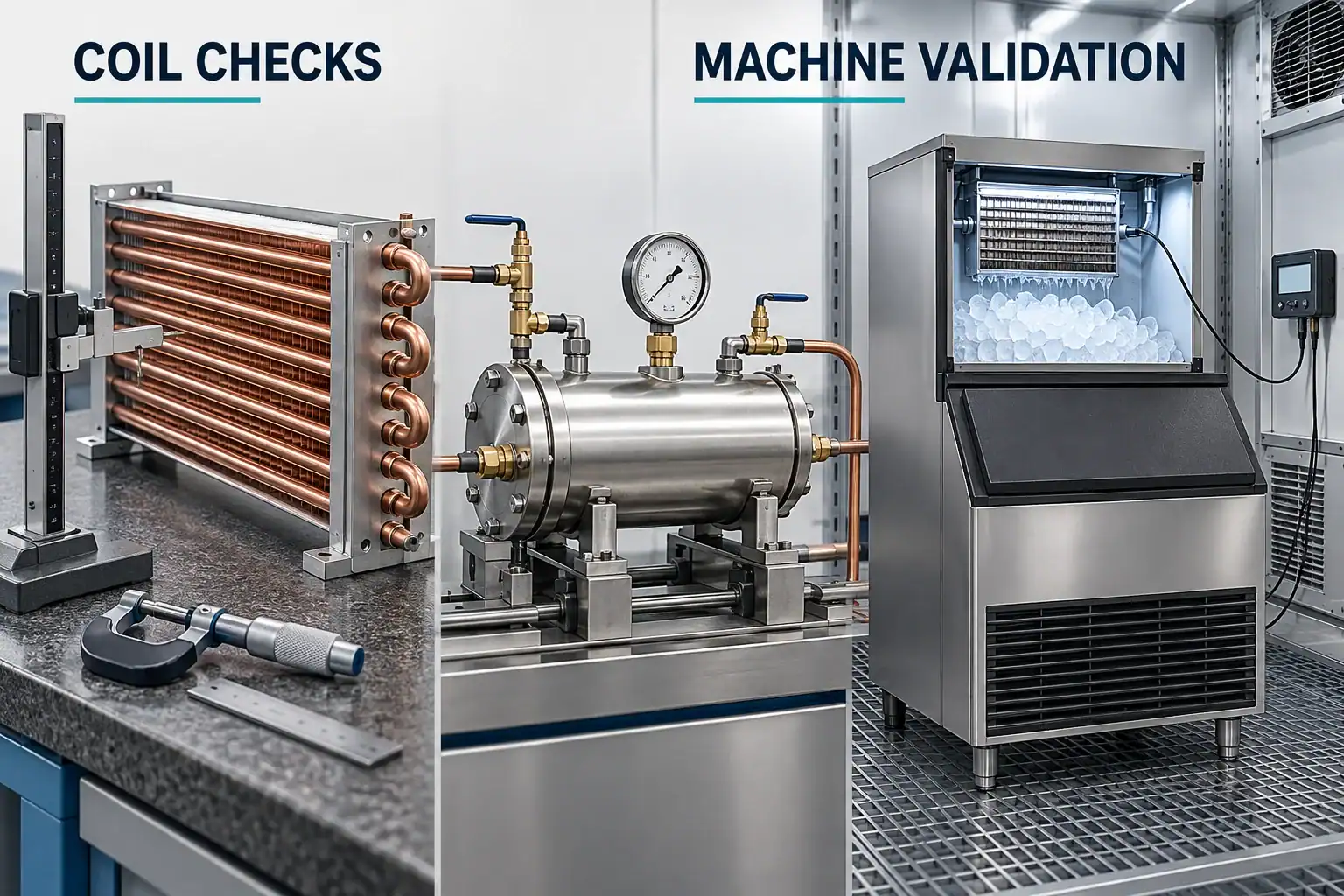
Validation illustration: component checks and complete-machine validation need separately defined scope.
If a gate remains open, name the missing evidence and its owner. A request for a revised sample can be specific: confirm the connection orientation against revision B, report the revised circuit volume, or repeat the agreed operating condition. That is more actionable than requesting a general assurance that a coil is suitable for R-290.
Keep the accepted sample identity with the released drawing. Later changes to a header, joint, coating or tube route should pass through the documented change process. This makes a future discrepancy traceable to a revision rather than to a product photograph or an informal message.
What belongs in an ice-machine coil RFQ?
Describe the component and tell the supplier what you need it to decide. Assemble the RFQ packet around these inputs:
- Target market, equipment architecture and ice-making method.
- Intended refrigerant and the relevant equipment or listing conditions supplied by the OEM.
- Capacity target and the operating conditions used to define it.
- Coil drawing, dimensions, mounting points, connections and revision history.
- Materials, refrigerant-side circuit requirements and any internal-volume limit.
- Freeze, harvest or continuous-operation requirements, as applicable.
- Inspection documents and sample tests requested, with acceptance criteria and responsible reviewers.
- Prototype quantity, production forecast, packaging requirements and requested timing.
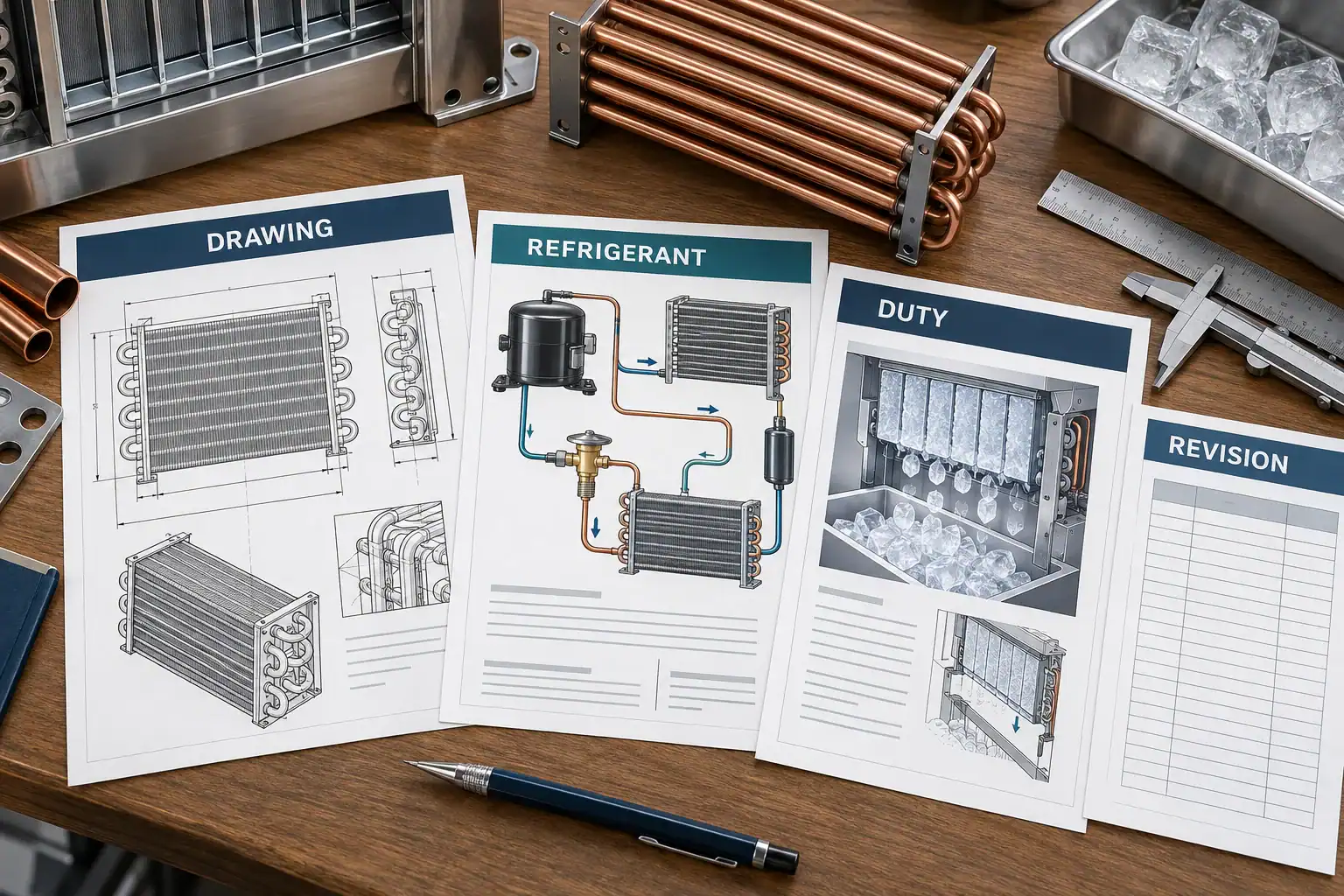
RFQ illustration: drawing, refrigerant, duty and revision information should describe the same proposed configuration.
List unknowns explicitly. If the permitted charge or certification scope is unresolved, identify who will settle it and when the supplier can expect the confirmed input. Ask the supplier to return assumptions with its proposal. This prevents a preliminary quotation from being mistaken for a released production design.
Frequently asked questions
Does EPA require all ice machines to use R-290 in 2026?
No. The rules distinguish equipment categories and restrict refrigerants by GWP or named substances. R-290 selection must also satisfy the applicable end-use and safety conditions.
Does the 1,000 lb/day threshold apply to continuous machines?
The smaller self-contained continuous category uses a 1,200 lb/day threshold. First confirm the machine’s production method and architecture; daily output alone does not establish its category.
Is a remote ice machine covered by the same 2026 event?
Remote systems have a separate installation restriction and a January 1, 2027 compliance date in EPA’s current sector table. Do not apply the self-contained manufacture/import event to a field-assembled system.
Can an existing HFC machine simply be recharged with propane?
A new-equipment transition rule does not authorize that conversion. The refrigerant, equipment construction, use conditions and applicable approvals require a specific review before any change.
Is there one R-290 charge limit for every ice machine?
Do not apply one charge figure to every model. Use the exact end-use conditions, applicable standard and equipment listing. A small coil volume does not establish the permitted complete-machine charge.
Does a new condenser drawing mean the whole machine is approved?
No. The drawing defines the component revision. Complete-machine evaluation also includes the relevant operating, safety and construction requirements, with scope determined by the responsible reviewers.
Should every new supplier repeat the same tests?
Define the evidence required for the actual supplier change. Preserve a common acceptance basis, record existing evidence that remains applicable, and obtain the review scope for the proposed construction.
What can Domi review from an ice-machine coil drawing?
Start with the component geometry, connections, materials, circuit and operating requirements described in Domi’s custom-fabrication service. Confirm project scope, sample requirements and requested documents with the team. Equipment certification and refrigerant approval remain separate responsibilities.
Prepare the coil specification before requesting samples
Send the machine classification and proposed component change with your supplier inquiry. Use Domi’s custom coil fabrication service to request a drawing-based component review. Include the intended refrigerant, operating envelope and revision information, then ask which inputs the team still needs for a quotation or sample proposal.
Where testing is part of the request, state the document and acceptance requirement rather than assuming it follows from a product description. Review the available testing-lab information with the team and confirm the project-specific scope before placing the order.