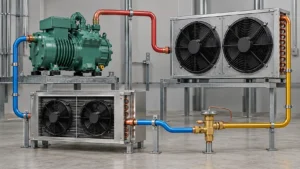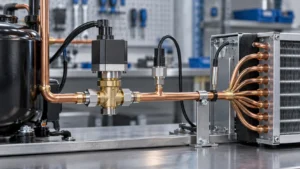

A replacement evaporator coil must match the refrigerator’s envelope, mounting, refrigerant circuit, airflow, defrost interfaces, materials, testing, and approved performance—not just the length and width of the old part.
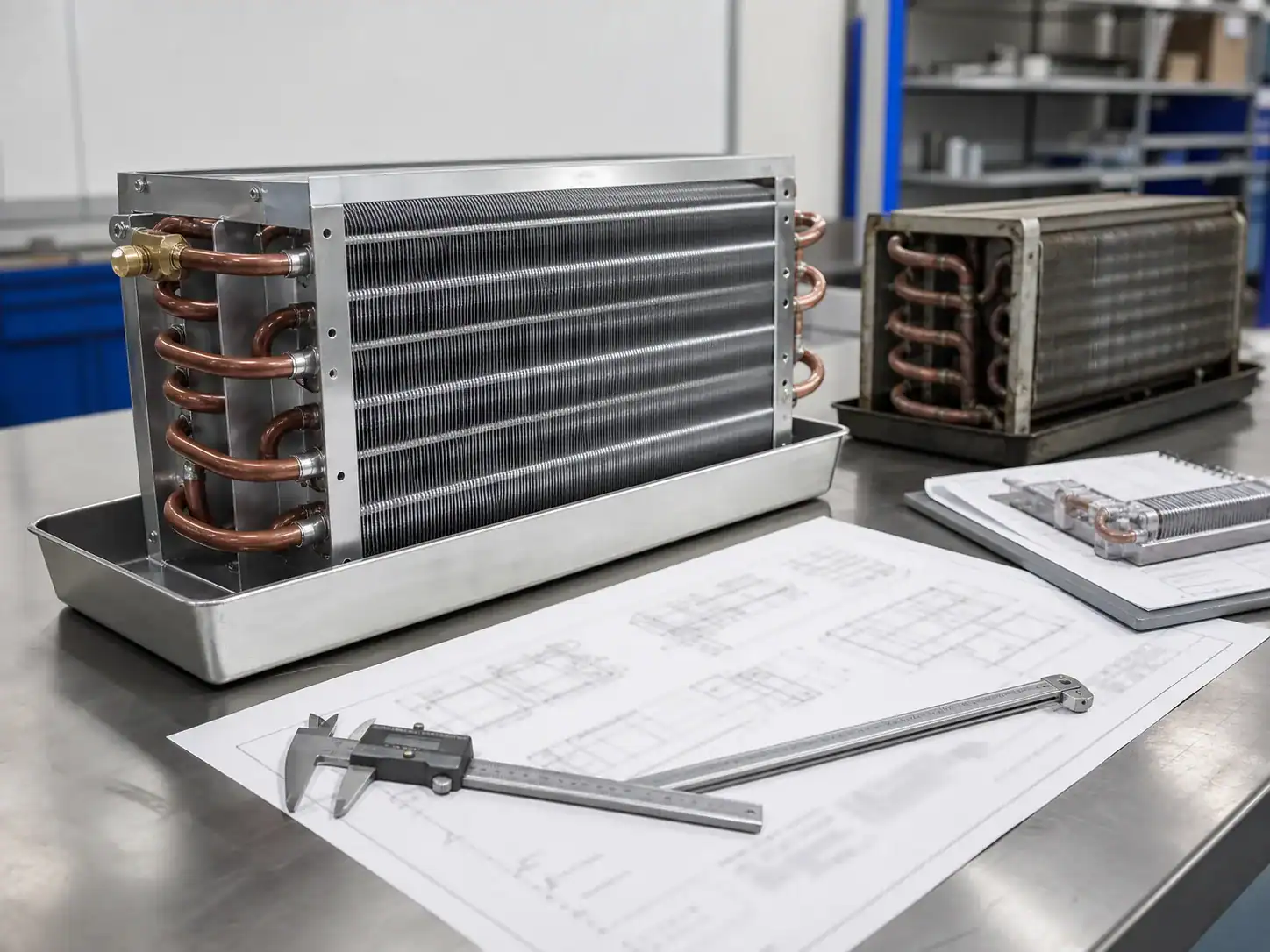
Ordering a replacement evaporator coil is not the same as ordering a generic piece of tubing and fins. The coil sits inside a cabinet with a defined air path, fan, cover, drain, heater, thermostat or sensor, insulation, refrigerant circuit, and service procedure. A part can fit the opening and still fail because its circuiting, pressure drop, frost behavior, defrost clearance, connection orientation, material, or capacity is wrong.
This guide helps OEM refrigerator and freezer teams, appliance service organizations, procurement managers, distributors, and engineering buyers prepare a replacement evaporator coil request. It focuses on the data that makes a quote reviewable and a sample testable. For a new or replacement program, the residential refrigeration coils page provides the product context; the Domi evaporator-coil quotation information guide provides a separate, more detailed input checklist.
The ENERGY STAR refrigerator guidance emphasizes airflow, clearance, and clean condenser areas as practical performance conditions. The same principle applies to an evaporator replacement: the coil must work in the cabinet’s actual airflow and service environment. The Danfoss cold-room troubleshooting resource is useful for the broader habit of connecting temperature, pressure, airflow, defrost, and component evidence.
What a replacement evaporator coil includes
Before requesting a quote, define the assembly boundary. “Evaporator coil” may mean a bare heat exchanger or a module with brackets, heater, thermostat, sensor clip, drain, pan, cover, insulation, harness, and protective packaging.
| Possible scope | Confirm with the quote |
|---|---|
| Bare coil | Tube, fin, header, connections, circuiting, end treatment and coating |
| Coil with mounting | Brackets, clips, holes, slots, supports, vibration isolation |
| Coil with defrost interface | Heater clearance, heater, sensor/thermostat clip, drain and pan |
| Complete evaporator module | Fan/shroud, cover, insulation, harness, controls and labels |
| Replacement service part | Part number, revision, backward compatibility, packaging and instructions |
Write down what is included, customer-supplied, optional, or still under review. A price comparison is unreliable when one supplier quotes a bare coil and another quotes a complete assembly.
Start with the old part and the approved requirement
A sample is valuable for geometry, but it cannot tell the supplier every operating requirement. Send the old coil, clear photos from several angles, a scale or dimensions, the appliance model and serial family, the old part number, the drawing revision, and the reason for replacement. If the old part is damaged, photograph the damage before cleaning or disassembly.
The approved requirement may differ from the old part. A field failure could be caused by corrosion, frost, fan bypass, an incorrect previous replacement, a changed refrigerant, or a cabinet revision. Ask whether the replacement must reproduce the old geometry or correct a known defect. Mark each difference as an approved change, supplier proposal, or open question.
Dimensions that matter
Overall envelope
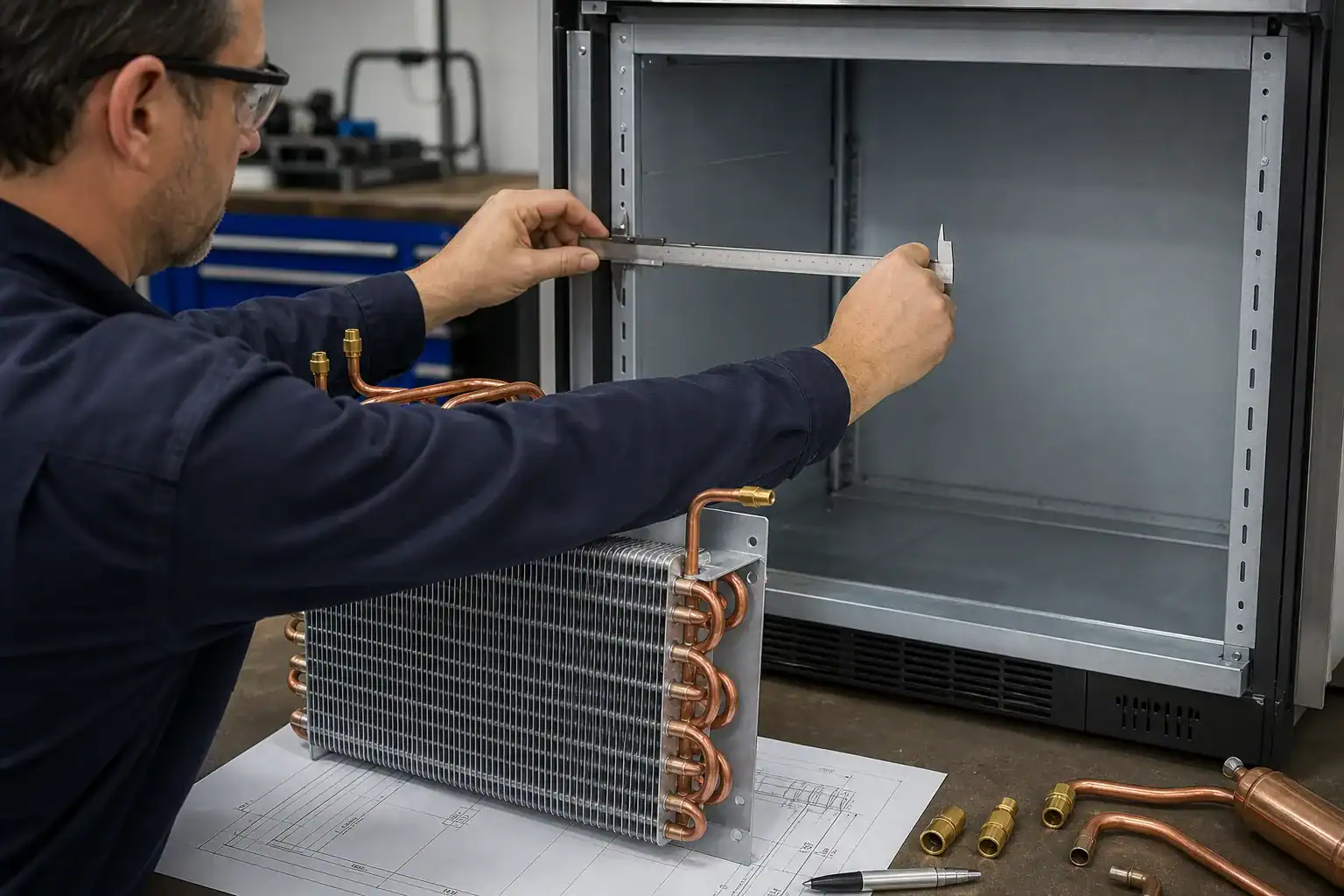
Measure length, height, depth, diagonal clearance, fin-pack thickness, header projection, connection projection, bracket projection, drain outlet, and cover or insulation space. Identify datums and measurement direction. A coil can fit between two walls but fail when the connector or tube bend needs assembly access.
Mounting and cabinet interface
Record bracket types, hole diameters, hole centers, slots, clips, fasteners, standoffs, isolation pads, drain supports, and orientation. Show the datum used to locate the coil in the cabinet. If a bracket is adjustable, record the allowed position and the final installed position.
Air-side clearance
Measure fan, shroud, duct, grille, bypass, cover, return, and insulation clearances. Include the direction of airflow and the keep-clear area for frost. Fin depth and density change pressure drop, so the same envelope does not guarantee the same airflow.
Refrigerant-side connections
Identify inlet and outlet, tube outside diameter, wall thickness if controlled, connection type, centerline, projection, bend radius, circuiting, header, capillary or restriction interface, and brazing or joining access. Take photographs with the coil in a known orientation and label the direction of refrigerant flow.
Defrost and drain interfaces
Show heater form and clearance, thermostat or sensor clip, wire exit, cover, drain, pan, slope, and lowest point. The Domi refrigerator defrost heater guide and defrost thermostat guide explain why these interfaces should not be treated as optional details.
Performance data for a replacement evaporator
Geometry alone cannot define heat-transfer performance. Provide or confirm:
- Refrigerant and applicable safety classification.
- Evaporating temperature or pressure range and condensing condition where relevant.
- Cooling capacity or heat load, setpoint, ambient, pull-down target, and duty cycle.
- Airflow, fan curve or operating point, face velocity, pressure-drop limit, and bypass condition.
- Frost allowance, humidity, defrost interval, heater, termination, drain, and recovery requirement.
- Materials, coating, corrosion exposure, cleanliness, vibration, noise, and food-zone constraints.
- Leak, pressure, dimensional, appearance, cleanliness, performance, and traceability tests.
If the buyer does not have capacity data, say so. A supplier can review the sample and propose a test or data collection step, but should not silently fill in a capacity or pressure requirement with a proxy. The replacement should be evaluated against the cabinet and system, not only a catalog description.
Circuiting and connection compatibility
Two coils with the same external dimensions can have different internal circuits. Circuiting affects refrigerant distribution, pressure drop, superheat, frost pattern, capacity, oil return, and the location where frost begins. Connection direction and tube size affect assembly, brazing, service access, and the rest of the refrigerant circuit.
Confirm refrigerant compatibility
State the refrigerant, design pressure, test pressure, materials, joint process, cleanliness, and applicable service requirements. Do not replace a coil with one designed for a different refrigerant or pressure without engineering review. A material or refrigerant change may require new validation, safety review, labels, service procedures, and drawing revision.
Confirm the inlet and outlet
Label the coil from the installed orientation, not only from a supplier’s viewpoint. Provide centerline coordinates and projection. Photograph the connection area with a ruler and orientation arrow. A connection that is flipped or extended can interfere with the cabinet, insulation, fan, or service tools.
Confirm restriction and metering assumptions
Some refrigerator systems use a capillary tube, fixed restriction, or another metering arrangement. The evaporator replacement must be reviewed with the restriction and charge basis. Do not change internal volume or circuiting without checking pull-down, superheat, pressure drop, charge, and compressor behavior.
Materials, coatings, and cleanliness
The replacement material should match the refrigerant, moisture, temperature, cleaning, corrosion, and cabinet environment. Copper, aluminum, steel, coatings, headers, brackets, and joining materials each have process and compatibility implications.
Corrosion environment
Review condensation, salt, food acids, detergents, humidity, and galvanic interfaces. If the old coil has pitting or leaks, identify the exposure rather than reproducing it. A coating proposal should state surface preparation, coverage, thickness or control method where required, edges, joints, and verification.
Cleanliness
Define internal cleanliness, residual oil, flux, chips, dust, packaging, and external residue. A replacement for a food-zone appliance may need a different cleanliness and handling record from an industrial coil. Ask how the supplier protects connections and fin packs during transport.
Fin and tube condition
Fins should be protected against crushing during forming, assembly, packing, and installation. Define allowable fin damage and how it is inspected. Tube ends and connections should be capped or protected to prevent foreign material entering the system.
Sample matching and first-article approval
Compare the sample to the drawing
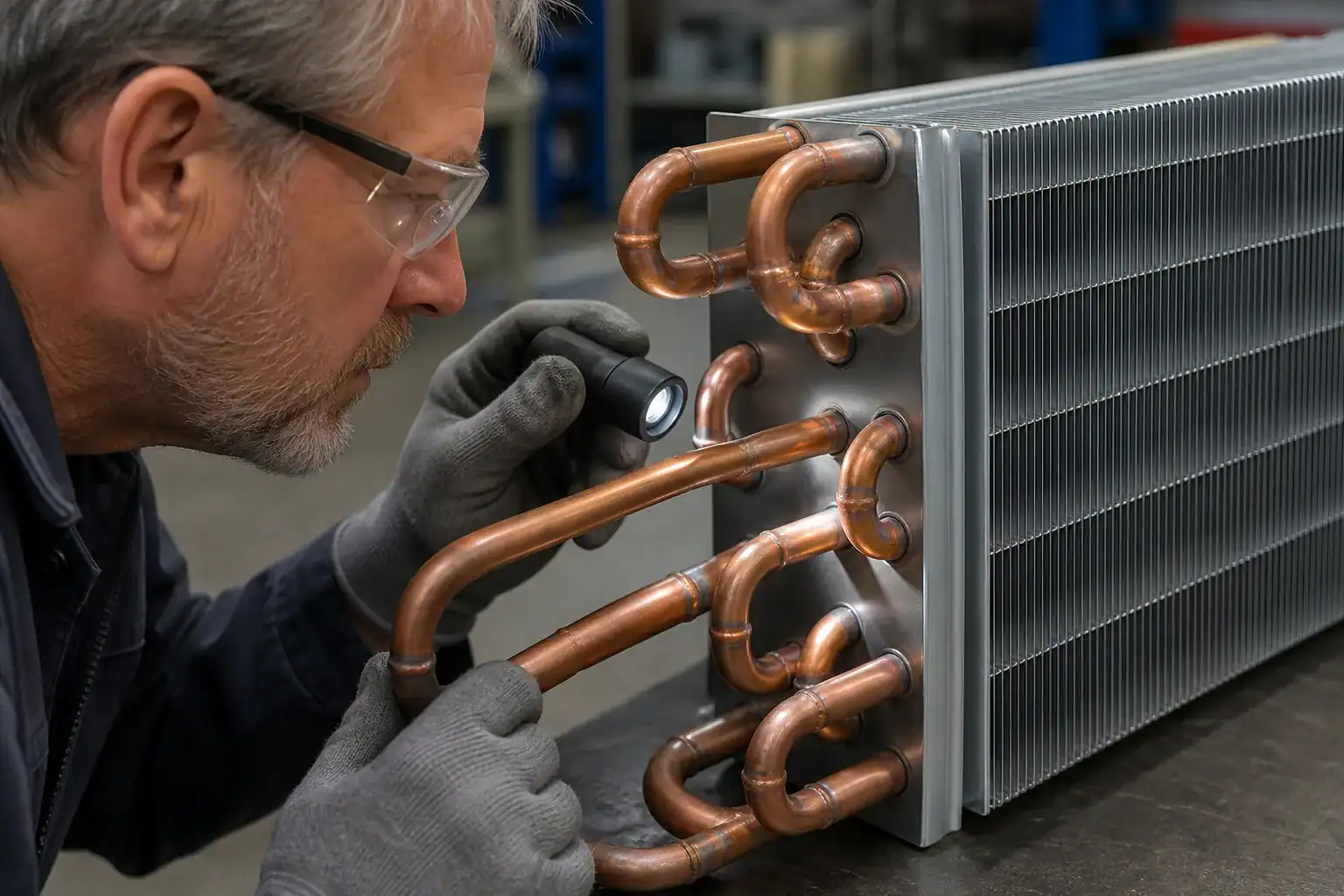
Use the same datum and revision for both. Check envelope, mounting, tube centerlines, connection projection, circuiting where inspectable, fin pitch, header, drain, heater or sensor interfaces, material, coating, labels, and protective caps. Photograph special features and record deviations.
Install the sample in the cabinet
Do not approve a replacement only on a bench. Confirm fit, fasteners, fan and shroud, cover, insulation, drain, heater, sensor, wiring, refrigerant joints, and service access. Check that the assembly can be installed without forcing or damaging tubing.
Run functional tests
Measure pull-down, steady-state temperature, capacity or heat load, airflow, pressure drop, frost, defrost, drain, noise, vibration, and post-defrost recovery under the approved conditions. Retain the test report with the part number and revision.
The Domi custom refrigeration coil prototype process describes a practical connection between drawing, sample, testing, and production review. Use the project-specific acceptance criteria rather than generic catalog numbers.
Replacement evaporator RFQ checklist
| RFQ group | Required or useful data |
|---|---|
| Identification | Appliance, model family, old part number, drawing revision, sample photos |
| Geometry | Envelope, datums, mounting, holes, brackets, cover and insulation |
| Connections | Tube, header, inlet/outlet, circuiting, centerlines, projection and joining |
| Air side | Fan, shroud, face area, fin pitch, duct, return, bypass and pressure drop |
| Defrost | Heater, thermostat/sensor, clips, drain, pan, cover and recovery |
| System | Refrigerant, operating condition, capacity, charge and pressure requirements |
| Materials | Tube, fin, header, bracket, coating, corrosion and cleanliness |
| Quality | Leak/pressure, dimension, appearance, cleanliness, function and traceability |
| Commercial | Sample, volume, MOQ, tooling, packaging, lead time and destination |
The Domi custom refrigerator coil RFQ checklist is a useful internal link for organizing these inputs. If data is missing, request a review list and identify the owner for each open item.
Common replacement-coil mistakes
Ordering by length and width only
The coil may fit but have the wrong connection, circuiting, fin density, capacity, defrost, drain, or pressure. Dimensional matching is necessary, not sufficient.
Matching the old failure without finding the cause
If the old coil leaked because of corrosion, a new coil with the same material and exposure can fail again. If the old coil iced because of a fan or defrost issue, a new coil may not change the symptom. Diagnose before reproducing.
Ignoring the revision
A service photo, drawing PDF, ERP record, purchase order, and supplier quote may show different revisions. Use one approved part and revision, and identify old-stock disposition. The Domi drawing revision-control guide explains why this matters.
Mixing assembly boundaries
A supplier may quote the bare evaporator while the buyer expects a complete module. List heater, thermostat, sensor, drain, pan, cover, fan, shroud, insulation, harness, packaging, and labels separately.
Skipping cabinet validation
An open test stand does not reproduce cabinet airflow, frost, drain, defrost, loading, or service access. Install the sample and run the relevant test plan.
A safe replacement workflow
- Protect food and users and diagnose the appliance symptom.
- Confirm whether the old coil is dirty, iced, damaged, leaky, or out of specification.
- Gather the part number, drawing, sample, photographs, dimensions, operating data, and failure evidence.
- Define scope: bare coil, coil with interfaces, or complete module.
- Request a quotation with assumptions, exclusions, sample, inspection, MOQ, packaging, lead time, and change control.
- Review the design and approve the sample against the drawing and cabinet.
- Validate fit, airflow, refrigerant circuit, frost, defrost, drain, performance, and service.
- Release the approved revision and control old stock and replacement records.
Read the old coil as a system record
The old assembly can show how the appliance was built, but it may also contain a previous supplier change or a field modification. Before measuring, identify whether the sample is the original approved configuration. Compare its markings with the service part list, drawing, purchase record, and cabinet revision. Photograph labels, brackets, connectors, welds or brazed joints, fin damage, coatings, drain, and heater or sensor clips.
Mark datums and orientation
Choose a clear installation datum such as the cabinet mounting plane or header face. Record measurements relative to that datum and mark the installed airflow direction. A measurement without orientation can be mirrored or rotated in a supplier drawing. Use arrows for refrigerant flow, air flow, top, bottom, front, rear, and service access.
Capture tolerances and variation
Measure more than one sample when the replacement must fit a production family. Record the minimum and maximum envelope, bracket locations, connection projection, and fin pack. A nominal measurement can hide a tolerance stack that causes an installation interference. Confirm whether the cabinet requires a hard limit, a nominal dimension, or an adjustable feature.
Separate evidence from assumptions
If a tube size is inferred from a photograph, label it as inferred. If circuiting is not visible, label it as to be confirmed. If capacity is unknown, do not copy a catalog value into the requirement. A supplier can propose a test or a design review, but an open item should remain visible until an engineer approves it.
Mechanical fit review
Fit is a chain of interfaces. Review the coil, cabinet, fan, cover, insulation, drain, heater, sensor, wiring, refrigerant joints, fasteners, and service tools.
Mounting and vibration
Check whether brackets carry the assembly weight, isolate vibration, support the header and connections, and prevent fin or tube contact with the cabinet. Review thermal expansion and transportation loads. If the replacement changes a bracket material or thickness, assess vibration, corrosion, and assembly torque.
Covers and insulation
The evaporator cover controls airflow, frost exposure, heater shielding, and water direction. Insulation affects cabinet temperature and sensor conditions. Confirm screw bosses, clips, sealing surfaces, drain openings, and clearance to the fin pack. A replacement coil that fits before the cover is installed may fail after insulation compression or cover tolerance is included.
Service access
The assembly should be installable and serviceable without bending connections, puncturing tubing, tearing insulation, or damaging the heater and sensor. Provide removal path, tool clearance, connector access, and replacement instructions. If a service replacement requires a different sequence, update the service part record.
Refrigeration and airflow review
Capacity and pressure drop
Match the coil to the required capacity at the actual evaporating condition, refrigerant, airflow, and ambient. Check pressure drop and distribution. A coil with a larger fin area can still reduce system performance if the fan cannot overcome the added resistance or if circuiting is not balanced.
Frost tolerance
Define the expected frost condition and the allowable performance decline before defrost. Review fin pitch, airflow, sensor location, heater clearance, drain, and cover. The Danfoss industrial defrost handbook provides general context for defrost heat, timing, and controls; apply the appliance-specific limits in the product test plan.
Air bypass and sealing
Inspect the seal between the fin pack, cover, shroud, duct, and cabinet. Air that bypasses the coil lowers effective capacity and can create uneven frost. Record gaps and sealing materials. A replacement supplier should know which surfaces are controlled and which are cabinet-supplied.
Temperature uniformity
Measure more than one shelf or air zone when the application requires uniform storage. Check entering and leaving air, return air, coil surface, refrigerant connections, and sensor location. A replacement that cools one probe but creates a warm zone can be a functional mismatch.
First-article test matrix
Use a written matrix so procurement, engineering, quality, and the supplier agree on what “approved” means.
| Test group | What to verify | Typical record |
|---|---|---|
| Identity | Part number, revision, sample and supplier | Approved sample report |
| Geometry | Envelope, brackets, holes, connections, fin pitch | Dimensional report |
| Assembly | Fit, cover, insulation, fan, sensor, heater, drain | Installation checklist and photos |
| Refrigerant side | Leak, pressure, joints, cleanliness, circuiting evidence | Test and inspection record |
| Air side | Airflow, pressure drop, bypass, temperature uniformity | Performance report |
| Frost/defrost | Frost pattern, heater, termination, drain and recovery | Cycle test record |
| Durability | Vibration, thermal cycling, corrosion or environment as required | Qualification report |
| Commercial | Packaging, label, MOQ, lead time and change control | Supplier release record |
The exact values and standards depend on the product. State the method, instrument, conditions, sample quantity, and acceptance limit. Avoid approval language such as “looks equivalent” without evidence.
Replacement coil material and coating review
If the old coil failed by corrosion or leakage, compare the environment and the proposed material. Review galvanic couples, moisture traps, salt, detergents, food acids, refrigerant oil, temperature cycling, forming damage, joint protection, and coating coverage. A coating at the fin face may not protect a cut tube end or a joint. Ask how the supplier verifies surface preparation and post-forming coverage.
If the design uses aluminum fins and copper tubes, review the tube-to-fin interface, cleaning chemistry, moisture, and field handling. If a steel bracket contacts a coated or bare aluminum surface, evaluate isolation and corrosion. If a new coating changes fin surface or thickness, confirm airflow, heat transfer, drainage, and cleanliness.
Supplier quotation review
Compare quotes on more than unit price. Ask each supplier to state:
- The source drawing, sample, part number, and revision used.
- What the quotation includes: coil, bracket, heater, thermostat or sensor clips, drain, cover, fan, insulation, harness, caps, labels, and packaging.
- Assumed refrigerant, pressure, capacity, airflow, materials, coating, cleanliness, and test requirements.
- Tooling, fixture, sample, first-article, pilot, and production timing.
- MOQ, annual volume, lead time, packaging method, shipping protection, and change-notification terms.
- Inspection records, certificates, leak/pressure tests, dimensional report, and traceability.
- Open questions, exclusions, deviations, and proposed alternatives.
The Domi refrigeration coil MOQ guide can help frame sample and production quantities. A lower quoted price may exclude the very interfaces or tests that make the part compatible.
Corrective replacement versus like-for-like replacement
Decide whether the job is a service replacement or an engineering correction. A like-for-like replacement preserves fit and service identity, but it may reproduce a known corrosion, frost, drain, or access problem. A corrective replacement changes the approved design and needs a defined validation and revision path.
| Decision | Use when | Control needed |
|---|---|---|
| Like-for-like service part | Old design meets requirements and failure is isolated | Compatibility, inspection and service traceability |
| Material or coating change | Corrosion or environment caused failure | Material review, sample and durability evidence |
| Geometry change | Fit, airflow, frost, drain or access is inadequate | Drawing revision, cabinet test and new service record |
| Circuiting change | Capacity, pressure drop or refrigerant distribution is wrong | Refrigeration validation and safety review |
| Complete module change | Coil interfaces cannot be separated safely | Assembly, electrical, defrost, drain and cabinet validation |
State the decision in the RFQ and purchase release. Do not let a supplier make a corrective change without communicating the effect on price, tooling, lead time, validation, service inventory, and backward compatibility.
Packaging and receiving inspection
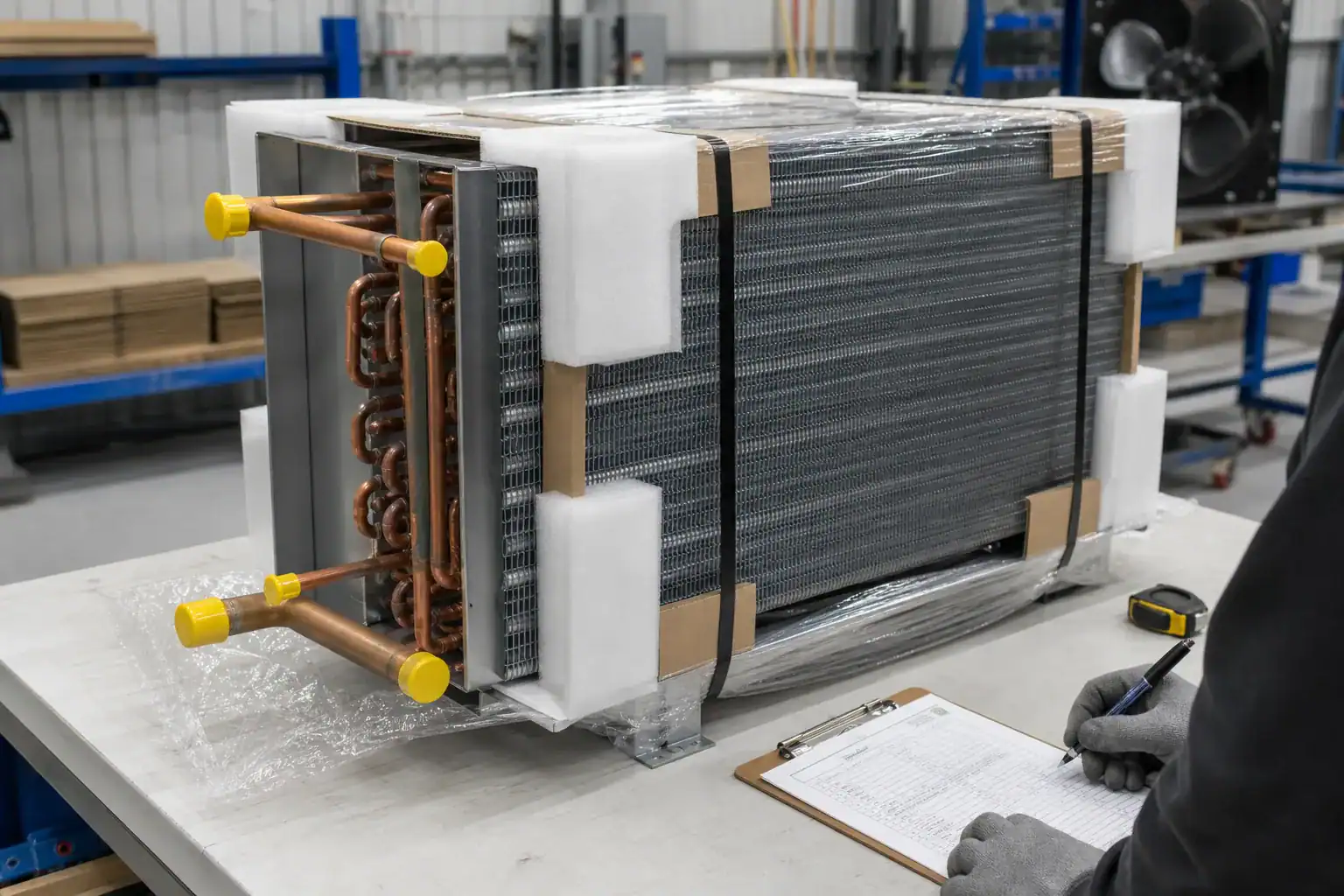
Fins, headers, connections, brackets, heaters, sensors, and coatings can be damaged during transport. Specify caps, separators, moisture protection, edge protection, lifting points, labels, and orientation. On receipt, check packaging, part identity, revision, visible damage, connection protection, fin condition, and quantity before the coil enters production or service stock.
If a sample arrives with a deviation, photograph it and quarantine it until engineering disposition. A coil that is installed before the deviation is recorded can become difficult to trace. Keep receiving evidence with the same part and revision identifiers as the quote and drawing.
Managing old stock and service compatibility
When the replacement changes a connection, bracket, circuit, material, defrost interface, or control relationship, review old stock and field units. Define whether the new part is backward-compatible, requires a kit, needs a service instruction, or is limited to a new cabinet revision. Label service inventory so technicians do not select by approximate shape.
The Domi refrigeration coil drawing revision-control guide describes how to connect the drawing, sample, inspection, quotation, production, and service records. Use that same identity across the replacement program.
Use a supplier review before the purchase release
Ask the supplier to return a marked-up drawing or interface list before production. Confirm the envelope, mounting datums, connection centerlines, circuiting assumption, airflow, fin pitch, defrost and drain, materials, coating, tests, packaging, and open items. A short review at this stage is less costly than discovering a mismatch after a shipment arrives. Keep the accepted drawing and quotation together so the buyer, quality team, and service organization are all working from the same replacement definition.
Keep an evidence packet with the approved part
The packet should contain the RFQ, marked-up drawing, supplier assumptions, quote, sample photographs, dimensional report, leak or pressure test, cabinet performance, defrost and drain evidence, packaging approval, and change history. If a future service team asks for the same replacement, the packet should answer what was approved and under which conditions. This is more reliable than using a marketplace image or a remembered dimension. It also gives the supplier a clear basis for repeat production and change notification.
Add the final installed orientation to the packet, including airflow arrow, refrigerant inlet and outlet, top and bottom, sensor or thermostat location, heater relationship, drain direction, and service access. These labels are especially important when the old sample is removed from the cabinet and a buyer sends only photographs. A replacement supplier can then review the same physical interfaces that the cabinet and service team will use, reducing the chance of a mirrored, rotated, or otherwise misidentified part.
Use the packet to brief the service-parts team before the first shipment.
The first service release should include the approved installation orientation, connection protection, inspection limits, and escalation route for any fit or performance deviation.
This record is part of the replacement specification.
It should remain available to engineering, quality, procurement, and service after the first production shipment.
Ask for a technical review before committing to the part
The fastest quote is not always the fastest project. If a drawing is incomplete, ask the supplier to identify the missing dimensions, circuiting, refrigerant, capacity, airflow, defrost, drain, material, test, or commercial data. A short review can reveal that the old coil was already a non-approved replacement or that the failure originated in a fan, control, drain, corrosion environment, or cabinet interface. Resolving that question before tooling and production reduces rework and protects service compatibility.
Once the requirement is clear, use one part number and revision across the supplier quote, sample label, purchase release, inspection report, cabinet test, and service record. If a proposed change is accepted, document its reason and effect. This makes the replacement repeatable for the next production lot and gives future technicians a reliable answer when the same appliance needs another coil.
Before closing the project, confirm that the public service description, internal part list, supplier drawing, and packaged label use the same approved name and revision. That small consistency check prevents a replacement from being ordered correctly but installed against an older instruction.
Keep the final evidence packet readable for a future buyer who was not in the original project meeting.
Include the approved test conditions and acceptance limits.
Retain the supplier assumptions.
FAQ: replacement evaporator coil
What is a replacement evaporator coil?
It is an evaporator assembly intended to restore or replace the cooling surface in a refrigerator, freezer, or related refrigeration system. It must match the application’s fit, refrigerant circuit, airflow, defrost, materials, pressure, and performance requirements.
Can I replace an evaporator coil using dimensions only?
No. Envelope and mounting are only part of the match. Confirm connections, circuiting, refrigerant, capacity, airflow, fin pitch, pressure drop, defrost heater and sensor, drain, materials, testing, and revision.
Can a supplier reverse-engineer an old coil?
Yes, a sample can provide geometry and interface evidence, but it cannot by itself define capacity, pressure, charge, frost, defrost, or safety requirements. Send the application and operating data and clearly label unknowns.
Should the replacement have the same fin pitch?
Only if the approved performance and airflow review supports it. Fin pitch affects heat transfer, pressure drop, frost tolerance, cleaning, and cabinet performance. A change should be evaluated and controlled.
Does a replacement evaporator include a defrost heater?
Not automatically. Confirm whether the quote is for a bare coil, coil with heater, or complete module. List heater, thermostat or sensor, clips, drain, cover, fan, and harness as included, customer-supplied, optional, or subject to review.
How do I know the old coil really needs replacement?
Confirm the symptom and inspect for leak, corrosion, crushed tubing, severe fin damage, blocked internal passage, irreversible contamination, or performance outside the approved requirement. Rule out fan, defrost, drain, controls, airflow, charge, and compressor faults.
What tests should approve a replacement coil?
Check dimensions, mounting, connections, leak or pressure integrity, materials, airflow, capacity or temperature performance, frost, defrost, drain, noise, service access, packaging, and traceability in the actual cabinet or approved test fixture.
What should an OEM send with a quote request?
Send appliance and part identification, drawing revision, sample and photos, envelope, mounting, tube and circuiting, refrigerant and pressure, airflow and fan, defrost and drain interfaces, materials, quality, packaging, volume, MOQ, sample quantity, and schedule.