
Beverage cooler condenser dust protection should limit lint buildup while preserving enough cooling airflow through the installed cabinet. An accessible inlet, suitable coil geometry and, where approved, a removable screen can help. Validate the assembly with contamination present and define its cleaning procedure. A fine filter added without an airflow review can make heat rejection worse.
This guide is for OEM engineers, procurement teams and aftersales managers investigating repeated condenser blockage in retail equipment. It addresses contamination control and service access; use the separate beverage cooler condenser selection guide for the wider heat-rejection and sizing process.
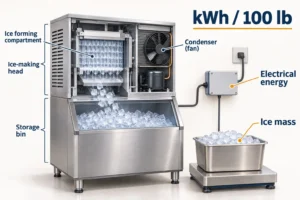
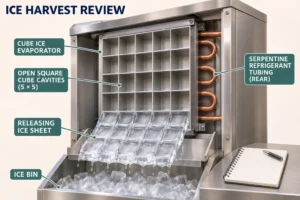
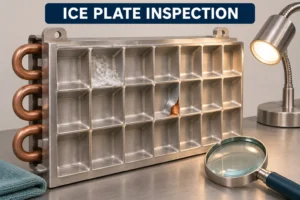
The illustrations are original AI-generated concepts, not Domi product photographs, measured test results or manufacturing drawings. Component positions and clearances require project drawings.
Jump to: contamination · screen choice · pressure budget · service access · validation · RFQ inputs
What should "dust-proof" mean in a cooler specification?
For an air-cooled condenser exposed to store air, define dust protection as a performance and maintenance requirement. Avoid promising that contamination can never reach the coil. A useful specification names the contaminant, the operating environment, the service interval and the condition the cabinet must tolerate before cleaning.
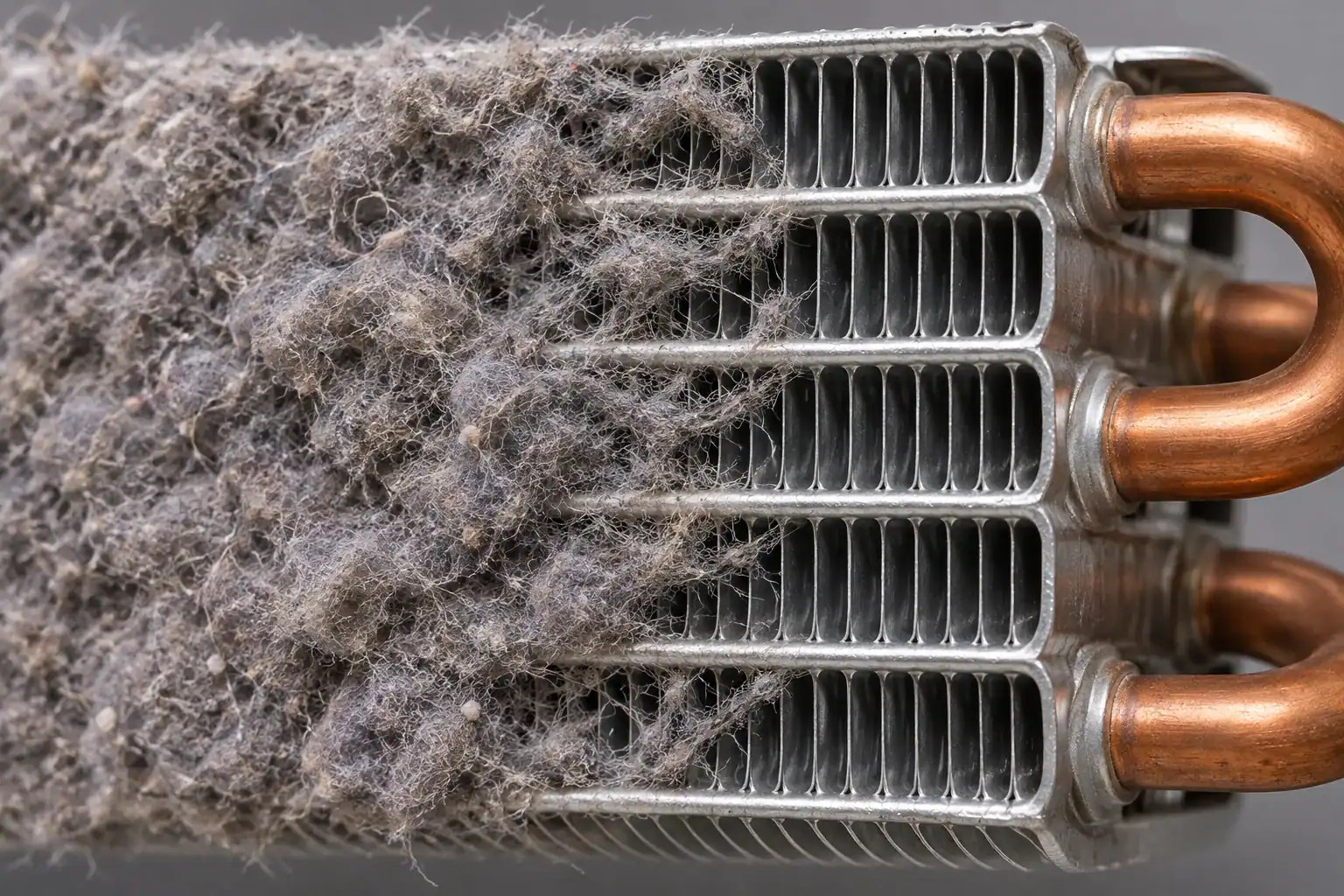
Lint can bridge the entrances to a fin pack. A screen can collect that lint at a more accessible surface, but the accumulated material still needs removal. The proposal should show where dirt will collect and who will remove it.
Replace “dust-proof condenser” in the purchase specification with a testable request: maintain the agreed cabinet temperature and component operating limits at defined ambient and loading conditions, with the agreed contamination state present. Record the cleaning and inspection trigger separately. Neither a clean-coil rating nor a photograph proves that requirement.
Match the design to the contamination
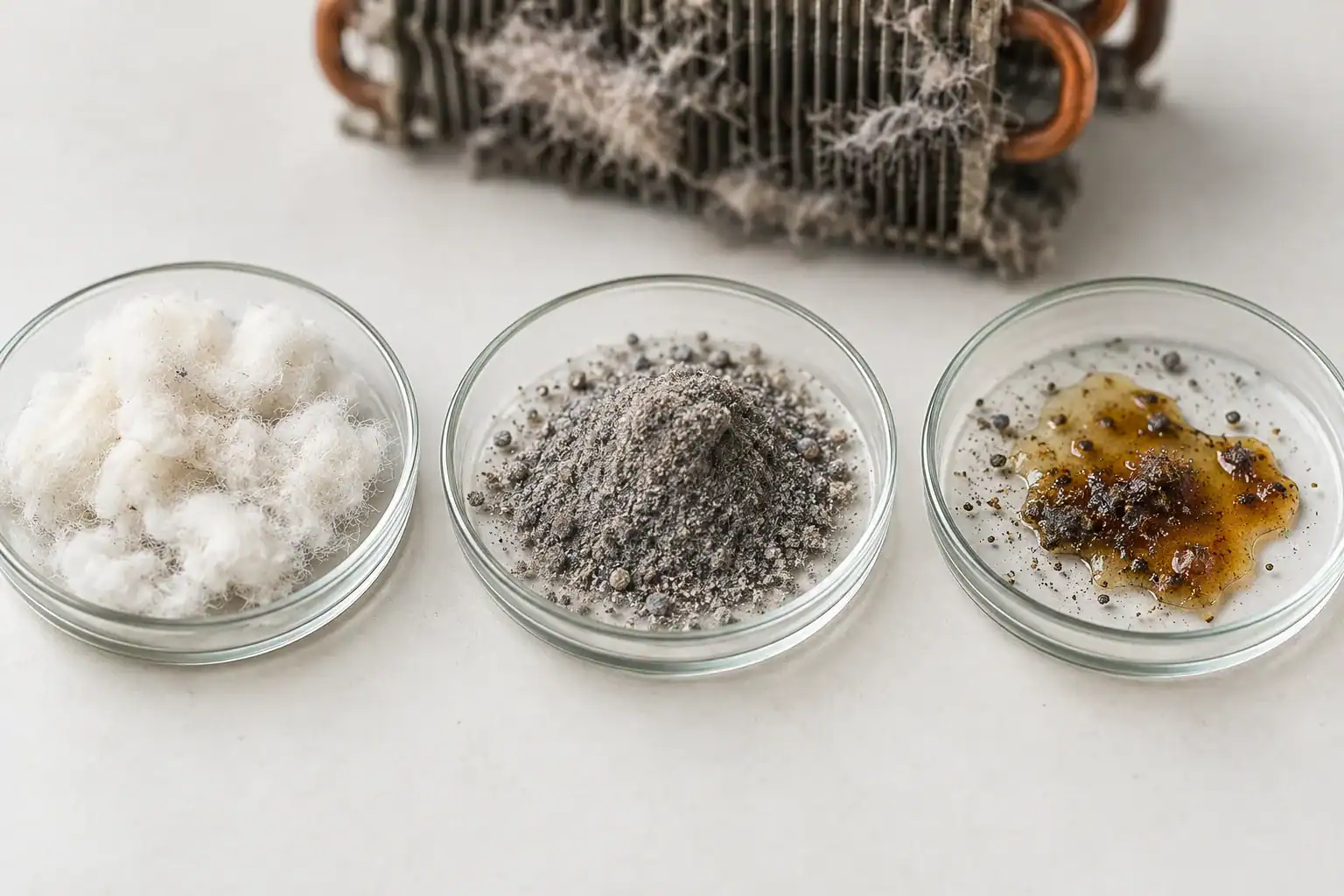
A retail site survey should distinguish dry fibers from fine particulate and sticky deposits. Photograph the inlet, the coil face and the surrounding installation before cleaning. Record how long the unit has operated since its last service and whether the same pattern occurs across several stores.
Observed deposit
Design question
Evidence to request
Observed deposit: Loose lint or packaging fibers
Design question: Can interception occur on an accessible surface?
Evidence to request: Capture pattern, screen resistance and removal demonstration
Observed deposit: Fine dry dust
Design question: Will particles pass through the proposed coarse screen?
Evidence to request: Contaminant description and condition after loading
Observed deposit: Grease holding dust
Design question: Can the deposit be removed using the approved method?
Evidence to request: Material compatibility and technician service procedure
Observed deposit: Dirt concentrated at one edge
Design question: Is air entering through a gap or an uneven intake?
Evidence to request: Seating inspection and local airflow review
These are screening questions, not a particle-classification standard. A coarse lint screen should not be described as a fine-dust filter without relevant evidence. If a deposit is oily, do not assume a dry brush mechanism will remove it.
Review the intake position before adding a screen
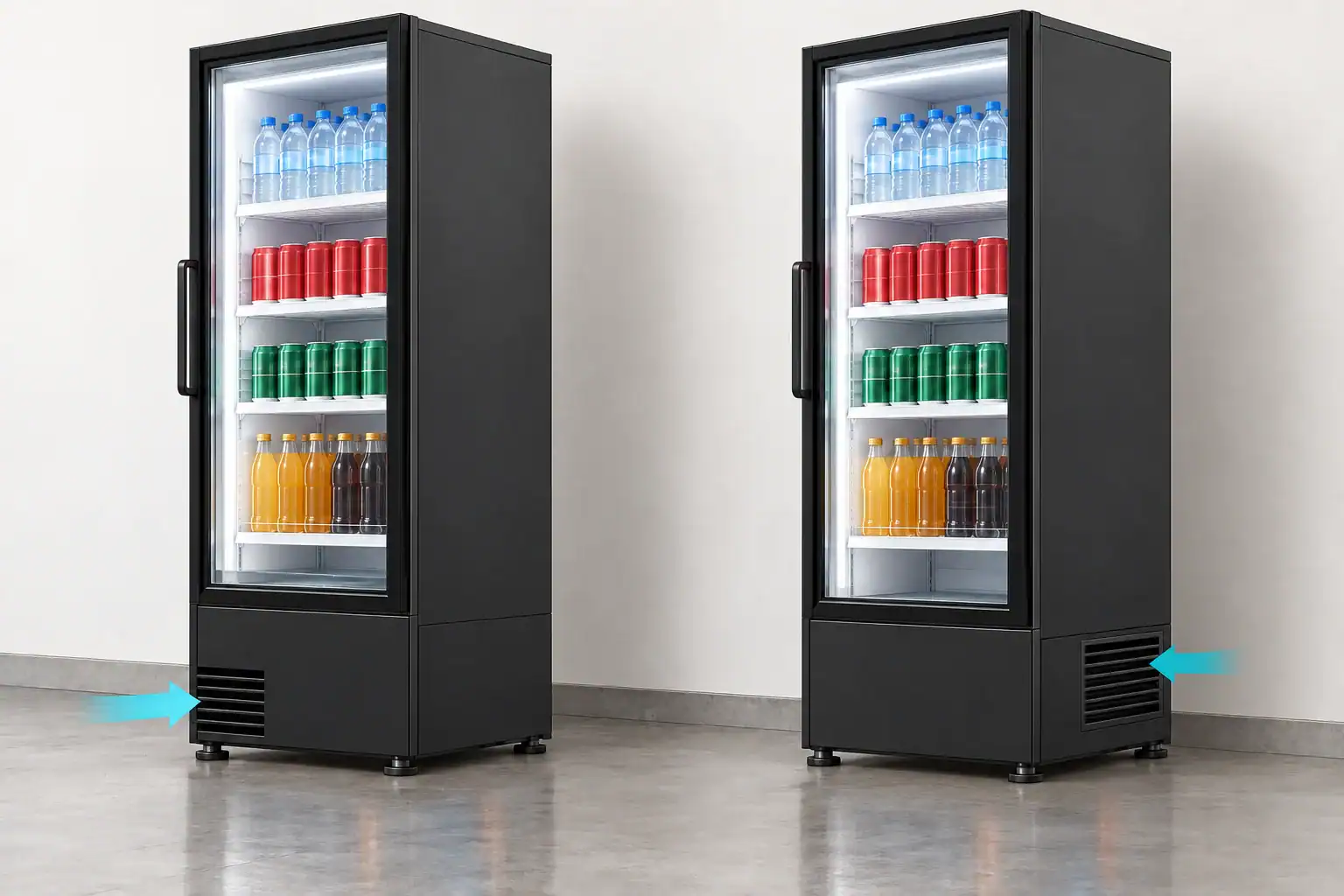
Mark the condenser inlet on the cabinet drawing and on photographs of the installed cooler. Check nearby cartons, shelving, skirting, floor mats and cleaning activity. An inlet that is unobstructed in the laboratory may be partly covered after store staff restock the aisle.
Moving an intake away from a recurring source of lint is a candidate design change. It needs a new review of air-path length, available opening area, outlet separation and service access. A higher or side-mounted inlet can face different obstructions, so compare both arrangements at their intended installation sites.
Use the installed arrangement for comparison. Include adjacent cabinets and the manufacturer’s required clearances rather than choosing a generic wall distance. Where relocation is impractical, an accessible grille and a clear inspection routine may be a better starting point than additional filtration.
Should a beverage cooler condenser have a filter?
Only where the equipment design and manufacturer permit it. A screen is a conditional design option, not a universal retrofit.
The Beverage-Air Slate manual advises against air filters on its covered equipment because they restrict cooling air. In contrast, the TEFCOLD PDA3 CTF manual describes a removable condenser dust cover, including rinsing, drying and refitting it. These are instructions for different products, not interchangeable permissions.
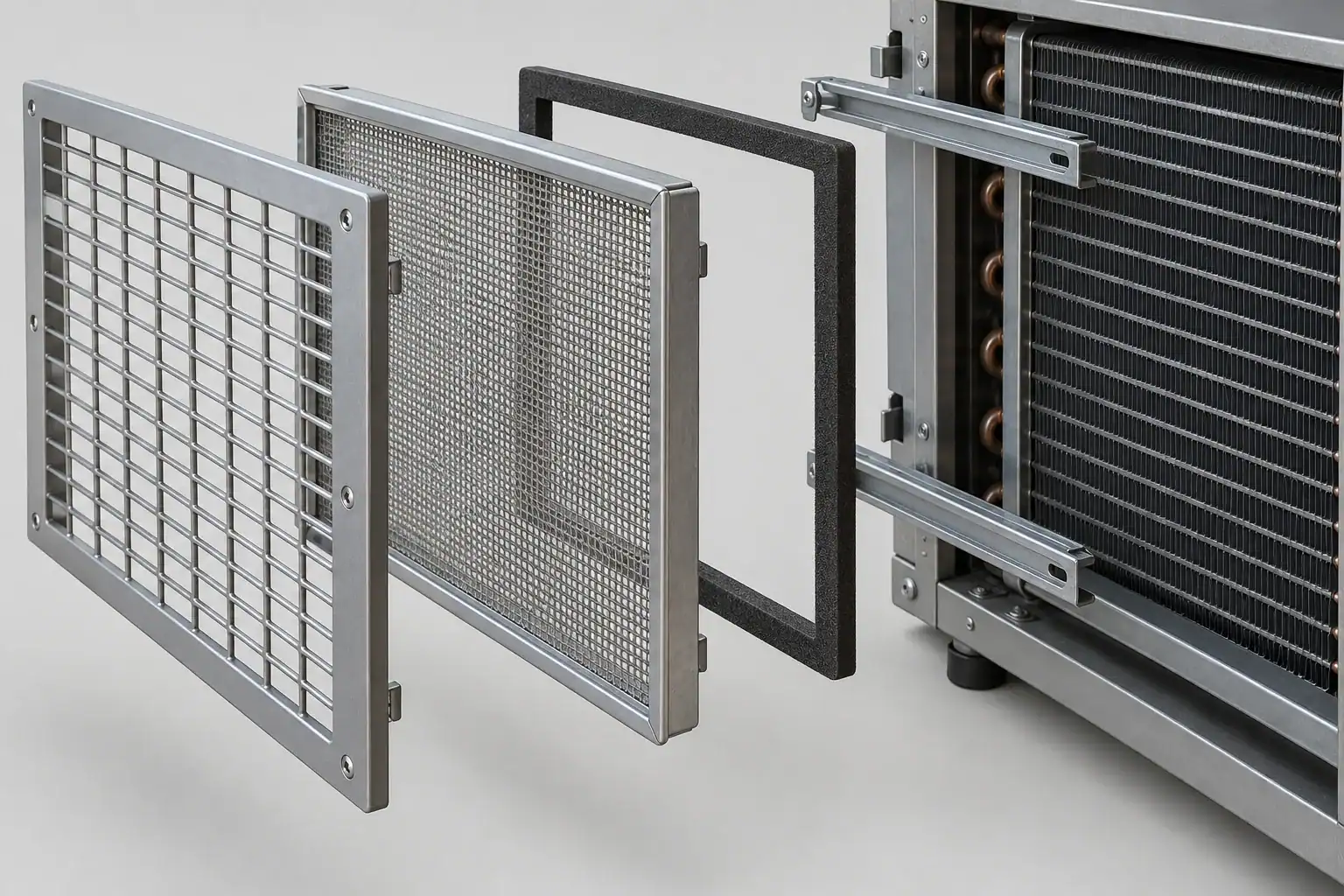
For a new OEM design, compare an unfiltered accessible coil, a removable coarse screen and any proposed active cleaning mechanism. Ask what each option adds to pressure loss, service work, parts supply and misuse risk. The screen needs adequate exposed area, secure retention and an obvious installed orientation.
Review a perimeter gap as a potential contamination bypass. Preventing air from bypassing a screen is different from preventing air from bypassing the coil. Do not seal unrelated machinery ventilation openings in an attempt to improve dust capture. The complete compartment still needs its approved ventilation arrangement.
Compare the screen when clean and when loaded
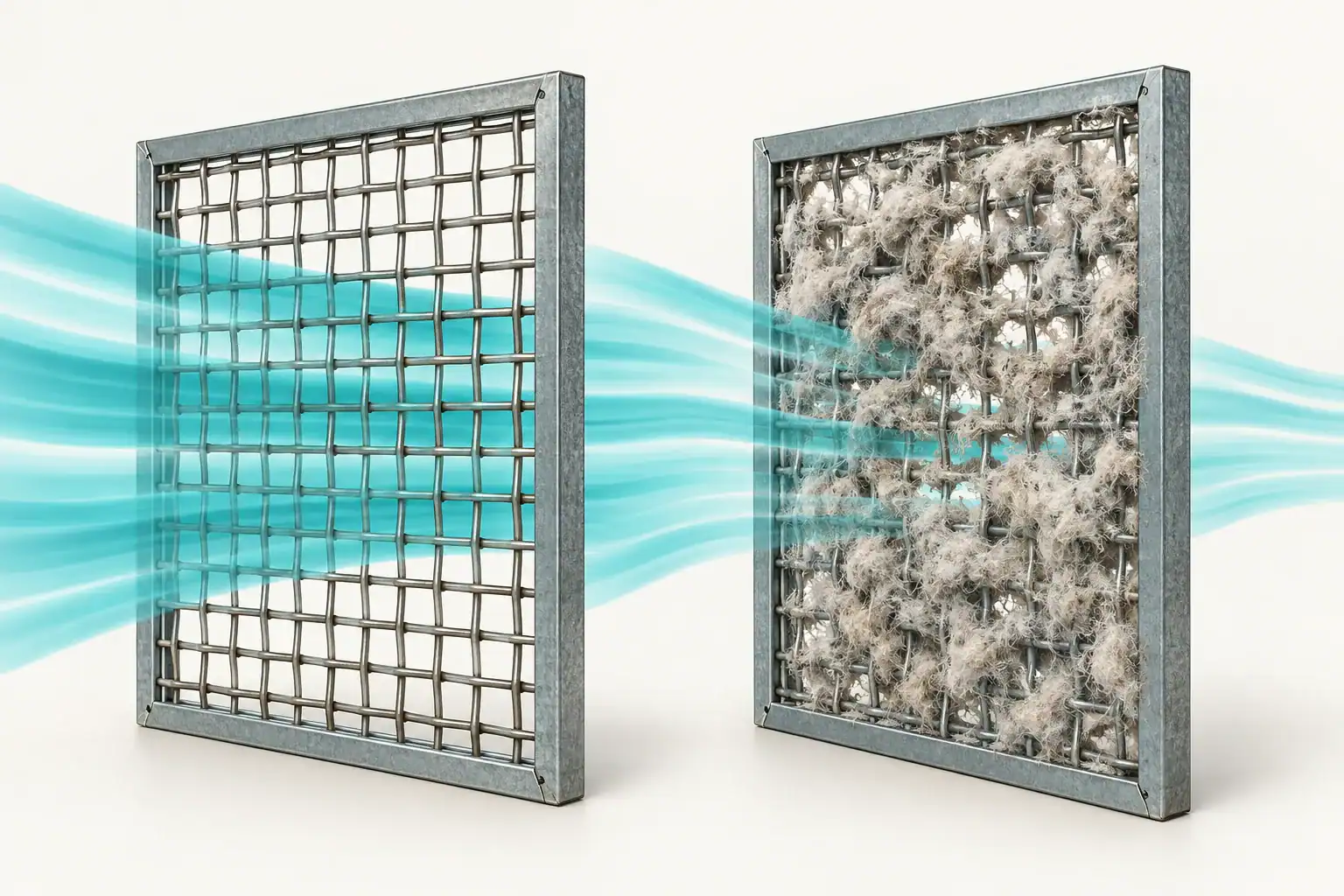
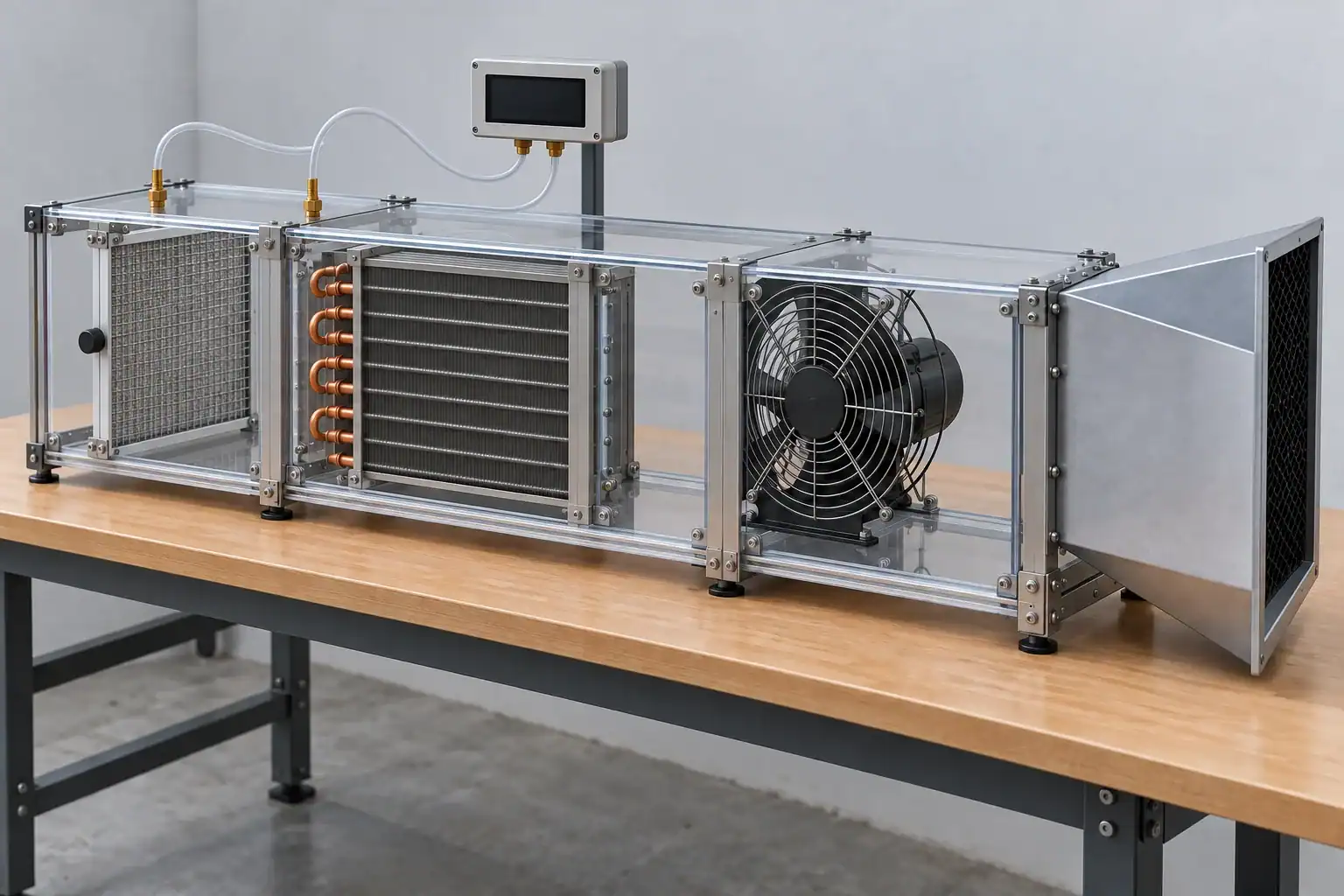
Ask for pressure loss at the required airflow for both conditions. A clean screen can appear acceptable while a lint layer changes its resistance enough to move the fan away from the intended operating point.
The ebm-papst fan FAQ explains the operating point through the intersection of the fan and system resistance curves. For the cooler, include the coil, screen, grille, shroud and compartment restrictions in that system. Free-air fan volume is not the installed airflow.
Specify what “loaded” means. Record contaminant type, quantity or application method, distribution, exposure time and photographs. Visible coverage alone does not establish a repeatable resistance. A thin felt layer and loose fibers can look similar but behave differently.
Use the same measurement boundary for the clean and loaded comparisons. If the grille or access panel is removed for one reading, the comparison no longer represents the same cabinet arrangement.
Work through a screen pressure budget
The following is a hypothetical screening calculation. It is not a Domi result, an allowable pressure limit or a substitute for a measured fan curve.
Assume the design needs 180 m³/h, and the selected fan can provide 70 Pa of usable static pressure at that flow. Assume all losses use the same static-pressure basis and air condition. The estimated losses at 180 m³/h are:
Item at the target airflow
Clean condition
Loaded-screen condition
Item at the target airflow: Condenser coil
Clean condition: 24 Pa
Loaded-screen condition: 24 Pa
Item at the target airflow: Grille and internal air path
Clean condition: 18 Pa
Loaded-screen condition: 18 Pa
Item at the target airflow: Screen
Clean condition: 6 Pa
Loaded-screen condition: 25 Pa
Item at the target airflow: Total estimated resistance
Clean condition: 48 Pa
Loaded-screen condition: 67 Pa
Item at the target airflow: Remaining pressure at the target flow
Clean condition: 22 Pa
Loaded-screen condition: 3 Pa
The calculation is 70 − (24 + 18 + 6) = 22 Pa when clean and 70 − (24 + 18 + 25) = 3 Pa when loaded. The small loaded-state remainder leaves little allowance for additional losses or variation. It does not establish the actual resulting airflow; that requires the fan and system curves or measurement.
Now assume the coil also loads and its loss becomes 34 Pa at the target flow. Total estimated resistance becomes 77 Pa, above the assumed 70 Pa available there. The target flow is no longer supported by this screening comparison. Revisit screen area, the air path, coil design or fan selection, then repeat the cabinet test. Raising fan speed also needs a power and sound review.
Choose fin geometry with a realistic cleaning method
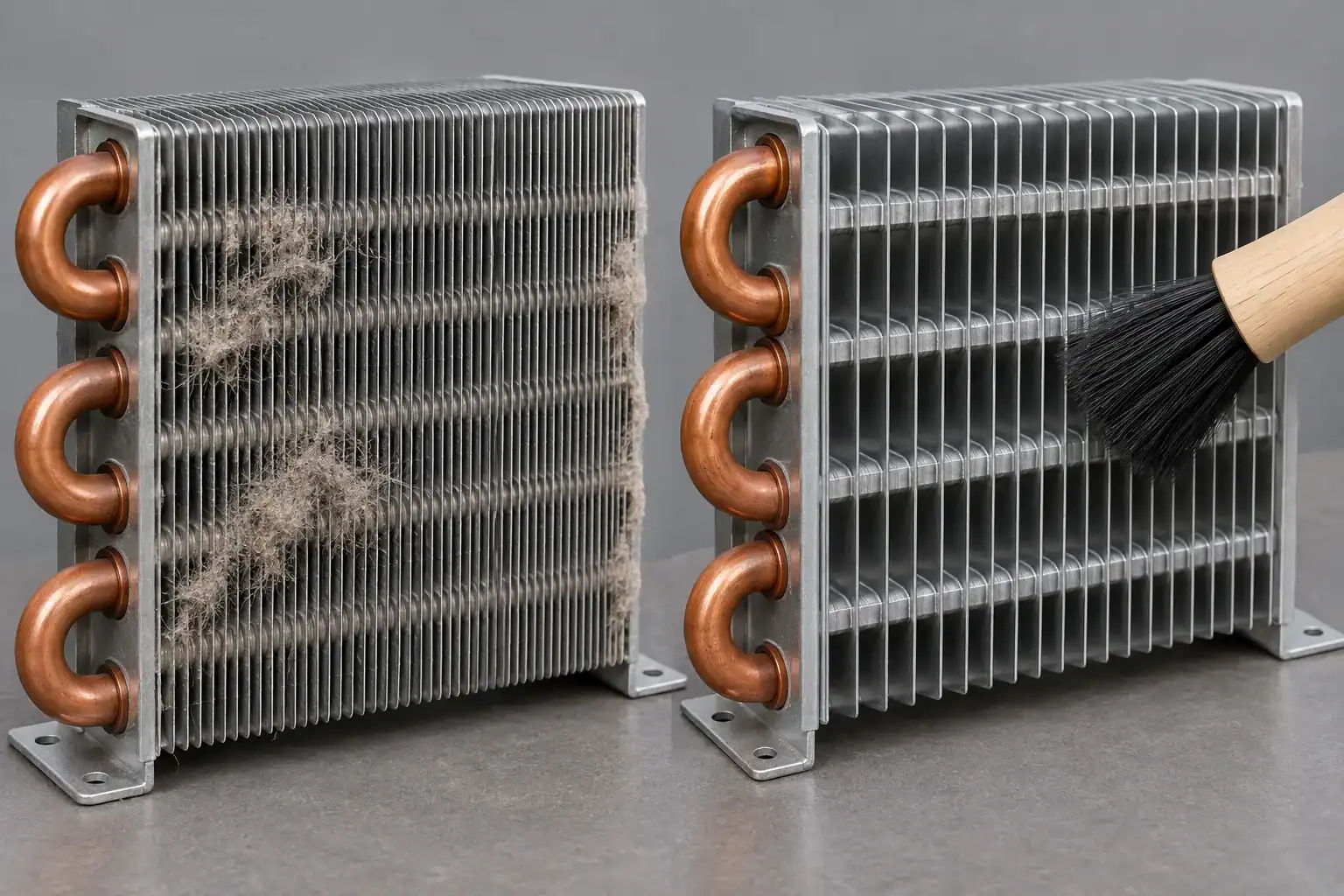
Specify fin pitch, pack depth and accessible faces together. More open passages may ease access and change how fibers collect, but they also change the available heat-transfer surface and the rest of the coil design. No single fin pitch guarantees satisfactory retail operation.
The supplier comparison should state heat rejection, entering-air condition, airflow and pressure loss for the proposed geometry. If a revised pitch changes face area or depth, check cabinet fit and the fan arrangement again. Use the commercial condenser fin design guide for the broader geometry trade-offs.
Demonstrate the proposed cleaning method on the actual assembly. A front face that is easy to brush does not prove that a deep pack can be cleaned through its full depth. Ask how the technician inspects the downstream face without damaging fins, tubes, wiring or surface treatment.
Keep the condenser inlet and hot outlet separated
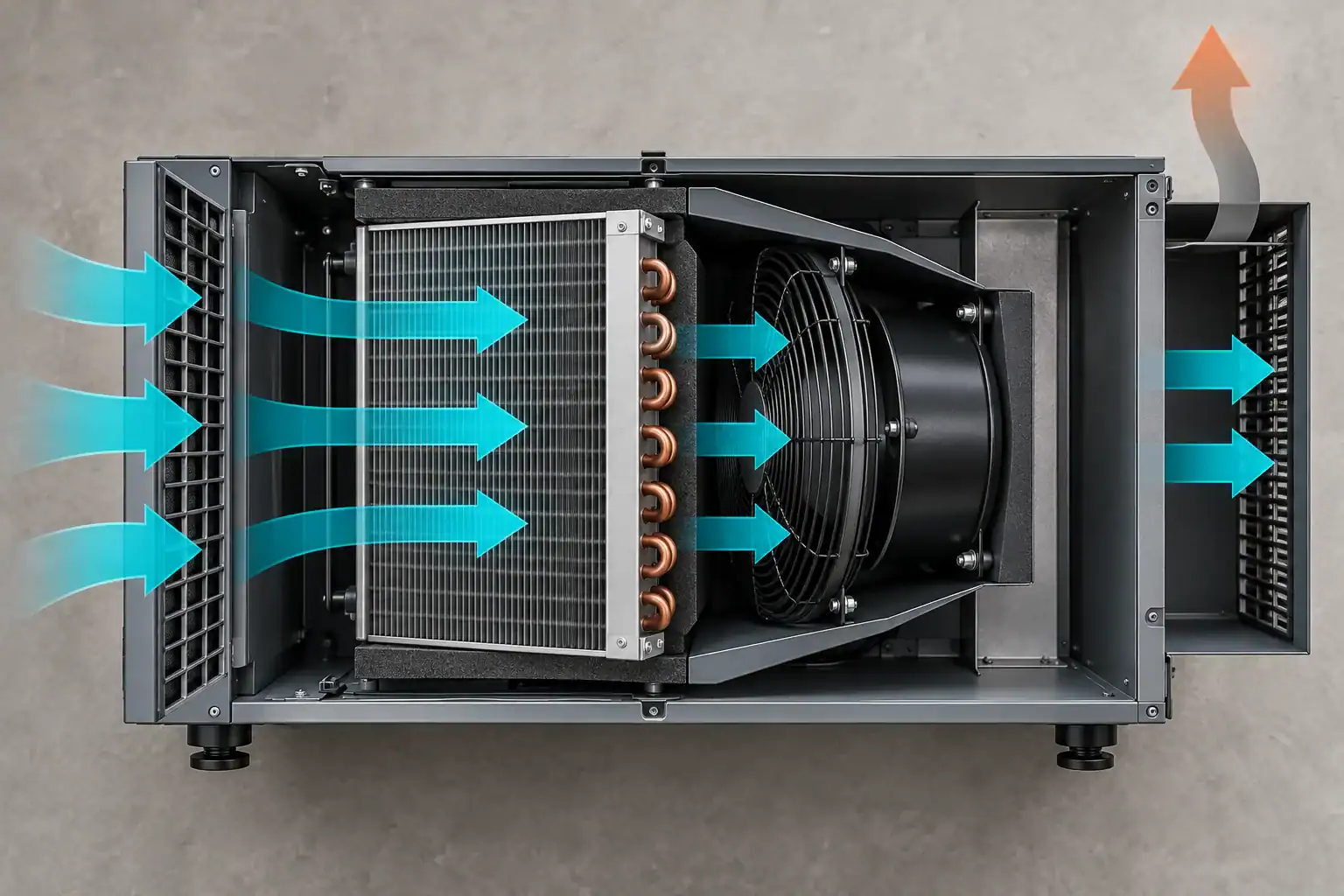
A clean screen cannot correct hot discharge air returning to the inlet. Likewise, airflow that passes around the coil can make an outlet measurement look healthy while little air crosses the heat-transfer surface.
Inspect shroud fit, coil edge clearances and partition locations. Record the air temperature entering the condenser, not only the room temperature elsewhere in the store. Compare the complete production air path with the development setup before blaming contamination for a warm cabinet.
Include grille opening area and the installed fan in the review. The condenser fan selection guide covers the supporting fan data. A dust-control change should retain a clear route through the intended heat exchanger and out of the compartment, without compromising other ventilation duties.
Make the cleaning path part of the drawing
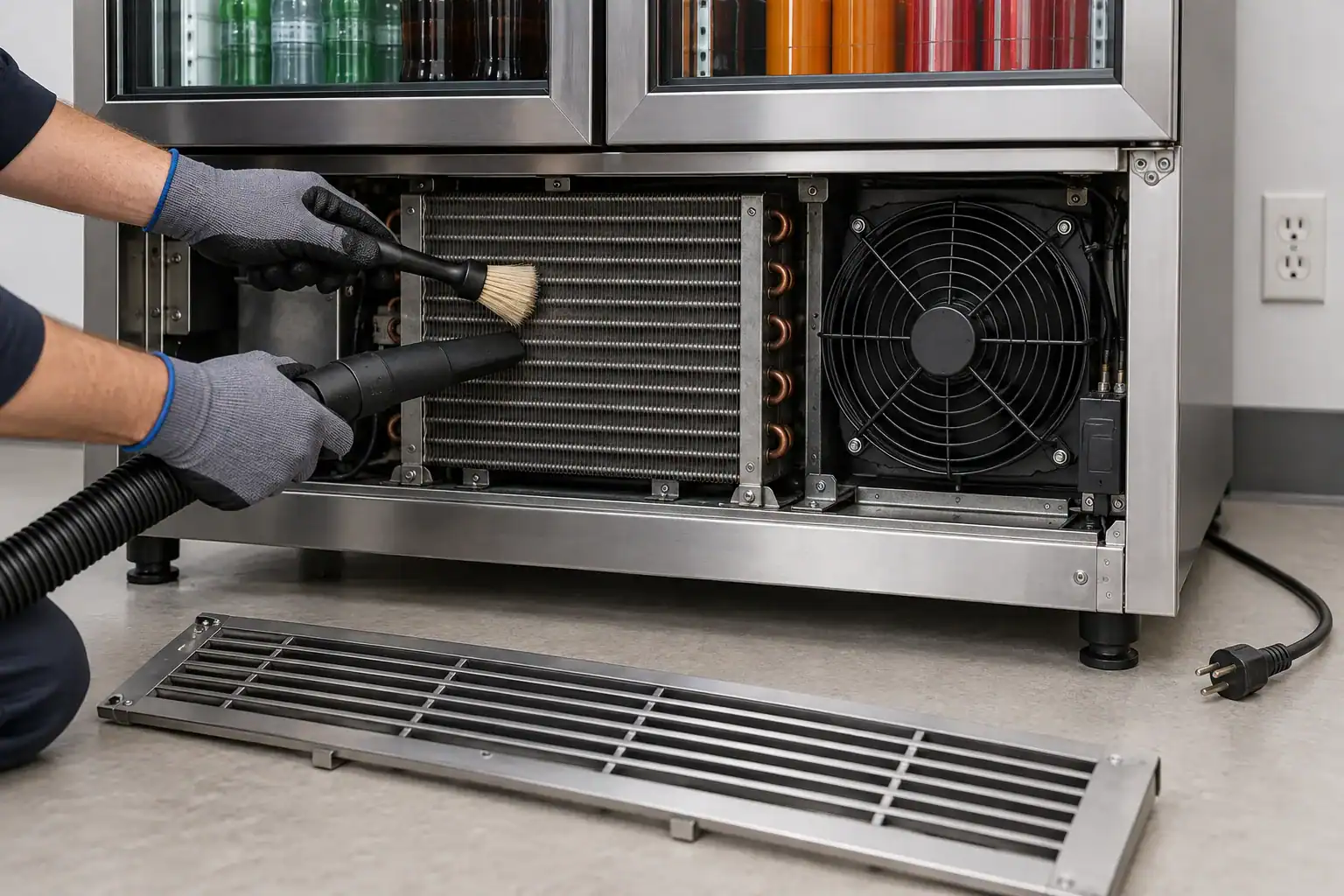
Draw the space needed to remove the grille and screen, reach the coil face and reinstall each part. Include the tools and hand access, not just a nominal gap in front of the cabinet. Check whether the work can be done at its installed location.
A removable screen that requires moving a fully stocked cooler creates a different service burden from one accessible at the front. Show the removal direction, fastener type, seating details and any cable attached to the cover. Keep routine maintenance distinct from work that requires a qualified refrigeration technician.
The Beverage-Air instructions cited above require power disconnection before condenser cleaning and assign greasy-coil cleaning to an experienced technician. Follow the actual equipment manual for isolation, tools, chemicals and refitting. Do not transfer another model’s washing procedure to a coil or electrical compartment that was not designed for it.
Validate clean, loaded, missing and mis-seated states
Agree the test states before sampling. The following is a proposed development plan; it is not a regulatory test method or a claim that Domi has performed these tests.
Assembly state
Question to resolve
Record for the design review
Assembly state: Clean, correctly assembled
Question to resolve: Does the starting configuration meet its requirements?
Record for the design review: Installed airflow, temperatures, power, sound and assembly revision
Assembly state: Defined contamination present
Question to resolve: Does the cabinet remain within agreed limits before service?
Record for the design review: Loading procedure, screen and coil condition, operating measurements
Assembly state: Screen absent
Question to resolve: What happens if a replaceable part is omitted?
Record for the design review: Changed air path, contamination exposure and required user response
Assembly state: Screen mis-seated
Question to resolve: Can a gap defeat interception or disturb airflow?
Record for the design review: Gap location, retention behavior and corrective instruction
Set the ambient, product load, door-use pattern and operating duration for each comparison. Record cabinet temperature recovery and the compressor or fan limits specified by their manufacturers. Keep personnel qualified for the instruments and refrigeration work involved.
After cleaning, repeat the agreed reference checks. Inspect the screen, frame and fin pack for damage or poor refitting. Recovery toward the original condition helps assess whether maintenance restores the assembly; failure to recover needs investigation.
An accelerated lint test does not automatically represent a number of months in service. Make that relationship only when field exposure and the loading method support it. Keep development observations separate from any required appliance certification or energy test.
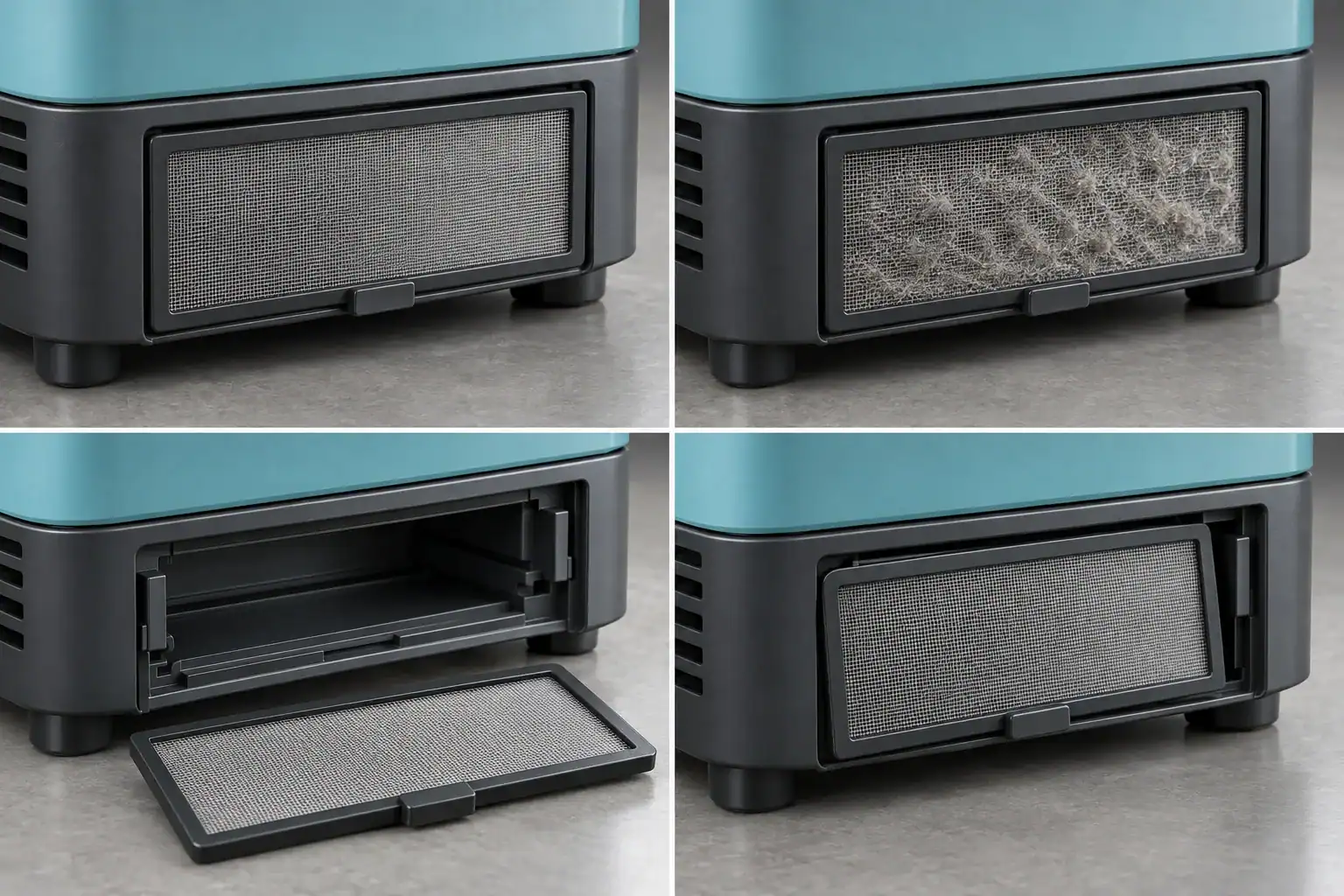
Hand over a maintenance trigger, not an immunity claim
The maintenance document should identify the inspection point, responsible person, permitted cleaning method and replacement part. Include a clear installed reference image and explain how to confirm the screen and grille are seated afterward.
Follow the product’s specified interval and assess whether site conditions require earlier inspection. TEFCOLD’s cited dust-cover procedure gives a two-month interval for that product. It is not a general interval for retail beverage coolers.
An active cleaning mechanism also has defined limits. The Turbo Air TOM-UC HC manual notes that its condenser cleaner may leave grease behind. Evaluate the specific mechanism, contaminant and maintenance instructions before treating “self-cleaning” as a reason to remove service planning.
For repeated complaints, use the general condenser maintenance guide alongside the model instructions. Compare the deposit pattern, cleaning record and installation before deciding whether to change the coil, screen or cabinet.
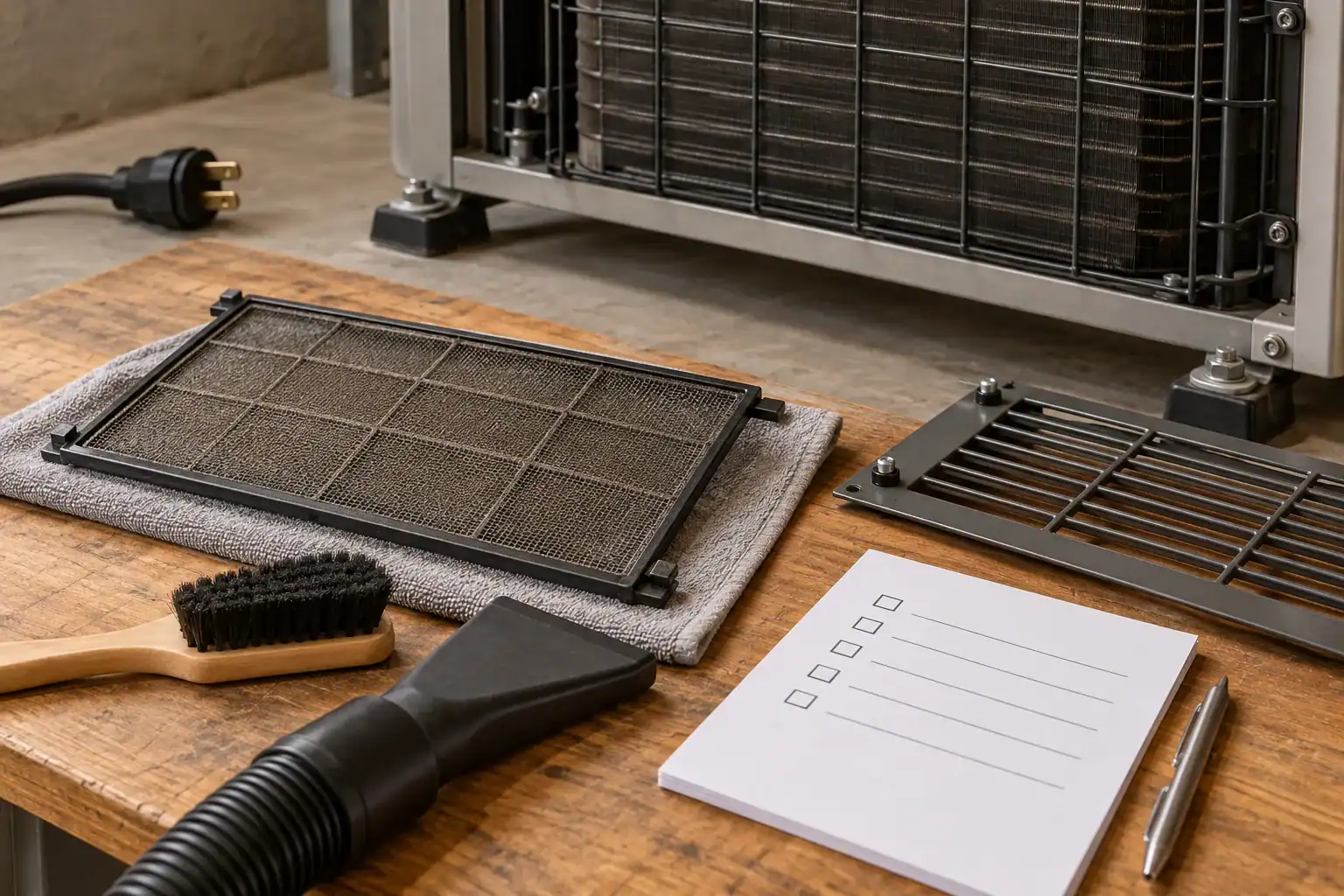
Put dust-control requirements in the condenser RFQ
Send a package that lets the supplier distinguish the coil requirement from the cabinet’s contamination-control design. Include:
- Cabinet drawing with intake, exhaust, grille, screen and service envelope.
- Refrigerant, compressor operating data, heat-rejection duty and required rating conditions.
- Fan identification or curve, installed airflow target and pressure-loss basis.
- Photos and description of the actual lint, dust or grease problem.
- Proposed screen material, opening, exposed area, mounting and loaded condition, if applicable.
- Cleaning method, inspection trigger, quantities, drawing revision and sample acceptance plan.
Have the supplier state the assumptions, exclusions and available evidence for each proposed configuration. A bare-coil quotation does not include a validated filter assembly unless the scope says so. Assign responsibility for the final cabinet, screen sourcing and service instructions explicitly.
For production release, keep the approved coil, fan, grille, screen and installation revisions together. A mesh substitution or grille change can alter the air path even when the condenser part number remains unchanged. Define which changes require review before purchasing substitutes.
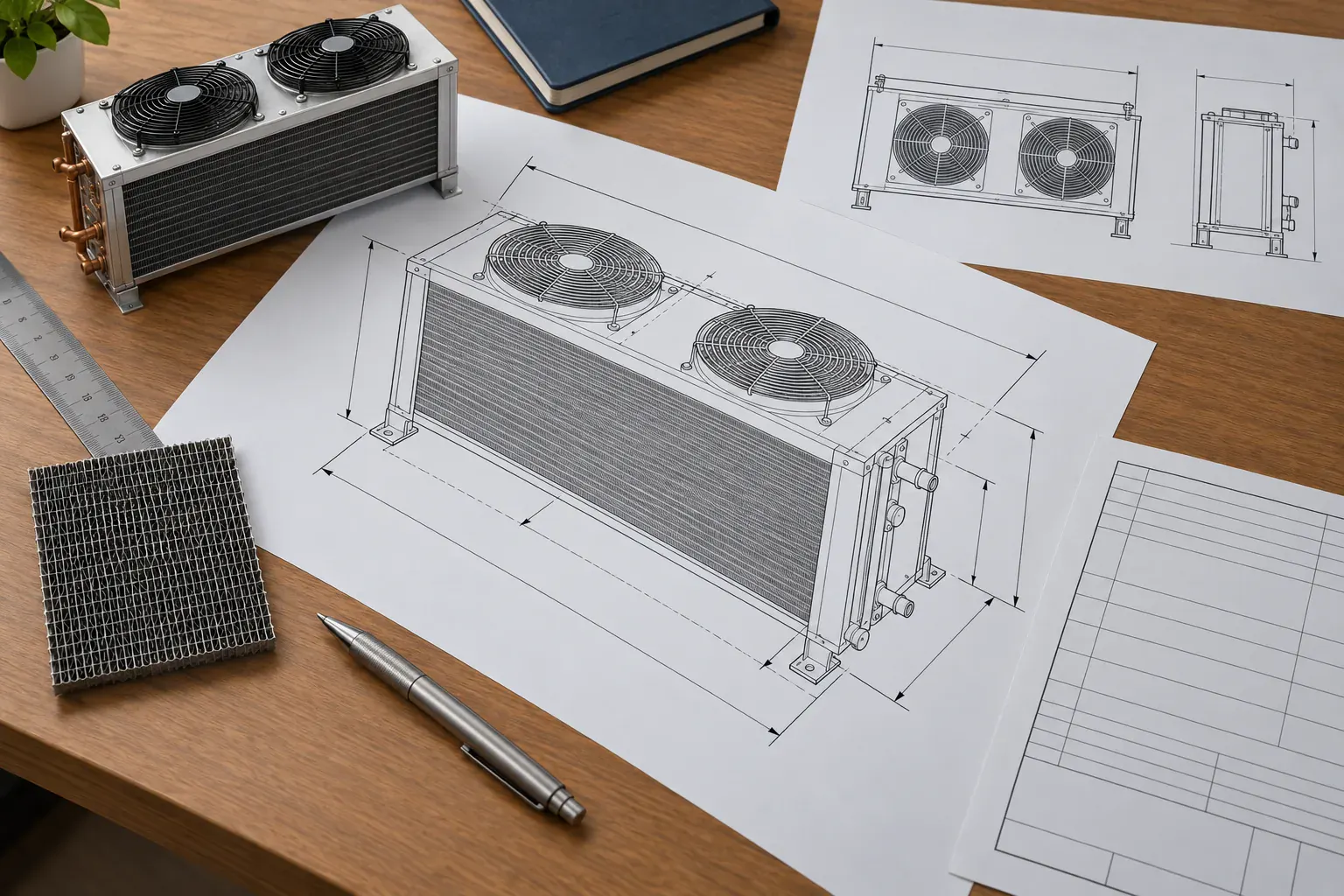
Frequently asked questions
Can a retail beverage cooler condenser be completely dust-proof?
An air-cooled condenser exposed to store air needs a defined contamination and maintenance strategy. Specify the conditions it must tolerate and how deposits are removed. An absolute dust-proof claim needs a stated test basis and must remain compatible with the cabinet’s ventilation requirements.
Can I add a foam filter to an existing beverage cooler?
Obtain approval for the equipment model first. Some manufacturers advise against added filters because of restricted cooling airflow. Filter appearance or nominal size does not establish suitability; review clean and loaded resistance, materials, retention and the service procedure.
Is a wider fin pitch always better for dusty stores?
No. It changes surface area, pressure loss and packaging as well as cleaning access. Compare candidate coils at the same required duty and installed air conditions, then evaluate contamination behavior. A geometry change may require a different face area or fan arrangement.
Does a self-cleaning condenser remove grease?
That depends on its mechanism and the manufacturer’s instructions. Turbo Air’s cited manual identifies grease as a limitation of its condenser cleaner. A device that handles loose lint should not be assumed to remove sticky deposits or eliminate all inspection work.
How often should a condenser dust screen be cleaned?
Start with the equipment manual and the site conditions. Set an inspection routine that can identify loading before the agreed operating limits are exceeded. Log the condition at each service visit. Another model’s monthly or two-month interval does not establish the correct interval for yours.
Can a clogged condenser cause compressor overheating?
Restricted heat rejection can contribute to excessive operating temperatures, but the symptom does not identify contamination as the only cause. A qualified technician should check the fan, inlet and outlet, ambient, load, controls and refrigeration circuit against the equipment data before prescribing a repair.
What should happen if store staff leave the screen out?
Define the response during equipment development. Check contamination exposure, guarding and any changed airflow or user instruction. A missing-screen state belongs in the development review; it is not permission to run equipment without required parts or defeat a protective function.
Does passing a lint test prove cabinet energy compliance?
No. A development test evaluates a stated configuration under its own conditions. Required appliance safety and energy evidence follow their applicable procedures. Keep those boundaries separate, and document whether each result describes a component, an assembled air path or the complete cooler.
Send the contamination evidence with the cabinet drawing
Choose the approach that the equipment can sustain between realistic service visits. Before release, confirm the loaded operating state, the cleaning access and who owns the complete assembly. A screen is useful only when its added resistance and maintenance demands fit the cabinet.
Domi’s commercial cooling coil range includes condenser coils and beverage cooler heat exchangers, with drawing and sample information used for project review. For a recurring lint problem, send the cabinet layout, coil dimensions, fan data and photographs taken before cleaning. State whether the inquiry covers a bare coil or a proposed air-side assembly.
Include the operating requirements and the evidence you need returned with a proposal. Domi can review the supplied information and identify open items; screen availability, fouling-test scope, performance, lead time and commercial terms require confirmation for the project.