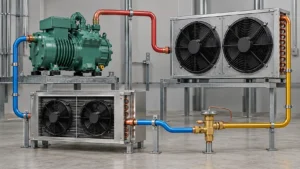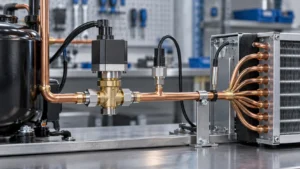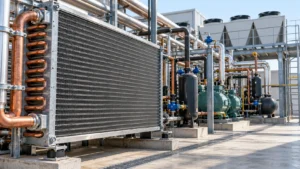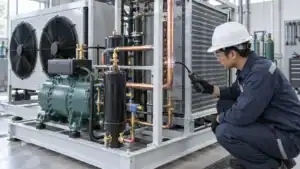

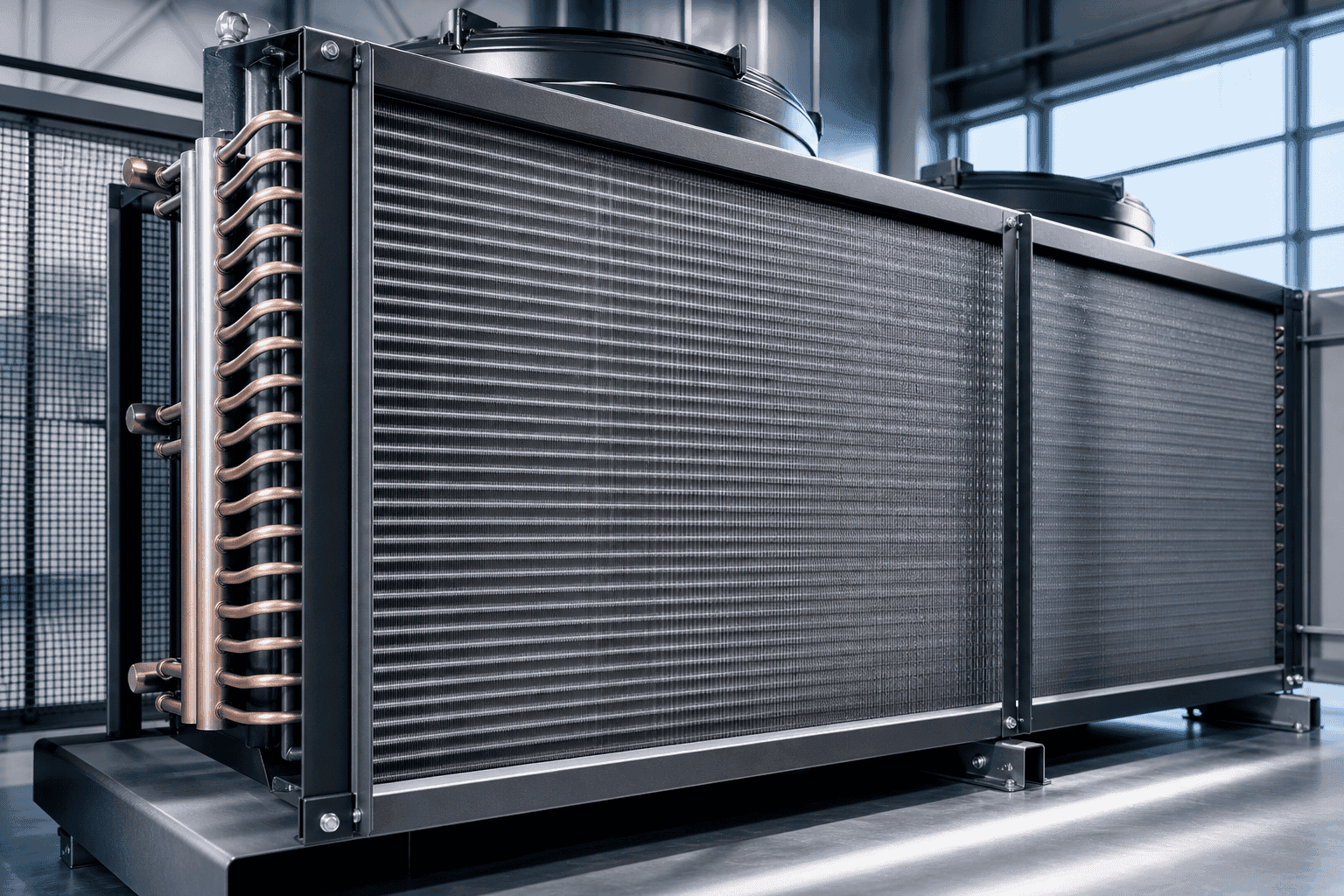
An air cooled condenser rejects refrigerant heat to ambient air through a finned heat-transfer surface and a fan system. Commercial selection depends on heat-rejection duty, refrigerant and condensing conditions, ambient design temperature, airflow, fan arrangement, fin and tube materials, circuiting, noise, fouling, corrosion, service access, and the approved equipment envelope.
The phrase air cooled condenser covers more than one market. Search results can include power-generation dry cooling, industrial heat-transfer equipment, air-conditioning condensers, remote refrigeration condensers, and small condensing units. The equipment may share a general principle, but the design duty and buyer inputs are different.
This guide narrows the discussion to commercial refrigeration and cooling equipment. It is intended for OEM engineers, refrigeration equipment integrators, cold-room and food-service buyers, distributors, maintenance teams, and procurement managers. It does not treat a power-generation dry condenser as interchangeable with a commercial refrigeration condenser. It also does not replace a project rating, refrigerant safety review, or final equipment approval.
The air cooled condenser sits on the high side of a refrigeration or cooling circuit. The compressor raises the refrigerant pressure and temperature. The condenser transfers heat from the refrigerant to the surrounding air. The fan and coil have to work together at the ambient condition the equipment will actually see. A component that looks large enough may still miss the required condensing condition if the fan, airflow path, fin spacing, or circuiting is wrong.
What an air cooled condenser does
An air cooled condenser changes the refrigerant from a high-temperature vapor toward a liquid by rejecting heat to air. The heat rejected includes the heat absorbed at the evaporator plus compressor work. In a refrigeration system, the air cooled condenser therefore affects head pressure, subcooling, compressor operation, expansion-device behavior, and the ability of the system to maintain the target condition.
The condenser is not a stand-alone capacity number. It has a rating point. That point may include refrigerant, condensing temperature, entering air temperature, airflow, fan speed, subcooling, fouling condition, and pressure drop. A quotation should show the basis. Without that information, two condenser capacity numbers cannot be compared fairly.
Commercial refrigeration condenser versus dry cooling equipment
Some search results for air cooled condenser describe steam condensation in power plants. That equipment can use large finned tube bundles and fans, but its working medium, temperature range, layout, controls, and duty are not the same as a commercial refrigerant condenser. A commercial buyer should state whether the project concerns refrigerant heat rejection, process cooling, a chiller, or another application.
For commercial refrigeration, the equipment may be a remote condenser, a condensing unit, a cabinet condenser, a condenser coil inside a package, or a custom heat-rejection assembly. State which arrangement applies. The words remote condenser or air cooled condenser alone do not define the mounting, fan, coil, or control scope.
Condenser coil and fan relationship
The fan moves ambient air through the finned surface. The fan curve, blade, guard, motor, speed, rotation, air path, and discharge arrangement influence the coil rating. A coil selected without the fan can be over- or under-ventilated. A fan selected without the coil can fail to provide the needed airflow at the installed pressure drop.
If the project uses an electronically commutated motor, variable-speed control, or a specific fan arrangement, state it. If the fan is not in the supplier scope, provide the expected airflow and external pressure. The supplier should label whether the rating uses an assumed fan or the actual fan curve.
| Air cooled condenser application | Typical heat source | Main design inputs | Boundary to define |
|---|---|---|---|
| Remote refrigeration condenser | Refrigerant from a compressor system | Heat rejection, refrigerant, ambient, airflow, fan, connections | Whether fan, frame, controls, and receiver are included |
| Condensing unit coil | Refrigerant and compressor package | Compressor duty, condensing condition, airflow, cabinet | Whether the coil is rated with the actual fan and compressor |
| Commercial display or food-service equipment | Refrigerant and cabinet load | Ambient, fouling, noise, space, cleaning, refrigerant | Whether the part is fit-only, duty-match, or redesign |
| Chiller or cooling package condenser | Refrigerant and system heat load | Operating modes, ambient, fluid loop, controls | Whether the rating covers all modes and ambient points |
| Industrial or process air cooler | Refrigerant or process medium | Duty, medium, pressure, airflow, environment | Whether the unit is a condenser, cooler, or another heat exchanger |
Put the application boundary on the RFQ. It prevents a generic term from carrying an incorrect design assumption.
Define the heat-rejection duty
The first step is to state the heat that the condenser must reject and the condition at which it must reject it. The value can come from a compressor selection, system simulation, equipment rating, measured field condition, or a preliminary estimate. Label the source. If the value is not final, call it a target or budgetary condition.
Refrigerant and operating condition
State the refrigerant designation and any project-specific safety or regulatory requirements. Include condensing temperature or pressure, expected subcooling basis, compressor discharge condition, liquid temperature target, and operating range. A refrigerant change can alter pressure, material questions, control settings, and circuiting. Do not assume that an existing air cooled condenser is directly compatible with a new refrigerant because the tubes and fins look similar.
For a new refrigerant or system change, the responsible engineer should review the applicable requirements. The U.S. EPA Section 608 refrigerant management requirements provide a public reference for certain United States obligations. A public article cannot certify a specific equipment package. That approval belongs in the project record.
Ambient air condition
State the design ambient temperature, operating range, altitude if it affects air density, and whether the rating is for clean or fouled operation. Summer ambient, solar exposure, enclosure location, recirculation, and nearby exhaust can raise the effective air temperature at the coil face.
Air density and fan performance can change with altitude. A condenser on a rooftop, in a plant room, or beside another heat source may see different air than a laboratory rating. Note the air path and the clearance around the coil. If the site condition is unknown, keep it as an open point.
Airflow and fan limits
Airflow should be tied to the fan curve and the condenser pressure drop. Include fan speed, motor, control mode, blade direction, inlet and outlet arrangement, guard, grille, filter, and any louver or duct. If the project uses variable-speed control, provide the range and the control signal.
A higher airflow may reduce condensing temperature under one condition, but it can increase sound, power, dust transport, and mechanical load. The design should balance heat rejection with the limits of the equipment and site. Avoid writing a universal percentage improvement or fixed sound value without a verified test basis.
Select fins, tubes, and circuiting
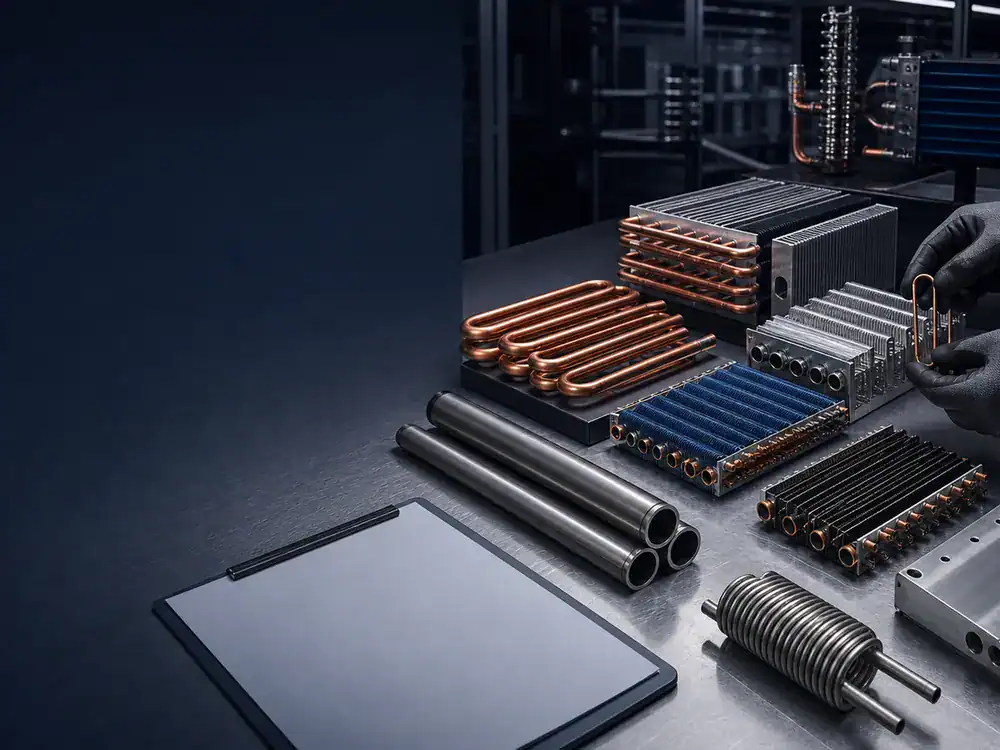
The heat-transfer surface is a system of tubes, fins, headers, circuits, frame, and air path. Tube material and diameter, fin material and spacing, rows, pattern, circuit length, headers, and connection position affect the rating and service result.
Fin spacing and fouling
Fin spacing affects surface area, air-side pressure drop, cleaning access, dirt retention, and the response to bent fins. A tight fin pitch can support a compact coil, but it may become difficult to clean in a dusty or greasy environment. A wider fin pitch can leave more open space, but it may require more face area or depth to meet the duty.
Describe the cleaning method and contamination. Dry dust, grease, salt, fibers, and chemical residue do not create the same service problem. The condenser may need a different surface arrangement from an evaporator in the same equipment. If the site uses high-pressure washing, include the pressure, chemical, direction, and frequency that the material must tolerate.
Tube and fin materials
Copper tubes with aluminum fins are common in many condensers, but the material selection should follow the working medium, environment, joining method, service plan, and production capability. Aluminum tubes, stainless components, coated fins, and other combinations may be considered for particular applications.
Do not specify a coating by brand or broad marketing name alone. Ask which surfaces are coated, how edges and joints are treated, what preparation is used, what test evidence is available, and how the site will clean or repair the part. If a coating, certification, corrosion grade, or service-life claim has not been confirmed by the business, write REQUIRES BUSINESS INPUT.
Circuiting and headers
Circuiting controls refrigerant distribution and pressure drop. A circuit change can affect velocity, oil return, liquid distribution, temperature uniformity, and system controls. The header, distributor, inlet, outlet, and receiver connection also affect how the condenser connects to the equipment.
Show the circuit direction and connection location on the drawing. State whether the condenser must support one mode or several. If the system has a receiver, liquid line, subcooler, bypass, head-pressure control, or heat-recovery connection, show its relationship to the condenser. The supplier should not have to infer the system arrangement from a product keyword.
| Design input | What to record | Why the air cooled condenser may change |
|---|---|---|
| Heat rejection | Duty source, compressor, rating points, operating range | Sets required surface and rating boundary |
| Refrigerant side | Refrigerant, condensing condition, pressure, subcooling | Changes circuiting, material, controls, and safety review |
| Air side | Ambient, airflow, fan curve, altitude, recirculation | Changes capacity, pressure drop, sound, and fan power |
| Construction | Tube, fin, rows, pitch, headers, connections | Changes heat transfer, service, weight, and fit |
| Environment | Salt, dust, grease, chemicals, wash-down, corrosion | Changes surface, drainage, cleaning, and inspection |
| Installation | Cabinet, frame, clearances, orientation, access | Determines whether the part can be installed and maintained |
This input record should follow the drawing and quotation. If one value changes, the supplier can identify which part of the design needs a new review.
Address noise, recirculation, and service access
An air cooled condenser rejects heat into the surrounding air, so the air path matters after installation. If hot discharge air returns to the inlet, the effective ambient temperature rises. A wall, roof, louver, enclosure, or nearby condenser can change the flow. The design should show inlet and discharge clearances and any restriction created by the cabinet.
Noise may come from the fan, motor, airflow through the fins and guard, vibration, or the mounting frame. State the sound target and measurement distance if it is a project requirement. Do not copy a catalog sound value into an installed guarantee without confirming the test basis.
Service access includes fin cleaning, fan removal, motor inspection, connection access, leak checking, and coil replacement. A compact condenser can create a maintenance problem if the fan guard or coil cannot be removed without dismantling the cabinet. Include the removal path and service side in the drawing.
Build an air cooled condenser RFQ
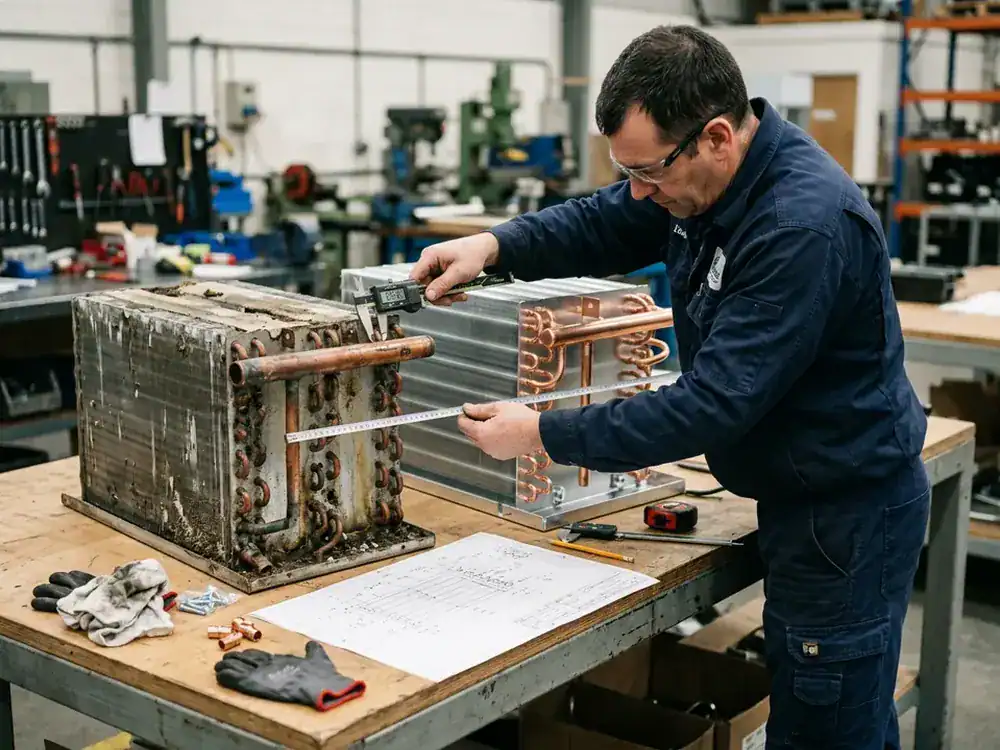
The RFQ should identify the application, heat rejection, refrigerant, condensing condition, ambient, airflow, fan, coil dimensions, connections, materials, environment, quantity, destination, and requested documents. If the part is a replacement, add the old coil, measured dimensions, failure area, equipment model, and whether the goal is exact fit, duty match, or improvement.
Ask for a rating sheet that names the refrigerant and test condition. Request the proposed coil and fan interface, circuiting or connection drawing, material list, pressure-drop information, inspection points, and packaging orientation. If the supplier is responsible for the fan, request the fan curve, motor, control range, power, and sound basis.
Separate prototype, tooling, testing, packaging, and production terms. The requested quantity may be a sample, pilot, or repeat order. State the required delivery destination and any customer document. If a lead time, MOQ, certificate, or test is not confirmed, mark it REQUIRES BUSINESS INPUT rather than filling a generic value.
| RFQ phase | Supplier response | Buyer approval check |
|---|---|---|
| Application review | Interpretation, open questions, and rating assumptions | Are duty, refrigerant, ambient, and fan conditions correct? |
| Preliminary design | Geometry, materials, circuiting, connections, and fan interface | Does the design fit and meet pressure and service limits? |
| Sample or prototype | Sample drawing, measurements, tests, and open-point list | Does the sample represent the intended production design? |
| Production release | Controlled drawing, inspection plan, packaging, and change control | Does the order reference the approved revision? |
Consider the condenser’s operating range
Many commercial systems do not run at one fixed point. The air cooled condenser may operate at mild and hot ambient conditions, during low load, during pull-down, or with variable-speed fans. State which points matter for the equipment and which are used for approval.
At low ambient, the system may need head-pressure control, fan cycling, fan speed control, a receiver, or another method to maintain stable expansion-device operation. At high ambient, the condenser may need enough surface and airflow to avoid excessive condensing pressure. The coil, fan, controls, and refrigerant charge should be reviewed as a system.
Do not copy a fixed cut-in or cut-out temperature into every design. The correct control depends on the refrigerant, equipment, compressor, expansion device, receiver, ambient range, and manufacturer requirements. Use the control concept in the equipment specification and leave unconfirmed thresholds as REQUIRES BUSINESS INPUT.
Remote and packaged arrangements
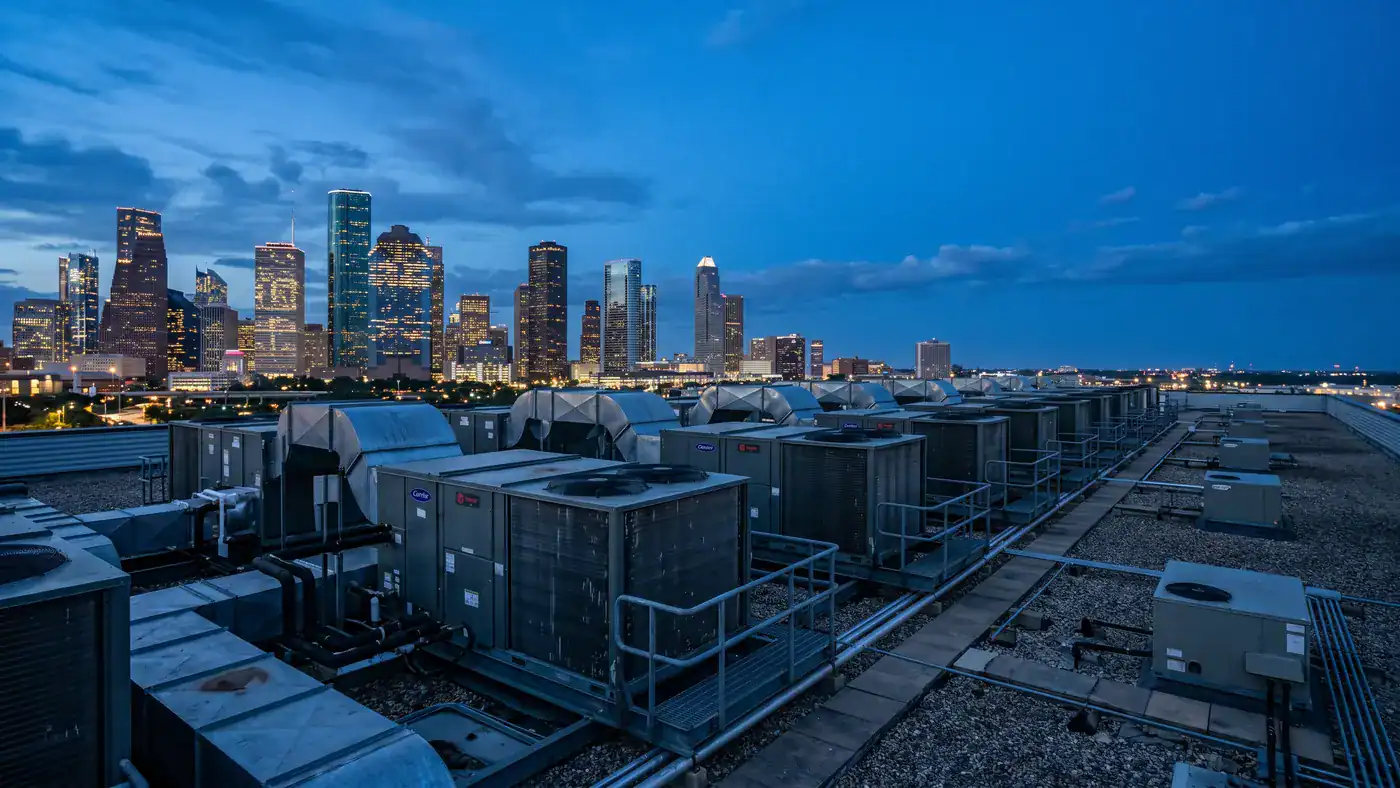
A remote air cooled condenser can be installed outside the main cabinet and connected by refrigerant piping. The piping length, elevation, oil return, liquid storage, insulation, and service valves can affect the equipment. A packaged condenser is already integrated with a cabinet, fan, compressor, receiver, or controls. The RFQ should state which arrangement applies.
Remote installations may see a different ambient and air path from the compressor cabinet. A long liquid line may change pressure drop and subcooling. A roof or wall location may need lifting, mounting, wind, noise, and access review. These system details are outside a simple coil-only rating but should be visible to the project team.
Heat recovery and special connections
Some equipment uses a condenser for heat recovery, desuperheating, liquid subcooling, or another process connection. If the condenser has more than one circuit or outlet, show the piping and control intent. A heat-recovery connection can change the rating condition and the way the condenser is controlled.
Do not assume that a standard inlet and outlet will support a special operating mode. Request a drawing and rating for each mode. If one port, receiver, valve, or control is not in the supplier scope, write that boundary on the quotation.
Choose the fan and motor deliberately
The fan is part of the heat-rejection design. State the fan diameter or arrangement if known, motor type, speed range, rotation, control signal, guard, louver, and allowable sound. If the fan is supplied by another party, provide the actual curve or the required operating point at the condenser pressure drop.
Variable-speed fans can reduce airflow at low load or mild ambient, but the control needs a stable sensor and a defined response. Fan cycling can create temperature swings and sound changes. A fixed-speed fan may have a simpler service path but less modulation. The right decision depends on the equipment and control plan.
The motor and fan mount should be checked for vibration, service, weather, and electrical scope. A coil drawing can show the fan interface, but it does not automatically prove the complete fan and motor assembly. Keep the supplier’s scope clear.
Treat corrosion as a system problem
A condenser coil can be exposed to salt air, dust, grease, chemical vapor, wash-down, rain, condensation, and dissimilar metals. Corrosion can begin at fins, tubes, headers, joints, frame, fasteners, or drain areas. A coating may help one surface but leave a joint or edge exposed.
The buyer should describe the exposure and cleaning method. Ask which material or surface option is proposed, how the part is prepared, what test evidence is available, how damaged areas are repaired, and whether cleaning chemicals are compatible. If the customer asks for a coating or corrosion class that the business has not confirmed, use REQUIRES BUSINESS INPUT.
Drainage can matter even on an air cooled condenser. Rain, wash-down, or condensation can collect on a frame or pan. Water that remains near dissimilar metals or a coated edge can create a local failure. Show drainage and mounting orientation on the drawing.
Validate the condenser before production release
The validation plan should reflect the design risk. A basic condenser may need dimensional, leak, pressure, fan, airflow, and thermal checks. A corrosive or wash-down application may need additional surface or corrosion testing. A variable-speed system may need several operating points. A complete condensing unit may need system-level checks that the coil supplier cannot perform alone.
Define conditions before testing. Record refrigerant, inlet state, condensing condition, ambient air, airflow, fan speed, power, instrumentation, sensor locations, and acceptance criteria. If an input is simulated, state the simulation. If the rating is a calculation, keep the calculation assumptions with the sample record.
The AHRI standards and certification resources can help the engineering team locate applicable rating references. The ASHRAE standards and guidelines resource provides another reference point. The standard scope must be checked for the actual condenser construction and condition.
If the condenser has a coating, ask for the test method and surface preparation record. If the condenser has a special material, ask how joints, headers, fasteners, and service repair will be handled. Do not treat a material name as a complete corrosion plan.
Air cooled condenser maintenance questions
Maintenance starts with a clear air path. Keep the inlet and discharge clear. Inspect fins for dirt, grease, salt, and damage. Check fan rotation, mounting, guard, motor, and control. Inspect connections and headers for signs of leakage or vibration. Record whether the unit is clean, fouled, wet, or affected by recirculated discharge air.
Cleaning should follow the equipment and coil manufacturer’s instructions. Aggressive pressure or chemicals can bend fins, damage coatings, remove protective layers, or force water into areas that should remain dry. State the cleaning method in the service plan and ask the supplier whether the proposed construction is compatible.
A condenser problem may be a system problem. High head pressure can relate to dirty fins, inadequate airflow, fan control, ambient conditions, refrigerant charge, noncondensables, restrictions, or another issue. Replacing the coil without diagnosing the system may repeat the failure. A buyer should include the failure pattern in a replacement request.
Air cooled condenser selection checklist
Before asking for a quotation, prepare:
- Application and equipment type, including refrigeration, air-conditioning, chiller, process, or another system.
- Heat-rejection duty, compressor information, rating points, operating range, and whether the value is measured or estimated.
- Refrigerant designation, condensing condition, pressure, subcooling basis, and safety or regulatory requirements.
- Ambient design temperature, operating range, altitude, recirculation, enclosure, and clearance.
- Airflow, fan type, motor, speed, control signal, sound target, and external restriction.
- Face width, height, depth, rows, fin spacing, tube pattern, headers, connections, frame, mounting, and service path.
- Salt, dust, grease, chemicals, wash-down, humidity, frost, corrosion, cleaning method, and coating requirements.
- Quantity, sample or prototype need, drawing format, inspection plan, packaging, destination, and change-control expectations.
- Missing capacity, coating, certification, test, MOQ, lead-time, or service information marked
REQUIRES BUSINESS INPUT.
Domi project discussion
Domi’s commercial cooling coils page is the appropriate internal link for a buyer who needs commercial cooling components. For a replacement or custom air cooled condenser, send the old coil, measured envelope, connections, fan information, refrigerant, ambient condition, heat-rejection target, quantity, and destination.
The industrial refrigeration condenser page provides a related application path. The custom coil fabrication page and engineering capabilities page provide additional internal routes for drawing and design discussions. The exact material, performance, test, MOQ, timing, and commercial terms must be confirmed for the project.
When the system has a known head-pressure or airflow problem, include the field record. A supplier needs to know whether the request is for a new design, a direct-fit replacement, a corrosion correction, a fan change, or a complete system review. That distinction keeps the quotation honest.
Review a condenser quote by operating condition
An air cooled condenser quotation should show the condition behind the proposed capacity. Ask for the refrigerant or working medium, entering condition, condensing temperature or pressure, ambient temperature, airflow, fan speed, and any subcooling basis. A capacity number without those inputs cannot be compared fairly with another offer. If the supplier used a catalog rating, keep the reference and the rating point with the quote.
Check whether the quoted duty is a design target, a guaranteed value, a calculated estimate, or a test result. These are different types of evidence. A calculation can be appropriate for an early design, while a sample test may be needed for release. The buyer should not turn a preliminary estimate into a guaranteed claim by copying the number into a purchase order.
Review the operating range as well as the nominal point. An air cooled condenser may run at mild and high ambient conditions, during pull-down, at part load, or with a variable-speed fan. Ask whether the fan control and head-pressure strategy can keep the system within its intended range. If the unit is installed in an enclosure, include recirculation and clearance assumptions.
The quotation should identify the air-side restrictions. Filters, guards, louvers, grilles, acoustic treatment, duct transitions, and nearby equipment can change airflow and pressure drop. A compact condenser that looks suitable on paper may lose performance when the actual air path is restricted. Ask who owns the fan selection and whether the coil rating assumes a particular fan.
Make the service path part of the design
Service access is a design input, not an afterthought. Show the space needed to inspect fins, clean the coil, check headers, remove a fan, disconnect electrical parts, and repair a joint. If the condenser will be mounted above a food-service area, on a roof, in a plant room, or near a wall, describe the lifting and cleaning route. The final installation still requires project confirmation, but the supplier needs the constraint early.
For a replacement air cooled condenser, compare the old part with the proposed part at the interface level. Confirm mounting, fan opening, guard, connection orientation, liquid outlet, discharge inlet, service valves, drain or rain path, and clearance. A new coil can have the same face size and still fail to fit because the header, frame, or fan position changed.
Maintenance records can guide the next version. If fins became blocked, ask whether the fin spacing or access method should change. If salt or chemicals caused attack, document the exposure and cleaning cycle before selecting material or coating. If the failure involved vibration, inspect supports, fan balance, tubing restraint, and joint loading. Do not assume that a thicker tube alone fixes a system-level problem.
The final air cooled condenser approval should include the drawing, rating basis, material list, inspection plan, test conditions, packaging notes, and open-point list. If a certificate, coating, lead time, MOQ, or performance value has not been confirmed, mark it REQUIRES BUSINESS INPUT. That label keeps the document useful without presenting an unverified commercial promise.
Air cooled condenser FAQ
What is an air cooled condenser?
An air cooled condenser rejects heat from a refrigerant or another working medium to ambient air. A finned heat-transfer surface and fan move the heat away. Commercial selection depends on the duty, refrigerant, ambient, airflow, construction, connections, and installation environment.
Is an air cooled condenser the same as a dry cooler?
They can look similar, but the working medium and application may differ. A refrigeration condenser rejects refrigerant heat. A dry cooler often rejects heat from water or glycol. Power-generation dry cooling equipment can have another duty and arrangement. Define the medium and application before comparing products.
What information is needed for an air cooled condenser quote?
Provide heat-rejection duty, refrigerant, condensing condition, ambient temperature, airflow, fan, dimensions, fin and tube requirements, connections, environment, quantity, destination, and requested documents. For a replacement, add the old coil, failure record, and measured interfaces.
How does ambient temperature affect condenser selection?
The condenser rejects heat to ambient air. A higher ambient condition reduces the temperature difference available for heat rejection and can change the required surface, airflow, fan speed, and operating condition. Use the actual design ambient and identify recirculation or enclosure limits.
Does more condenser surface always improve performance?
More surface may increase capacity under a defined condition, but it can also raise cost, weight, pressure drop, dirt retention, and cabinet size. The design should balance heat rejection, fan duty, service, corrosion, and the system’s controls.
What fin spacing should an air cooled condenser use?
Fin spacing depends on duty, airflow, dirt, grease, salt, frost risk, cleaning method, and available face area. A tighter pitch is not automatically better. The supplier should rate the proposed spacing and explain the maintenance boundary.
Can an existing condenser use a different refrigerant?
Do not assume direct compatibility. Refrigerant changes can affect pressure, temperature, material, circuiting, controls, oil, safety, and system approval. The responsible engineer should review the full system and confirm the replacement basis.
Can Domi quote a custom air cooled condenser?
Domi’s commercial cooling page provides a route for a component and application discussion. Send the drawing, refrigerant, heat-rejection target, ambient, fan, connections, environment, quantity, and destination. The specific supply scope and performance must be confirmed against the project documents.