
An evaporator transfers heat into a liquid so that some or all of that liquid becomes vapor. In refrigeration, the evaporating liquid is the refrigerant and the useful result is cooling. In process equipment, evaporation removes a solvent, often water, to concentrate a product. Those two uses share a physical principle but require different equipment.
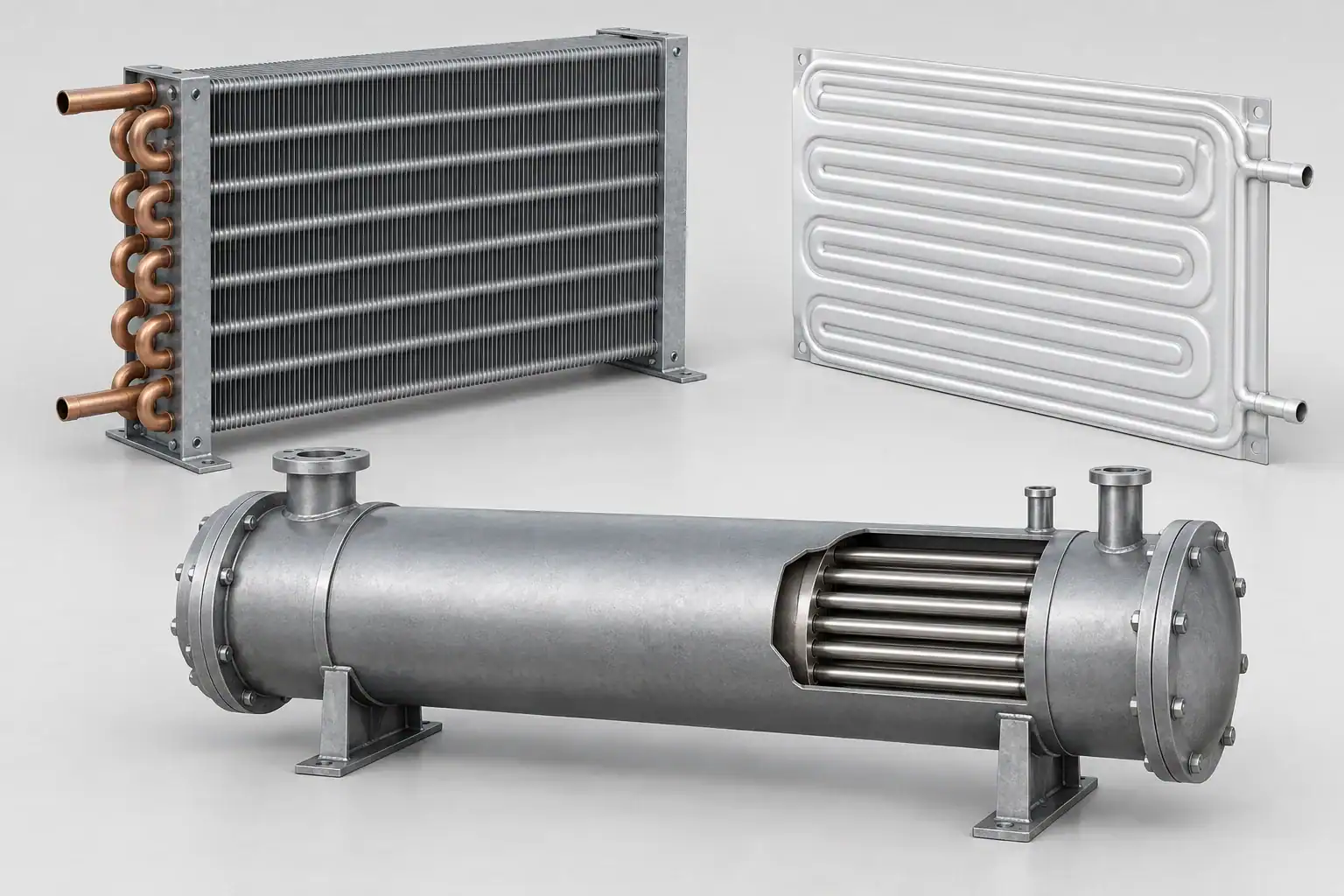
Common refrigeration evaporators include fin-and-tube coils, roll-bond plates, shell-and-tube units and plate heat exchangers. They may use direct expansion, flooded operation or refrigerant recirculation. Process evaporators include falling-film, rising-film, forced-circulation and wiped-film designs.
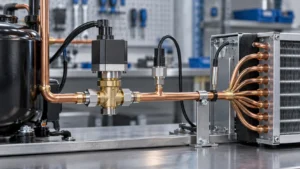
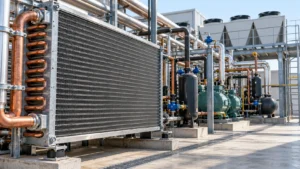
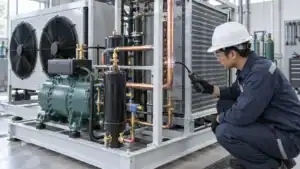
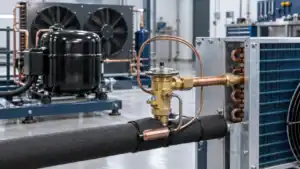
This guide explains 40 named types and configurations. The categories overlap: a cold-room unit can be finned, fan-assisted and direct-expansion at the same time. Read the group heading before comparing two names. The illustrations show generic concepts, not Domi product photographs, project installations or construction drawings.
Browse the guide
- Start with what is evaporating
- 1-5: Refrigerant feed and boiling arrangements
- 6-10: Coil and plate constructions
- 11-15: Evaporators that cool water or another liquid
- 16-20: Air movement and installation formats
- 21-25: Application-specific evaporators
- 26-30: Circuiting and defrost configurations
- 31-40: Process evaporators and concentration arrangements
Start with what is evaporating
Ask one question before requesting a quotation: which liquid changes into vapor? If it is refrigerant inside a closed cooling circuit, use the refrigeration sections below. If it is water or solvent being removed from a feed, use the process-concentration section. A chilled-water coil that contains liquid water throughout is a cooler, not itself a refrigerant evaporator.
The word “dry” also needs care. A dry-expansion evaporator contains boiling liquid over much of its refrigerant path. The name refers to its operating arrangement, commonly with superheated vapor at the outlet; it does not mean that the entire internal surface is dry. Nor does it tell you whether moisture condenses on the outside.
For a quick comparison, identify four attributes:
- Duty: cooling air, cooling liquid, freezing a product, or concentrating a feed.
- Construction: tubes, fins, plates, a drum or a heated film surface.
- Operating arrangement: DX, flooded, recirculated, batch or continuous.
- Installation constraints: space, cleaning access, drainage and the available utilities.
Keep the purchase specification separate from the type name. The existing industrial refrigeration evaporator selection guide covers the rating and quotation inputs once you have identified the family.
1-5: Refrigerant feed and boiling arrangements
These names describe how refrigerant reaches and wets the heat-transfer surface. They do not specify the casing, tube material or application. The Danfoss industrial refrigeration handbook explains the distinction between evaporator control and pumped circulation; detailed system design still needs a rated selection and a qualified engineer.
1. Direct-expansion evaporator
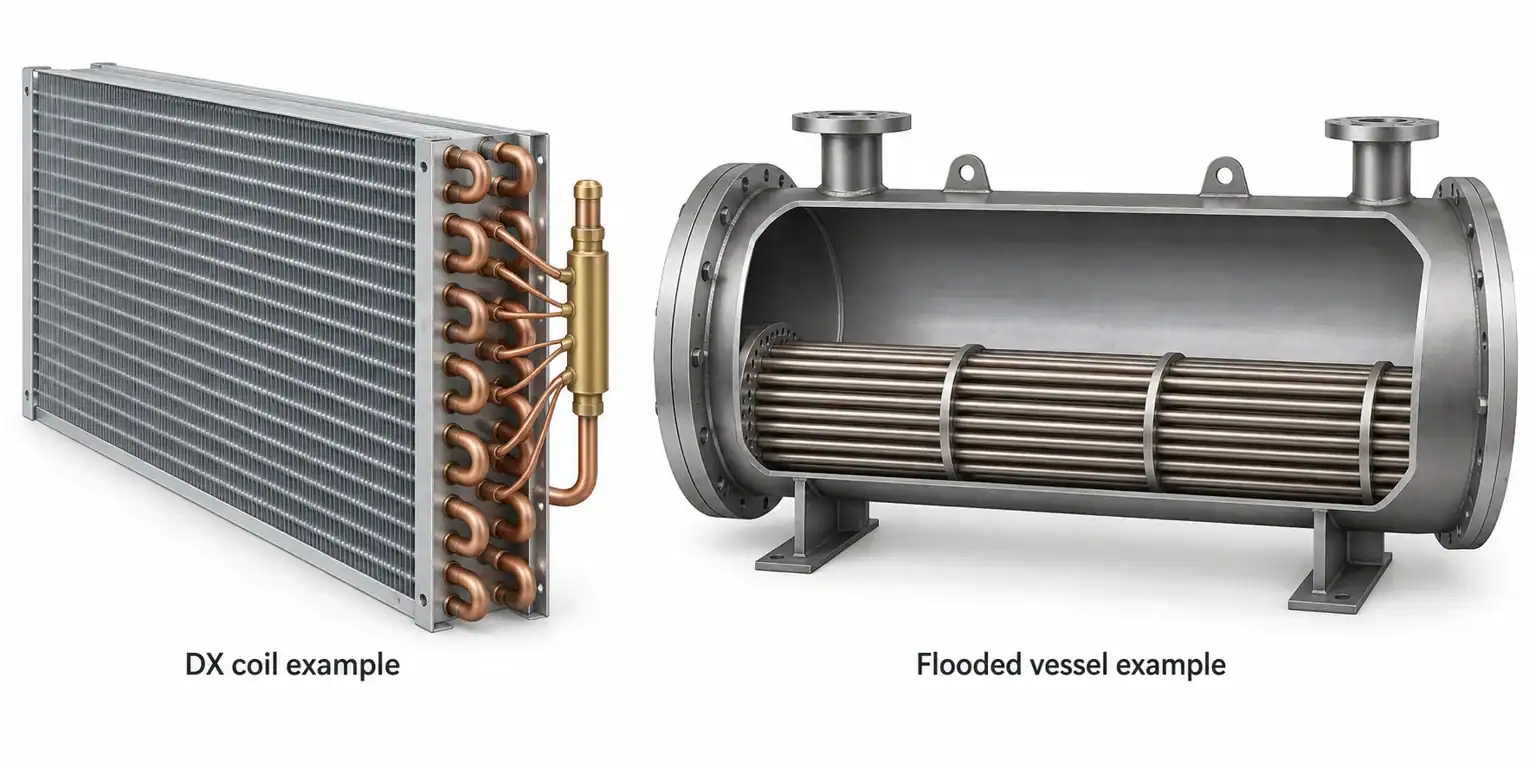
A direct-expansion, or DX, evaporator meters refrigerant into the heat exchanger and evaporates it as heat enters from the load. Many systems regulate outlet superheat to manage the feed. DX suits packaged air conditioning, commercial refrigeration and purpose-designed industrial equipment. It avoids a separate pumped-overfeed loop, but the distributor, circuits and expansion control must work together across the expected load range. A coil with the right external size can still perform poorly if its internal distribution does not match the refrigerant and duty. Ask for the rating conditions and minimum-load operating limits, not only nominal capacity.
2. Flooded pool evaporator
In a flooded pool arrangement, liquid refrigerant surrounds a heat-transfer surface while vapor separates above it. A common example is a chiller with water inside tubes and refrigerant boiling on the shell side. Maintaining a wetted surface can support close temperature approaches, although the complete result depends on the design. This arrangement needs liquid-level management, vapor separation and an oil-management strategy. It is a poor match for a project that assumes the vessel can be substituted for a DX unit without revisiting controls, refrigerant inventory and service access.
3. Gravity-recirculated evaporator
A gravity-recirculated evaporator connects to a separator so that differences in fluid density drive circulation. Liquid travels toward the evaporator and a lighter vapor-liquid mixture returns to the separator. The arrangement can keep surfaces supplied with liquid without a mechanical refrigerant pump. Its usefulness depends strongly on relative elevation and pipe resistance, so a compact equipment layout may remove the driving head it needs. Treat the separator and connecting lines as part of the selection. A coil alone cannot establish whether the gravity circuit will circulate adequately.
4. Pumped-overfeed evaporator
A pumped-overfeed system supplies more liquid refrigerant than the evaporator boils during one pass. The outlet mixture returns to a separator, and unevaporated liquid circulates again. This is an established arrangement for industrial facilities with multiple evaporators. The added equipment includes pumps, separation vessels and distribution piping; those components affect installation, operating inventory and maintenance. Choose it as a system architecture, not as a coil feature. Confirm how the plant manages part load, pump operation, defrost and liquid separation before comparing evaporator quotations.
5. Falling-film refrigerant evaporator
Here, a distributor spreads refrigerant over heat-transfer surfaces as a film instead of submerging the full bundle in a deep pool. Refrigerant boils as the film absorbs heat from the fluid being cooled. Chiller designers may use this arrangement to reduce liquid inventory while retaining useful surface wetting. The distribution system becomes particularly important at low load: uneven coverage can leave part of the surface underused. This is different from a process falling-film concentrator, where the film is the product or solvent-containing feed. Confirm the evaporating fluid before using the same name in an RFQ.
6-10: Coil and plate constructions
Construction determines how an evaporator fits into equipment and how heat reaches the refrigerant. Any of these forms may be paired with a suitable feed arrangement. Compare them at the conditions in which they will actually run; the construction name does not establish capacity or efficiency.
6. Bare-tube evaporator
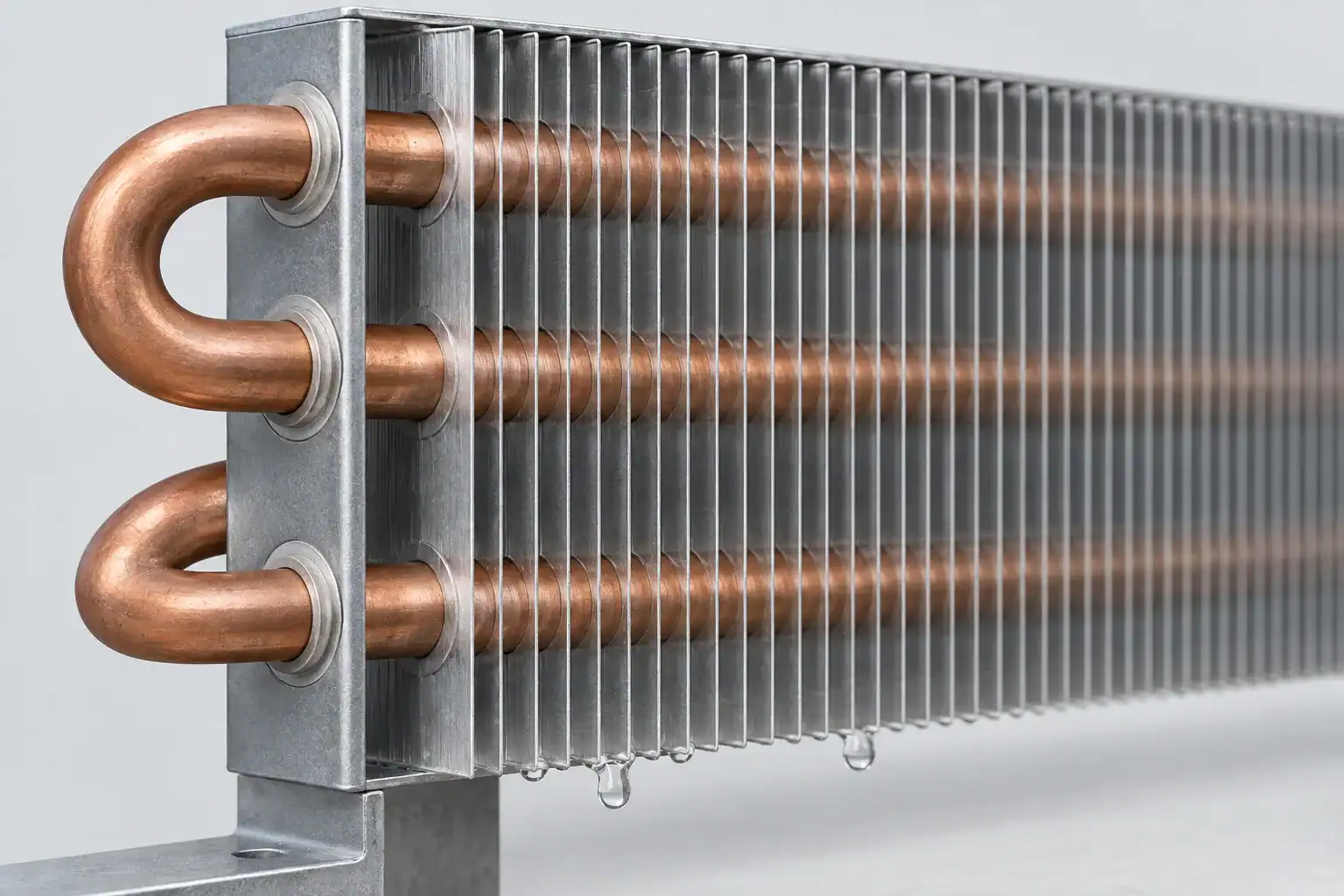
A bare-tube evaporator uses the outside of a tube as the heat-transfer surface without attached fins. It may take the form of a serpentine pipe, coil or purpose-built immersed surface. The relatively open construction can help where cleaning or ice formation makes a dense fin pack unsuitable. For air cooling, however, removing the fins also removes substantial external surface area within a given envelope. Evaluate the available space and surrounding flow before choosing it. Bare tubing is a construction choice, not evidence that cleaning access or freezing expansion has been addressed.
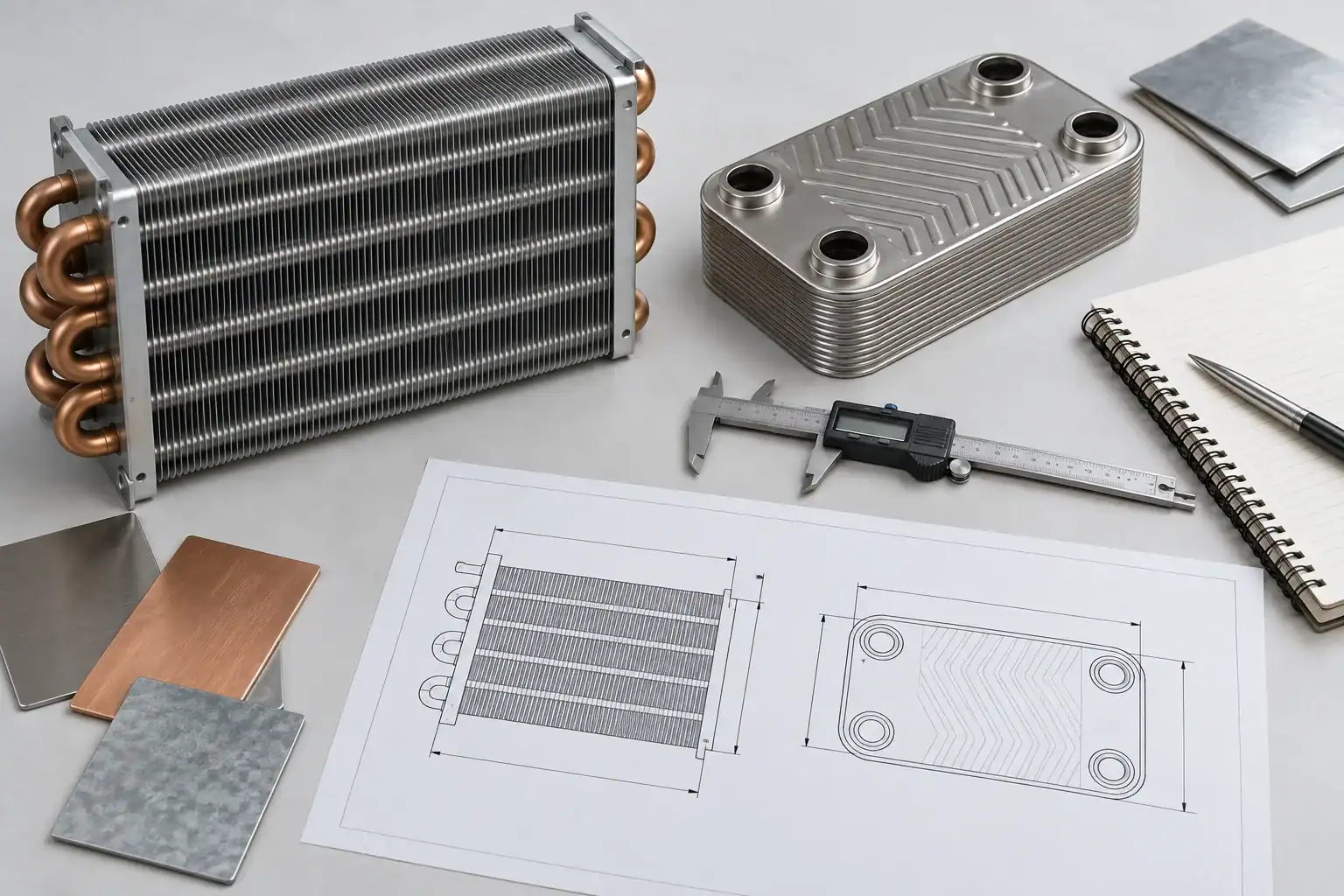
7. Fin-and-tube evaporator
Thin fins extend the air-side area around refrigerant tubes. This makes fin-and-tube coils useful in air handlers, display cases and unit coolers where the air side would otherwise limit heat transfer. Buyers should look beyond the number of rows: fin spacing, circuit layout and available fan pressure affect the operating result. A tightly packed coil may perform differently after frost or contamination develops. Specify the expected moisture and cleaning conditions, then compare ratings at the intended airflow. Copper and aluminum combinations are common, but materials require a separate compatibility review.
8. Tube-on-plate evaporator
In a tube-on-plate design, refrigerant tubing is attached to a plate that spreads heat across a wider surface. It can fit a cabinet wall or a defined contact-cooling area without the depth of a fin pack. The attachment quality and contact between plate and tube influence temperature uniformity. This is useful when a simple surface shape matters more than high forced-air capacity. Ask how the assembly accommodates expansion, mounting loads and the intended cleaning method. A plate that looks identical from the front may have different tubing and performance behind it.
9. Roll-bond evaporator
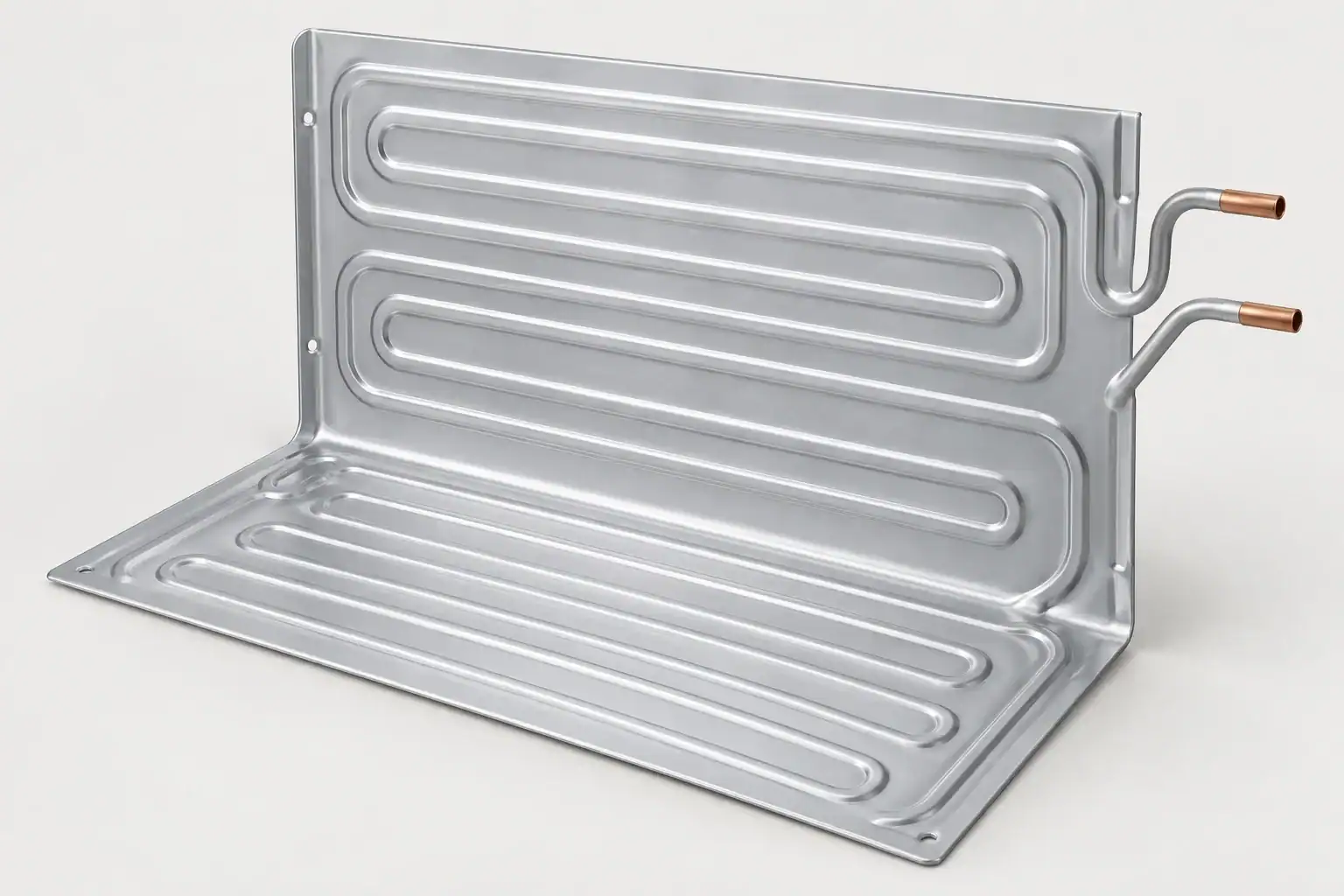
A roll-bond evaporator forms refrigerant passages within bonded metal sheets, commonly aluminum. The plate can be shaped to suit a refrigerator or compact cooling compartment. Its low-profile construction lets the heat exchanger follow the equipment envelope, but channel geometry and forming limits constrain later changes. Compare the passage layout, connections and mounting details rather than treating the panel as ordinary sheet metal. A replacement also needs pressure and refrigerant compatibility checks. Domi’s roll-bond evaporator category is the relevant product route for that construction.
10. Microchannel evaporator
Microchannel evaporators use multiple small refrigerant passages, often in flat tubes joined to fins. A compact core and small internal passages can suit carefully engineered equipment, but a condenser core cannot simply be relabeled as an evaporator. Two-phase distribution, drainage, frost behavior and oil return need design-specific attention. Cleaning and field repair options may also differ from a conventional round-tube coil. Consider this type when the equipment supplier can substantiate its evaporator performance over the required operating envelope, including part load, rather than from its size or low charge alone.
11-15: Evaporators that cool water or another liquid
These constructions separate refrigerant from a secondary liquid. Identify which fluid occupies each side before looking at the connections. That assignment affects cleaning access and freeze risk. A similar-looking heat exchanger may be rated as a condenser or a single-phase cooler instead.
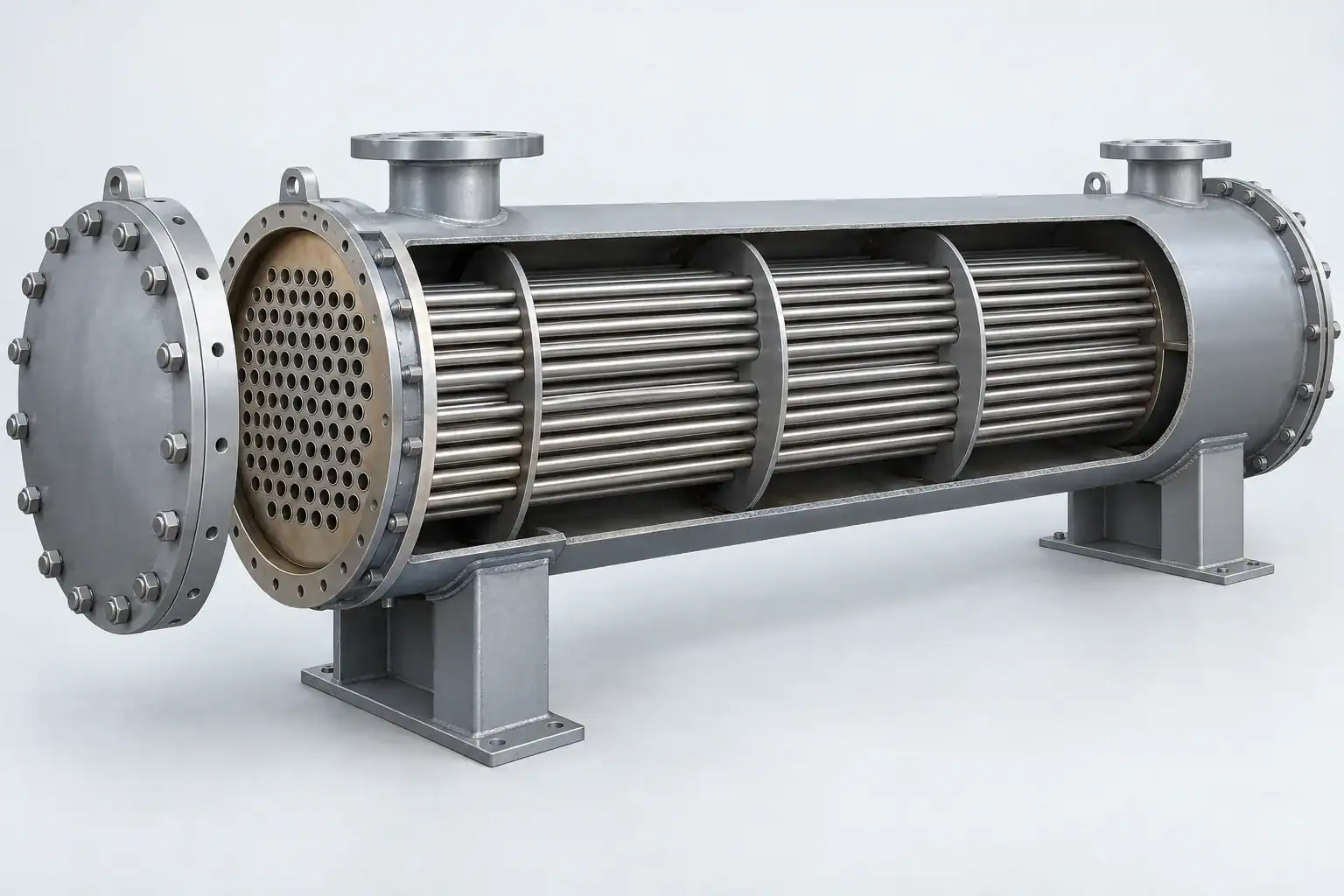
11. Dry-expansion shell-and-tube evaporator
In a typical DX shell-and-tube chiller evaporator, refrigerant passes through tubes while water or brine flows around them. The shell provides a pressure boundary and supports the bundle. Tube arrangements and internal features manage refrigerant distribution and the required heat-transfer area. This type can suit packaged and industrial chillers, but the name alone does not identify the cleanable side. Check fluid quality, flow limits and protection against freezing. Specify leaving-fluid conditions and pressure-drop limits so the supplier can evaluate the complete duty rather than choose solely by connection size.
12. Flooded shell-and-tube evaporator
A flooded shell-and-tube evaporator commonly places the cooled liquid inside the tubes and boiling refrigerant outside them. That reverses the usual fluid assignment of a DX shell-and-tube unit. A removable water-side cover may provide access to straight tubes, subject to the specific construction. The installation must allow that cover or bundle to be serviced. Compare the liquid-level strategy, refrigerant inventory and low-load performance along with the thermal rating. It is not a direct replacement for a DX vessel just because shell diameter and cooling capacity appear similar.
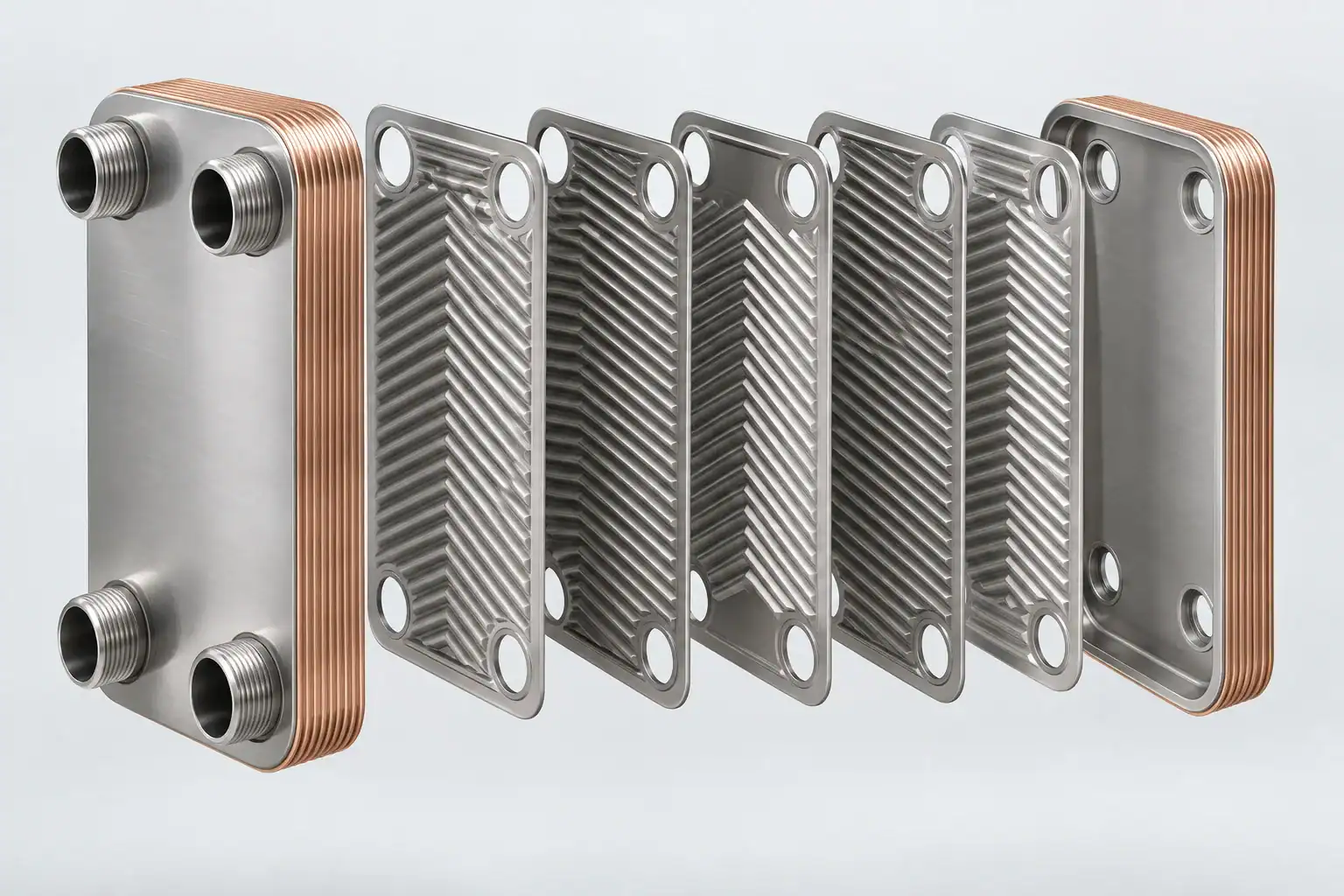
13. Brazed-plate evaporator
A brazed-plate evaporator places the two fluids in alternating passages between joined corrugated plates. It offers a compact way to cool water or a secondary fluid, and it often fits packaged equipment where space is limited. The same compact passages make fluid cleanliness and freeze protection important. The pack cannot normally be opened for individual plate cleaning, so the service strategy must suit the actual contamination. Check refrigerant distribution and approved orientation, as well as the compatibility of the plate and brazing materials. Four connections do not make every brazed exchanger an interchangeable evaporator.
14. Semi-welded plate evaporator
Semi-welded plate equipment combines welded plate pairs with gasketed interfaces. The construction can isolate the refrigerant within welded channels while allowing access to the other side, depending on the design. It is relevant when serviceability, material compatibility or a particular industrial refrigerant makes an ordinary copper-brazed pack unsuitable. The gaskets, welds, plate materials and pressure limits all need review. Ask which passages can be opened and what replacement parts are available. Do not assume that a semi-welded exchanger has the same maintenance procedure as a fully gasketed water-to-water unit.
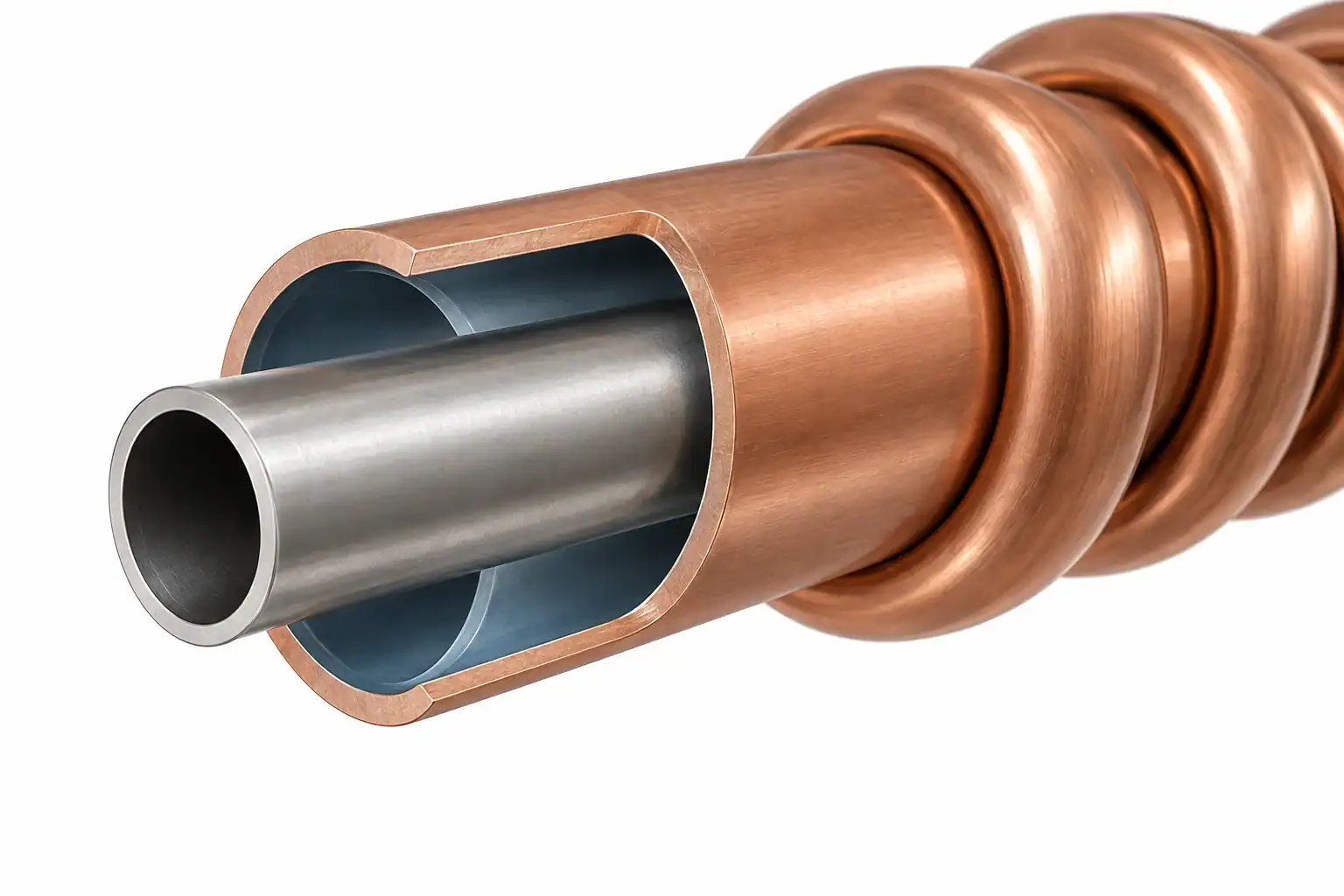
15. Coaxial or tube-in-tube evaporator
A coaxial evaporator has one passage inside another, often formed into a coil. Refrigerant and the secondary liquid remain separated by the inner tube wall. The form can fit compact chillers and heat pumps, although fluid assignments and geometry differ between designs. Its shape can make external inspection straightforward while leaving internal mechanical cleaning difficult. Confirm how the unit will be flushed, protected against freezing and supported against vibration. Evaluate pressure drop at the real flow rate; a coiled shape does not, by itself, establish how tolerant it is of fouling or low flow.
16-20: Air movement and installation formats
Air-side formats determine where the cooled air goes and whether the equipment fits the room. When comparing complete assemblies, allow for fan power and service clearance, and check whether the rating describes a clean coil or the condition expected during use.
16. Natural-convection air evaporator
Natural-convection designs rely on buoyancy-driven air movement rather than a dedicated fan. Cooling plates and open coil arrangements can operate this way in suitable cabinets or small enclosures. They avoid fan noise and fan electricity, but they need an unobstructed path for air circulation. Closely packed contents or an altered enclosure can interfere with that path. Choose this arrangement when the load and temperature uniformity requirements allow it. Do not replace a forced-air assembly with a passive surface solely because both are described as evaporators.
17. Forced-convection air evaporator
A forced-convection evaporator uses a fan or blower to move air across the heat-transfer surface. It is common where an enclosure needs controlled air circulation or a larger heat load must be handled in limited space. The fan and coil must be selected together: nominal airflow without the coil’s resistance is not the operating airflow. Frost, filters and ductwork can further change the duty point. Ask for the assembly rating and the intended air path. Increasing fan speed may increase noise and product drying without solving poor refrigerant distribution.
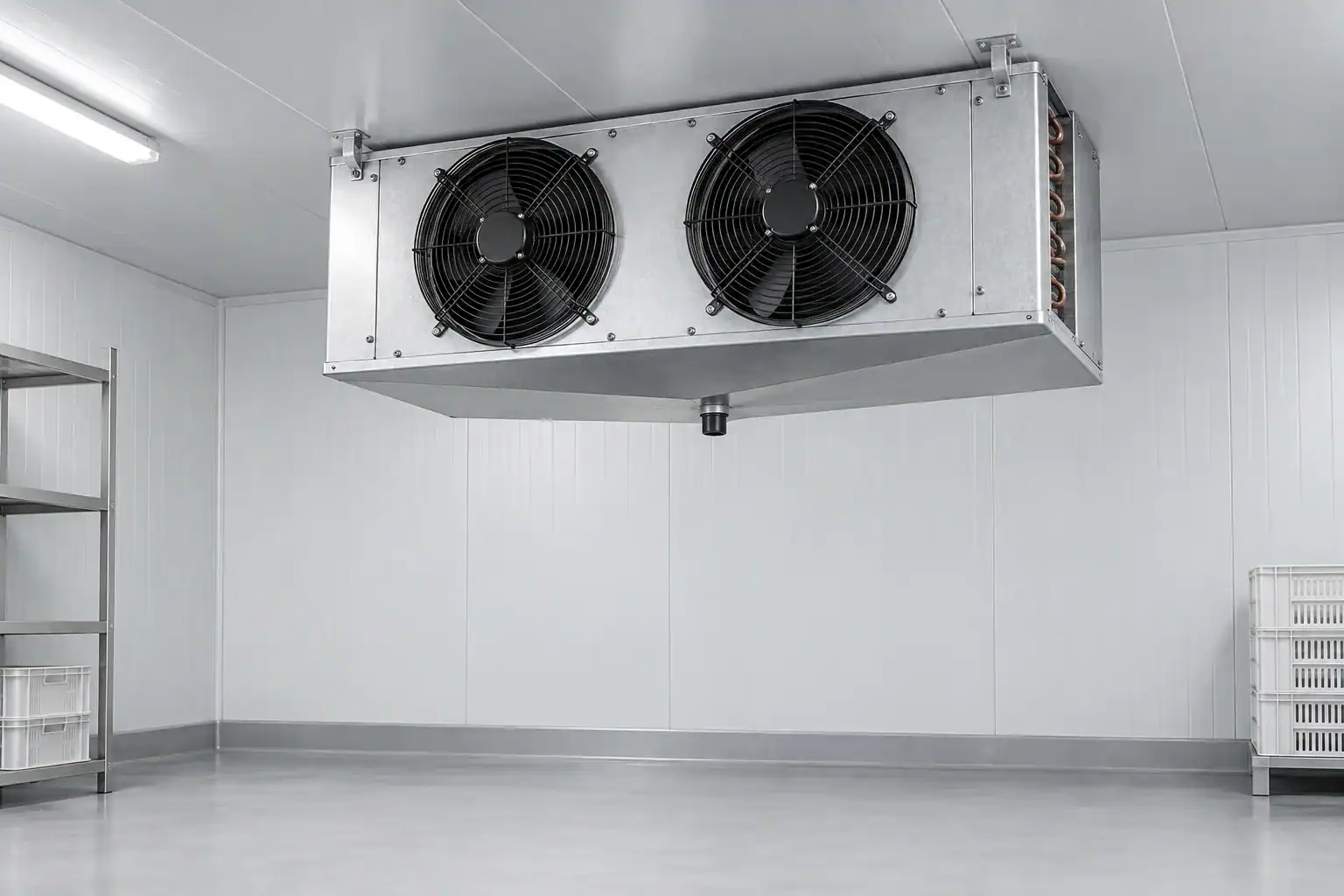
18. Ceiling-mounted unit cooler
A ceiling unit cooler packages an evaporator coil with fans, casing and condensate management above the usable room area. It is a familiar cold-room format because it leaves floor space available for product movement. Placement still matters: racks, door traffic and the distance to obstructions affect air circulation. The mounting arrangement must also permit maintenance and drainage. Include casing height, service clearance and drain routing in the layout review. The equipment footprint on a drawing is smaller than the space required to operate and service it.
19. Dual-discharge unit cooler
A dual-discharge cooler sends air in two directions from its casing. This can help distribute air in certain room layouts and reduce reliance on a single concentrated discharge path. It is an air-distribution option, not a different evaporation principle. Suitability depends on where people, products and obstacles sit relative to both air streams. Compare throw, return-air access and noise at the intended fan setting. Two outlets will not correct a room layout that blocks the return path or places sensitive products directly in the discharge.
20. Ducted evaporator coil
A ducted evaporator sits within an air-handling path rather than blowing directly into an open room. Its casing, drain pan and access arrangement must work with the duct system. Coil pressure drop becomes part of the blower selection, and the wet-coil condition may matter more than the clean, dry condition. This format suits central air treatment and custom equipment integration. Specify airflow direction, installation orientation and maintenance access early. A loose coil placed in an improvised cabinet can leave bypass gaps or condensate problems even when the coil itself is correctly rated.
21-25: Application-specific evaporators
These names describe the equipment’s job. Most use one of the constructions already listed, but their operating cycles explain why a standard-looking coil may need an application-specific design.
21. Blast-freezer evaporator
A blast-freezer evaporator works with a high air-circulation load and a changing product load during the freezing cycle. Selection has to account for the product arrangement and the resistance of racks or packaging, not only empty-room airflow. Moisture entering with product and door openings affects frost accumulation and run time between defrosts. A coil intended for holding frozen stock is not automatically suitable for rapid pull-down. Ask how the quoted performance relates to the loaded freezer and its duty cycle; the evaporator alone does not establish a food-freezing process time.
22. Refrigerated display-case evaporator
A display-case evaporator operates inside a tightly constrained cabinet air path. Shelf arrangement, air curtains, lighting and openings can influence its load and temperature distribution. Coil geometry and condensate drainage must fit the cabinet without obstructing service. A replacement based only on length and height can change airflow resistance or refrigerant distribution enough to affect the display. Review it as part of the cabinet system. For an OEM project, identify whether the proposal is a bare coil, a coil-and-pan assembly or a complete fan-assisted cooling section.
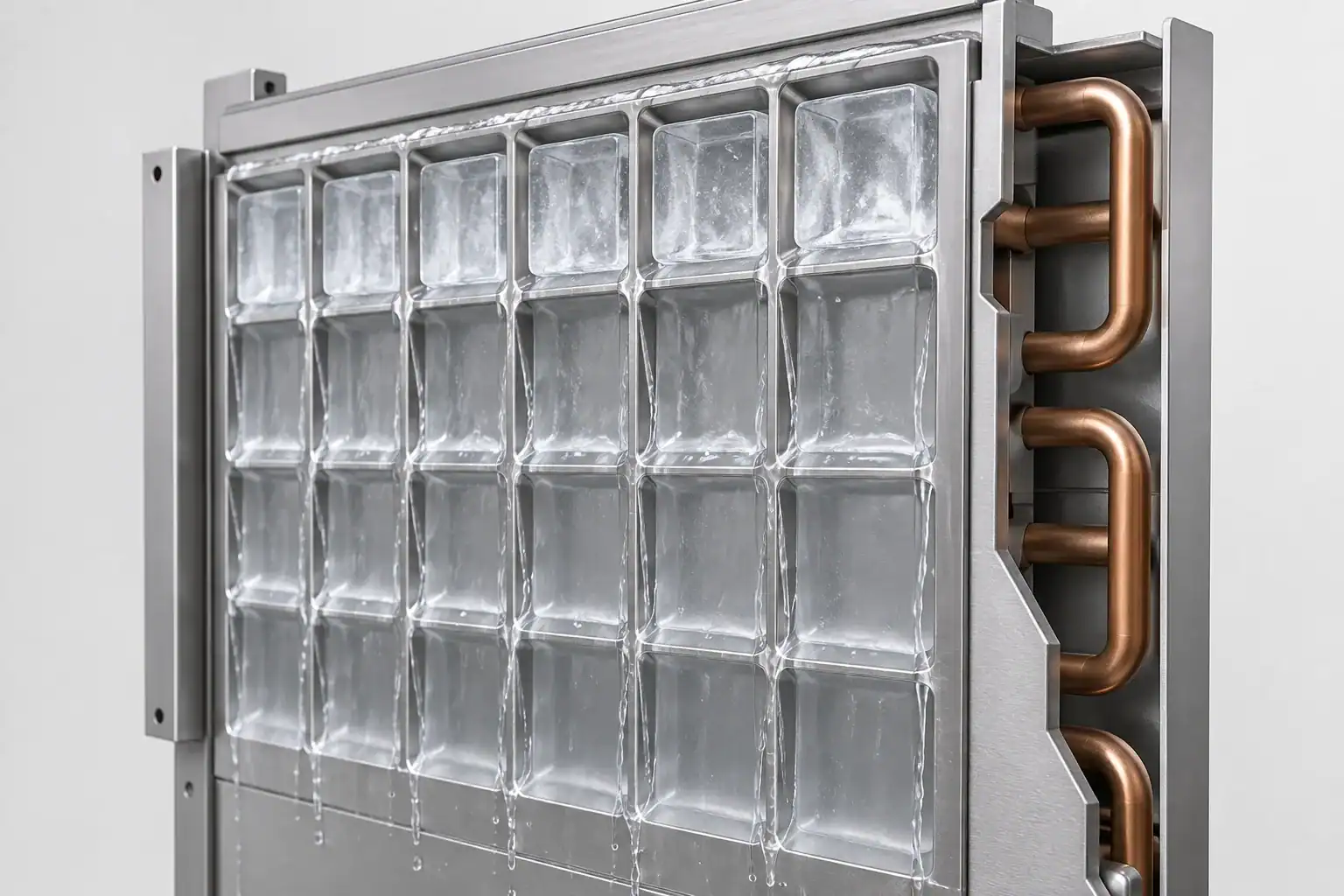
23. Ice-making plate evaporator
An ice-making plate deliberately freezes water against a defined surface. Depending on the machine, the geometry shapes cubes or another ice form, and a harvest stage releases the finished ice. The evaporator therefore experiences a repeated thermal cycle rather than steady room cooling alone. Surface condition, water distribution and the harvest method affect the result. Confirm the food-contact boundary and cleaning requirements with the machine designer. See the ice-machine evaporator guide for the specific inputs needed to review this application.
24. Drum or cylindrical ice evaporator
A cylindrical ice evaporator forms ice on a curved surface and releases or removes it using the machine’s intended harvesting arrangement. Some designs produce flake ice with a mechanical scraper. Surface geometry, refrigerant distribution and mechanical clearance must be considered together; an evaporator change can affect the harvesting mechanism. This is a machine-specific assembly, not a general-purpose substitute for a flat plate. Ask which parts belong to the evaporator supply and which belong to the drive or scraper system, and confirm how cleaning and inspection reach the ice-forming surface.
25. Heat-pump outdoor evaporator
In heating mode, many air-source heat pumps use the outdoor coil as an evaporator to collect heat from outdoor air. The same reversible coil can act as a condenser in cooling mode. Its duty therefore includes changing flow conditions, outdoor exposure and frost management. A one-mode cooling rating cannot describe the entire job. Review low-ambient behavior, defrost and drainage within the heat-pump manufacturer’s operating envelope. This application also explains why a component should be named by its current cycle function rather than simply by whether it sits indoors or outdoors.
26-30: Circuiting and defrost configurations
Circuiting determines which parts of the coil operate together. Defrost determines how accumulated ice is removed. These are configuration choices layered onto the earlier types, and two or more may appear on the same evaporator.
26. Face-split evaporator
A face-split coil assigns separate portions of the face to independent refrigerant circuits. That can allow staged operation or separate systems within one casing. When only one portion operates, air distribution becomes important because air crossing an inactive portion receives less cooling. The configuration needs to suit the air-handling arrangement and the required leaving-air condition. Ask for both full-load and single-circuit performance. Equal-looking face areas do not prove that a staged coil will provide the desired temperature or humidity control in every operating state.
27. Intertwined-circuit evaporator
An intertwined arrangement distributes separate refrigerant circuits across a shared coil face. It can keep active surface spread through the airstream when one circuit operates, rather than concentrating all active tubing in one face region. That is useful in some staged air-conditioning applications. The circuit arrangement still needs matched distribution and a rating for each stage. Inspect the circuit diagram and identify the connections clearly. An intertwined coil can be difficult to replace from external measurements alone because the internal pattern is part of its function.
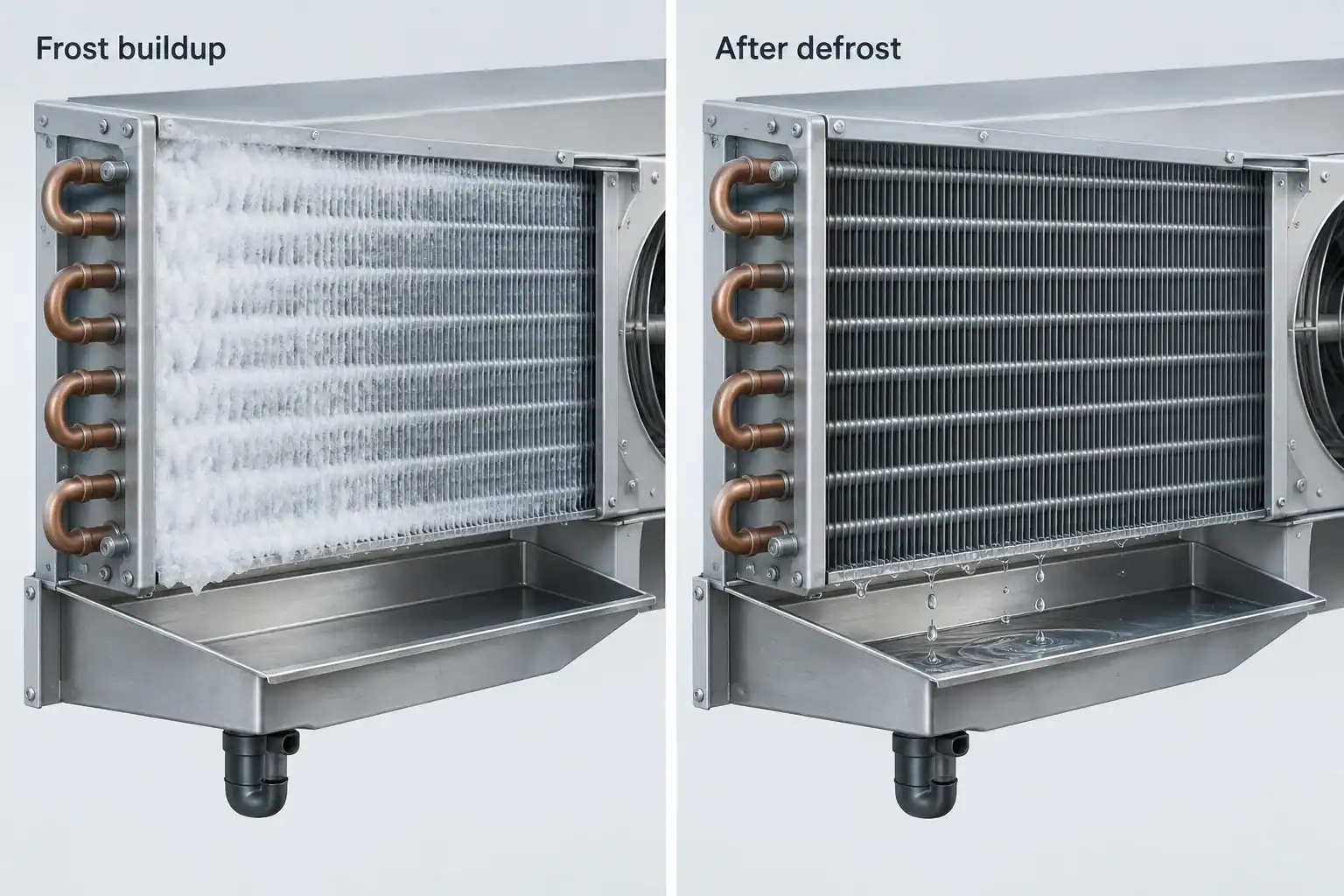
28. Off-cycle-defrost evaporator
Off-cycle defrost stops active refrigeration and uses heat available in the surrounding air to melt frost. It is an operating method rather than a special heat-exchanger shape. It can be practical when the air is warm enough and the system can tolerate the recovery period. It is generally unsuitable as the only defrost method for a continuously subfreezing space. Confirm drainage and the time available between cooling periods. Calling a coil “off-cycle” does not prove that a particular cabinet can clear its accumulated ice before refrigeration restarts.
29. Electric-defrost evaporator
Electric-defrost assemblies use heaters to remove frost from the coil and, where required, keep the pan or drain path clear. They can suit freezer applications where surrounding air cannot provide enough heat. Heater placement, electrical supply, termination controls and the restart sequence all affect the result. Compare more than heater wattage: heat that enters the refrigerated space must later be removed. Specify the complete defrost arrangement with the equipment designer, including accessible replacement parts. Electrical protection and installation must follow the applicable equipment instructions and local requirements.
30. Hot-gas-defrost evaporator
Hot-gas defrost directs hot refrigerant gas through an evaporator circuit so that released heat melts frost. Its viability depends on the refrigeration system, valve arrangement and management of condensed refrigerant. It is not an accessory that can be added to an arbitrary coil without engineering review. Pressure changes and liquid handling make the transition into and out of defrost especially important. Compare the complete engineered system and control sequence. This classification guide does not provide a piping or commissioning procedure; use the equipment manufacturer’s instructions and qualified refrigeration personnel.
31-40: Process evaporators and concentration arrangements
In this group, water or another volatile component leaves the product feed as vapor. These systems appear in food processing, chemical manufacturing, wastewater treatment and laboratories. They are included to clarify the broader word “evaporator”, not to claim that Domi supplies every process plant described here.
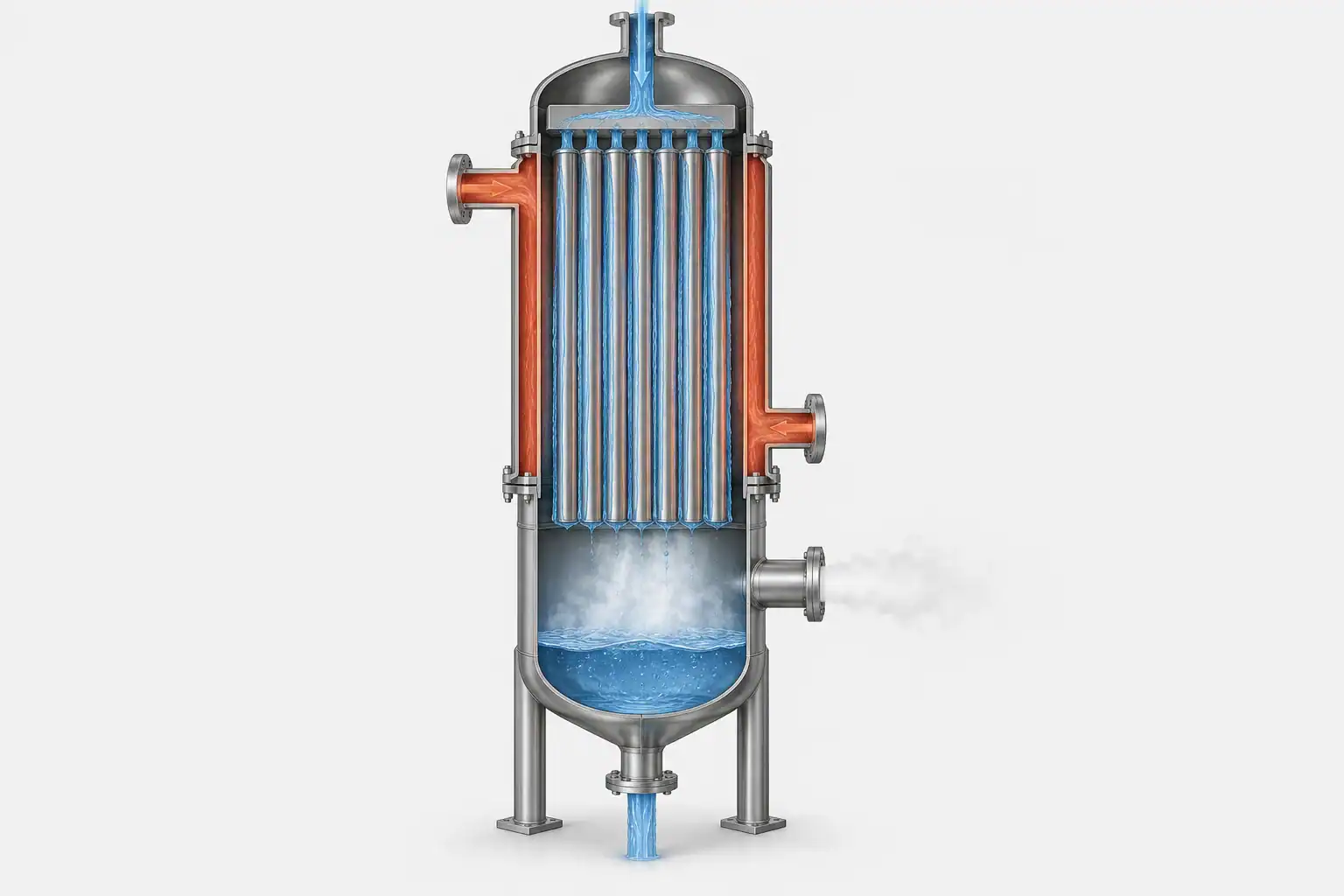
31. Falling-film process evaporator
Feed spreads into a thin film that travels downward along heated surfaces, commonly inside vertical tubes. The short passage through the heated zone can suit temperature-sensitive liquids when wetting and distribution remain stable. A feed that coats unevenly, forms deposits or becomes very viscous may need another arrangement or a separate finishing stage. Ask for evaluation at the final concentration as well as the inlet condition. GEA’s falling-film description identifies product sensitivity and fouling behavior as selection considerations; those are more useful starting points than vessel height.
32. Rising-film process evaporator
A rising-film design uses vapor formation to help move liquid upward through a heated passage. It is associated with feeds that can sustain the required boiling and circulation behavior. Performance depends on the available temperature difference and how the feed properties change as solvent is removed. Consider it when the operating envelope supports stable upward film formation; avoid choosing it simply because the plant has limited headroom. Confirm startup behavior and the intended concentration range with the supplier. “Rising film” is a flow pattern, not a general guarantee against fouling or thermal damage.
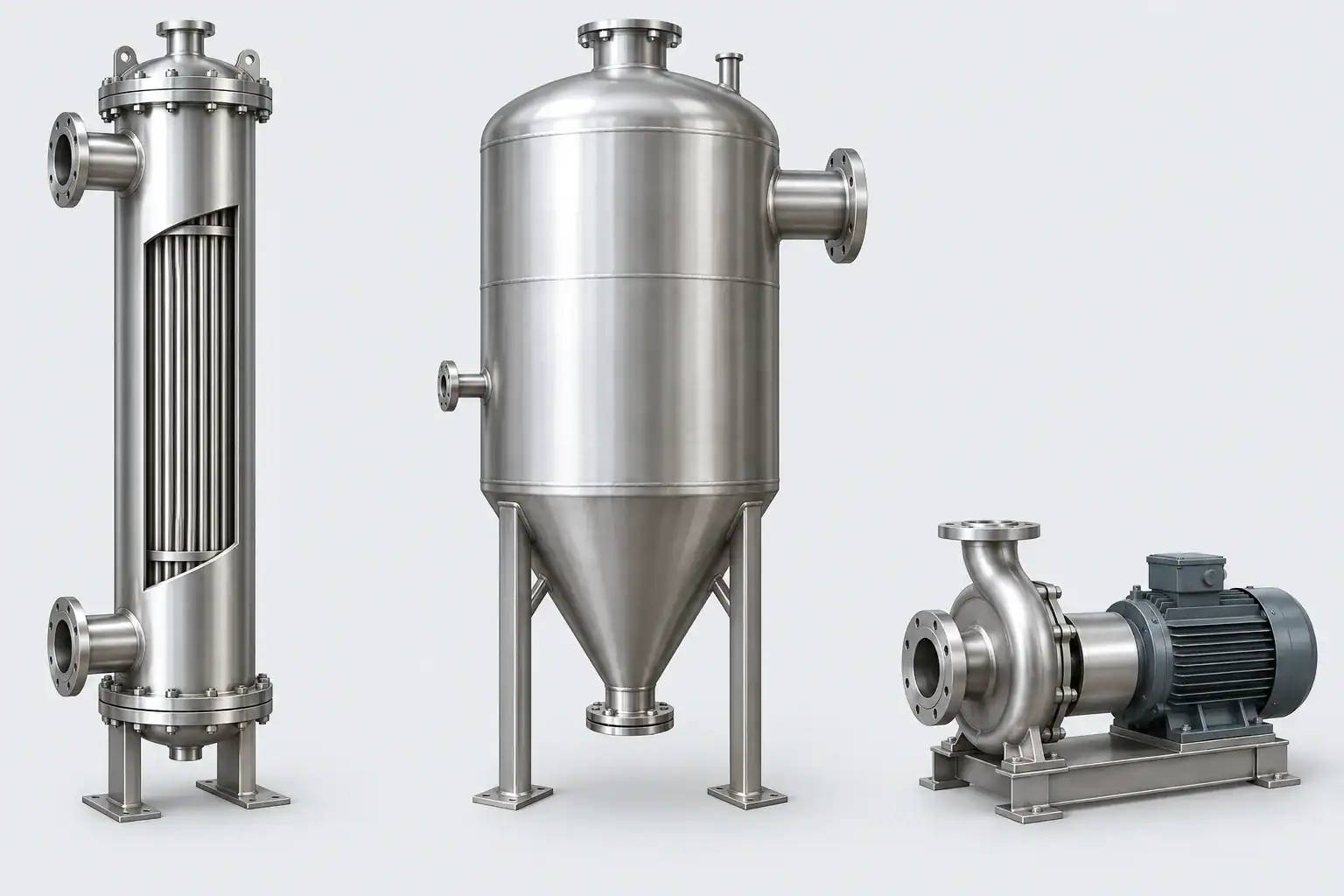
33. Forced-circulation process evaporator
A pump circulates process liquid through a heater and a separation vessel. In common arrangements, pressure limits boiling within the heater and vapor forms when heated liquid reaches the separator. The circulation loop can help handle duties where a once-through film is unsuitable, but it adds pumping demand and exposes the feed to repeated circulation. Alfa Laval’s forced-circulation equipment illustrates this distinct heater-and-separator arrangement. Ask how viscosity, suspended solids and cleaning affect pump and exchanger selection; do not confuse this process loop with a pumped refrigerant evaporator.
34. Batch or stirred-vessel evaporator
A batch evaporator holds a charge while heat removes part of its solvent. Agitation can improve mixing and heat transfer, but performance changes as the batch becomes more concentrated. This arrangement may suit variable recipes, modest throughput or processes where batch traceability matters. The trade-off is the time needed for charging, evaporation, discharge and cleaning. Specify the full cycle and allowable product exposure, not just an instantaneous evaporation rate. A vessel that works well with a dilute feed may mix or drain poorly near the end of the batch.
35. Wiped-film evaporator
A rotating wiping assembly spreads feed over a heated surface and renews the thin film. It is used for demanding separations where viscosity or heat sensitivity makes a simple film difficult to manage. Moving parts, seals and the behavior of deposits become part of the maintenance question. Ask for trials with representative feed rather than extrapolating from a clean solvent. In a conventional wiped-film evaporator, vapor may travel to an external condenser; an internal condenser defines an important short-path variant. The terms should not be counted as unrelated machines without checking their actual construction.
36. Short-path evaporator
A short-path evaporator places a condensing surface close to the evaporating film, reducing the distance traveled by vapor. It is commonly paired with high-vacuum operation for difficult thermal separations. The design overlaps with wiped-film technology rather than replacing the need to form and heat the film. Pope’s equipment classification distinguishes external-condenser evaporators from internal-condenser short-path stills. Evaluate vacuum integrity, feed volatility and achievable separation together. A short vapor path alone does not establish product purity, yield or suitability for a specific feed.
37. Rotary evaporator
A laboratory rotary evaporator rotates a flask in a heating bath, usually under reduced pressure, while a condenser collects the vapor. Rotation spreads and mixes the liquid and helps heat reach the sample. It suits laboratory solvent removal and process development, subject to chemical compatibility and operating precautions. Flask capacity is not the same as practical batch throughput. Consider foaming, available condenser cooling and safe handling of the solvent. BÜCHI’s rotary evaporation explanation describes this rotating-flask approach; it is not a refrigeration evaporator coil.
38. Multiple-effect evaporator
A multiple-effect plant uses vapor generated in one stage as a heating source for another stage operating at an appropriate lower pressure. The stages may contain falling-film or other evaporator constructions. This is a heat-reuse arrangement, not a separate surface geometry. It can reduce fresh heating demand compared with a comparable single-effect duty, while adding equipment and control interactions. Compare the available temperature difference, boiling-point changes and cleaning requirements across the whole train. Adding effects does not produce a universal reduction in total operating cost regardless of feed and utilities.
39. Thermal-vapor-recompression evaporator
Thermal vapor recompression, or TVR, uses motive steam in a steam-jet device to raise the pressure of part of the generated vapor so it can be reused for heating. The evaporator itself may still be a falling-film or another familiar type. TVR can suit plants with an appropriate steam supply, but the motive-steam conditions and process pressure range constrain performance. Request a utility balance at the intended duty and turndown. The label describes how heat is recycled; it does not identify the product-contact material or how the plant handles fouling.
40. Mechanical-vapor-recompression evaporator
Mechanical vapor recompression, or MVR, uses a powered compressor or fan to increase vapor pressure and temperature for reuse as heating vapor. The operating comparison therefore includes electricity, startup heat, cooling demand and compressor maintenance. It can fit continuous concentration duties with a suitable pressure lift and stable vapor supply. GEA’s process-system description separates FF/FC evaporation technology from TVR/MVR heating options. Make the same distinction in a proposal: an MVR plant still needs a defined evaporator construction and a feed-specific performance basis.
How to compare two evaporator proposals
First, put the two proposals on the same classification axis. Comparing “DX” with “finned” tells you little because one describes refrigerant supply and the other describes the surface. A useful description could be “DX fin-and-tube ceiling unit cooler for a freezer room”. Each part adds information; none establishes the final rating on its own.
For a refrigeration duty, compare capacity at the same air or liquid entering conditions, evaporating condition, flow and permitted pressure drop. Confirm whether fan heat, frost and defrost are included in the stated basis. Then compare access, replacement parts and the responsibility for controls. A smaller coil may cost less to buy but require a different fan or a different operating temperature.
For a concentration duty, compare feed composition, inlet and final concentrations, evaporation rate, permitted product temperature and cleaning requirements. Keep heating input, compressor electricity and cooling-water duty in their own units. Without a shared duty basis, an energy claim is not a reliable comparison.
For a replacement, include the physical interfaces and explain why the old unit is being changed. Copying its dimensions may preserve the same operating problem. The replacement evaporator coil guide covers the evidence needed for that review.
Questions buyers ask about evaporator types
How many types of evaporators are there?
There is no universal total because the names describe different attributes. This guide covers 40 recognized types and configurations across refrigerant feed, construction, installation, application, defrost and process concentration. One physical machine can belong to several entries. A longer list does not necessarily describe more distinct working principles.
Which evaporator type is best for refrigeration?
The answer depends on what needs cooling and the equipment constraints. A finned coil is a candidate for air cooling, a plate or shell-and-tube exchanger for liquid cooling, and a roll-bond plate for some compact cabinet layouts. Refrigerant, load range, moisture, service access and operating conditions determine whether a candidate is suitable.
Is a flooded evaporator more efficient than a DX evaporator?
Flooded operation can maintain wetted heat-transfer surfaces, but that does not establish the efficiency of the entire system. Compare the same duty, temperature approach, refrigerant and part-load conditions, then include pumps, controls and other auxiliaries. A type label cannot replace a rated system comparison.
Is an evaporator the same as a condenser?
No. An evaporator absorbs heat while liquid changes toward vapor; a condenser releases heat while vapor changes toward liquid. Reversible heat-pump coils can perform either function in different modes, but their role at a given moment depends on the refrigeration cycle. See the condenser versus evaporator comparison for the component distinction.
Is a glycol air cooler an evaporator?
If glycol stays liquid through the air coil, that coil is a secondary-fluid cooler, not a refrigerant evaporator. The refrigeration plant may contain a separate evaporator that cools the glycol. Suppliers sometimes use broader catalog language, so state the actual fluid and whether phase change occurs inside the quoted component.
Can one evaporator be used with any refrigerant?
No. Refrigerant changes can affect allowable materials, design pressure, distribution, oil behavior and safety requirements. Matching the external dimensions is insufficient. The equipment designer and supplier must confirm compatibility for the intended refrigerant and operating envelope before a replacement or redesign is approved.
Describe the evaporator before choosing the supplier
A useful specification names the application, heat-transfer construction and operating arrangement separately. Add the duty conditions and physical interfaces, then identify what the quotation includes. That gives the supplier a defined engineering question instead of a long list of interchangeable names.
Turn a refrigeration concept into a coil review
Domi’s published evaporator range includes finned coils and roll-bond constructions for refrigeration equipment. For those applications, use this guide to identify the family you need, then send the equipment context with your drawing or sample details. Do not assume that the process-concentration systems discussed above are part of that product range.
For a finned coil, show the available envelope, airflow direction, mounting points and connection positions. For a formed plate, include the panel geometry and the surfaces that must cool the cabinet. In either case, provide the refrigerant, operating conditions and expected quantity, and identify anything that is still an assumption. Ask the supplier to state its proposed rating basis and what the sample must verify before production approval.